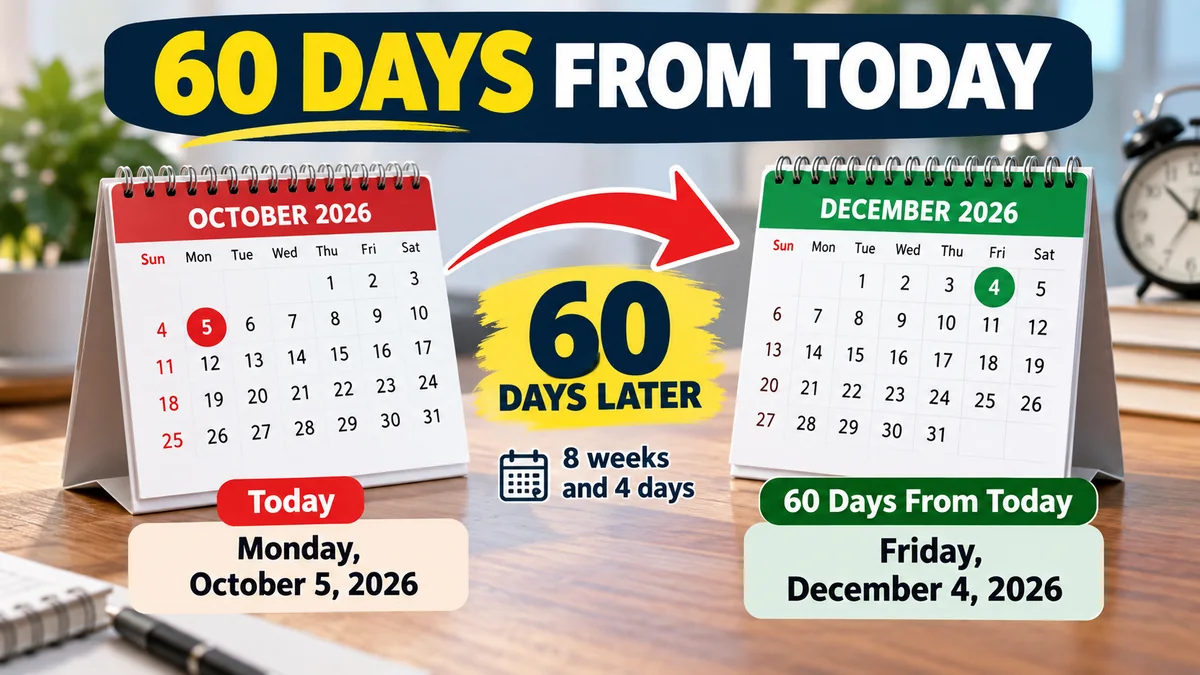
If you are counting 60 days from today, the date is Friday, December 4, 2026. This calculation starts from Monday, October 5, 2026 and counts forward 60 calendar days.
60 days from today is Friday, December 4, 2026. The calculation includes every calendar day—weekdays, Saturdays, Sundays, and holidays. Sixty days equals 8 weeks and 4 days, so the resulting weekday moves four days forward from Monday to Friday.
| Detail | Result |
|---|---|
| Today | Monday, October 5, 2026 |
| 60 days from today | Friday, December 4, 2026 |
| Number of days | 60 calendar days |
| Number of weeks | 8 weeks and 4 days |
| Month | December |
| Year | 2026 |
| Day of the week | Friday |
| ISO date | 2026-12-04 |
What Date Is 60 Days From Today?
The exact date 60 days from today is December 4, 2026.
Today is Monday, October 5, 2026. When 60 calendar days are added to this starting date, the result falls on Friday, December 4, 2026. Current date-calculation sources independently return the same result.
A simple way to express the calculation is:
October 5, 2026 + 60 days = December 4, 2026
The key phrase here is calendar days. Unless a deadline specifically says “business days,” “working days,” or something similar, a day-based calculation normally counts consecutive dates rather than automatically skipping weekends.
Does 60 days from today include today?
For the standard calculation, today is treated as day zero. Tomorrow is day 1, and the date reached after adding 60 complete days is the answer.
This distinction matters because treating October 5 as day 1 would create an inclusive count and move the numbered 60th day back by one date. Date calculators typically use standard date addition when answering “60 days from today.”
How to Calculate 60 Days From Today
You do not have to count 60 individual squares on a calendar. A faster approach is to break the period into weeks.
Since:
8 weeks × 7 days = 56 days
there are another:
60 − 56 = 4 days
So 60 days is exactly:
8 weeks and 4 days
Starting on Monday, October 5, 2026, eight full weeks bring you to Monday, November 30, 2026. Moving another four days forward gives:
- Tuesday, December 1 — day 57
- Wednesday, December 2 — day 58
- Thursday, December 3 — day 59
- Friday, December 4 — day 60
That makes Friday, December 4, 2026 the final result. The 8-weeks-and-4-days relationship is also reflected by current date calculators.
Month-by-month calculation
You can also verify the result using the remaining days in October.
Starting after October 5:
- October 6 through October 31 = 26 days
- November = 30 days
- December 1 through December 4 = 4 days
Now add them:
26 + 30 + 4 = 60 days
Once again, the result is December 4, 2026.
60 Days From Today in Different Date Formats
The same date can look quite different depending on the date format used in your country or software.
| Format | 60 Days From Today |
|---|---|
| Written date | December 4, 2026 |
| US format (MM/DD/YYYY) | 12/04/2026 |
| DD/MM/YYYY | 04/12/2026 |
| ISO 8601 | 2026-12-04 |
| Month abbreviation | Dec 4, 2026 |
| Day and date | Friday, December 4, 2026 |
This is worth checking when entering a deadline into an international form. For example, 12/04/2026 can be interpreted as December 4 in the United States but as April 12 under a day/month convention. Writing the month in words or using ISO format removes that ambiguity.
Is 60 Days the Same as Two Months?
Not necessarily.
It is tempting to treat 60 days and two months as interchangeable, but they describe different kinds of time intervals.
Sixty days is always a fixed duration. Two calendar months depend on the lengths of the months involved, which can be 28, 29, 30, or 31 days.
From October 5, 2026:
- 60 days later: December 4, 2026
- 2 calendar months later: December 5, 2026
So in this particular example, the two calculations differ by one day.
This difference becomes particularly important when dealing with contracts, application periods, return windows, payment terms, reservations, or other deadlines. If the instructions specify 60 days, calculate 60 days rather than automatically moving forward two months.
How long is 60 days?
Sixty days equals:
| Unit | Equivalent |
|---|---|
| Weeks | 8 weeks and 4 days |
| Hours | 1,440 hours |
| Minutes | 86,400 minutes |
| Seconds | 5,184,000 seconds |
These conversions describe a 60-day duration in ordinary 24-hour-day terms.
60 Calendar Days vs. 60 Business Days From Today
This is one of the most important distinctions when calculating a future deadline.
60 calendar days counts every date on the calendar. Saturdays and Sundays are included.
60 business days, by contrast, normally means counting Monday through Friday while skipping weekends. Depending on the specific rule being followed, public or federal holidays may also need to be excluded.
From October 5, 2026, adding 60 ordinary calendar days produces Friday, December 4, 2026. A current calculator that excludes weekends places 60 working days from October 5 on Monday, December 28, 2026, before making any additional adjustment that a particular holiday policy might require.
| Calculation | Result |
|---|---|
| 60 calendar days from October 5, 2026 | December 4, 2026 |
| 60 weekdays from October 5, 2026 | December 28, 2026 |
| Weekends included? Calendar days | Yes |
| Weekends included? Weekdays | No |
| Holidays automatically excluded? | Depends on the rule or calculator |
If a contract, employer, government agency, court, bank, or other organization gives you a deadline, check its exact definition of a “business day” rather than assuming that only weekends are excluded.
What Day of the Week Is 60 Days From Today?
60 days from today falls on a Friday.
There is also a simple mathematical reason.
Sixty days can be divided into eight complete seven-day weeks with four days remaining:
60 ÷ 7 = 8 weeks with 4 days left over
A complete week returns to the same weekday. Therefore, the eight full weeks do not change the weekday relationship. Only the four extra days matter.
Starting with Monday:
Monday → Tuesday → Wednesday → Thursday → Friday
So 60 days after Monday, October 5, 2026 falls on Friday, December 4, 2026.
Dates Around 60 Days From Today
Sometimes you need nearby dates rather than only the 60-day result. The following table provides useful reference points based on October 5, 2026.
| Days From Today | Date |
|---|---|
| 1 day | October 6, 2026 |
| 7 days | October 12, 2026 |
| 14 days | October 19, 2026 |
| 30 days | November 4, 2026 |
| 45 days | November 19, 2026 |
| 60 days | December 4, 2026 |
| 90 days | January 3, 2027 |
The 30-, 45-, 60-, and 90-day dates are also shown by current date-calculation results based on October 5, 2026.
These intervals can be useful when dividing a longer deadline into smaller milestones. For example, a 60-day project can have a 30-day midpoint and a 45-day review before the final date.
What Was 60 Days Ago From Today?
The opposite calculation is also useful.
Instead of adding 60 days to October 5, subtract 60 days:
October 5, 2026 − 60 days = August 6, 2026
Therefore, 60 days ago was Thursday, August 6, 2026.
This should not be confused with the main calculation:
- 60 days ago: August 6, 2026
- Today: October 5, 2026
- 60 days from today: December 4, 2026
Why People Calculate 60 Days From Today
A 60-day period is long enough to cover many medium-term plans while still being easy to track on a calendar.
Common reasons for calculating the date include project deadlines, payment schedules, document submission periods, return windows, subscription dates, appointments, travel planning, training programs, administrative notices, and personal goals.
The exact counting rule matters more than the reason for the calculation.
For a personal goal, counting ordinary calendar days may be perfectly adequate. For an official deadline, however, the governing document or organization may specify whether weekends, holidays, the starting date, or the final date should be included.
Planning a 60-day deadline
For ordinary planning, a simple milestone structure can make the period easier to manage:
- Day 1: Start the plan.
- Day 15: Review early progress.
- Day 30: Reach the halfway point.
- Day 45: Complete a final progress review.
- Day 60: Reach the target date.
If the period begins today, October 5, 2026, the 60-day endpoint is December 4, 2026.
How to Calculate 60 Days From Any Date
The same method works even when your starting date is not today.
Start with the date you have, treat it as day zero, and add 60 calendar days. You can count through each month or simplify the process by adding eight weeks and then four additional days.
For example, current date tables show:
| Start Date | 60 Days Later |
|---|---|
| October 2, 2026 | December 1, 2026 |
| October 3, 2026 | December 2, 2026 |
| October 4, 2026 | December 3, 2026 |
| October 5, 2026 | December 4, 2026 |
| October 6, 2026 | December 5, 2026 |
| October 7, 2026 | December 6, 2026 |
| October 8, 2026 | December 7, 2026 |
This sequence is independently reflected in current date-calculator data.
Can you calculate 60 days with Excel or Google Sheets?
Yes. Spreadsheet applications store dates in a way that allows ordinary date arithmetic. If your starting date is in cell A1, adding 60 to that date gives a date 60 calendar days later.
For example, if A1 contains October 5, 2026, adding 60 days produces December 4, 2026.
For business-day calculations, use the spreadsheet’s working-day functions instead, especially when weekends or a custom list of holidays needs to be excluded.
Final Answer: 60 Days From Today
60 days from today is Friday, December 4, 2026, based on today’s date of Monday, October 5, 2026.
That period equals 8 weeks and 4 days and counts all calendar days, including weekends. It is not automatically the same as two calendar months or 60 business days.
For an ordinary date calculation, use December 4, 2026. If you are calculating a legal, financial, employment, contractual, or other official deadline, confirm whether the applicable rules require calendar days, working days, holiday exclusions, or inclusive counting before relying on the final date.