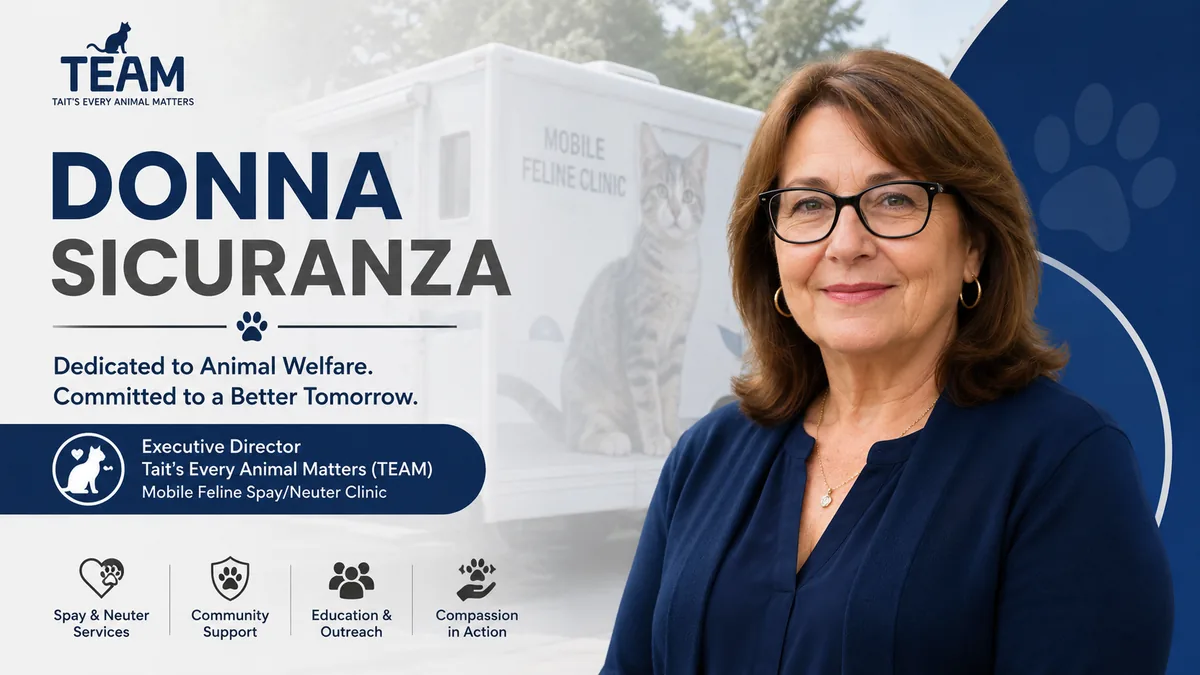
Donna Sicuranza is best known for her long-running leadership in animal welfare and her work with Tait’s Every Animal Matters, commonly known as TEAM, in Connecticut. Rather than building a public profile through entertainment or celebrity media, she became known through decades of nonprofit work focused on feline spaying, neutering, vaccination, and access to affordable veterinary services.
Her story is also a useful example of why online biographies require careful sourcing. Search results for Donna Sicuranza can refer to more than one person. In particular, Donna Marie Sicuranza, a New York banking professional who died in 2017, is a different individual from the Connecticut animal-welfare leader discussed here.
Quick answer: Donna Sicuranza is an American nonprofit executive associated with Tait’s Every Animal Matters (TEAM), a Westbrook, Connecticut organization known for its mobile feline spay/neuter program. She helped develop the mobile clinic with veterinarian Dr. John A. Caltabiano in the 1990s and has remained closely connected with TEAM’s animal-welfare mission for decades.
Who Is Donna Sicuranza?
Donna Sicuranza is a Connecticut-based nonprofit leader whose public career centers on animal welfare, particularly the prevention of feline overpopulation.
She has served as Executive Director of Tait’s Every Animal Matters. Her involvement goes back to the period when TEAM was developing a practical response to a widespread problem: large numbers of unwanted cats and kittens and limited access to affordable sterilization services.
Her role is documented beyond modern biography sites. In a 2002 Connecticut General Assembly hearing, Sicuranza introduced herself as Executive Director of Tait’s Every Animal Matters and described the organization as developing programs and services for animals in need and the people caring for them.
That record helps establish the central fact behind her public identity: Donna Sicuranza is primarily an animal-welfare and nonprofit professional, not a conventional celebrity.
Donna Sicuranza and Donna Sicuranza Marconi
Some newer references use the name Donna Sicuranza Marconi, while older materials identify her as Donna Sicuranza or Donna J. Sicuranza. Recent coverage of TEAM treats these names as referring to the same nonprofit executive.
This variation is worth recognizing when researching her career because searches using only one version of the name may miss relevant records.
Donna Sicuranza’s Career Before Animal Welfare
Before becoming closely associated with TEAM, Sicuranza worked in communications.
Historical reporting describes her as having worked in journalism and public relations when she became involved with Dr. John Caltabiano and the project that eventually developed into TEAM’s mobile feline clinic.
Professional profiles also associate her background with writing, editing, public relations, and English studies. Her LinkedIn profile lists Trinity College-Hartford among her education and places her professionally in the Westbrook, Connecticut area with Tait’s Every Animal Matters.
Those communications skills have obvious applications in nonprofit management.
An organization such as TEAM needs more than veterinarians. It must explain its services to the public, communicate with donors, coordinate with host communities, educate pet owners, build trust, and maintain awareness of the larger problem it is trying to solve.
Writing and public relations therefore were not unrelated stages of Sicuranza’s career. They provided skills that could be transferred directly into community-based nonprofit work.
How Tait’s Every Animal Matters Developed
To understand Donna Sicuranza’s career, it helps to understand TEAM itself.
The organization grew from animal-welfare efforts connected with veterinarian Dr. John A. Caltabiano. Historical reporting says Caltabiano had previously established a nonprofit called All-Animal Adoption. A later bequest from the estate of businessman and animal lover Vernon A. Tait provided resources that allowed the organization to be reestablished under a new name connected with Tait.
The challenge was deciding where those resources could make the greatest difference.
One major problem kept appearing: cats.
People reported unwanted litters, large numbers of kittens, feral populations, and situations in which owners or caretakers struggled to obtain affordable veterinary services.
Sicuranza recalled that there seemed to be no end to unwanted litters. That observation helped shape the organization’s central approach—preventing uncontrolled reproduction through accessible feline spaying and neutering.
Instead of focusing only on what happened after cats became homeless, TEAM could address one of the underlying causes.
Donna Sicuranza and the TEAM Mobile Feline Clinic
The project most closely associated with Donna Sicuranza is the TEAM Mobile Feline Spay/Neuter Clinic.
In 1997, Sicuranza and Caltabiano partnered to put a mobile spay/neuter clinic on the road in Connecticut. Historical reporting describes it as the state’s first mobile program of its type.
The concept was straightforward: rather than expecting every cat owner or feral-cat caretaker to find and travel to affordable services, bring a focused veterinary service closer to communities.
That approach addressed two common barriers simultaneously:
- the cost of veterinary procedures;
- practical access to appropriate services.
A 2001 report described the TEAM Mobile Feline Unit as Connecticut’s first and then-only mobile cat clinic. Sicuranza, serving as TEAM’s spokeswoman, explained how the unit returned to communities where residents had barn cats and feral cats needing services. The report stated that TEAM had already sterilized more than 40,000 cats since the program began in March 1997.
The early numbers reveal how quickly demand developed.
What began as a targeted nonprofit project had found a significant unmet need.
Why Spaying and Neutering Became TEAM’s Focus
Feline overpopulation is not simply a question of how many cats exist. It creates a chain of problems for communities, shelters, rescue groups, individual caretakers, and the animals themselves.
When cats reproduce without effective population control, more kittens can enter environments where adequate food, veterinary care, shelter, or permanent homes are unavailable.
Spaying and neutering interrupts that cycle.
TEAM’s model therefore focuses heavily on preventive veterinary care rather than attempting to solve overpopulation only after cats enter shelters.
Historically, the mobile clinic combined sterilization with other basic veterinary services. A 2001 report, for example, described a package that included an examination, spay or neuter surgery, vaccinations, nail trimming, and treatment for ear mites.
The specific pricing of such services has changed over the years, but the underlying model has remained recognizable: make high-impact feline care more accessible.
How the Mobile Model Improved Access to Veterinary Care
A mobile clinic changes where veterinary services can be delivered.
For people in rural communities, households facing financial constraints, and individuals caring for feral-cat colonies, traditional veterinary access may involve more than simply making an appointment.
Transportation, procedure costs, distance, and the logistics of handling multiple cats can all become barriers.
TEAM’s approach was designed to reduce some of those barriers.
Sicuranza has also made an important distinction between TEAM and conventional veterinary practices. In a 2021 interview, she explained that the organization was not attempting to replace traditional veterinary hospitals. Instead, its role was to provide lower-cost services to people who might otherwise struggle to afford them.
That distinction helps explain why TEAM’s model has endured.
A focused spay/neuter clinic can address a specific community need while regular veterinary hospitals continue to provide comprehensive ongoing medical care.
Growth From a Small Program to a Long-Running Mission
The scale reached by TEAM is perhaps the clearest indication of the program’s impact.
By July 2001—only a little more than four years after the mobile program began—TEAM had reportedly sterilized more than 40,000 cats.
After Caltabiano’s death in November 2009, an animal-welfare publication reported that TEAM, continued by his longtime partner Donna Sicuranza, had already sterilized more than 128,000 cats.
By 2021, the cumulative number had exceeded 200,000 cats spayed or neutered and vaccinated aboard the mobile clinic.
More recent TEAM-focused reporting places the cumulative figure above 225,000 cats.
| Period | Reported TEAM Milestone |
|---|---|
| March 1997 | Mobile feline clinic begins operating |
| 2001 | More than 40,000 cats sterilized |
| 2009–2010 | More than 128,000 cats sterilized |
| 2021 | More than 200,000 cats served |
| Recent reporting | More than 225,000 cats sterilized and vaccinated |
The figures come from reports published at different points in the program’s history, but together they show sustained activity over decades rather than a short-term campaign.
Working With Dr. John A. Caltabiano
Dr. John A. Caltabiano is central to the history of both TEAM and Donna Sicuranza’s animal-welfare career.
Caltabiano established an early small-animal mobile veterinary practice in Connecticut and later worked with the organization that became TEAM. In 1997, he and Sicuranza helped put TEAM’s mobile neutering program into operation.
Their skills complemented one another.
Caltabiano brought veterinary experience and knowledge of mobile animal care, while Sicuranza’s communications and organizational background helped support public outreach and nonprofit operations.
Caltabiano died of cancer on November 6, 2009, at age 55. Contemporary animal-welfare reporting described Sicuranza as his longtime partner and noted that she continued TEAM’s work after his death.
The continuation of the mobile program is an important part of Sicuranza’s professional story. Organizations built around a founder can struggle when that person is no longer present. TEAM’s ability to continue serving cats for many years afterward shows that the program had developed an operational structure capable of lasting beyond its original partnership.
Donna Sicuranza’s Role as a Nonprofit Leader
Running a small animal-welfare organization requires a broader skill set than the title “Executive Director” may suggest.
The work can involve staff coordination, fundraising, public education, scheduling, community relationships, donor communication, program planning, veterinary partnerships, and responding to changing costs and demand.
Sicuranza’s public record shows long-term involvement in these kinds of responsibilities.
Her 2002 testimony before Connecticut lawmakers is particularly useful because it demonstrates that her role extended beyond clinic administration. She publicly represented TEAM while discussing animal protection and the services provided to animals and their caretakers.
This combination of administration and advocacy is typical of community nonprofits.
The executive director must keep an organization functioning while also explaining why its mission matters.
Communication as Part of Animal Welfare
Sicuranza’s earlier journalism and public-relations experience appears particularly relevant here.
Animal welfare depends partly on medical services, but it also depends on behavior and public understanding.
People need clear information about why sterilization matters, when cats should receive veterinary attention, what services a clinic provides, and where owners can find help.
Donors also need to understand where their money goes.
Communities need confidence that a mobile clinic operates responsibly.
Those are communication problems as much as administrative ones.
Sicuranza’s career shows how professional communication skills can become practical tools for a mission-driven organization.
What Makes TEAM’s Approach Significant?
TEAM’s importance is easier to understand when its model is viewed as an access strategy.
The organization did not attempt to become a replacement for every veterinary service a cat might need. Instead, it concentrated resources on a defined problem where preventive intervention could have a broad effect.
That created several practical advantages:
- Focused services: The clinic could concentrate on sterilization, vaccination, and related basic care.
- Mobility: Services could be brought closer to communities.
- Affordability: The model was designed for people who might struggle with conventional costs.
- Population prevention: Sterilization could prevent future unwanted litters rather than addressing only existing homeless animals.
- Support for caretakers: The program could help people caring for owned, barn, stray, or feral cats.
This focus helps explain how a relatively small organization could eventually report services involving hundreds of thousands of cats.
Donna Sicuranza’s Public Advocacy
Sicuranza’s public work has not been limited to operating a mobile clinic.
Her appearance before the Connecticut General Assembly demonstrates involvement in broader conversations about animal welfare and legal protections.
During the 2002 Judiciary Committee hearing, she identified herself as TEAM’s Executive Director while discussing the organization’s work helping animals and their caretakers.
Public advocacy matters for organizations like TEAM because animal welfare is influenced by more than veterinary medicine.
Local laws, shelter practices, community attitudes, funding, abandonment, responsible ownership, and access to sterilization services all interact.
A nonprofit leader therefore often has to operate at the intersection of practical service delivery and public education.
Is Donna Sicuranza a Celebrity?
Donna Sicuranza is not a celebrity in the conventional sense.
Her public relevance comes primarily from nonprofit leadership and animal welfare.
This distinction matters because some online biography pages treat virtually anyone receiving search traffic as a celebrity and then attempt to fill standard sections about net worth, family, relationships, age, or lifestyle.
For Sicuranza, much of that information is either private or not reliably documented.
A responsible biography should not convert missing information into speculation.
Her professional work provides more than enough material for understanding why her name appears in public records.
What Is Known About Donna Sicuranza’s Age and Personal Life?
Reliable public sources provide considerably more information about Sicuranza’s professional career than about her private life.
Her exact date of birth is not clearly established in authoritative sources reviewed for this profile. Similarly, details about children, parents, siblings, personal finances, and other family matters should not be treated as established facts without stronger documentation.
This is especially important because another woman with the same name frequently appears in search results.
Donna Marie Sicuranza, born March 24, 1942, was a former resident of Mt. Vernon and New Rochelle, New York. She worked for Walker Studios and later spent more than 20 years at the Bank of New York in Bronxville before retiring as an assistant manager. She died on March 10, 2017, at age 74.
Those details belong to a different person.
Mixing them into the biography of TEAM’s Connecticut executive would create an inaccurate profile.
Why Source Confusion Surrounding Donna Sicuranza Matters
The confusion surrounding the name offers a broader lesson about online biographical research.
Search engines can place pages about different people side by side simply because their names match. Once one website combines those identities incorrectly, other publishers may repeat the same information.
Over time, repetition can make an unsupported claim appear established.
For Donna Sicuranza, reliable historical records create a clearer professional timeline: journalism and public relations, collaboration with Dr. John Caltabiano, the 1997 mobile feline clinic, public representation of TEAM, and decades of work connected with affordable cat care.
Details outside that documented professional record deserve greater caution.
The Long-Term Impact of Donna Sicuranza and TEAM
A single spay or neuter procedure may appear small when considered alone.
At scale, the effect is very different.
Tens of thousands of sterilizations mean tens of thousands of animals that can no longer contribute to uncontrolled reproduction. When a program continues for decades, that preventive effect compounds across generations of cats.
TEAM’s reported growth from more than 40,000 cats served by 2001 to more than 200,000 by 2021 demonstrates the durability of the model.
Behind those statistics are individual owners who found affordable care, feral-cat caretakers trying to manage colonies responsibly, veterinary professionals providing services, and communities dealing with fewer unwanted litters.
Donna Sicuranza’s contribution is best understood within that long-term operational context.
Her public story is not primarily about personal fame. It is about sustaining a specific animal-welfare solution year after year.
What Donna Sicuranza’s Career Represents
There is a practical lesson in Sicuranza’s career.
Large social problems are not always addressed through large institutions.
Sometimes progress comes from identifying one manageable part of a problem and building a system capable of addressing it repeatedly.
TEAM concentrated on feline overpopulation and affordable preventive care. A mobile clinic gave the organization a mechanism for turning that goal into direct action.
Sicuranza’s background in writing and public relations also illustrates how skills developed in one profession can become valuable in another. Communication, organization, community engagement, and public trust are essential parts of nonprofit leadership even when the organization’s visible service is veterinary.
Most importantly, her career demonstrates the value of consistency.
Launching an innovative program can attract attention. Keeping it operating for decades is harder.
That sustained work is the most meaningful part of the Donna Sicuranza story.
Donna Sicuranza’s Continuing Legacy in Animal Welfare
Donna Sicuranza has built her public reputation around a relatively focused mission: helping make feline spaying, neutering, vaccination, and preventive care more accessible through Tait’s Every Animal Matters.
Her work with Dr. John A. Caltabiano helped establish the TEAM mobile clinic in 1997, and historical reporting documents its expansion from a small Connecticut program into an initiative that has served hundreds of thousands of cats.
The available evidence also makes one thing clear: her biography should be told through verified professional achievements rather than unsupported celebrity-style claims about age, wealth, or family.
For anyone searching Donna Sicuranza, the most important story is therefore not a conventional tale of fame. It is the story of communications experience transformed into nonprofit leadership, a mobile veterinary concept sustained across decades, and a long-term commitment to reducing feline overpopulation through practical, accessible care.