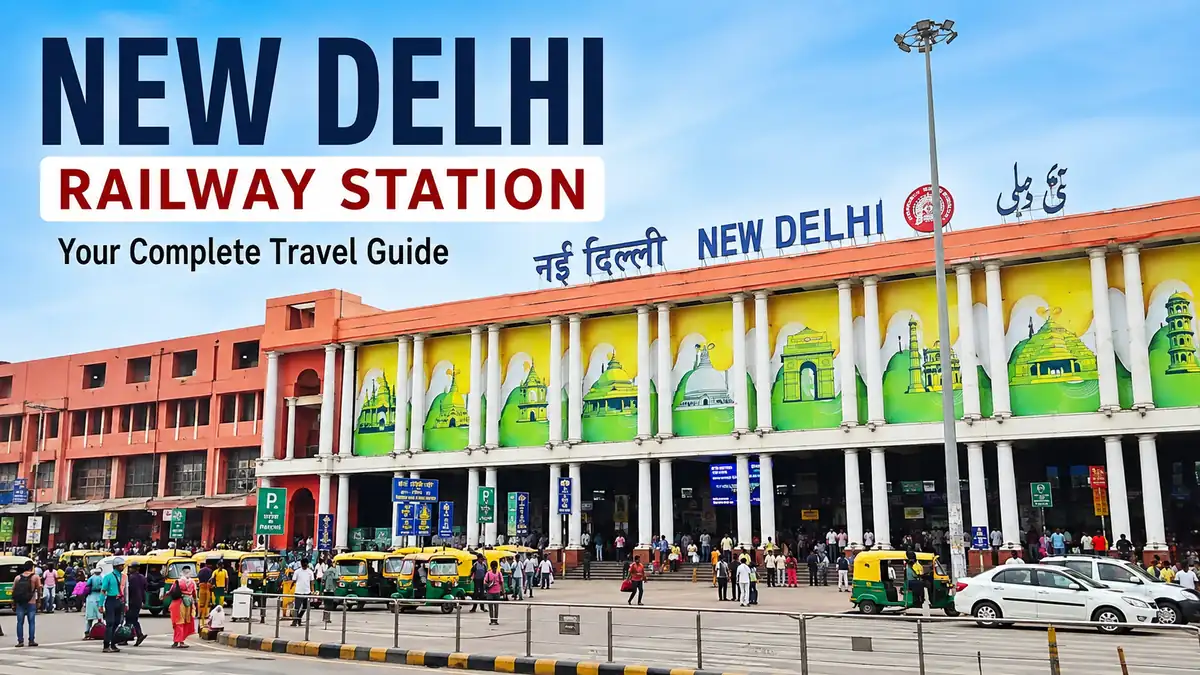
For many travelers, new delhi railway station is their first encounter with India’s capital—and it can feel overwhelming. Multiple entrances, 16 platforms, heavy passenger traffic, metro connections, taxis, ticket counters, waiting areas, and ongoing redevelopment mean knowing the layout before you arrive can save considerable time.
New Delhi Railway Station, identified by the station code NDLS, is one of Delhi’s principal railway hubs and is operated by Indian Railways under Northern Railway. It has 16 platforms, major entrances on the Paharganj and Ajmeri Gate sides, and direct access to Delhi Metro services, making it an important interchange for rail, metro, road, and airport journeys.
This guide explains how the station works, which entrance to use, how to reach it, what facilities are available, and what travelers should know before arriving.
new delhi railway station at a Glance
New Delhi Railway Station is located in central Delhi, roughly two kilometers north of Connaught Place. Its official Indian Railways station code is NDLS, and it falls within the Northern Railway zone.
Here are the details most passengers need first:
| Station detail | Information |
|---|---|
| Station name | New Delhi Railway Station |
| Station code | NDLS |
| Railway zone | Northern Railway |
| Number of platforms | 16 |
| Main sides | Paharganj and Ajmeri Gate |
| Platform 1 side | Paharganj |
| Platform 16 side | Ajmeri Gate |
| Nearby metro station | New Delhi Metro Station |
| Metro connectivity | Yellow Line and Airport Express |
| Railway operator | Indian Railways |
| Station type | Major long-distance and suburban railway station |
The station has 20 tracks and 16 passenger platforms. Platform 1 faces the Paharganj side, while Platform 16 is on the Ajmeri Gate side.
That distinction matters more than it might seem. Entering from the wrong side can leave you with a long walk across foot overbridges, particularly when you have heavy luggage or little time before departure.
What is the station code for New Delhi Railway Station?
The station code is NDLS.
This is the code passengers should look for when checking reservations, train schedules, live running information, boarding details, and railway announcements.
Do not assume every train described as departing from “Delhi” uses NDLS. Delhi has several important railway terminals, including Old Delhi, Hazrat Nizamuddin, Anand Vihar Terminal, and Delhi Sarai Rohilla. New Delhi Railway Station is only one of them.
Always verify the station code printed on your ticket.
new delhi railway station Platforms and Entrances
Understanding the relationship between the platforms and the two station sides is probably the most useful thing a first-time passenger can learn.
Paharganj side
The Paharganj entrance is associated with Platform 1.
This side faces the Paharganj area and is useful for travelers coming from parts of central and western Delhi or staying in the numerous hotels and guesthouses around Paharganj.
Historically, the Paharganj entrance has had tighter space constraints than the newer Ajmeri Gate side.
Because redevelopment work can affect surrounding roads and access arrangements, passengers using this side should leave additional travel time. For example, Delhi Traffic Police warned of significant congestion near the Paharganj entrance during redevelopment activity in December 2025.
Ajmeri Gate side
The Ajmeri Gate entrance corresponds to the Platform 16 end of the station.
For many travelers using Delhi Metro or the Airport Express, Ajmeri Gate is particularly convenient because New Delhi Metro Station is accessible from this side.
Ajmeri Gate also has passenger drop-off and parking facilities.
How many platforms are at New Delhi Railway Station?
There are 16 platforms.
Foot overbridges connect the different platform areas, helping passengers move across the station. Passenger infrastructure also includes elevators and escalators in parts of the complex.
Do not rely on an old blog, social-media post, or previous journey to predict your departure platform. Operational requirements can cause platform assignments to change.
Check the station information displays and announcements after arriving.
For live railway information, the official National Train Enquiry System (NTES) provides services such as “Spot Your Train” and “Live Station.”
Quick Takeaway: Check your ticket for NDLS, choose the entrance that makes sense for your transport and platform, and verify the final platform on official railway displays or NTES.
How to Reach New Delhi Railway Station
One reason NDLS is so important is its location in central Delhi and its connection with several transport modes.
By Delhi Metro
New Delhi Metro Station serves both the Yellow Line and the Airport Express Line. DMRC’s official station information confirms these connections.
For many passengers, Metro is the simplest way to avoid unpredictable road congestion around the railway station.
The Yellow Line provides convenient access from numerous parts of Delhi and the National Capital Region, while the Airport Express creates a fast public-transport connection between central Delhi and the airport corridor.
From Delhi airport
Travelers arriving at Indira Gandhi International Airport can use the Airport Express toward New Delhi Metro Station. DMRC specifically describes the Airport Express as connecting New Delhi Railway Station with the IGI Airport corridor.
Once at New Delhi Metro Station, follow signs toward the railway station.
A useful improvement was completed in 2025 when Foot Over Bridge 1 was extended so passengers leaving NDLS could access the Metro Station more directly. The Railway Ministry said the extension was intended to improve multimodal connectivity and reduce platform congestion.
By taxi, auto-rickshaw, or app-based cab
Taxis, auto-rickshaws, and app-based cabs are commonly used to reach both station sides.
When booking a ride, specify Ajmeri Gate side or Paharganj side rather than simply saying New Delhi Railway Station. This reduces the risk of being dropped at the opposite end from the entrance you want.
Traffic around the station can become very slow during rush hours, festivals, road restrictions, and redevelopment work.
By private vehicle
Both sides have road access, but drivers should pay attention to current parking and circulation rules.
Northern Railway introduced access-controlled arrangements on the Ajmeri Gate side to discourage vehicles from waiting in the drop-off zone. Under parking charges announced in December 2025, the first eight minutes were free for private vehicles, while commercial vehicles were subject to a charge.
Parking policies can change, so treat posted signs at the station as the final authority rather than relying on an older online tariff.
Facilities at new delhi railway station
NDLS has far more passenger infrastructure than a small railway station, although availability and operating arrangements can change during construction or periods of unusually high demand.
Yatri Suvidha Kendra
One of the biggest recent additions is the Yatri Suvidha Kendra, a permanent passenger holding facility completed in 2025.
According to the Ministry of Railways, the facility was designed to accommodate approximately 7,000 passengers at a time and help manage surges during major travel periods.
It is organized into separate pre-ticketing, ticketing, and departure/post-ticketing areas.
Facilities include:
- 22 modern ticket counters
- 25 Automatic Ticket Vending Machines (ATVMs)
- seating for around 200 passengers
- 18 high-volume, low-speed fans
- RO drinking water
- toilets
- LED train-information screens
- public-address speakers
- CCTV surveillance
- luggage scanners
- door-frame metal detectors
- fire-safety equipment.
The government has described access to the Yatri Suvidha Kendra waiting area as free.
For passengers traveling during Diwali, Chhath, summer holidays, or other peak periods, facilities like this are especially significant because crowd management can become one of the biggest challenges at NDLS.
Waiting areas
Waiting facilities are available at the station, although busy periods can make seating scarce.
Your entitlement to particular waiting-room facilities may depend on your ticket and class of travel.
The practical rule is simple: arrive early enough to find your platform, but do not assume that arriving many hours early guarantees a quiet place to sit inside the main platform areas.
Retiring rooms
Indian Railways passengers looking for accommodation inside or around railway stations can also check the official IRCTC Retiring Room system.
The IRCTC station list includes NEW DELHI (NDLS) among stations where online retiring-room reservations are offered.
IRCTC states that railway retiring rooms include rooms and dormitory accommodation, subject to availability and booking conditions.
If you have an overnight connection, checking availability before reaching Delhi is far better than assuming a room will be free after arrival.
Luggage storage and cloak-room options
Luggage storage has traditionally been available at New Delhi Railway Station, and passenger guides commonly identify cloak-room facilities around the main station areas.
However, locations, charges, eligibility rules, and opening arrangements can change during redevelopment.
There is also a paid cloak-room facility at New Delhi Metro Station on the Airport Express Line, according to DMRC.
Before leaving luggage, confirm identification, ticket, security, collection-time, and permitted-item requirements at the facility itself.
Food and drinking water
Food stalls, snack outlets, drinking-water facilities, and other basic passenger services are available around the station complex.
The newer Yatri Suvidha Kendra includes an RO-based drinking-water system.
For a long journey, buying water and essential snacks before reaching your coach can be sensible, but leave enough time to return to the correct platform.
Toilets and accessibility
Modernization work has added or improved toilets, passenger information systems, lighting, seating, and accessibility-oriented facilities.
The Yatri Suvidha Kendra includes dedicated sanitation infrastructure, while reported improvements on the Ajmeri Gate side have included separate toilets for men, women, and persons with disabilities.
Elevators and escalators also assist movement between parts of the station, although a passenger who requires step-free access should still arrive with extra time because routes can be affected by maintenance or construction.
Train Information, Tickets, PNR and Platform Checks
New Delhi Railway Station handles a very large mix of originating, terminating, and passing trains.
Rather than depending on a fixed online list—which can quickly become outdated—use official railway systems for the train that matters to your trip.
Where should you check live train status?
The official National Train Enquiry System (NTES) provides live railway information, including train-running and live-station services.
This is particularly useful for checking delays before leaving for NDLS.
How do you check PNR status?
Indian Railways provides an official PNR enquiry system. A PNR search displays information such as booking status, current status, coach or berth information when available, boarding point, journey class, chart status, and other reservation details.
Check again close to departure when your ticket originally shows RAC or a waiting-list status.
Can platform numbers change?
Yes.
Platforms are operational assignments rather than permanent guarantees for a particular train. Maintenance, congestion, late-running services, special trains, or operational changes can result in a different platform.
The best sequence is:
- Check your train and departure time before leaving home.
- Confirm the station code is NDLS.
- Check live status using NTES.
- Reach the correct station entrance with sufficient time.
- Read electronic train-information displays.
- Listen for station announcements.
- Recheck the platform shortly before boarding.
This is more reliable than searching the web for “train X platform at New Delhi,” because a page indexed days or months earlier may not reflect the actual platform on your travel date.
How Early Should You Reach New Delhi Railway Station?
For a large station such as NDLS, arriving at the entrance a few minutes before departure is risky.
There is no single ideal arrival time for every traveler. Someone carrying one backpack and already familiar with Platform 1 needs less time than a family with children, several suitcases, an elderly passenger, and a train departing from the opposite side of the station.
A practical approach is to build extra time into the trip for:
- traffic near the station;
- security screening;
- walking from the entrance to the platform;
- foot overbridge movement;
- locating the correct coach position;
- platform changes;
- crowds at peak times.
During major festivals, the margin should be considerably larger. Northern Railway has had to introduce special holding areas, additional ticketing facilities, CCTV monitoring, announcements, scanners, and crowd-management measures specifically because passenger volumes can surge dramatically.
If you enter from the wrong side
Do not panic.
Platforms are connected through the station’s pedestrian infrastructure, but crossing the station takes time. Follow the numbered platform signs rather than attempting shortcuts.
With luggage, allow extra time for elevators, escalators, or assistance.
This is why checking whether Paharganj or Ajmeri Gate is more convenient before arriving is worthwhile.
Common Mistakes First-Time Passengers Make
Most problems at NDLS are not caused by the railway timetable itself. They happen because travelers underestimate the size and complexity of the station.
Confusing NDLS with another Delhi railway station
This is the most serious mistake.
A ticket for another Delhi terminal does not mean you can board from New Delhi Railway Station. Always read the station name and code on the ticket.
Asking a driver only for “Delhi railway station”
Delhi has several railway terminals.
Tell your driver New Delhi Railway Station, NDLS, followed by the side you need: Ajmeri Gate or Paharganj.
Trusting an old platform number
A platform listed on a travel website or remembered from a previous journey may not be the platform used today.
Use the official station displays and railway announcements.
Arriving with no buffer
NDLS is not a station where you want to arrive at the last minute.
Even when your train is on time, reaching your coach can involve a substantial walk.
Waiting in the vehicle outside the entrance
Busy station approaches are designed for passenger movement, not lengthy roadside waiting.
Traffic-management and access-controlled parking systems have been introduced around NDLS specifically to reduce congestion.
Ignoring coach position
Once your platform is confirmed, check the coach-position indicators if available.
A long-distance train can extend across much of the platform. If your coach is near the opposite end, walking there after the train arrives creates unnecessary stress.
Quick Takeaway: At NDLS, knowing your station code, entrance, platform, coach position, and live train status is more useful than simply knowing the scheduled departure time.
Safety and Crowd Management at NDLS
New Delhi Railway Station has extensive security and passenger-management infrastructure.
The Yatri Suvidha Kendra alone includes CCTV cameras, luggage scanners, door-frame metal detectors, train-information displays, announcement systems, and fire-fighting equipment.
The broader station also uses railway and police security arrangements.
Passengers should still follow basic precautions:
- keep valuables in zipped or locked bags;
- do not leave luggage unattended;
- use official counters and clearly identified railway personnel for assistance;
- avoid accepting unsolicited offers involving tickets or reservations;
- keep your phone, wallet, passport, and travel documents secure in crowded areas;
- follow official announcements during platform changes or crowd-control measures.
Peak festival travel requires particular patience. In October 2025, railway authorities deployed extensive crowd-management measures in Delhi, including additional personnel, CCTV monitoring, announcements, ticket vending facilities, drinking water, toilets, and charging arrangements.
Crowd conditions can change quickly, so passengers should follow directions from railway and security staff rather than pushing toward a platform before boarding is organized.
New Delhi Railway Station Redevelopment
NDLS is undergoing a major long-term modernization program.
The Railway Ministry’s redevelopment concept includes larger station buildings on both sides, a spacious air concourse, modern passenger amenities, improved parking, a multimodal transport hub, and new surface and elevated roads intended to reduce congestion around the station.
Earlier Cabinet-approved station redevelopment principles also emphasized roof plazas, waiting lounges, food facilities, better integration between both sides of railway tracks, and improved passenger spaces.
Is New Delhi Railway Station being closed for redevelopment?
No blanket shutdown was announced.
In May 2024, the Ministry of Railways issued an official clarification after reports claimed that New Delhi Railway Station would close for redevelopment. The ministry stated that the station would not be shut down, although individual trains could be diverted or regulated when required during construction.
That distinction remains important for travelers.
Redevelopment can still lead to:
- temporary entrance changes;
- road restrictions;
- altered pedestrian routes;
- relocated facilities;
- platform-related works;
- individual train diversions or regulation.
For example, Northern Railway has previously issued specific passenger-entry instructions during platform work, while road congestion around the Paharganj side has also been affected by redevelopment activity.
Therefore, passengers traveling during construction should verify their train and access information close to the journey date.
What has already improved?
A major completed passenger-facing improvement is the Yatri Suvidha Kendra opened in October 2025.
Its roughly 6,000-square-meter facility was developed to improve crowd handling and provide ticketing, waiting, sanitation, drinking-water, information, and security services.
The extension of Foot Over Bridge 1 toward the Metro Station has also improved the connection between railway and metro services.
Further redevelopment is intended to make NDLS a more integrated transport hub connecting rail with metro, road transport, and other modes.
Useful Places Around New Delhi Railway Station
The station’s central location means travelers are close to several of Delhi’s busiest commercial and visitor areas.
Paharganj
Paharganj lies directly outside the Platform 1 side.
The neighborhood is known for budget accommodation, restaurants, small shops, travel services, and dense street activity. It can be convenient for an overnight stop, but traffic and pedestrian congestion are common.
Connaught Place
Connaught Place is roughly two kilometers from the station and is one of central Delhi’s major commercial districts.
For travelers with several hours between trains, it is comparatively close, although leaving the station during a short connection is rarely worth the risk.
Ajmeri Gate
The historic Ajmeri Gate area lies near the eastern side of the station. The Ajmeri Gate entrance is particularly useful for passengers connecting with New Delhi Metro Station.
Practical Checklist Before Traveling Through NDLS
A few minutes of preparation can make a surprisingly large difference at new delhi railway station.
Before leaving, confirm:
- Your station code: it should say NDLS if you are traveling from New Delhi Railway Station.
- Train number and departure time: check your ticket rather than relying on memory.
- Live running status: use NTES close to departure.
- PNR status: especially if your reservation began as RAC or waitlisted.
- Best entrance: Paharganj or Ajmeri Gate.
- Transport route: Metro may be more predictable than road transport during heavy traffic.
- Platform: confirm at the station rather than trusting an old online listing.
- Coach position: check once the platform has been confirmed.
- Construction updates: allow extra time during redevelopment.
- Festival crowds: build in a substantially larger buffer during major travel periods.
New Delhi Railway Station is large and extremely busy, but it becomes much easier to navigate once you understand its basic structure. Remember NDLS, Platform 1 on the Paharganj side, Platform 16 on the Ajmeri Gate side, and the nearby Yellow Line and Airport Express connections.
For your actual journey, use official Indian Railways and station information for the final train status and platform assignment. With the right entrance selected and a reasonable time buffer, traveling through new delhi railway station is far more straightforward than it first appears.