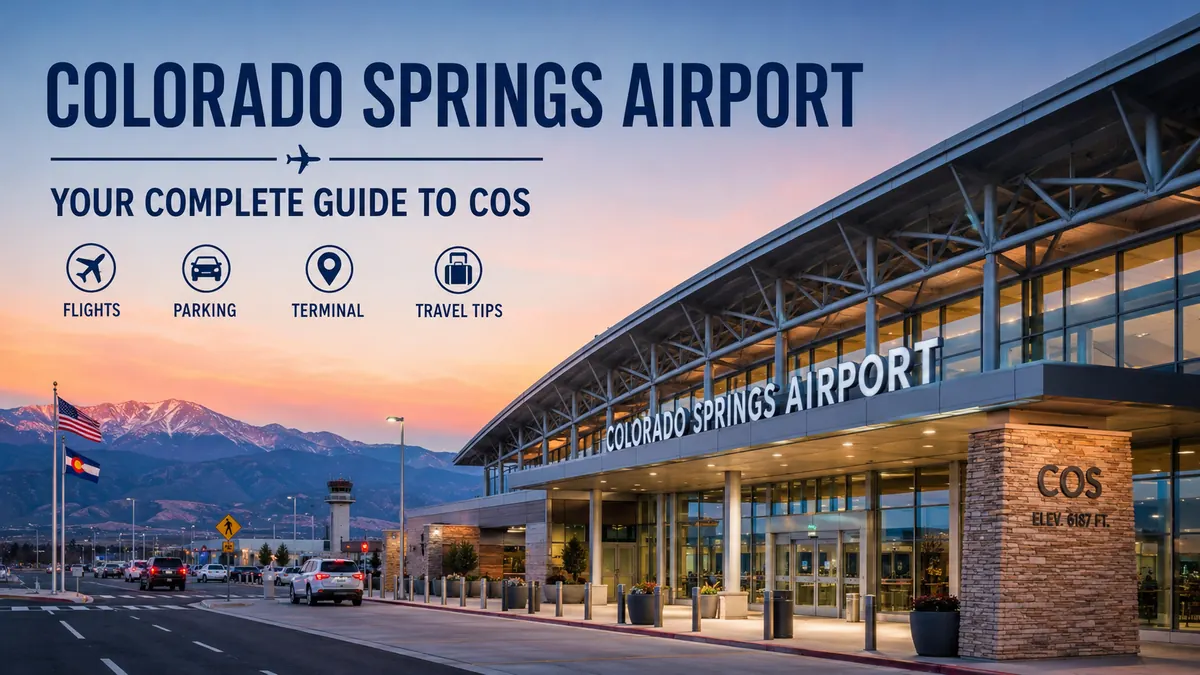
Flying through a major airport can mean long security lines, crowded terminals, distant parking lots, and extra travel time. colorado springs airport offers a different experience: a relatively compact commercial airport serving Colorado Springs and the wider Pikes Peak region while connecting travelers with major airline hubs across the United States.
Colorado Springs Airport (COS) is a public civil-military airport southeast of downtown Colorado Springs and Colorado’s second-busiest commercial-service airport after Denver International Airport. Travelers can use nonstop routes to major hubs such as Denver, Dallas/Fort Worth, Atlanta, Chicago, Houston, and Salt Lake City, along with several seasonal destinations.
This guide explains how COS works, which airlines serve it, where you can fly nonstop, what to expect inside the terminal, how parking and ground transportation work, and what first-time passengers should know.
colorado springs airport at a Glance
Colorado Springs Airport uses the three-letter airport code COS and the ICAO identifier KCOS. It serves Colorado Springs, El Paso County, and much of the Pikes Peak region.
The airport is owned and operated by the City of Colorado Springs. According to the Federal Aviation Administration, COS handles a diverse combination of commercial airlines, military aircraft, general aviation, flight-training operations, and medical flights. Peterson Space Force Base is located on the north side of the airfield.
Here is a quick overview:
| Airport detail | Information |
|---|---|
| Airport name | Colorado Springs Airport |
| IATA code | COS |
| ICAO code | KCOS |
| City served | Colorado Springs, Colorado |
| Airport type | Public, civil-military |
| Commercial terminal | One main passenger terminal |
| Major airline connections | Denver, Dallas, Atlanta, Chicago, Houston, Salt Lake City and others |
| Public transportation | Mountain Metro Route 37 |
| Rental cars | Available at the airport |
| Wi-Fi | Free terminal Wi-Fi |
| Downtown access | Roughly 12 miles by the primary visitor route |
The FAA describes the airport as approximately six miles southeast of downtown based on the airfield’s geographic position, while local visitor information describes the passenger airport journey as about 12 miles from downtown by road.
Is COS the same as Denver International Airport?
No.
Colorado Springs Airport and Denver International Airport are separate airports.
COS serves Colorado Springs, while DEN is the much larger international hub serving the Denver metropolitan area and connecting passengers to destinations worldwide.
For travelers whose final destination is Colorado Springs, COS can eliminate the drive south from Denver. DEN, however, offers substantially more nonstop destinations and international service.
The better airport therefore depends on your airfare, schedule, destination, connection options, and ground transportation plans.
Quick Takeaway: COS is usually the more geographically convenient airport when your trip centers on Colorado Springs or the southern Front Range, while DEN provides a much larger flight network.
Airlines Serving colorado springs airport
Airline schedules change throughout the year, particularly for seasonal routes, so passengers should verify their specific flight before departure.
Current air-service information identifies American Airlines, Delta Air Lines, Southwest Airlines, United Airlines, and Allegiant Air among the carriers operating scheduled service at COS.
American Airlines
American provides an important connection between Colorado Springs and its Dallas/Fort Worth hub.
Dallas/Fort Worth International Airport (DFW) gives passengers access to a large American Airlines connecting network. American also operates service between COS and Chicago O’Hare (ORD).
Recent 2026 airport updates listed as many as six daily DFW flights and service to Chicago O’Hare, although frequencies can vary by date.
Delta Air Lines
Delta connects COS with major hubs including:
- Atlanta (ATL)
- Salt Lake City (SLC)
- Minneapolis/St. Paul (MSP), seasonally
The airport’s May 2026 update listed twice-daily Atlanta and Salt Lake City service plus daily Minneapolis/St. Paul service during its operating season.
These routes are particularly useful because Atlanta and Salt Lake City provide extensive onward connectivity.
Southwest Airlines
Southwest has become a significant part of the COS route network since beginning Colorado Springs service in 2021.
Its 2026 destinations include routes such as:
- Denver (DEN)
- Dallas Love Field (DAL)
- Chicago Midway (MDW)
- Houston Hobby (HOU)
- Las Vegas (LAS)
- Phoenix (PHX)
- San Diego (SAN)
- San Antonio (SAT), seasonally
Exact frequencies vary considerably by route and season.
United Airlines
United provides frequent access to Denver and connections to other major hubs.
Recent COS service information lists:
- Denver (DEN)
- Houston Intercontinental (IAH)
- Chicago O’Hare (ORD)
The May 2026 airport update listed as many as 12 daily Denver flights, along with twice-daily Houston and Chicago service.
The short COS-DEN route can be useful primarily as a connecting flight into United’s wider network.
Allegiant Air
Allegiant operates selected leisure-oriented routes from Colorado Springs.
Current schedules include seasonal or limited-frequency service to destinations such as Phoenix/Mesa, Santa Ana/Orange County, and the St. Petersburg/Tampa area. These services do not necessarily operate every day or throughout the entire year.
That distinction matters when planning a trip around an Allegiant flight: a route being available from COS does not mean it operates daily.
Nonstop Flights From colorado springs airport
COS has a smaller route network than a major hub, but many of its nonstop destinations are strategically useful because they connect passengers with some of the largest airline hubs in the country.
Recent schedules and airport updates show service to destinations including:
| Destination | Airport | Typical airline connection |
| Atlanta | ATL | Delta |
| Chicago Midway | MDW | Southwest |
| Chicago O’Hare | ORD | American, United |
| Dallas/Fort Worth | DFW | American |
| Dallas Love Field | DAL | Southwest |
| Denver | DEN | Southwest, United |
| Houston Hobby | HOU | Southwest |
| Houston Intercontinental | IAH | United |
| Las Vegas | LAS | Southwest |
| Minneapolis/St. Paul | MSP | Delta, seasonal |
| Phoenix | PHX | Southwest |
| Phoenix/Mesa | AZA | Allegiant, seasonal |
| Salt Lake City | SLC | Delta |
| San Antonio | SAT | Southwest, seasonal |
| San Diego | SAN | Southwest |
| Santa Ana/Orange County | SNA | Allegiant, seasonal |
| St. Petersburg/Tampa area | PIE | Allegiant |
Route availability and operating days change, and some destinations are offered only during selected months. Recent schedules, for example, show seasonal changes affecting MSP, SAT, AZA and other markets.
Can you fly internationally from Colorado Springs?
International service from COS has been more limited than its domestic network.
Southwest operated seasonal Cancun service during selected dates in 2026, following development work that allowed the airport to accommodate international-arrival requirements. Early 2026 airport updates showed Cancun flights on specific March and April dates rather than as a continuous year-round schedule.
Travelers should therefore not assume that an international route previously announced or operated remains available on their dates.
For most international journeys from Colorado Springs, passengers connect through a U.S. hub such as Denver, Dallas/Fort Worth, Atlanta, Houston, Chicago, or Salt Lake City.
Understanding the COS Terminal
One of the main advantages of COS is its relatively straightforward terminal layout.
The present passenger terminal opened in 1994. It was constructed as a roughly 280,000-square-foot facility with 12 gates, with additional facilities developed during the 1990s.
Commercial passenger activity is primarily centered on the main concourse and gates 1 through 12.
That smaller footprint can make the airport easier to understand than airports with several terminals, trains, satellite concourses, or complicated transfer systems.
ElevateCOS terminal improvements
Passengers may encounter ongoing modernization work.
The airport began extensive concourse renovations in September 2023 under the ElevateCOS project. The multiyear program focuses on accessibility, sustainability, infrastructure, and passenger amenities.
Renovation work can occasionally affect the passenger experience, so temporary construction areas or altered access should not necessarily be interpreted as permanent terminal arrangements.
Arrivals and baggage claim
Passengers arriving at COS follow terminal signs toward baggage claim and ground transportation.
Rental-car counters are located on the lower level outside the secured area across from baggage claim, making it possible to collect checked luggage and continue directly to a rental vehicle.
If someone is picking you up, coordinate your meeting point before landing. It avoids unnecessary waiting and repeated driving around the terminal roadway.
Security and When to Arrive at COS
A smaller terminal does not mean passengers should arrive at the last minute.
Security demand can change rapidly when several departures are scheduled close together. Weather, holidays, staffing, construction, checked baggage, and airline procedures can also add time.
For most trips, a sensible approach is to arrive roughly:
- Two hours before a domestic departure
- Earlier when instructed by your airline for international travel
- With extra time during holidays, major events, severe weather, or peak travel periods
These are planning guidelines rather than guarantees of how long security will take.
Does Colorado Springs Airport have TSA PreCheck?
Security programs and lane availability can vary by operating period and checkpoint conditions. Passengers enrolled in TSA PreCheck should confirm current availability through their airline, boarding pass, or TSA information before relying on expedited screening.
Even when you qualify for an expedited program, arriving with reasonable time in hand is safer than planning around an assumed short security line.
What actually saves time at COS?
The biggest gains usually come before you reach the checkpoint.
Check in online, confirm your terminal information, review baggage restrictions, have identification ready, and avoid packing prohibited items in your carry-on.
If you are checking luggage, pay attention to your airline’s bag-drop cutoff. A short TSA line will not help if you arrive after the carrier stops accepting checked bags.
Quick Takeaway: COS is relatively easy to navigate, but flight and baggage deadlines still apply. Treat the compact terminal as a convenience rather than permission to arrive late.
Parking at colorado springs airport
Parking is one reason many travelers consider COS convenient.
The airport offers parking close to the passenger terminal, and visitor information describes COS as providing comparatively easy-access, low-cost airport parking. Long-term parking users can also use designated complimentary parking-shuttle service.
Parking arrangements, rates, payment systems, and lot availability can change, so checking the airport’s current parking information shortly before your trip is preferable to relying on an old rate published elsewhere.
Short-term parking
Short-term parking makes the most sense when you are:
- Meeting an arriving passenger
- Dropping someone off and need to enter the terminal
- Parking for a relatively brief period
- Prioritizing proximity over the lowest daily cost
For a multiday trip, compare the total cost with long-term parking rather than looking only at the first-hour rate.
Long-term parking
Long-term parking is designed for travelers leaving their vehicle while away.
Allow enough time to park, secure your vehicle, find the appropriate shuttle stop if necessary, and reach the terminal.
One of the easiest airport mistakes is calculating arrival time based on when your car reaches airport property rather than when you actually enter the terminal.
Picking up passengers
Before driving to the terminal, check the arriving flight’s actual status rather than its scheduled arrival time.
An aircraft marked “landed” also does not mean the passenger is immediately standing outside. Taxiing, deplaning, walking through the terminal, and collecting checked baggage can add significant time.
Ground Transportation From COS
Getting from Colorado Springs Airport to the city is relatively straightforward, with public transit, rental cars, taxis, ride-app services, private transportation, and shuttles among the available choices.
The airport itself does not operate taxi or ride-app companies; those are independent transportation providers.
Mountain Metro Route 37
Public transportation is available through Mountain Metropolitan Transit Route 37.
Route 37 connects the airport with Hancock Plaza and includes a stop at Integration Loop. Local tourism information states that the route operates seven days a week and can connect passengers with other services toward downtown Colorado Springs and Security-Widefield.
If using public transit, verify the current timetable before your flight. Bus schedules and airline schedules do not always align conveniently, especially for very early or late departures.
Rental cars
Rental cars are a practical choice for travelers planning to explore beyond central Colorado Springs.
On-airport rental companies have included:
- Alamo
- Avis
- Budget
- Dollar
- Enterprise
- Hertz
- National
Rental-car counters are positioned on the terminal’s lower level near baggage claim.
A vehicle can be especially useful when visiting attractions spread across the Pikes Peak region rather than remaining exclusively downtown.
Taxis and ride apps
Taxi and app-based ride services provide another direct option between COS, hotels, downtown Colorado Springs, and surrounding communities.
Availability and pricing depend on demand, distance, time of day, and the provider.
Check the designated pickup area after arriving rather than requesting a vehicle while you are still walking through the concourse.
Private shuttles
Private shuttle and car services can connect COS with surrounding destinations or, in some cases, Denver International Airport.
This can be useful when a group is traveling together or when your itinerary involves both airports.
Amenities Inside colorado springs airport
A smaller airport still needs the essentials travelers expect during a modern journey.
Current visitor information identifies amenities including:
- Free Wi-Fi
- Food and beverage concessions
- Retail options
- Airport Ambassadors
- PAWS for COS therapy dogs
- The Lounge Colorado Springs
- Rental-car services
- Accessibility improvements
Food and drinks
Dining options are available inside the terminal, but passengers should not expect the sheer number of restaurants found at a major international hub.
That matters during very early or late flights, when operating hours may be limited.
If you have dietary restrictions or are traveling with children, carrying an appropriate snack through security can provide a useful backup.
The Lounge Colorado Springs
COS now includes The Lounge Colorado Springs, giving eligible passengers another place to wait before departure.
Access conditions, opening hours, guest policies, and fees can change, so verify the current rules before planning your airport arrival around lounge access.
Free Wi-Fi
Free Wi-Fi is available in the passenger terminal.
That is particularly useful when checking flight updates, downloading entertainment, contacting a hotel, or arranging transportation after landing.
Accessibility
Accessibility is also part of the airport’s ongoing modernization work. The ElevateCOS concourse project specifically includes accessibility enhancements alongside sustainability and infrastructure improvements.
Passengers who require wheelchair assistance or another airline-provided service should normally arrange it in advance through their carrier rather than waiting until they reach the airport.
COS vs. Denver International Airport
For many visitors to Colorado Springs, the real decision is not whether COS is a good airport. It is whether flying into COS makes more sense than using Denver International Airport.
The answer depends on the entire trip rather than airfare alone.
| Factor | Colorado Springs Airport (COS) | Denver International (DEN) |
| Airport size | Smaller | Major international hub |
| Colorado Springs access | Closer | Requires travel south |
| Nonstop choices | More limited | Extensive |
| International network | Limited/seasonal | Large |
| Terminal navigation | Generally simpler | Much larger complex |
| Connections | Strong access through major hubs | Major connecting hub itself |
| Best suited for | Colorado Springs-focused trips | Travelers prioritizing route choice |
Denver serves vastly more destinations. Its nonstop network includes Colorado Springs itself alongside a broad collection of domestic and international markets.
COS, however, avoids making Colorado Springs-bound passengers begin or end their trip with a substantial ground journey between Denver and Colorado Springs.
When COS makes more sense
COS is especially worth considering when:
- Your final destination is Colorado Springs.
- The airfare difference is modest.
- COS provides a convenient nonstop flight.
- A one-stop COS itinerary has reasonable connection times.
- You value a smaller terminal and shorter ground journey.
- Parking or rental-car logistics work better for your itinerary.
When DEN may make more sense
Denver International can be preferable when:
- It offers a significantly cheaper fare.
- You need a nonstop route unavailable at COS.
- You are traveling internationally.
- Your schedule requires departure times COS cannot provide.
- Your Colorado itinerary already includes Denver or northern Colorado.
Do not compare only the ticket prices.
Add transportation, parking, fuel, shuttle costs, rental-car timing, and the value of the additional ground-travel time. A cheaper DEN ticket can remain the better deal, but the difference may shrink once the complete journey is considered.
Why COS Is an Unusual Civil-Military Airport
Colorado Springs has a major military and aerospace presence, and the airport reflects that environment.
The FAA classifies COS as a civil-military airport and notes that Peterson Space Force Base occupies the north side of runway 13/31. Airport traffic can include military aircraft alongside scheduled passenger airlines, general aviation airplanes, medevac helicopters, and flight-school traffic.
Passengers may therefore see military aircraft while taxiing or waiting at the terminal.
Runways at COS
The airfield has three major runways:
- 17R/35L
- 17L/35R
- 13/31
The airport’s long runways and high-altitude environment support a wide variety of aviation operations. FAA airport information confirms the widely spaced parallel runway configuration plus runway 13/31.
The field elevation is above 6,000 feet, reflecting Colorado Springs’ location along Colorado’s Front Range.
These characteristics are more relevant to pilots than ordinary passengers, but they help explain why COS accommodates such a diverse mixture of aircraft.
A Brief History of Colorado Springs Airport
Colorado Springs’ aviation history extends far beyond the terminal passengers use today.
A passenger terminal was built on the west side of the runways in 1966 and expanded in subsequent decades. The city later approved construction of a new terminal, which opened in October 1994.
The roughly 280,000-square-foot facility initially had 12 gates and represented a major investment in the city’s aviation infrastructure.
COS experienced particularly high passenger traffic during the Western Pacific Airlines era in the 1990s. Western Pacific operated a hub at Colorado Springs before moving its hub operation to Denver.
More recently, Southwest’s arrival in March 2021 helped strengthen commercial passenger activity.
The airport continues to evolve through route additions and the ElevateCOS modernization program.
Getting From COS to Colorado Springs Attractions
Colorado Springs Airport is positioned conveniently for travelers whose trip is focused on the Pikes Peak region.
Visitor information describes the airport as approximately 12 miles from downtown and highlights relatively quick access to many outdoor attractions.
Popular destinations in the broader region include:
- Downtown Colorado Springs
- Garden of the Gods
- Pikes Peak
- Manitou Springs
- The Broadmoor area
- Cheyenne Mountain
- U.S. Olympic & Paralympic Museum
- U.S. Air Force Academy
Driving time depends heavily on the specific destination, traffic, weather, and road conditions.
Should visitors rent a car?
For a trip focused only on downtown, you may be able to combine public transit, taxis, and ride-app services.
For an itinerary involving Pikes Peak, Garden of the Gods, Manitou Springs, mountain areas, or multiple attractions spread across the region, a rental car can offer substantially more flexibility.
Colorado weather deserves consideration as well. Mountain and Front Range driving conditions can change quickly, particularly during winter.
Weather and High-Altitude Travel Considerations
Colorado Springs sits at a high elevation, and its weather can differ considerably from what visitors expect based purely on the season.
For air travelers, thunderstorms, snow, strong winds, and weather elsewhere in an airline’s network can all affect schedules.
A clear day in Colorado Springs does not guarantee that your flight will operate on time. Your inbound aircraft may be arriving from a city experiencing severe weather.
Winter flights
During winter:
- Check flight status before leaving home or your hotel.
- Allow extra driving time during snow or ice.
- Do not assume a delayed flight means you should arrive late.
- Keep medication and essential items in your carry-on.
- Leave reasonable connection time if traveling through another winter-weather hub.
A delay can shrink or disappear as airlines adjust operations.
Summer thunderstorms
Colorado’s summer thunderstorms can develop quickly, particularly later in the day.
Even brief storms can influence ramp operations and flight sequencing. Travelers with tight connections should keep this possibility in mind when choosing itineraries.
Practical Tips for Flying Through COS
The most useful airport advice is usually simple.
1. Check the operating airline
Codeshare tickets can display one airline’s flight number while another carrier actually operates the aircraft.
Check the operating carrier before arriving so you know where to check in and whose baggage rules apply.
2. Verify seasonal routes
Do not assume a route operates every day because you saw it on a destination map.
Several COS services operate only on selected days or during particular seasons. The airport’s 2026 schedule, for example, includes seasonal patterns for Minneapolis/St. Paul and San Antonio and limited schedules for several Allegiant destinations.
3. Look at the whole airfare
A COS ticket may cost more or less than a comparable DEN itinerary.
Compare:
airfare + bags + seat fees + parking + ground transportation + travel time
That gives you a much more realistic comparison.
4. Build connection time into your itinerary
Many COS journeys connect through DEN, DFW, ATL, ORD, IAH, or SLC.
A very short connection may look efficient when booking but leave little margin for weather or operational delays.
5. Check your flight before heading to the airport
Schedules can change.
Confirm:
- Departure time
- Flight status
- Operating airline
- Gate information
- Baggage requirements
- Any weather advisories
The airline’s own app or website should be the primary source for your specific flight.
6. Do not underestimate Colorado weather
If snow is expected, build additional time into both your road journey and flight plan.
The same principle applies to summer storms.
7. Plan transportation before landing
Knowing whether you will use Mountain Metro, a rental car, taxi, ride app, hotel shuttle, or private transportation saves time after baggage claim.
This is especially valuable after a late arrival.
Is colorado springs airport Easy to Navigate?
For most passengers, yes.
The relatively compact passenger terminal, centralized baggage-claim area, on-site rental cars, free Wi-Fi, and straightforward commercial concourse make COS considerably less complex than many large U.S. airports.
That simplicity is arguably the airport’s strongest practical advantage.
You still need to account for security, airline deadlines, seasonal route changes, parking, construction, and Colorado weather, but navigating the building itself is unlikely to be the hardest part of the journey.
Final Thoughts on colorado springs airport
colorado springs airport combines the convenience of a smaller regional airport with nonstop access to major U.S. airline hubs. American, Delta, Southwest, United, and Allegiant provide a network that can connect Colorado Springs passengers with destinations across the country and, through connecting hubs, much of the world.
Its compact terminal, nearby parking, on-site rental cars, public bus connection, passenger amenities, and proximity to Colorado Springs make COS particularly practical for trips centered on the Pikes Peak region.
The main limitation is route choice. COS cannot match Denver International Airport’s enormous nonstop network, and some Colorado Springs routes are seasonal or operate only a few days per week.
Before traveling, verify your flight schedule, airline requirements, current parking information, transportation arrangements, and weather conditions. With those details handled in advance, COS can provide a straightforward starting or ending point for a Colorado Springs trip.