Flight looks effortless when a swallow turns sharply in mid-air or a bat slips between trees at night. Evolutionarily, however, getting an animal off the ground is one of the most demanding transformations a body can undergo.
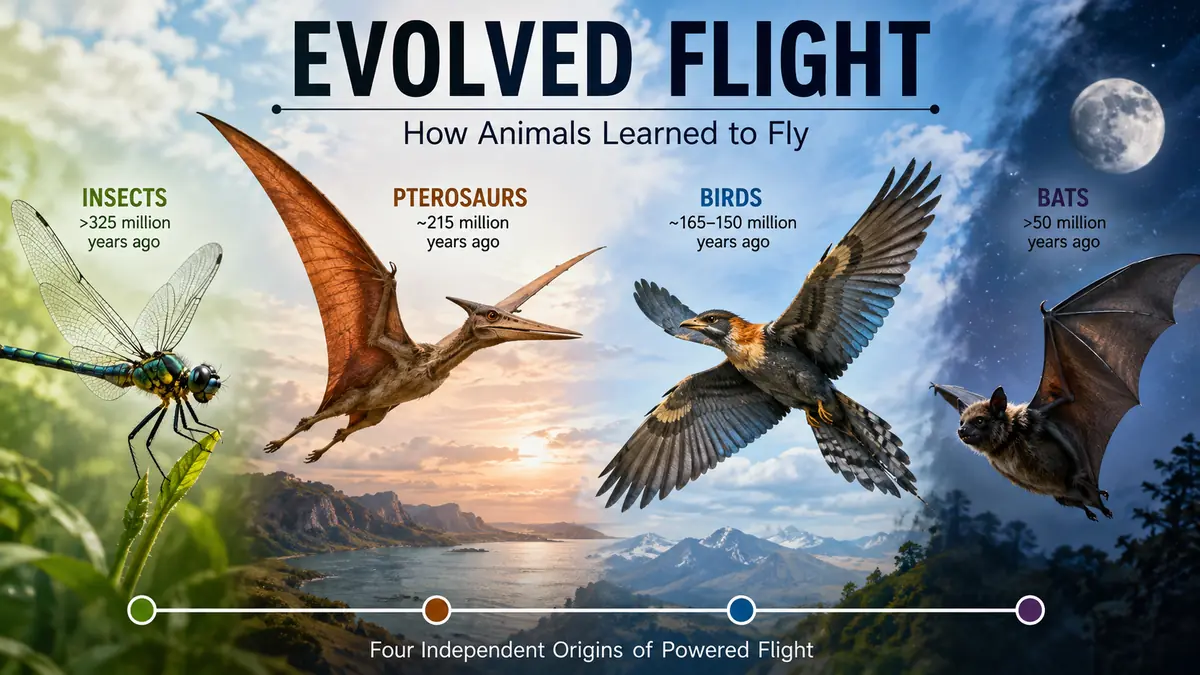
evolved flight refers to the independent evolutionary development of controlled, powered aerial locomotion. True powered flight arose separately in four major animal lineages—insects, pterosaurs, theropod dinosaurs that gave rise to birds, and bats. Each lineage developed different wings, muscles, skeletons, and flight-control systems while solving the same aerodynamic problems.
The remarkable part is that evolution did not invent one universal flying animal and modify it repeatedly. Insects use wings unlike vertebrate limbs. Pterosaurs flew on membranes supported largely by an elongated finger. Birds transformed feathered forelimbs into wings. Bats stretched flexible skin across greatly lengthened fingers.
That makes the history of flight one of biology’s clearest examples of convergent evolution.
What Does evolved flight Actually Mean?
When scientists discuss how animals evolved flight, they normally distinguish powered flight from jumping, parachuting, gliding, and soaring.
A flying squirrel can cross an impressive distance between trees, but it does not generate continuous thrust by beating wings. It is a glider. A bat, by contrast, actively moves its wings to generate the aerodynamic forces needed to remain airborne and maneuver.
Powered flight therefore requires more than simply becoming light enough to fall slowly.
A successful flying animal needs to solve four basic aerodynamic forces:
| Force | What it does |
|---|---|
| Lift | Acts mainly upward and counters body weight |
| Weight | Pulls the animal toward Earth |
| Thrust | Moves the animal forward through the air |
| Drag | Resists movement through the air |
Flapping wings can contribute to both lift and thrust. Wing shape, angle, speed, body orientation, muscle power, and air flow all affect how successfully an animal flies.
Animals also need extraordinary control. A wing cannot simply push against the air randomly. Its orientation must continually change during a wingbeat so that useful aerodynamic forces are produced without wasting excessive energy.
This combination of anatomical and physiological demands helps explain why powered flight is rare compared with walking, swimming, climbing, or even gliding.
Flying and gliding are not the same evolutionary achievement
Gliding has evolved far more frequently.
Flying squirrels, sugar gliders, colugos, some lizards, frogs, snakes, and other animals use aerodynamic surfaces to control descent or travel horizontally without powered wingbeats.
Gliding can be extremely sophisticated, but the animal generally trades altitude for horizontal distance.
Powered flyers actively replace lost energy through muscular wing motion.
Bats illustrate the distinction particularly well. They are the only living mammals capable of true powered flight; animals commonly called flying squirrels or flying lemurs are gliders instead.
How Many Times Has evolved flight Appeared?
The strongest evidence supports four major independent origins of powered animal flight:
- Insects
- Pterosaurs
- Theropod dinosaurs, including the lineage leading to birds
- Bats
These groups are separated by enormous evolutionary distances. Their last common ancestor was not a winged animal, meaning their flight systems developed independently rather than being inherited from a single flying ancestor.
There is an important scientific nuance, particularly with dinosaurs.
Research on feathered dinosaurs suggests aerodynamic behavior and potentially powered flight may have arisen more than once among bird-like theropods. Studies of dinosaurs such as Microraptor have therefore made the dinosaur side of the story more complicated than a simple single transition from terrestrial dinosaur to flying bird.
So saying that powered flight has four major evolutionary origins remains a useful overview, while acknowledging that individual lineages may contain additional independent experiments with aerial locomotion.
A simplified timeline
The approximate evolutionary sequence looks like this:
| Flying lineage | Approximate appearance | Key wing solution |
|---|---|---|
| Insects | More than 325 million years ago | Wings extending from the thoracic region |
| Pterosaurs | About 215 million years ago | Membrane supported by elongated fourth finger |
| Bird-like dinosaurs | Roughly 165–150 million years ago | Feathered forelimbs |
| Bats | More than 50 million years ago | Skin membrane supported by elongated fingers |
The dates represent fossil evidence rather than exact moments when the first individual became capable of flight. Evolutionary transitions occur gradually, while fossil preservation is incomplete.
Insects Were the First Animals to Conquer the Air
Long before birds appeared, insects had already transformed Earth’s skies.
Evidence indicates that insect flight was established more than 325 million years ago. The emergence of wings coincided with an extraordinary expansion of insect ecological diversity.
That makes insects the oldest known lineage of powered flyers.
Yet their origin presents scientists with a frustrating problem: early insect fossils leave relatively little evidence showing exactly how a wingless ancestor became a flying insect.
Where did insect wings come from?
Unlike the wings of birds, bats, and pterosaurs, insect wings are not modified arms.
Their evolutionary origin has therefore generated several competing ideas. Modern work incorporates fossil evidence and evolutionary developmental biology, or evo-devo, to investigate whether wings developed primarily from structures associated with the upper body wall, limb-related tissues, or a combination of both. Recent scientific discussions describe tergal, pleural, and dual-origin hypotheses.
The question remains active because the critical transitional stages occurred so long ago and are poorly represented in fossils.
Once flight appeared, however, its advantages were substantial. Insects could reach food unavailable to ground-dwelling competitors, find mates across larger areas, escape predators, disperse into new habitats, and eventually exploit flowering plants.
Wing structures later became useful for far more than movement. In different insect groups, they were modified for protection, acoustic communication, camouflage, courtship, and visual signaling.
Quick takeaway: Insects show that evolutionary innovation does not stop after a structure acquires its first successful function. Once wings existed, natural selection repeatedly modified them for entirely new roles.
Pterosaurs Became the First Flying Vertebrates
More than 100 million years before bats appeared, reptiles had already mastered powered flight.
Pterosaurs entered the fossil record roughly 215 million years ago during the Late Triassic and were the first vertebrates known to evolve powered flight. They were not dinosaurs, although both belonged to closely related branches of the reptile family tree.
This distinction matters because popular culture frequently labels pterosaurs as “flying dinosaurs.” Scientifically, dinosaurs and pterosaurs were separate groups.
How a pterosaur wing worked
A pterosaur’s wing was fundamentally different from a bird wing.
Instead of relying on feathers, it used a flight membrane supported by the forelimb and an enormously elongated fourth finger. That arrangement created a broad aerodynamic surface while maintaining a remarkably lightweight flying structure.
Some pterosaurs eventually reached enormous sizes, demonstrating that powered flight was not restricted to tiny animals.
Their skeletons also possessed adaptations associated with a lightweight, highly active body plan. Air-filled cavities evolved in several ornithodiran groups, including pterosaurs and theropod dinosaurs. Such structures likely had respiratory advantages before or alongside their importance for keeping bodies relatively light.
That is an important recurring pattern in flight evolution: a feature useful for flying often existed before flight itself.
How Birds Evolved Flight From Dinosaurs
The origin of bird flight is one of the best-known evolutionary transitions, but it is also one of the most frequently oversimplified.
Birds did not suddenly appear as fully formed flying animals. They are surviving members of the theropod dinosaur lineage, and the anatomical ingredients needed for flight accumulated over tens of millions of years.
Feathers are a classic example.
Feathers existed before birds needed them for flight
Early feathers were probably useful for functions such as thermal insulation, display, camouflage, or communication. Only later were increasingly complex feathers incorporated into aerodynamic surfaces.
This process is known as exaptation: a feature originally shaped for one function is later recruited for another.
Feathers were therefore not necessarily “invented for flying.”
The same applies to several other bird characteristics. Small body size, powerful forelimbs, respiratory adaptations, lightweight skeletons, and changes in posture emerged gradually among theropods.
Smithsonian researchers describe the anatomical pieces needed for flight as appearing before the animals possessing them became accomplished flyers.
Why Archaeopteryx remains important
Archaeopteryx, discovered in the nineteenth century in Germany, became one of the most famous transitional fossils because it combined dinosaur-like characteristics with complex feathers associated with aerial locomotion.
Bird-like dinosaurs existed during the Late Jurassic roughly 165–150 million years ago, placing the beginnings of dinosaur flight deep within the Mesozoic Era.
Archaeopteryx is not best understood as a magical halfway creature that suddenly turned dinosaurs into birds. It represents part of a much broader evolutionary radiation involving numerous feathered species experimenting with running, climbing, jumping, gliding, flapping, and flying.
Did bird flight begin from trees or the ground?
For decades, explanations were commonly divided into two models.
The trees-down hypothesis proposed that climbing ancestors jumped or glided from elevated locations. Natural selection could then favor increasingly controlled aerodynamic surfaces until powered wingbeats developed.
The ground-up hypothesis proposed that fast-running terrestrial dinosaurs used feathered forelimbs for functions that gradually became aerodynamically useful.
Modern fossil discoveries have blurred this simple division.
Researchers now investigate behaviors such as leaping, wing-assisted movement, controlled descent, climbing, fluttering, and short aerial transitions rather than assuming that flight followed one neat sequence. Smithsonian work, for example, has highlighted the possibility that flapping-like behavior could have preceded sophisticated gliding.
A landmark shift in the scientific debate came from paleontologist John Ostrom, whose work helped move discussion away from speculative ancestral scenarios toward dinosaur anatomy, fossils, behavior, and the evolution of the flight stroke.
The modern picture is therefore less “trees versus ground” and more a mosaic of behaviors and adaptations interacting over evolutionary time.
Why Scientists Think Dinosaurs May Have Evolved Flight More Than Once
Feathered dinosaur discoveries have created another intriguing possibility: powered or near-powered flight may not have appeared only along the direct ancestry of modern birds.
Researchers studying the aerodynamic capabilities of small theropods have concluded that several dinosaur lineages possessed combinations of body size, feathers, wing loading, and skeletal anatomy consistent with aerial locomotion.
One analysis reported evidence that flight evolved at least three times among theropod dinosaurs, including lineages separate from the one that ultimately produced modern birds.
Microraptor is especially famous because it possessed long feathers on both its forelimbs and hind limbs, giving it a four-winged appearance.
These evolutionary experiments show why the history of flight should not be imagined as a ladder with modern birds at the top.
Evolution produces branching lineages. Some anatomical experiments disappear. Some persist. Others converge on similar solutions independently.
Modern birds represent the surviving outcome of only part of that enormous prehistoric diversity.
How Bats Evolved Powered Flight
Bats created yet another solution to exactly the same aerodynamic challenge.
Instead of developing feathers, they fly with an elastic skin membrane stretched across greatly elongated arm and finger bones.
This structure effectively turns much of the hand into the framework of the wing.
Bats are therefore not simply “mammalian birds.” Their wings are independently evolved structures produced from the mammalian forelimb in a very different way.
What did the first bat look like?
Here the fossil record becomes frustratingly incomplete.
Some of the oldest well-preserved bats are already recognizable as flying bats. Fossils from Wyoming dating to more than 52 million years ago include forms such as Icaronycteris and Onychonycteris. Their anatomy indicates that sophisticated wings had already evolved by that point.
Onychonycteris retained claws on its wing digits, providing hints of an earlier climbing ancestry. But scientists have not yet found a complete sequence of fossils showing every stage between a non-flying mammal and an early powered bat.
That gap makes the precise origin of bat flight much less certain than the dinosaur-to-bird transition.
A common hypothesis involves small arboreal mammals that climbed through vegetation, jumped between branches, developed increasingly effective membranes for controlled descent, and eventually acquired powered wingbeats.
It remains a hypothesis rather than a fully documented fossil sequence.
Which came first: bat flight or echolocation?
Another fascinating issue is whether bats began flying before sophisticated echolocation emerged.
Early fossils do not all show identical sensory abilities. Smithsonian discussions of Onychonycteris and Icaronycteris indicate that flight was already highly developed among early bats while echolocation capabilities varied between lineages.
This makes bat evolution especially useful for understanding how complex adaptations can develop as partially independent systems.
A bat needed wings to fly, but the modern combination of flight, echolocation, sensory processing, and nocturnal hunting did not necessarily appear as one evolutionary package.
Why Flight Evolved Despite Being So Expensive
Flying is energetically demanding.
An animal must accelerate its wings repeatedly, generate enough aerodynamic force to support its mass, overcome drag, maintain balance, and power the muscles responsible for continuous flapping.
So why did natural selection repeatedly favor such an expensive form of locomotion?
Because access to the air can produce enormous ecological advantages.
A flying animal may escape terrestrial predators, reach isolated food supplies, travel efficiently across barriers, move between feeding and breeding locations, exploit elevated nesting sites, catch airborne prey, and disperse over areas inaccessible to terrestrial competitors.
Those benefits can outweigh flight’s metabolic cost.
Flight opens entirely new ecological niches
Once a lineage becomes capable of controlled flight, natural selection can begin refining that ability for different tasks.
Compare a hummingbird with an albatross.
Both are birds, yet one is optimized for hovering and precise flower feeding while the other uses long wings to travel immense distances efficiently.
Bats show similar diversification. Some hunt insects in cluttered forests. Others feed on fruit, nectar, fish, or small vertebrates.
Insects range from delicate butterflies to extraordinarily maneuverable dragonflies.
The initial evolution of flight therefore opened an ecological opportunity that could later generate massive evolutionary radiations.
The Anatomy That Makes Powered Flight Possible
There is no universal flight anatomy, yet successful flyers repeatedly evolve solutions to the same physical challenges.
Large aerodynamic surfaces
Every flying lineage requires structures capable of interacting with enough air to support its body.
For birds these are feathered wings. For bats and pterosaurs they are membranes. Insects evolved entirely different wing structures.
High muscular power
Generating repeated wingbeats requires substantial muscle output.
Flying vertebrates typically dedicate significant anatomy to powering the stroke, while insects possess specialized thoracic flight musculature.
Research comparing flight muscles across flying animal groups shows that powered flight imposes demanding constraints on muscle contraction and energetic efficiency.
Low effective body mass
Being light helps, but “lightweight” does not simply mean fragile.
Flying animals must balance low mass against structural strength. Birds and pterosaurs evolved skeletal systems capable of resisting aerodynamic stresses without becoming unnecessarily heavy.
Efficient oxygen delivery and metabolism
Flight muscles consume energy rapidly.
Respiratory and circulatory systems therefore play a major role in sustaining flight. High oxygen availability, rapid fuel delivery, and efficient muscle metabolism are as essential as wing shape.
Fine neurological control
Aerial movement is a three-dimensional control problem.
Pitch, roll, yaw, wing angle, speed, gusts, obstacles, and landing surfaces can change within fractions of a second.
Successful flyers therefore require advanced sensory integration and motor control, whether the system belongs to an insect, bird, or bat.
Convergent Evolution Explains Similarities Without Common Wings
The fact that insects, pterosaurs, birds, and bats all fly might make their wings look like versions of the same evolutionary structure.
Functionally, they are similar.
Evolutionarily, they are not.
Bird wings and bat wings both contain the basic forelimb bones inherited from ancient tetrapod ancestors. Yet the aerodynamic portions of their wings developed very differently. Birds rely heavily on feathers attached to a modified forelimb, while bats support an extensive membrane with elongated digits.
Pterosaurs created another configuration centered on an elongated fourth finger.
Insects do not even use modified vertebrate limbs.
This is convergent evolution: unrelated or distantly related organisms independently develop features that solve similar environmental problems.
Flight is one of its most dramatic examples.
Natural selection repeatedly encountered gravity and aerodynamic constraints, but evolutionary history supplied each lineage with different raw materials.
The result was not one perfect wing. It was several workable answers.
What Flight Evolution Teaches Us About Natural Selection
The history of evolved flight reveals something deeper than how animals became airborne.
Complex structures do not need to appear fully formed.
A feather can provide insulation before contributing to lift. A forelimb can capture prey before becoming an aerodynamic surface. A membrane can help an animal control a fall before being capable of sustained flapping flight.
Natural selection works with existing variation.
This is why exaptation, gradual anatomical modification, behavioral change, and ecological opportunity matter so much when reconstructing flight evolution.
The fossil record also reminds us that evolution contains dead ends. Many feathered dinosaurs experimented with aerial behavior but left no living descendants. Pterosaurs dominated the skies for more than 150 million years and then disappeared entirely.
Modern birds, bats, and insects represent survivors rather than predetermined endpoints.
Why Scientists Still Debate the Origin of Flight
We understand the basic physics of animal flight far better than we understand every evolutionary step that produced it.
There are several reasons.
Soft tissues such as membranes rarely fossilize. Small, lightweight skeletons can be difficult to preserve. Transitional species may have lived in forests where fossilization conditions were poor. Behaviors such as jumping, climbing, flapping, or controlled descent cannot usually be observed directly from bones.
Bats demonstrate the problem particularly clearly: fossils more than 52 million years old already possess recognizable flight adaptations, but fossils documenting the preceding transition remain elusive.
Insect wing origins pose another deep challenge because the relevant transition occurred hundreds of millions of years ago.
Even the comparatively rich dinosaur record cannot tell scientists precisely how every feathered species moved.
Researchers therefore combine multiple forms of evidence: fossil anatomy, biomechanics, phylogenetics, developmental biology, living-animal behavior, aerodynamic modeling, muscle physiology, and comparative anatomy.
New discoveries can change the details without undermining the broader evolutionary picture.
evolved flight Shows Evolution Solving the Same Problem Four Ways
The story of evolved flight is not the story of a single invention.
It is the story of life independently confronting the same physical challenge and arriving at remarkably different solutions.
Insects took to the air first, more than 325 million years ago. Pterosaurs later became the first flying vertebrates. Feathered theropod dinosaurs developed increasingly sophisticated aerial abilities and ultimately produced birds. Much later, mammals produced bats with flexible membrane wings stretched across elongated fingers.
Across those lineages, flight emerged through gradual changes in anatomy, behavior, physiology, and ecology rather than through a single dramatic transformation.
That is what makes evolved flight scientifically valuable. Insects, pterosaurs, birds, and bats use different biological hardware, but every one of them must obey the same laws of aerodynamics. Their histories show how natural selection can repeatedly transform existing structures into new capabilities—and, eventually, turn Earth’s atmosphere into an ecosystem of its own.