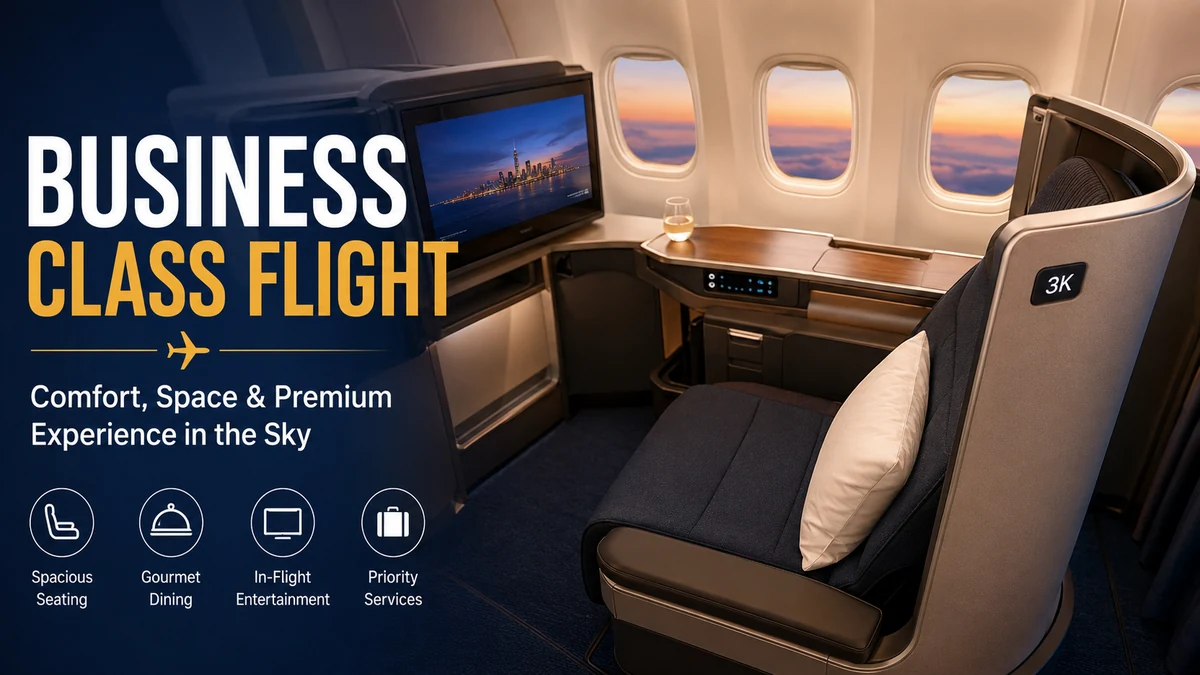
A business class flight can feel dramatically different from economy, especially on a long international journey. The upgrade is not simply a wider seat. Depending on the airline, aircraft, route, and fare type, it can change almost every stage of the trip—from airport check-in and lounge access to sleeping, dining, baggage handling, and arrival.
A business class flight is a premium airline cabin positioned above economy and premium economy and, on airlines that still offer it, below first class. It typically provides more personal space, enhanced meals, priority airport services, lounge access, additional baggage, and—on many long-haul aircraft—a seat that converts into a fully flat bed.
The important word is typically. There is no universal business-class standard. A short regional flight may provide an economy-style seat with extra space, while an overnight international flight can offer a private suite with a door and direct aisle access.
That variation is why knowing the airline name alone is not enough. The aircraft, route, seat configuration, fare family, and even departure airport can determine what you actually receive.
What Is a business class flight?
Business class is a premium travel class designed to provide substantially greater comfort and service than economy. It originally developed as a cabin between economy and first class, but the distinction has changed over time.
Many airlines have reduced or eliminated international first class while investing more heavily in business cabins. American Airlines, for example, is expanding its Flagship Suite business seating while removing Flagship First from redesigned Boeing 777-300ER aircraft.
That trend helps explain why modern long-haul business class can resemble what travelers once associated with first class.
A typical international business-class journey may include:
- Dedicated or priority check-in, expedited security where available, airport lounge access, priority boarding and baggage handling, a larger seat or lie-flat bed, upgraded food and beverages, better bedding and amenities, extra checked baggage, in-seat power and entertainment, and greater privacy.
British Airways, for example, lists dedicated check-in, lounges, fully flat beds, premium dining, bedding, amenity kits, entertainment and in-seat power among its Club World features. American Airlines includes priority airport services, lounge access, lie-flat seating, multi-course dining and enhanced entertainment in Flagship Business.
Yet those examples should not be treated as universal rules. Business-class inclusions vary considerably.
What Happens Before a Business Class Flight?
The difference often begins well before passengers reach the aircraft.
Dedicated check-in
Many airlines provide separate check-in counters for premium passengers. These queues can be particularly useful at busy international airports where standard economy lines become long.
Priority services may also extend to baggage acceptance, security lanes and immigration channels, although fast-track access depends on the airport and local authorities.
British Airways, for example, provides dedicated Club World check-in at most airports and advertises Fast Track security at selected airports such as London Heathrow, London Gatwick and New York JFK.
That illustrates an important point: a benefit advertised as part of business class may not exist at every airport.
Airport lounge access
Lounge access is one of the most recognizable business-class benefits.
A good international business lounge may provide seating away from the main terminal, Wi-Fi, charging outlets, workspaces, meals, snacks, beverages and showers. Larger airline hubs can have considerably more elaborate facilities.
Emirates’ Dubai Business Class Lounge, for example, includes dining, Wi-Fi, quiet areas, business facilities and shower facilities. British Airways operates its own Club lounges as well as access arrangements involving partner lounges.
However, business-class ticket does not automatically mean lounge access in every situation.
Airlines are increasingly dividing premium cabins into different fare families. Emirates states that its Business Class Special fare does not automatically receive the same complimentary Dubai lounge access provided with Business Saver, Flex and Flex Plus fares. Delta has also introduced differentiated Delta One business fare products with varying airport benefits.
Always check the conditions attached to the specific fare rather than assuming the cabin name guarantees every premium benefit.
Priority boarding
Business passengers commonly board before most economy groups.
Priority boarding serves a practical purpose beyond convenience: it gives travelers more time to settle into complicated premium seats, organize personal belongings and secure overhead storage.
Some airports and lounges even support direct or expedited boarding arrangements.
What Are Business Class Seats Like?
The seat is usually the biggest reason travelers notice the difference between business class and other cabins.
But saying “business-class seat” tells you surprisingly little.
Short-haul business class
On shorter flights, business class may look quite similar to economy.
Some airlines use the same physical seat throughout the aircraft but leave the middle seat empty in business class. Others provide wider recliner-style seats similar to domestic first class in the United States.
You may receive better meals, airport priority and lounge access without receiving anything resembling a bed.
For that reason, someone taking a two-hour business class flight should not assume they will get the same cabin shown in advertisements for a 12-hour international service.
Long-haul lie-flat seats
Long-haul international business class is where the product changes substantially.
Many leading airlines now offer 180-degree lie-flat seats on their principal long-distance aircraft. American Airlines states that its Flagship Business product is offered on aircraft equipped with fully lie-flat seats, including selected Boeing 777, Boeing 787 and Airbus aircraft. Delta One similarly advertises 180-degree flat-bed seating on its premium long-haul product.
Once converted, the seat becomes a narrow bed rather than merely reclining backward.
For overnight travel, that difference can matter more than almost any other amenity.
Direct aisle access
Seat layout is nearly as important as whether the seat becomes flat.
Modern premium cabins increasingly use a 1-2-1 layout, meaning one seat at each window and two in the center. Every passenger can reach the aisle without climbing over another traveler.
Older configurations may use 2-2-2 or other arrangements where a window passenger must step past a neighbor.
For solo travelers, direct aisle access is usually one of the first specifications worth checking.
Business-class suites
Some newer products add sliding privacy doors.
British Airways Club Suite provides direct aisle access and a door, while Delta says suites with doors and privacy dividers are available on most Airbus A350 and A330-900 Delta One flights.
A door does not transform the seat into a completely enclosed hotel room. Cabin walls remain relatively low for operational and safety reasons, and crew members must still be able to monitor the cabin.
It nevertheless creates noticeably more privacy.
Business Class Seat Types Compared
| Seat type | Typical experience | Sleeping comfort | Privacy |
|---|---|---|---|
| Economy-style business seat | Standard seat with adjacent space blocked or improved service | Low | Low |
| Recliner | Wider seat with significant recline | Moderate | Low |
| Angled-flat seat | Extends toward a bed but remains slightly sloped | Good | Moderate |
| Fully flat seat | Converts to a horizontal sleeping surface | Very good | Good |
| Business suite | Lie-flat seat plus partitions or door | Very good | Very good |
The best option depends heavily on flight duration. A recliner may be perfectly comfortable for a short daytime sector but much less attractive for an overnight journey.
Why the Aircraft Matters So Much
One of the most common mistakes first-time business travelers make is selecting a flight based on the airline’s overall reputation rather than researching the specific aircraft.
The same airline can operate several generations of business-class seats simultaneously.
Emirates is a useful example. Its business experience differs across the Airbus A380, Airbus A350 and Boeing 777 fleet, and the airline specifically warns that products and features can vary according to aircraft type, model, route and configuration.
British Airways also operates different Club World seat designs depending on aircraft and route. Its newer Club Suite differs considerably from the older Club World product.
When researching a business class flight, look for the aircraft type and seat map, not merely photographs on the airline’s general business-class page.
Even then, aircraft swaps can occur for operational reasons.
What Is the Food Like on a Business Class Flight?
Business-class dining is normally a significant step above economy.
Instead of receiving a single meal tray, long-haul passengers may be served courses separately with proper tableware. Airlines commonly offer multiple main-course choices along with appetizers, desserts and snacks.
American Airlines describes its Flagship Business service as chef-inspired multi-course dining paired with wine, while British Airways Club World provides a choice of main courses with starters and desserts.
Some carriers also allow passengers to select or preorder meals before departure. Emirates currently permits Business Class meal preordering on selected routes, generally from 14 days until 24 hours before departure.
Meal quality still varies by airline, route, catering station and flight length.
A polished menu does not guarantee restaurant-level food at altitude. Cabin pressure, reheating limitations and the realities of mass catering affect what can be served.
Dine or sleep?
On an overnight flight, eating every course is not always the smartest way to use business class.
If the journey is relatively short, finishing a long dinner service can consume a meaningful percentage of potential sleeping time.
Some airlines address this with express dining or pre-flight meals. British Airways, for example, offers a Goodnight Service on qualifying late departures so passengers can choose a faster meal before sleeping.
For overnight travel, maximizing uninterrupted sleep may provide more value than maximizing the number of premium meals consumed.
Do You Get a Bed in Business Class?
On many long-haul flights, yes—but not literally.
The aircraft does not normally contain conventional beds. Instead, the business-class seat changes position until the sitting surface becomes a horizontal sleeping platform.
Bedding can include a pillow, blanket or duvet and, with some airlines, a mattress pad or seat cover. Delta One, for example, provides flat-bed seating with premium bedding, while British Airways supplies bedding on long-haul Club World services.
Sleeping comfort depends on more than the “lie-flat” label.
Seat width, bed length, footwell size, cabin temperature, noise, turbulence and proximity to galleys or toilets all affect rest.
Tall travelers should pay particular attention to bed length. British Airways lists its Club Suite bed at approximately 198 cm (6 ft 6 in), compared with approximately 183 cm (6 ft) for its older Club World seat.
A few centimeters can make a surprisingly noticeable difference on an overnight flight.
Business Class vs Premium Economy
Premium economy occupies the space between economy and business on many long-haul airlines.
It generally provides a wider seat, additional legroom and improved food or service, but the seat usually remains a recliner.
Business class moves much further toward sleep, privacy and airport services.
| Feature | Premium economy | Business class |
|---|---|---|
| Seat | Larger reclining seat | Often lie-flat on long-haul routes |
| Personal space | More than economy | Substantially more |
| Lounge access | Usually not included automatically | Common, but fare-dependent |
| Airport priority | Limited or airline-dependent | Usually extensive |
| Dining | Upgraded economy-style service | More elaborate premium dining |
| Bedding | Basic | Often enhanced |
| Privacy | Moderate | High on modern cabins |
| Direct aisle access | Rare | Common on newer long-haul products |
For a daytime flight, premium economy may provide plenty of comfort. On an overnight sector, however, the ability to sleep horizontally often creates the biggest practical difference.
Business Class vs First Class
Business and first class have become harder to distinguish because modern business cabins have improved considerably.
Traditional international first class remains the more exclusive cabin where it exists. It may provide a larger suite, fewer passengers, more individualized service, premium lounges and more elaborate dining.
Business class, however, already covers most of the benefits that substantially change a journey: lie-flat sleeping, airport priority, lounge access, improved food and greater privacy.
KAYAK’s current comparison similarly identifies space, service, amenities and exclusivity as major differences, while noting that lie-flat seating and lounge access are common features of international business class.
First class is also becoming less widespread. Some major carriers have concentrated their premium strategy on business class instead.
That means business is now the highest cabin available on many aircraft.
Does Business Class Include Extra Baggage?
Usually, but allowances differ dramatically.
Premium tickets often permit more checked luggage than economy and may provide higher individual bag weight limits. Business passengers commonly receive priority baggage tags as well, intended to make checked bags arrive earlier at baggage claim.
British Airways Club World passengers, for example, can normally check up to two bags under its published cabin allowance, subject to the ticket and route conditions.
Never assume another airline follows the same rule.
Baggage policies can depend on destination, operating carrier, frequent-flyer status and whether the airline calculates allowance by weight or by number of pieces.
Check the baggage allowance printed on the actual reservation before packing.
Are Amenity Kits Included?
Long-haul business cabins frequently provide amenity kits containing travel essentials such as an eye mask, socks, dental products or skincare items.
Bedding may also be supplied separately.
These amenities are useful, but they should rank well below seat design when evaluating a flight. A premium toiletry bag cannot compensate for an uncomfortable overnight seat.
The features that materially affect a journey are generally seat comfort, sleeping space, aisle access, airport efficiency and departure/arrival timing.
Wi-Fi, Power and Entertainment
Modern business cabins are designed for both working and relaxing.
Common features include an entertainment screen, electrical outlet, USB charging and headphones. Newer aircraft increasingly add USB-C ports, Bluetooth connectivity and wireless charging.
Wi-Fi availability is less consistent.
Some airlines provide complimentary connectivity under certain conditions; others charge for access, limit free use to messaging or restrict service by aircraft.
American Airlines, for example, says Wi-Fi can be purchased on selected Flagship Business aircraft, while Emirates lists onboard Wi-Fi among its Business Class travel benefits.
If internet access is essential for work, verify the specific flight rather than assuming a premium ticket guarantees a fast connection.
Satellite coverage, aircraft equipment and technical problems can still interrupt service.
Business Class Can Vary Even Within One Airline
This is perhaps the most useful lesson for anyone researching premium travel:
You are choosing a specific flight, not simply a brand.
Imagine two flights operated by the same airline.
Flight A uses a newer aircraft with a 1-2-1 cabin, fully flat seats and direct aisle access.
Flight B uses an older configuration where passengers sit side by side without direct aisle access.
Both tickets can legitimately be labeled business class.
Airport benefits may differ as well. One fare can include lounge access while a lower business fare on the same airline may restrict it.
This variation is becoming more important as airlines introduce cabin-specific fare families such as Basic, Classic, Flex or Extra products.
How to Evaluate a Business Class Flight Before Traveling
A simple checklist prevents most unpleasant surprises.
Start with the operating airline, particularly on codeshare itineraries. The airline whose flight number appears on the booking may not be the carrier physically operating the aircraft.
Then identify the aircraft model and configuration. Look at the seat map and determine whether your seat is lie-flat, whether every passenger has aisle access and whether a privacy door is available.
Check the fare rules separately. Confirm lounge eligibility, baggage allowance, seat-selection charges, change rules and mileage earning.
Next, consider the schedule itself.
A perfect seat on a badly timed itinerary may provide less useful rest than a slightly weaker product departing at a convenient time.
Finally, check the connection. Long transfers can make lounge quality more important, while short connections make terminal location and priority services more valuable.
Quick Takeaway
For long-haul travel, evaluate business class in roughly this order: seat and sleeping comfort first, schedule second, direct aisle access and privacy third, then lounge, food and smaller amenities.
The expensive-looking extras are memorable, but sleep and journey time usually determine how refreshed you feel after arrival.
Which Business-Class Seat Is Best for Solo Travelers?
Solo passengers generally benefit most from a window seat in a 1-2-1 cabin.
It provides both privacy and uninterrupted aisle access.
In some configurations, the window-side table separates the passenger from the aisle, making certain seats significantly more private than others.
Center seats are usually better for couples traveling together, particularly when their privacy divider can be lowered.
Some modern designs, however, angle center seats away from each other, so even adjacent seats may not be ideal for conversation.
Seat maps therefore tell only part of the story. The exact seat design matters.
Which Seat Is Best for Sleeping?
For an overnight journey, a seat away from high-traffic areas is usually preferable.
Seats near toilets, galleys and onboard bars can experience more foot traffic, light and conversation. Bulkhead seats sometimes offer larger footwells, although that varies by cabin design.
Travelers sensitive to engine noise may prefer positions farther forward depending on the aircraft.
The practical objective is simple: find a lie-flat seat that gives you enough length, sufficient foot space and the fewest likely interruptions.
Is a business class flight Worth It?
There is no universal answer because the value depends on what the journey demands.
The biggest difference is usually felt on long overnight flights where a lie-flat seat allows several hours of genuine sleep.
Consider an eight- or twelve-hour journey. A wide seat, horizontal bed, quiet lounge, faster airport processing and priority arrival can fundamentally change how you feel when you reach the destination.
On a 90-minute daytime flight, the calculation is very different. Business class may offer priority treatment and improved service but comparatively little extra time to enjoy it.
For informational comparison, the strongest reasons for choosing business class tend to be sleep, physical comfort, privacy, productivity and smoother airport handling, rather than luxury for its own sake.
Common Business Class Mistakes
One common mistake is assuming every business-class seat becomes a flat bed. Short-haul and regional products often do not.
Another is assuming photographs on an airline’s website represent every aircraft. Mixed fleets can contain older and newer products simultaneously.
Travelers also sometimes overlook fare restrictions. A ticket can say “Business” while excluding a benefit available with another fare in the same cabin.
Lounge assumptions create similar surprises. Access can depend on the fare, airline, airport, alliance status and whether the flight is operated by the airline that sold the ticket.
Finally, some passengers focus heavily on food, amenity kits and champagne while ignoring departure time and seat configuration.
Those smaller touches are pleasant. They rarely matter as much as six hours of uninterrupted sleep.
Major Business Class Products You May Encounter
Airlines frequently market business class under brand names rather than simply calling it “Business.”
British Airways uses Club World for its long-haul business cabin. Delta markets its premium long-haul experience as Delta One, while American Airlines uses Flagship Business on qualifying international and long-distance routes. Emirates uses Business Class across aircraft including the Airbus A380, A350 and Boeing 777.
Other airlines likewise give their flagship products distinctive identities.
The brand name is useful, but the underlying questions remain the same:
Is the seat fully flat? Does everyone have aisle access? Which aircraft operates the route? What airport benefits come with this particular fare?
Those answers tell you far more than the marketing name.
Business Class on Connecting Flights
A business-class itinerary does not necessarily mean every segment offers the same experience.
A long international sector may feature a private lie-flat suite, while the connecting regional flight uses a conventional recliner or an economy-style seat.
Mixed-cabin itineraries can also occur when award tickets or irregular operations are involved.
Check each segment individually.
The phrase “business class” beside the overall reservation is not enough to determine what every flight contains.
What Actually Makes Business Class Better?
The most meaningful improvement is not champagne, porcelain plates or an amenity kit.
It is control over your space and time.
A lie-flat seat lets you choose to sleep. Direct aisle access lets you get up without disturbing anyone. A lounge gives you somewhere quieter to eat or work before departure. Priority services reduce unnecessary airport waiting.
Those features become increasingly useful as journeys become longer.
Business class is therefore best understood not as one luxury product but as a collection of improvements designed to reduce the physical and logistical strain of flying.
Final Thoughts on a business class flight
A business class flight can range from a modest short-haul upgrade to a private lie-flat suite designed for intercontinental travel. The cabin name alone does not tell you which experience you will receive.
Modern long-haul products commonly combine lie-flat seating, lounge access, priority airport services, upgraded dining, enhanced baggage allowances, entertainment, bedding and greater privacy. Yet aircraft configuration and fare rules can change several of those benefits.
Before any business-class journey, check the operating airline, aircraft type, seat map, bed configuration, lounge eligibility, baggage allowance and fare conditions for the exact flight.
That small amount of research gives you a much clearer picture of what “business class” will actually mean once you step on board.