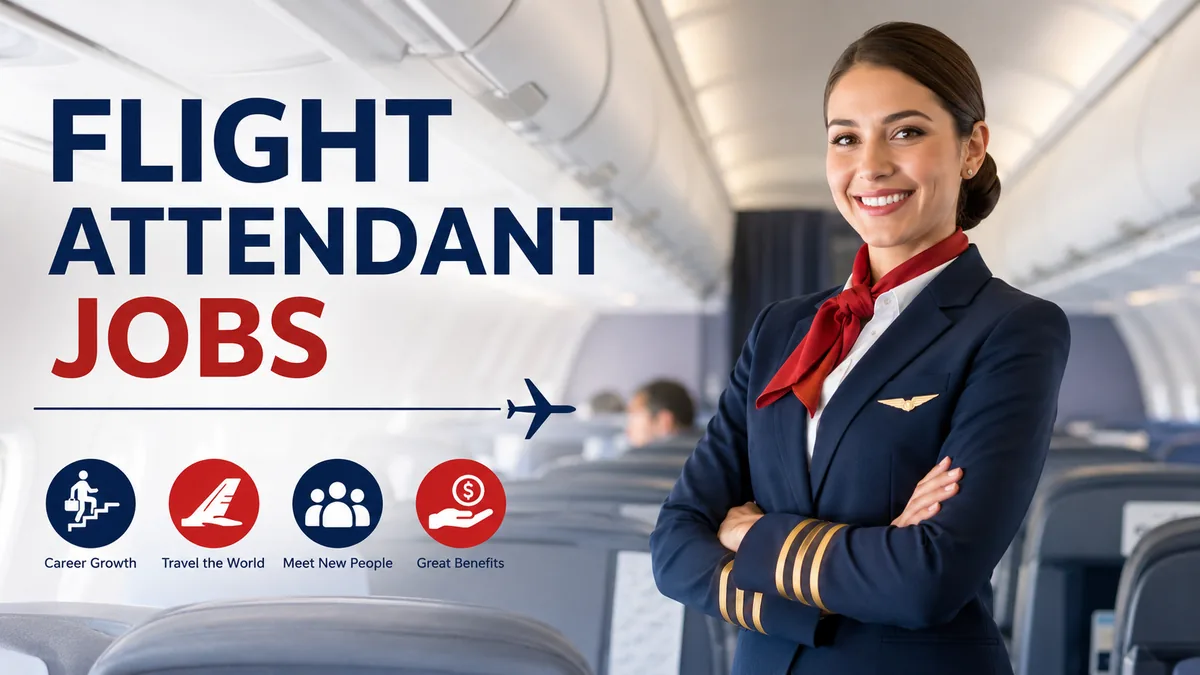
For many applicants, the attraction is obvious: travel, airline benefits, an unconventional workplace, and the chance to meet people from around the world. But flight attendant jobs are first and foremost aviation safety positions. Cabin crew members are responsible for passenger safety, emergency response, regulatory compliance, and customer care—not simply serving drinks at 35,000 feet.
Flight attendants provide routine passenger service while preparing for and responding to emergencies. In the United States, candidates normally need at least a high school diploma or equivalent, must complete airline-provided training, and must qualify for an FAA Certificate of Demonstrated Proficiency before serving on covered commercial aircraft. Requirements such as minimum age, passport validity, reach ability, customer-service experience, and appearance standards vary by airline.
What Are flight attendant jobs Really Like?
A flight attendant is a trained cabin safety professional employed by an airline or other air carrier. The role combines aviation safety, security, emergency preparedness, passenger assistance, teamwork, and hospitality.
The U.S. Bureau of Labor Statistics describes the core responsibility as ensuring the safety and comfort of airline passengers. Typical duties include attending preflight briefings with pilots, inspecting emergency equipment, demonstrating safety procedures, confirming compliance with seat-belt rules, helping passengers with special needs, responding to turbulence, coordinating emergency medical assistance, and directing an evacuation when necessary.
That distinction matters. Customer service is highly visible, but safety comes first.
What Does a Flight Attendant Do Before Takeoff?
The working day normally begins before passengers board. Cabin crew may receive information about the route, flight time, weather or turbulence concerns, passenger requirements, security issues, and other operating details.
Crew members then inspect relevant safety and emergency equipment and prepare the cabin for boarding. Once passengers arrive, attendants monitor baggage placement, assist travelers who need help, observe cabin conditions, and prepare the aircraft for departure.
Before takeoff, they verify that required safety procedures have been followed and demonstrate equipment such as seat belts and oxygen masks.
What Happens During the Flight?
Once airborne, responsibilities depend on the route and airline.
Cabin crew may provide food and beverages, answer passenger questions, monitor the cabin, support passengers with disabilities or medical needs, manage conflicts, respond to turbulence, provide first aid, and deal with unusual situations.
A routine flight can change quickly. A medical emergency, smoke indication, severe turbulence, disruptive passenger, decompression event, or emergency landing can require immediate action.
This is why airlines look for candidates who remain composed when conditions stop being routine.
What Happens After Landing?
Responsibilities do not necessarily end when the wheels touch the runway. Flight attendants may complete cabin checks, assist passengers during deplaning, report incidents or safety issues, check for forgotten property, and prepare for another flight sector.
Depending on the schedule, the crew may operate several flights that day or spend the night at a destination before working the next assignment.
Requirements for flight attendant jobs
There is no single worldwide set of cabin crew eligibility rules. Airlines operate under different national regulations and establish their own recruitment standards.
In the United States, however, a high school diploma or equivalent is typically enough academically. A college degree can be useful, especially in hospitality, tourism, communications, languages, psychology, or related areas, but it usually is not a universal requirement.
Current airline requirements illustrate how much the details can differ:
| Requirement | Typical Expectation |
|---|---|
| Education | High school diploma, GED, Grade 12, or equivalent |
| Minimum age | Commonly 20 or 21, depending on airline |
| Language | Strong spoken and written English |
| Passport | Usually required for international operations |
| Work authorization | Required for the airline’s employing country |
| Customer service | Often preferred; some airlines specifically require experience |
| Physical capability | Must safely perform cabin and emergency duties |
| Background screening | Common during pre-employment |
| Drug screening | Common among U.S. carriers |
| Schedule flexibility | Nights, weekends, holidays, reserve and overnight trips |
| Training | Airline-specific initial training must be completed |
For example, Delta currently requires flight attendant applicants to be at least 21, have a high school diploma or equivalent, have U.S. work authorization, communicate fluently in English, and be willing to work domestic and international trips with nights, weekends, holidays, and irregular hours.
Southwest currently lists a minimum age of 20, U.S. work authorization, a valid passport, and the ability to move safely through cabin aisles and exits and use a jumpseat harness.
United currently requires applicants to be at least 21, have a high school diploma or GED, possess at least one year of customer-service experience in specified service environments, and hold a qualifying passport. It also publishes specific functional reach and physical-duty requirements.
The practical lesson is simple: never assume one airline’s eligibility criteria apply to another.
Do You Need a College Degree?
Usually not.
A high school qualification is sufficient for many U.S. airline positions. Employers may nevertheless value postsecondary education because the role involves communication, cultural awareness, judgment, and passenger interaction.
Someone with restaurant, hotel, healthcare, teaching, retail, tourism, sales, emergency-response, or customer-support experience can also bring highly relevant skills without having an aviation degree.
Is Customer-Service Experience Required?
Sometimes.
United currently specifies at least one year of customer-service experience in areas such as hospitality, retail, education, food service, aviation, or social services. Emirates likewise lists at least one year of hospitality or customer-service experience among its cabin crew criteria.
Other airlines may treat previous service experience as preferred rather than mandatory.
Useful experience is not about learning how to hand someone a drink. Recruiters are interested in evidence that you can communicate professionally, enforce rules without creating unnecessary conflict, work with a team, handle difficult customers, and remain calm under pressure.
Are There Height and Reach Requirements?
Airline policies vary.
Modern recruitment often focuses on whether a candidate can safely reach and operate required equipment rather than imposing one universal height standard.
United, for example, currently publishes a specific functional reach assessment. Emirates requires applicants to be at least 160 cm tall and able to reach 212 cm.
These requirements relate to accessing safety equipment and performing emergency duties in the aircraft cabin.
Can You Become a Flight Attendant With Tattoos?
Possibly.
Tattoo, piercing, hair, grooming, and uniform policies differ considerably between airlines. Emirates currently specifies no visible tattoos while wearing its cabin crew uniform, while United publishes professional appearance and tattoo/piercing expectations as part of its requirements.
Always check the airline’s current policy rather than relying on an old forum post or social-media video.
How to Get flight attendant jobs Step by Step
Airline recruitment is competitive because many vacancies attract large numbers of applicants. The strongest strategy is to treat the process as a safety-and-service hiring assessment rather than a conventional hospitality interview.
A typical path looks like this:
- Check the airline’s official requirements. Confirm age, education, passport, employment authorization, language ability, physical requirements, base expectations, appearance policy, and availability before applying.
- Build relevant experience. Customer-facing work in hospitality, retail, healthcare, education, tourism, restaurants, sales, or support roles can demonstrate communication and conflict-management skills.
- Prepare an airline-focused resume. Emphasize safety awareness, teamwork, reliability, customer service, problem solving, de-escalation, leadership, language skills, and experience working irregular schedules.
- Apply through the airline’s official career website. Hiring windows can close after enough applications are received, so qualified candidates often benefit from applying promptly.
- Complete assessments and interviews. Depending on the carrier, this may include online questionnaires, recorded video interviews, virtual interviews, group exercises, reach tests, and an in-person recruiting event.
- Pass pre-employment checks. Depending on the airline and jurisdiction, candidates may face identity checks, employment verification, background investigations, fingerprinting, medical or functional evaluations, and drug screening.
- Complete airline training. Training covers aircraft-specific procedures, emergency equipment, evacuation, firefighting, first aid, security, crew communication, passenger handling, and normal service procedures.
- Complete required qualification or certification. In the United States, eligible flight attendants serving aboard covered aircraft must hold an FAA Certificate of Demonstrated Proficiency.
- Begin line flying, frequently with less schedule control. Newly hired attendants may initially work reserve or other junior schedules until seniority improves their bidding options.
Actual recruitment pipelines vary. Delta’s current process includes an application, candidate assessments, an on-demand interview, an in-person event, a conditional offer, pre-employment requirements, and seven weeks of onsite training in Atlanta.
American Airlines describes a process involving an application and online assessment, personal introduction video, virtual interview, in-person group experience, seven-week training, and qualification to begin flying.
Do You Need Flight Attendant School Before Applying?
Usually not for major U.S. airlines.
Airlines train successful recruits according to their own procedures, aircraft, equipment, regulatory obligations, and operating standards.
The BLS states that flight attendants typically receive employer-provided on-the-job training.
Private cabin crew courses can introduce aviation terminology or interview preparation, but completing one does not guarantee employment and generally does not replace the airline’s required initial training.
Be cautious of organizations implying that paying for a private course automatically qualifies you for an airline position.
Flight Attendant Training and FAA Certification
Training is one of the most demanding parts of becoming cabin crew.
Candidates may study aircraft configurations, emergency exits, evacuation commands, portable oxygen equipment, fire extinguishing, decompression response, turbulence procedures, first aid, security threats, crew resource management, dangerous goods awareness, passenger handling, and company policies.
There are written examinations as well as practical demonstrations.
Failing required assessments can prevent a trainee from continuing, so getting hired does not necessarily mean the job is secured.
How Long Does Flight Attendant Training Take?
Training duration varies by airline.
Delta currently states that successful candidates complete seven weeks of onsite training in Atlanta. American Airlines’ current 2027 hiring information also describes seven-week training at its Dallas-Fort Worth campus.
Programs at other airlines can differ in duration.
Applicants should also check whether training is paid. Compensation, meals, lodging, transportation, and other training arrangements are airline-specific and can change between hiring programs.
What Is the FAA Flight Attendant Certificate?
In the United States, federal law requires eligible flight attendants serving on qualifying Part 121 and Part 135 aircraft to hold a Certificate of Demonstrated Proficiency issued by the Federal Aviation Administration.
The FAA explains that the certification requirement has applied since December 11, 2004. Airlines provide the required training and submit qualifying information after the flight attendant completes the necessary process.
This is different from independently studying for a pilot-style license before applying for work.
Flight Attendant Salary and Job Outlook
Pay is one of the most misunderstood parts of cabin crew careers because airline compensation does not always resemble a conventional 40-hour salaried job.
According to the latest U.S. Bureau of Labor Statistics data, the median annual wage for flight attendants was $63,580 in May 2025. The lowest 10% earned less than $35,110, while the highest 10% earned more than $136,430.
Those numbers demonstrate the wide income range possible within the occupation.
Experience, airline, seniority, contract terms, monthly flying hours, international routes, premium assignments, position within the crew, and other compensation rules can affect earnings.
The BLS also projects flight attendant employment to grow 9% from 2025 to 2035, with about 18,500 openings per year on average over that decade. Many openings are expected to result from people leaving the occupation or labor force as well as industry growth.
Why Flight Attendant Pay Can Be Confusing
Airline pay systems can involve several components rather than one simple hourly wage.
A compensation package may include flight-hour pay, per diem or meal allowances, boarding-related compensation depending on the airline agreement, premium positions, international pay differences, incentives, and other contractual payments.
Benefits may include employee travel privileges, discounted travel for eligible relatives or companions, health coverage, retirement programs, hotel accommodations during qualifying work trips, and expense allowances.
Those benefits can be valuable, but they should not distract applicants from understanding the actual pay rules of a specific airline.
Work Schedules, Reserve Duty and Airline Bases
This is where the glamorous image of cabin crew life often meets reality.
Flight attendants routinely work nights, early mornings, weekends, holidays, and irregular schedules. Trips may keep them away from home for several nights. The BLS specifically notes that attendants may spend multiple nights per week away from home.
Flights also operate regardless of birthdays, family celebrations, public holidays, or the traditional Monday-to-Friday workweek.
What Is Reserve?
Reserve is essentially an availability system used by airlines to cover operational staffing needs.
Instead of knowing every trip weeks in advance, a reserve flight attendant may be available for assignment within defined periods and receive trips when another crewmember is unavailable or additional staffing is required.
Reserve structures differ by carrier.
For someone considering the career, the practical issue is not simply, “Am I comfortable traveling?” It is, “Can I live with limited control over my schedule, especially during the early years?”
What Is a Flight Attendant Base?
A base, sometimes called a domicile, is the location from which a flight attendant’s work assignments generally begin and end.
Being hired by an airline does not necessarily mean you will be based in your preferred city.
JetBlue, for example, currently states that Inflight crewmembers may be assigned to one of its crew bases and must relocate or commute accordingly.
Delta likewise says base availability depends on operational need and that available locations are communicated during the hiring process.
Commuting by air to a base is possible for some crew members, but it introduces additional risks. A weather disruption or full flight does not automatically excuse arriving late for an assignment.
Skills Airlines Look for in Cabin Crew
Communication gets most of the attention, but successful flight attendants need a broader combination of abilities.
Strong candidates typically demonstrate situational awareness, clear verbal communication, teamwork, emotional control, conflict resolution, cultural sensitivity, adaptability, attention to detail, reliability, professional judgment, and the ability to follow procedures precisely.
Physical stamina matters too. Cabin crew may spend long periods standing, push heavy service carts, work through turbulence, operate emergency exits, assist during evacuations, and respond rapidly in confined spaces.
United’s current requirements explicitly include communicating during evacuations, security threats, medical emergencies, severe weather, and turbulence, as well as performing duties involving walking, kneeling, bending, reaching, lifting, and pushing or pulling equipment.
Does Speaking Another Language Help?
Yes.
International airlines frequently recruit bilingual or multilingual crew for specific routes.
Delta uses the term Language of Destination (LOD) for some bilingual positions and requires successful candidates to speak, read, and write the relevant language.
Emirates requires English and states that additional languages are advantageous.
Language ability can therefore expand the number of positions for which a candidate qualifies, although language-specific applicants may face proficiency testing.
Major Airlines Hiring Flight Attendants
The terminology differs across the industry.
U.S. airlines generally use flight attendant. International airlines commonly use cabin crew, while JetBlue calls its flight attendants Inflight crewmembers.
Large employers associated with this career path include Delta Air Lines, American Airlines, United Airlines, Southwest Airlines, Alaska Airlines, Hawaiian Airlines, JetBlue, Emirates, Etihad Airways, Qatar Airways, and numerous regional, charter, and private aviation operators.
Hiring is not continuously open at every airline. Recruitment often occurs in windows based on fleet growth, attrition, staffing levels, new routes, and training capacity.
As of September 2, 2026, Delta announced applications for upcoming 2027 flight attendant classes, including English-speaking and bilingual positions.
JetBlue’s Inflight career page, by contrast, was showing no matching open Inflight positions when most recently crawled, illustrating why applicants should check each airline’s official career portal rather than assuming major carriers are always hiring.
Domestic vs International Cabin Crew Careers
Not every flight attendant career operates under the same employment model.
U.S.-based airlines such as Delta, United, American, Southwest, Alaska, and JetBlue typically hire candidates authorized to work in the United States and assign crew to domestic bases.
Gulf carriers such as Emirates operate a different model. Emirates currently requires applicants to be at least 21, meet UAE employment visa requirements, have at least Grade 12 education, possess one year of hospitality or customer-service experience, meet its height/reach requirements, and comply with its uniform tattoo policy.
That difference matters for international applicants. Eligibility should be checked based on the country and airline rather than applying U.S. requirements globally.
How Competitive Are Flight Attendant Jobs?
Competition can be significant.
The attraction of travel benefits and the relatively accessible education requirement can generate high application volumes when major airlines open recruitment.
Delta specifically warns that flight attendant opportunities are in high demand and that recruitment windows can close once the airline receives the number of applications it needs.
Meeting minimum qualifications therefore does not automatically make an applicant competitive.
What Actually Strengthens an Application?
Practical examples matter more than vague statements such as “I love people” or “travel is my passion.”
A strong candidate can explain situations where they enforced a rule professionally, calmed an upset customer, handled an emergency, solved a problem under time pressure, worked effectively with unfamiliar colleagues, managed several priorities simultaneously, or accepted feedback and quickly adjusted.
Interviewers are evaluating behavior.
If asked about an angry customer, for example, focus on what you did: listened, clarified the problem, maintained boundaries, applied policy consistently, looked for an appropriate solution, involved a supervisor if necessary, and kept the situation from affecting others.
That demonstrates cabin-crew thinking far more effectively than saying you have “excellent customer service skills.”
Common Mistakes When Applying
One frequent mistake is treating the position as a travel job instead of a safety job. Recruiters already know applicants like travel. They need evidence that candidates can take responsibility for passengers when something goes wrong.
Another mistake is applying without reading the complete job posting. Passport validity, tattoo policies, relocation requirements, age restrictions, reach tests, reapplication periods, and training commitments can immediately affect eligibility.
Candidates should also be careful with recruitment scams.
Southwest explicitly states that candidates apply through its official careers website and that it does not charge application or training fees.
Be suspicious of anyone promising a guaranteed airline job in exchange for payment, especially through social media, messaging apps, or unofficial email accounts.
Advantages and Challenges of Being a Flight Attendant
Travel privileges are a genuine attraction, but the career works best when someone evaluates both sides.
Potential advantages include seeing new destinations, meeting diverse passengers and coworkers, travel benefits, avoiding a conventional desk environment, developing emergency-response and interpersonal skills, and building seniority that may eventually improve schedule options.
The trade-offs are equally real.
Expect irregular sleeping patterns, time-zone changes, weekends and holidays at work, difficult passengers, delays, lengthy duty days, prolonged standing, turbulence, limited control over assignments early in a career, and nights away from family.
The BLS notes that attendants frequently work evenings, weekends, and holidays because airlines operate every day, and schedules can vary substantially.
For the right person, that lifestyle can be rewarding. For someone who strongly values predictable evenings, weekends, and location stability, it can become exhausting.
Can Flight Attendants Build a Long-Term Career?
Yes.
Seniority plays an important role in many airline careers. As attendants accumulate service time, they may gain greater access to desirable schedules, destinations, vacation periods, or other assignments depending on airline rules and collective bargaining agreements.
Experienced flight attendants can also progress into positions such as lead or purser roles, training, recruiting, inflight management, safety, standards, scheduling, customer experience, or other airline departments.
Bilingual qualifications can open additional route assignments as well.
The transferable skills are substantial. Safety compliance, emergency response, public communication, conflict management, multicultural teamwork, service delivery, and rapid decision-making can be useful well beyond the aircraft cabin.
Is a Flight Attendant Career Right for You?
Ask yourself a harder question than whether you enjoy flying.
Could you remain professional while dealing with an angry passenger at 2 a.m. after a long delay? Could you work Christmas, weekends, or overnight trips? Could you relocate to an assigned base? Could you respond decisively during a medical emergency or evacuation? Could you enforce a safety rule even when a passenger strongly disagrees?
If those responsibilities still sound appealing, the career may be worth pursuing.
The best preparation for flight attendant jobs is to compare official airline requirements, build strong customer-facing experience, obtain the necessary passport and work documentation, prepare examples demonstrating safety-minded judgment and teamwork, and apply directly when qualified positions open.
The travel perks are memorable. The real profession, however, is built around something much more important: getting passengers safely from departure to destination.