Finding the right word can make a sentence clearer, more precise, and more natural. That is why people frequently search synonyms for a word when writing an essay, email, article, social post, report, or everyday message.
A synonym is a word or phrase that has the same or a closely related meaning as another word. For example, large, big, huge, and enormous share related meanings, but they are not interchangeable in every situation. Choosing the best synonym requires attention to meaning, tone, grammar, and context.
Quick answer: When you search synonyms for a word, you are looking for alternative words or phrases with the same or a similar meaning. A thesaurus, synonym dictionary, or word finder can provide alternatives, but the best choice depends on the sentence, intended meaning, level of formality, and audience.
What Does “Synonyms For” Mean?
The phrase synonyms for is commonly used when someone wants alternative ways to express a particular word or idea.
For example:
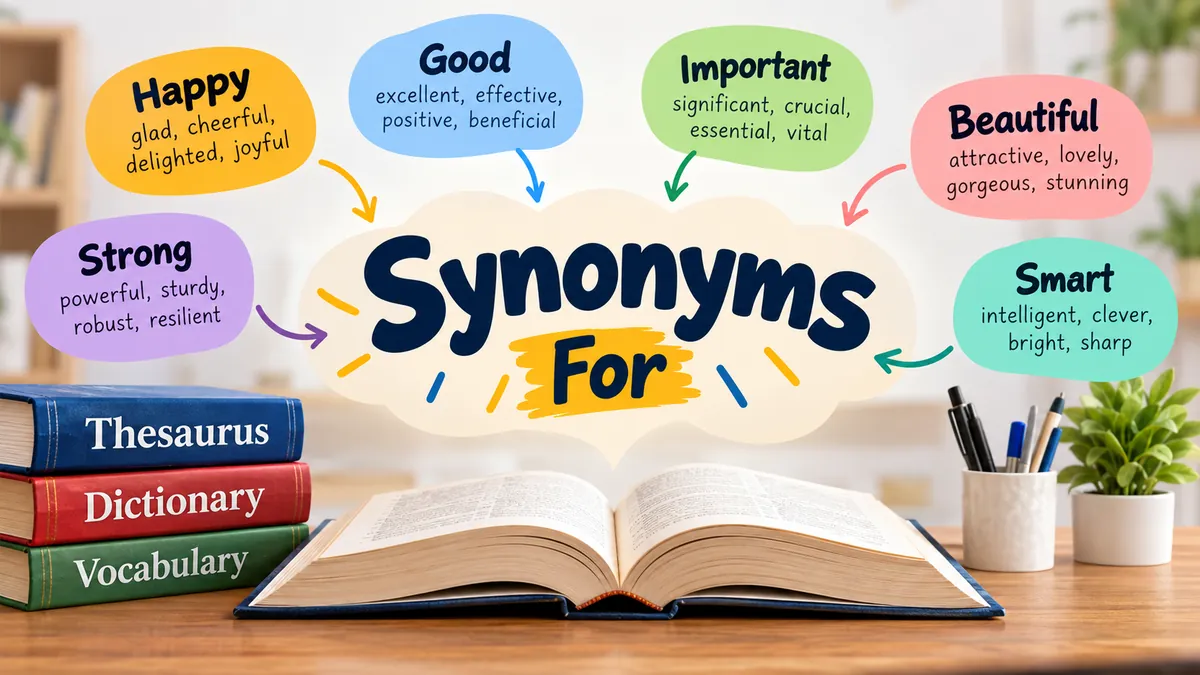
- synonyms for happy
- synonyms for beautiful
- synonyms for important
- synonyms for good
- synonyms for amazing
- synonyms for strong
- synonyms for help
- synonyms for said
If someone searches “synonyms for happy,” they are essentially asking:
What are some other words that mean happy or express a similar idea?
Possible answers might include glad, cheerful, delighted, pleased, joyful, and content.
However, each alternative carries a slightly different shade of meaning.
Consider these sentences:
She was pleased with the results.
She was delighted with the results.
Both are correct, but delighted communicates stronger positive emotion than pleased.
This distinction is why a good synonym search involves more than replacing one word with another.
What Is a Synonym?
A synonym is a word or expression whose meaning is identical or similar to that of another word.
Cambridge lists alternatives for synonym itself such as equivalent word, parallel word, analogue, and equivalent. It contrasts a synonym with an antonym, which expresses an opposite meaning.
For example:
| Word | Possible Synonyms |
|---|---|
| Happy | glad, joyful, cheerful, delighted |
| Big | large, huge, enormous, substantial |
| Small | little, tiny, miniature, compact |
| Smart | intelligent, clever, bright, sharp |
| Fast | quick, rapid, swift, speedy |
| Beautiful | attractive, lovely, gorgeous, stunning |
| Angry | annoyed, irritated, furious, enraged |
| Important | significant, essential, crucial, vital |
| Strong | powerful, sturdy, robust, forceful |
| Help | assist, aid, support, facilitate |
These alternatives are related, but their meanings can differ in intensity, tone, or appropriate context.
Why Are Synonyms Useful?
Synonyms give writers and speakers more ways to express the same general idea.
Without them, language would quickly become repetitive.
Imagine writing:
The movie was good. The actors were good. The story was good, and the ending was good.
The meaning is understandable, but the repetition makes the writing flat.
Using context-appropriate alternatives creates a more natural version:
The movie was enjoyable. The actors delivered strong performances, the story was engaging, and the ending was satisfying.
The second version does not merely replace good mechanically. Each alternative describes a specific quality.
That is one of the most useful principles to remember when searching for synonyms: choose the word that expresses your exact meaning, not simply the first alternative in a thesaurus.
How to Find Synonyms for a Word
There are several reliable ways to find alternative words.
1. Use a Thesaurus
A thesaurus organizes words according to similar or related meanings.
Depending on the resource, searching for a word may produce synonyms, antonyms, related terms, definitions, examples, and different senses of the same word.
Cambridge, for example, groups alternatives according to meaning rather than assuming every listed word is interchangeable. Its entry for search distinguishes alternatives such as look, hunt, rummage, comb, and scour.
That contextual grouping is useful because hunt for a book and scour an area for evidence communicate different nuances.
2. Check a Dictionary
A dictionary is useful when you need to verify what a suggested synonym actually means.
This matters because two words can be closely related without having exactly the same definition.
If you are uncertain about an alternative:
- Look up its definition.
- Check its part of speech.
- Read example sentences.
- Compare its meaning with the original word.
- Decide whether it fits your sentence.
This extra check can prevent awkward substitutions.
3. Search for “Another Word for…”
Another common approach is searching:
another word for + [word]
For example:
- another word for important
- another word for beautiful
- another word for difficult
- another word for improve
This usually has the same basic intent as searching “synonyms for.”
4. Search by Context
Context-specific searches can produce much better results than a broad synonym search.
Instead of:
synonyms for good
try:
synonyms for good performance
or:
professional synonyms for good
The word good can describe quality, morality, ability, health, suitability, or enjoyment. A useful replacement therefore depends on what good means in your particular sentence.
Synonyms Are Not Always Exact Replacements
One of the biggest mistakes writers make is assuming that every synonym has precisely the same meaning.
It usually does not.
Consider power.
Depending on context, alternatives can include strength, force, authority, influence, capacity, or energy. Cambridge separates these senses: strength and force can describe physical power, while authority and influence relate to control or status.
Compare:
The president has the power to approve the decision.
Here, authority may work.
The machine needs more power.
Here, authority obviously does not work.
He demonstrated impressive physical power.
Here, strength may be appropriate.
The original word is identical in all three examples, but its meaning changes with context.
Meaning Comes Before Substitution
Before replacing a word, ask:
What does this word mean in this particular sentence?
Only then should you choose an alternative.
This approach is much safer than replacing words solely because a thesaurus lists them together.
Types of Synonyms
Synonyms can be understood in several practical categories.
Near Synonyms
Most words commonly called synonyms are actually near synonyms. They have closely related meanings but are not perfectly interchangeable.
For example:
angry → annoyed → irritated → furious → enraged
All relate to anger, but the emotional intensity changes.
Similarly:
walk → stroll → wander → march → stride
Each word involves movement on foot, but each describes a different manner or purpose.
Contextual Synonyms
Some words function as synonyms only in particular situations.
Consider strong and powerful:
a strong argument
a powerful argument
Both can work.
But:
strong coffee
sounds natural, while:
powerful coffee
has a noticeably different tone and is much less conventional.
Context determines whether the words function as useful alternatives.
Formal and Informal Synonyms
Some synonyms differ primarily in register or formality.
| Everyday Word | More Formal Alternative |
|---|---|
| help | assist |
| buy | purchase |
| ask | inquire |
| need | require |
| start | commence |
| end | conclude |
| show | demonstrate |
| use | utilize |
| enough | sufficient |
| about | approximately |
The more formal option is not automatically better.
“Please help me” sounds natural in everyday conversation.
“Please assist me” sounds more formal.
Good writing uses the level of formality appropriate for the audience.
Common Synonyms for Everyday Words
Many synonym searches involve common words that writers feel they are repeating too often.
Synonyms for Good
Depending on context:
- excellent
- positive
- beneficial
- favorable
- effective
- enjoyable
- impressive
- suitable
- satisfactory
- admirable
Example:
Instead of:
This is a good solution.
You could write:
This is an effective solution.
If effectiveness is what you actually mean, the second version is more precise.
Synonyms for Bad
Possible alternatives include:
- poor
- harmful
- negative
- unpleasant
- inadequate
- unfavorable
- defective
- inferior
- unacceptable
- damaging
Again, context determines the correct option.
A poor performance and a harmful substance can both be described loosely as “bad,” but poor and harmful are not synonyms for each other.
Synonyms for Important
Common alternatives include:
- significant
- essential
- crucial
- vital
- major
- notable
- meaningful
- influential
- consequential
- prominent
Compare:
Water is essential for survival.
The discovery was significant.
She played a crucial role in the project.
All three alternatives can relate to important, but each conveys a more precise idea.
Synonyms for Beautiful
Depending on what is being described:
- attractive
- lovely
- gorgeous
- stunning
- elegant
- exquisite
- charming
- picturesque
- graceful
- magnificent
A picturesque village, an elegant dress, and a stunning view may all be beautiful, yet different alternatives fit each noun more naturally.
Synonyms for Happy
Possible choices include:
- glad
- pleased
- cheerful
- joyful
- delighted
- content
- satisfied
- thrilled
- upbeat
- ecstatic
The emotional strength varies considerably between content and ecstatic.
Synonyms for Strong
Common alternatives include:
- powerful
- sturdy
- robust
- tough
- forceful
- resilient
- solid
- vigorous
- muscular
- durable
Large thesaurus databases associate strength with words such as power, force, might, energy, vigor, potency, resilience, and stamina, demonstrating how quickly one concept can branch into different shades of meaning.
How to Choose the Best Synonym
A long synonym list is useful only if you know how to select the right word.
Use this process.
Step 1: Identify the Original Meaning
Determine exactly what the original word means in your sentence.
Take:
The test was hard.
Does hard mean:
- difficult?
- physically solid?
- intense?
- severe?
In this sentence, it means difficult.
That immediately eliminates many unrelated senses.
Step 2: Consider the Tone
Decide whether your writing is:
- conversational
- academic
- professional
- technical
- persuasive
- creative
- humorous
A word that works in a text message may sound inappropriate in an academic paper.
Step 3: Check Intensity
Synonyms frequently differ in strength.
For example:
cold → chilly → freezing
or:
concerned → worried → alarmed → terrified
Replacing one with another can change how readers interpret the situation.
Step 4: Check Grammar
Make sure the replacement has the correct grammatical role.
If the original word is an adjective, replacing it with a noun may require rewriting the sentence.
For example:
She is confident.
You cannot simply substitute the noun confidence:
She is confidence.
Instead:
She has confidence.
The meaning is related, but the sentence structure changes.
Step 5: Read the Sentence Aloud
A synonym can be grammatically correct and still sound unnatural.
Reading the sentence aloud often reveals awkward phrasing, unnecessary formality, or an alternative that does not fit the surrounding words.
Synonyms, Antonyms, and Related Words
These categories are easy to confuse.
Synonyms
Words with identical or similar meanings.
happy → joyful
Antonyms
Words with opposite meanings.
happy → sad
Related Words
Words connected to the same concept without necessarily having similar meanings.
For example:
education → teacher, student, classroom, learning, curriculum
These words belong to the same topic, but they are not synonyms.
This distinction becomes especially important when using large online word databases. A “related words” section may contain useful vocabulary without indicating that those terms can directly replace the original word.
Synonym vs. Thesaurus
A synonym is a word with the same or similar meaning as another word.
A thesaurus is a reference resource used to find synonyms and related terms.
Cambridge’s thesaurus entry for synonym dictionary includes terms such as thesaurus, synonym finder, word finder, and dictionary of synonyms and antonyms.
In simple terms:
Synonym = the alternative word.
Thesaurus = a tool for finding alternative words.
A dictionary primarily helps explain what words mean, while a thesaurus primarily helps users explore alternative and related expressions.
Using both together is often the safest approach.
Synonyms and Vocabulary
Learning synonyms can expand vocabulary because it exposes you to different ways of expressing related ideas.
The term vocabulary itself has several related alternatives, including lexicon, terminology, jargon, phraseology, diction, lingo, and vernacular. Cambridge similarly lists words such as word stock, lexicon, speech, language, terminology, and idiom.
These words demonstrate another key lesson about synonyms.
Lexicon may refer to the vocabulary of a person, language, or field.
Terminology often refers to specialized terms used within a subject.
Diction concerns word choice in speaking or writing.
Jargon usually refers to specialized language associated with a profession, group, or activity.
Vernacular can refer to language commonly spoken by people in a particular place or community.
They occupy the same semantic neighborhood without meaning exactly the same thing.
How Synonyms Improve Writing
Synonyms are valuable when they improve meaning—not when they merely make writing sound more complicated.
Reduce Unnecessary Repetition
If the same word appears repeatedly within a paragraph, an appropriate alternative can improve flow.
Make Meaning More Precise
Instead of:
He walked into the room.
You might write:
He strolled into the room.
or:
He marched into the room.
The alternatives add information about how he moved.
Match the Intended Emotion
Compare:
She looked at him.
She glanced at him.
She stared at him.
She glared at him.
These verbs all involve looking, but they create very different mental images.
Adapt Writing to the Audience
A technical report, children’s story, university essay, marketing page, and text message require different vocabulary.
Choosing synonyms allows you to adjust your language without changing the underlying idea.
Common Mistakes When Using Synonyms
A thesaurus can improve writing, but careless synonym replacement can make it worse.
Choosing the Most Complicated Word
A longer or rarer word is not automatically more professional.
Simple words are often clearer.
Instead of changing use to utilize every time, keep use unless utilize communicates something more appropriate in context.
Ignoring Connotation
Words can share dictionary meanings while carrying different emotional associations.
For example, slim and skinny both describe thinness, but their connotations can differ.
The emotional effect of a word matters as much as its literal definition.
Ignoring Collocations
Some words naturally occur together more often than others.
English speakers normally say:
heavy rain
rather than:
strong rain
Even though heavy and strong can sometimes describe intensity, they are not interchangeable in every phrase.
These conventional word combinations are called collocations.
Replacing Every Repeated Word
Repetition is not always bad.
Technical terms, key concepts, names, and important instructions often need to remain consistent.
If an article discusses “search engine optimization,” repeatedly changing it to loosely related phrases simply to avoid repetition may make the writing less precise.
Trusting a Synonym List Without Checking Meaning
Large synonym resources can contain hundreds or even thousands of related terms for common concepts. For example, online thesaurus results for power span meanings involving ability, strength, authority, control, force, energy, and influence.
A large list therefore gives you possibilities—not permission to substitute every listed word into every sentence.
Synonyms for Academic Writing
Academic writing benefits from precise vocabulary, but clarity should remain the priority.
Here are some common alternatives:
| Common Word | Possible Academic Alternatives |
|---|---|
| show | demonstrate, indicate, illustrate |
| say | state, argue, suggest, report |
| important | significant, critical, essential |
| result | outcome, consequence, finding |
| idea | concept, proposition, perspective |
| change | alter, modify, transform |
| improve | enhance, strengthen, refine |
| explain | clarify, describe, demonstrate |
| use | employ, apply |
| find | identify, observe, determine |
These alternatives should not be selected automatically.
For example:
The researchers found a relationship between the variables.
Depending on the methodology, identified or observed might work.
But changing found to proved would alter the scientific claim significantly.
Precision matters more than variety.
Synonyms for Professional and Business Writing
Business communication often benefits from concise, neutral vocabulary.
Useful alternatives include:
| Everyday Expression | Professional Alternative |
|---|---|
| help | assist, support |
| fix | resolve, correct |
| talk about | discuss |
| check | review, verify |
| ask for | request |
| tell | inform, notify |
| get | receive, obtain |
| deal with | address, manage |
| make better | improve, enhance |
| plan | strategy, proposal, approach |
Still, overly formal vocabulary can make ordinary emails sound stiff.
“Please send the document” is often better than an unnecessarily elaborate alternative.
Professional writing should sound clear and confident, not complicated for its own sake.
How to Build a Stronger Vocabulary With Synonyms
Instead of memorizing random lists, learn synonyms in groups based on meaning and context.
Suppose you are learning alternatives for walk.
Create a small semantic group:
- stroll — walk leisurely
- wander — move without a fixed direction
- stride — walk with long, confident steps
- march — walk with regular, deliberate steps
- tiptoe — walk quietly on the toes
- trudge — walk slowly with effort
Now you understand not only the words but also the differences between them.
This method makes vocabulary easier to apply in real writing.
Learn Synonyms Through Sentences
Instead of memorizing:
angry = furious
learn:
He was angry about the mistake.
He was furious when he discovered the deception.
The examples show that furious usually communicates greater intensity.
Group Words by Strength
Another useful method is arranging alternatives on a scale:
pleased → happy → delighted → thrilled → ecstatic
or:
uncomfortable → painful → severe → excruciating
The exact ordering can depend on context, but thinking about intensity helps prevent inappropriate substitutions.
Should You Use a Dictionary or a Thesaurus?
Use both, but for different purposes.
A thesaurus is useful for discovering possibilities.
A dictionary is useful for checking whether those possibilities actually mean what you think they mean.
A practical workflow is:
- Identify the word you want to replace.
- Search a thesaurus for alternatives.
- Shortlist two or three possibilities.
- Check their dictionary definitions.
- Review example sentences.
- Choose the word that best matches your intended meaning.
- Read your completed sentence naturally.
This takes slightly longer than selecting the first synonym you see, but the result is usually much better.
Can Two Synonyms Mean Exactly the Same Thing?
Sometimes words can be extremely close in meaning, but perfect interchangeability is uncommon in natural language.
Differences can appear in:
- connotation
- formality
- intensity
- grammatical behavior
- regional usage
- collocation
- technical meaning
- emotional tone
That is why synonym dictionaries frequently organize alternatives by different senses of a word rather than presenting one universal replacement list.
The question is therefore not simply:
“Is this word a synonym?”
A better question is:
“Is this word an appropriate synonym in this sentence?”
That small change in thinking produces much more accurate writing.
Final Takeaway
Searching synonyms for a word is one of the easiest ways to discover alternative vocabulary, reduce unnecessary repetition, and make writing more precise. But synonyms are rarely simple one-for-one replacements.
Start by identifying the meaning of the original word in context. Then compare possible alternatives for tone, intensity, grammar, connotation, and natural usage. Use a thesaurus to discover options and a dictionary to verify them.
The best synonym is not necessarily the longest, rarest, or most impressive word. It is the word that communicates your intended meaning most clearly.