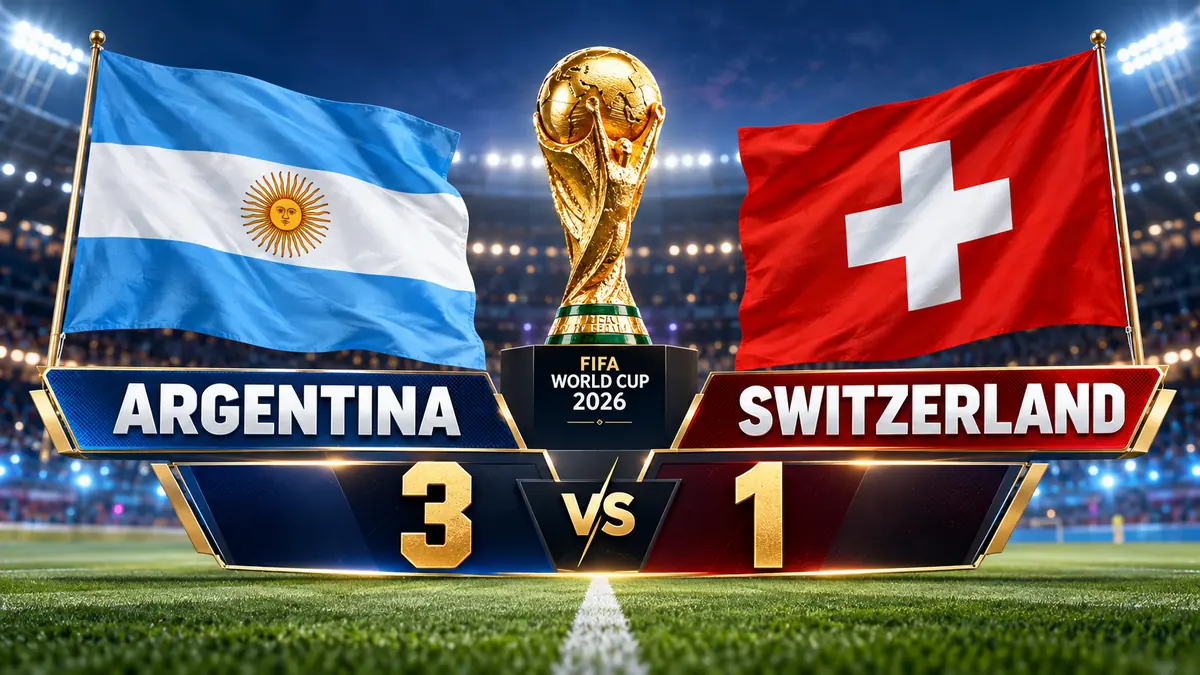
Argentina and Switzerland produced another dramatic World Cup knockout match when they met in the 2026 quarter-finals in Kansas City. The teams were level after 90 minutes before Argentina scored twice in extra time to secure a 3-1 victory and advance to the semi-finals.
Argentina beat Switzerland 3-1 after extra time in their 2026 FIFA World Cup quarter-final. Alexis Mac Allister opened the scoring in the 10th minute, Dan Ndoye equalized in the 67th, Julián Álvarez restored Argentina’s lead in the 112th minute, and Lautaro Martínez completed the scoring at 120+1.
argentina vs switzerland Final Score
The quarter-final was played at GEHA Field at Arrowhead Stadium in Kansas City on July 11 local time, with the match extending into July 12 in several international time zones. The official attendance was 69,045.
| Match detail | Argentina | Switzerland |
|---|---|---|
| Final score | 3 | 1 |
| Score after 90 minutes | 1 | 1 |
| Alexis Mac Allister | 10′ | — |
| Dan Ndoye | — | 67′ |
| Julián Álvarez | 112′ | — |
| Lautaro Martínez | 120+1′ | — |
| Result | Advanced | Eliminated |
The 3-1 score does not fully convey how competitive the match was. Switzerland recovered from conceding early and forced the defending champions into extra time before Argentina finally created separation in the closing stages.
How Argentina Took an Early Lead
Argentina made the breakthrough after only 10 minutes.
Alexis Mac Allister found space during a corner routine and converted Lionel Messi’s delivery to give Argentina a 1-0 advantage. It was precisely the type of early goal that can reshape a knockout match: Argentina could control possession rather than chase the game, while Switzerland had to become progressively more adventurous.
Lionel Scaloni’s starting side featured Emiliano Martínez in goal, with Nicolás Molina, Cristian Romero, Lisandro Martínez and Nicolás Tagliafico among the defenders. Leandro Paredes, Rodrigo De Paul, Enzo Fernández and Mac Allister featured through midfield, while Messi and Julián Álvarez provided the attacking threat.
Switzerland, managed by Murat Yakin, started Gregor Kobel in goal. Manuel Akanji, Nico Elvedi, Ricardo Rodríguez, Granit Xhaka, Remo Freuler, Fabian Rieder, Djibril Sow, Dan Ndoye and Breel Embolo were among the players tasked with containing Argentina and creating opportunities at the other end.
Switzerland Fight Back Through Dan Ndoye
Switzerland did not collapse after going behind.
Their persistence was rewarded in the 67th minute when Dan Ndoye scored to make it 1-1, with Ricardo Rodríguez credited with the assist. Suddenly, the quarter-final was open again.
The equalizer placed Argentina in a situation familiar from tournament football: possession and territorial control no longer mattered unless they could convert them into another goal.
Switzerland had succeeded in staying close enough to make one attacking moment count.
That approach also reflected the wider history of this matchup. Although Argentina have held the stronger head-to-head record, Switzerland have repeatedly made individual meetings difficult, including draws in previous friendlies and the tight 2014 World Cup knockout game.
Breel Embolo’s Red Card Changes the Contest
One of the decisive moments arrived shortly after Switzerland’s equalizer.
Breel Embolo was sent off in the 72nd minute, leaving Switzerland to complete the remainder of regulation time—and eventually extra time—with ten players.
Playing with ten men against an Argentina side capable of keeping the ball created an increasingly difficult physical problem.
Switzerland now had to maintain defensive organization, protect central areas and still find enough attacking outlets to prevent Argentina from committing everyone forward.
Despite the numerical disadvantage, Switzerland survived until the end of normal time.
After 90 minutes, the score remained Argentina 1-1 Switzerland.
Extra time was required.
Julián Álvarez Breaks the Deadlock in Extra Time
Argentina continued pushing against Switzerland’s reduced defensive unit, but the breakthrough did not arrive immediately.
It eventually came in the 112th minute.
Julián Álvarez scored Argentina’s second goal to make it 2-1. José Manuel López supplied the assist after entering the match as a substitute.
The timing was crucial.
Switzerland had spent approximately 40 minutes playing with ten men by that stage, including stoppage time and extra time. Once Argentina regained the lead so late in the contest, Switzerland had little time to respond while also needing to take greater risks.
Those risks created more space for Argentina.
Lautaro Martínez Makes It 3-1
Argentina added a third goal in stoppage time at the end of extra time.
Lautaro Martínez scored at 120+1 to establish the final 3-1 scoreline.
The late goal made the final margin appear relatively comfortable, but Argentina had been held at 1-1 throughout regulation and for most of extra time.
The decisive separation came during the final eight minutes of extra time.
Argentina therefore advanced with a 3-1 victory after extra time rather than a routine three-goal performance.
argentina vs switzerland Match Stats
The statistics illustrate Argentina’s territorial advantage while also showing that Switzerland remained capable of testing Emiliano Martínez.
Argentina finished with 59% possession compared with Switzerland’s 41%. They recorded 22 shots to Switzerland’s 11, with seven attempts on target compared with five for the Swiss. Argentina also held an 8-2 advantage in corners.
| Statistic | Argentina | Switzerland |
|---|---|---|
| Possession | 59% | 41% |
| Shots | 22 | 11 |
| Shots on target | 7 | 5 |
| Corners | 8 | 2 |
| Accurate passes | 614 | 398 |
| Passing accuracy | 89% | 85% |
Argentina’s passing volume was particularly significant. Completing more than 600 passes helped Scaloni’s team stretch Switzerland and control long phases of the match, especially after the red card.
Switzerland nevertheless registered five shots on target from 11 attempts. That helps explain why the game remained competitive for so long despite Argentina controlling more of the ball.
Why Argentina Won the Match
Three factors shaped the outcome.
First, Argentina scored early. Mac Allister’s 10th-minute goal allowed the South American side to dictate much of the game’s tempo rather than immediately facing the pressure of chasing a knockout match.
Second, Switzerland’s red card changed the tactical and physical balance. Embolo’s dismissal came only five minutes after Ndoye had equalized, preventing Switzerland from fully exploiting the momentum created by their goal.
Third, Argentina’s squad depth became increasingly valuable as the match stretched beyond 90 minutes. Substitutes contributed directly to the late stages, with López assisting Álvarez before Lautaro Martínez added the final goal.
Argentina needed patience rather than an immediate response.
That patience ultimately paid off.
Lionel Messi’s Role Against Switzerland
Messi did not score, but he still influenced the match.
His corner provided the assist for Mac Allister’s opening goal in the 10th minute.
That contribution also continued an interesting pattern in Argentina’s World Cup meetings with Switzerland.
Twelve years earlier, Messi had provided the decisive pass for Ángel Di María during Argentina’s 1-0 extra-time victory over Switzerland in the 2014 World Cup round of 16.
In both knockout meetings, Messi therefore contributed an assist to a goal that helped Argentina progress.
Argentina vs Switzerland Head-to-Head Record
Argentina and Switzerland have not met frequently, but their encounters stretch back decades.
Their first World Cup meeting came in 1966, when Argentina won 2-0 at Hillsborough. Argentina later recorded friendly victories in 1980 and 1984, while the teams also played draws before Argentina won 3-1 in a 2012 friendly.
The 2026 quarter-final became their eighth recorded senior international meeting in the head-to-head dataset.
| Year | Competition | Result |
|---|---|---|
| 1966 | FIFA World Cup | Argentina 2-0 Switzerland |
| 1980 | Friendly | Argentina 5-0 Switzerland |
| 1984 | Friendly | Switzerland 0-2 Argentina |
| 1990 | Friendly | Switzerland 1-1 Argentina |
| 2007 | Friendly | Switzerland 1-1 Argentina |
| 2012 | Friendly | Switzerland 1-3 Argentina |
| 2014 | FIFA World Cup | Argentina 1-0 Switzerland (AET) |
| 2026 | FIFA World Cup | Argentina 3-1 Switzerland (AET) |
Across those eight meetings, Argentina recorded six victories while two matches finished level. Switzerland did not record a win in this sequence.
The pattern is even more striking at the World Cup: Argentina won all three meetings—in 1966, 2014 and 2026.
What Happened in Argentina vs Switzerland at the 2014 World Cup?
The 2014 meeting remains an essential part of the rivalry because it followed a remarkably similar script.
Argentina and Switzerland met in the round of 16 at Arena Corinthians in São Paulo on July 1, 2014.
Neither team scored during the opening 90 minutes.
The match remained 0-0 deep into extra time before Messi carried the ball forward and found Ángel Di María. The winger finished in the 118th minute to give Argentina a 1-0 lead.
Switzerland nearly produced an immediate response. Blerim Džemaili headed against the post before failing to convert the rebound, and Argentina survived to reach the quarter-finals.
Argentina subsequently defeated Belgium and eventually reached the 2014 World Cup final.
The parallels with 2026 are clear: both World Cup knockout matches between these sides required extra time, and both were eventually won by Argentina.
How the 2026 Match Differed From 2014
Despite the similar outcome, the two games developed differently.
The 2014 encounter was goalless for 117 minutes. Argentina needed one late Di María strike to escape with a 1-0 victory.
The 2026 match featured significantly more scoring.
Mac Allister put Argentina ahead early, Ndoye brought Switzerland level, and the contest remained tied until Álvarez and Lautaro Martínez scored in extra time.
Another major difference was Switzerland’s red card in 2026. Playing with ten men from the 72nd minute increased the defensive workload and eventually gave Argentina more opportunities to exploit tired spaces.
Yet Switzerland once again demonstrated why knockout football cannot be reduced to reputation or possession figures. They remained level through 90 minutes despite facing one of international football’s strongest tournament teams.
What the Result Meant for Argentina
The victory sent Argentina into the 2026 FIFA World Cup semi-finals.
More broadly, it extended Argentina’s unbeaten head-to-head record against Switzerland in the recorded senior meetings covered here and maintained their perfect World Cup record against the Swiss.
It also reinforced Argentina’s ability to navigate long knockout matches.
They did not immediately find a second goal after Switzerland equalized. Instead, the defending champions kept applying pressure until Álvarez finally broke the deadlock in the 112th minute.
For Switzerland, elimination came after a performance that was far more competitive than the final 3-1 score might suggest.
They recovered from an early deficit, equalized in the second half and remained level until deep into extra time despite playing with ten men.
Key Takeaways From argentina vs switzerland
The latest argentina vs switzerland World Cup meeting added another dramatic chapter to a matchup that has repeatedly favored Argentina.
Argentina won 3-1 after extra time, with Alexis Mac Allister, Julián Álvarez and Lautaro Martínez scoring. Dan Ndoye scored Switzerland’s equalizer, while Breel Embolo’s second-half dismissal became a major turning point.
The result also echoed their famous 2014 encounter. That match needed extra time before Di María scored in the 118th minute; in 2026, Argentina again had to go beyond 90 minutes before Álvarez and Lautaro Martínez settled the contest.
Across their World Cup history, Argentina have now defeated Switzerland in all three of their meetings: 2-0 in 1966, 1-0 after extra time in 2014, and 3-1 after extra time in 2026.
For anyone looking back at argentina vs switzerland, the 2026 quarter-final will be remembered as a match in which Switzerland pushed Argentina deep into extra time, but Argentina’s possession, numerical advantage and late attacking quality ultimately decided the contest.