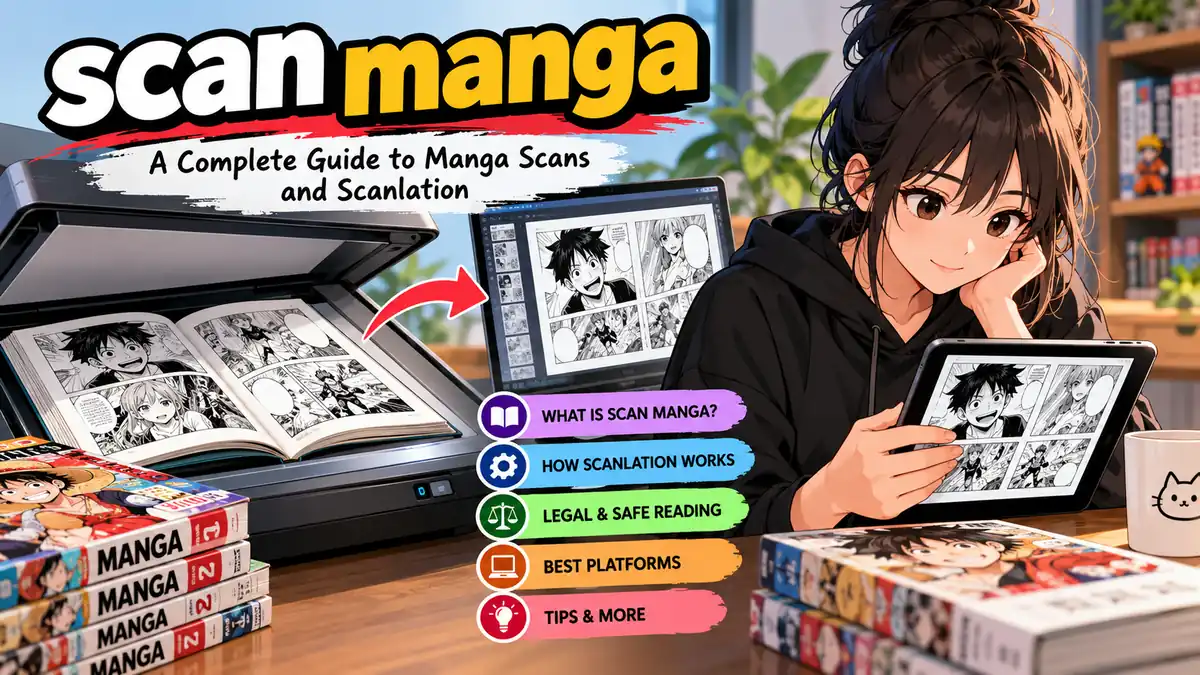
Manga fans often encounter the phrase scan manga when searching for Japanese comics online. Yet the term can mean different things depending on where it appears: a digital copy of a manga page, a fan-translated chapter, or a website that hosts scanned comics.
Understanding these differences helps readers find accurate translations, avoid unsafe websites, and support the artists who create their favorite stories.
scan manga generally refers to manga pages converted into digital images, often for online reading. When fans scan, translate, edit, and distribute manga without an official publisher, the process is commonly called scanlation. Although fan translations can make stories accessible across languages, their distribution may raise copyright concerns.
What Is scan manga?
The term combines two familiar ideas: scanning and manga.
Manga refers to Japanese comics and graphic narratives, while scanning describes converting physical pages into digital files. Together, the words commonly describe digitized manga artwork that can be viewed on a computer, tablet, or smartphone.
However, not every digital manga chapter comes from a physical scan. Publishers also distribute digitally produced artwork directly through official reading platforms.
Manga scans versus digital manga
A manga scan usually begins with a printed source, such as a collected volume or serialized magazine chapter. Someone captures its pages using a scanner or camera, creating image files.
Digital manga is a broader category. It includes scanned print editions, officially published electronic volumes, and comics created entirely with digital illustration software.
For readers, both may look similar on screen. The key difference is how the content was produced and whether its distribution is authorized.
What does scanlation mean?
Scanlation combines the words scan and translation.
It describes the fan-led process of converting manga into another language, frequently involving several volunteers with specialized responsibilities.
A typical scanlation team may include translators, proofreaders, image cleaners, typesetters, and quality reviewers.
The finished chapter usually preserves the original artwork while replacing Japanese dialogue with translated text.
Scanlation communities developed partly because many Japanese manga series were unavailable internationally or received official translations much later than their original publication.
How Does the scan manga Process Work?
Creating a readable manga scan involves more than capturing images. Each stage affects how clearly readers can understand the artwork, dialogue, and storytelling.
1. Obtaining and scanning manga pages
The process traditionally begins with a printed manga magazine or collected volume.
Pages may be captured using a flatbed scanner or a high-resolution camera. Image quality depends on lighting, alignment, resolution, paper texture, and the condition of the original pages.
Poor captures can introduce shadows, distorted panels, or missing details near the book’s binding.
Digital-first manga may not require scanning because the artwork already exists electronically.
2. Cleaning and preparing the images
After digitization, editors improve readability by adjusting contrast, correcting page alignment, removing unwanted marks, and preserving line art.
Manga artwork often uses screentones, fine hatching, and delicate grayscale shading. Excessive image processing can damage these details.
Good image preparation therefore focuses on clarity without changing the artist’s visual style.
3. Translating Japanese dialogue
Translation is one of the most demanding parts of scanlation.
Japanese dialogue frequently contains cultural references, wordplay, honorifics, regional expressions, and character-specific speech patterns.
A literal translation may communicate individual words but fail to capture the intended meaning.
For example, the Japanese honorifics -san, -kun, and -chan communicate social relationships that do not always have direct English equivalents.
Translators must decide whether to preserve these expressions or adapt them for the target audience.
4. Typesetting translated text
Typesetting places translated dialogue inside speech bubbles, narration boxes, and other areas of the artwork.
Editors consider font size, spacing, alignment, reading order, and the emotional tone of each scene.
Sound effects are particularly challenging because Japanese manga frequently integrates stylized text into the illustration itself.
Some translations preserve the original Japanese sound effects with explanatory notes, while others replace them with translated lettering.
5. Proofreading and quality checking
Before a chapter is distributed, reviewers may check spelling, dialogue consistency, image quality, missing panels, and translation accuracy.
Character names, recurring terminology, and fictional locations should remain consistent across chapters.
Even experienced teams can make mistakes, particularly when a story contains ambiguous dialogue or complicated cultural references.
6. Distribution and online reading
Completed chapters may be packaged as image files, archives, or web-readable pages.
However, creating a translation does not automatically grant permission to distribute copyrighted artwork. Unauthorized publication can infringe the rights of manga creators and publishers.
This distinction matters when comparing fan-hosted chapters with licensed digital editions.
scan manga vs. Official Manga: Key Differences
Readers sometimes assume that all online manga chapters are equivalent. In practice, their accuracy, availability, quality, and legal status can differ considerably.
| Feature | Fan scanlation | Official digital manga |
|---|---|---|
| Translation | Fans or volunteer teams | Publisher-authorized translators |
| Distribution rights | Often unauthorized | Licensed or rights-holder operated |
| Release timing | Varies by team | Follows official schedules |
| Image quality | Depends on source and editing | Usually standardized |
| Terminology | May vary between groups | Often managed editorially |
| Creator support | Usually no direct compensation | Supports the licensed publishing ecosystem |
| Availability | May be inconsistent | Depends on region and licensing |
Are fan translations always less accurate?
No. Some volunteer translators have strong Japanese-language skills and extensive knowledge of manga culture.
However, quality varies significantly between projects.
An unofficial translation may interpret a joke particularly well while making errors elsewhere. Official translations also involve editorial decisions and can occasionally contain mistakes.
Readers interested in translation differences can compare licensed editions, translator notes, and the original Japanese text when available.
Why do some readers prefer scanlations?
Fan translations have historically provided access to series that were not licensed in a reader’s country.
Other readers appreciate translation notes explaining cultural references or differences in Japanese speech.
Still, convenience and cultural commentary do not resolve copyright issues. Readers can often find licensed editions with reliable translation and better image consistency.
Where Can You Read scan manga Legally?
The growth of official digital manga services has made it easier to access Japanese comics without relying on unauthorized scans.
Some platforms publish translated chapters close to their Japanese release dates, while others specialize in collected volumes, subscriptions, or digital purchases.
MANGA Plus by SHUEISHA
MANGA Plus is operated by the Japanese publisher Shueisha.
The service offers official manga chapters from popular series, including titles associated with Weekly Shonen Jump.
Readers can access selected chapters for free, and some releases become available internationally at approximately the same time as their Japanese publication.
Availability, language options, and chapter access conditions depend on the title and service rules.
Shueisha confirms that MANGA Plus is an official service and that its publishing model supports manga creators.
MANGA Plus by SHUEISHA
Official website: https://mangaplus.shueisha.co.jp/
VIZ Media and Shonen Jump
VIZ Media publishes licensed English-language manga and operates digital reading services.
Its Shonen Jump offering provides access to selected free chapters and additional titles through membership options.
VIZ is particularly relevant to readers interested in major Japanese action and adventure series.
Regional restrictions may apply, so readers should check whether specific titles are accessible in their country.
Official website: https://www.viz.com/
K MANGA by Kodansha
K MANGA is associated with Kodansha, one of Japan’s major manga publishers.
Its catalog includes officially translated manga, with chapter access and payment arrangements depending on the title and region.
Readers should consult the service’s current availability before assuming that every Kodansha title can be accessed worldwide.
Official website: https://kmanga.kodansha.com/
BOOK☆WALKER
BOOK☆WALKER is an ebook platform offering manga and light novels.
Unlike chapter-focused services, it is especially useful for readers who prefer purchasing and organizing digital volumes.
Its international store offers English-language publications, although regional licensing affects the available catalog.
Official website: https://global.bookwalker.jp/
How to recognize an authorized manga website
A professional design or large chapter library does not prove that a website is licensed.
Look for clear publisher information, copyright notices, licensing details, and links from recognized rights holders.
Free access does not necessarily mean unauthorized distribution. Publishers sometimes provide promotional chapters or free reading programs themselves.
prograse.com
Is scan manga Legal and Safe?
The legality of manga scans depends primarily on copyright authorization, the activity involved, and applicable national laws.
Scanning a manga volume for private reference, publishing a complete unauthorized copy online, and reading an official digital edition are not legally identical activities.
Copyright and fan translations
Manga artwork and written dialogue are generally protected by copyright.
Copyright holders ordinarily control reproduction, distribution, and the creation of derivative works, including translations.
A fan translator may invest considerable effort in a project, but that work does not automatically provide permission to reproduce and distribute the underlying manga.
Some countries recognize limited exceptions for activities such as private copying, research, criticism, or quotation. Their scope varies, and they should not be interpreted as blanket permission to share complete manga chapters.
In the United States, for example, fair use is assessed case by case rather than automatically applying to every noncommercial fan project.
hyperlific.com
Can reading manga scans expose you to security risks?
Yes, particularly when visiting unfamiliar websites that use aggressive advertising or deceptive download prompts.
Potential risks include malicious redirects, phishing pages, misleading subscription offers, and files containing unwanted software.
A website may also request unnecessary browser permissions or attempt to collect personal information.
To reduce exposure:
- Prefer official publisher websites and recognized reading applications.
- Avoid downloading executable files presented as manga chapters.
- Keep your browser and operating system updated.
- Do not grant notification permissions to unfamiliar sites.
- Be cautious of pop-ups claiming that a special reader or extension is required.
- Verify website addresses before entering payment information.
An HTTPS connection encrypts communication with a website, but it does not guarantee that the site’s content or downloads are trustworthy.
Are free manga websites always illegal?
No. Free and unauthorized are different concepts.
A publisher can choose to make selected chapters freely accessible, distribute promotional samples, or offer advertising-supported reading.
By contrast, a website that republishes copyrighted manga without permission may infringe copyright even when readers pay nothing.
The most reliable indicator is authorization from the publisher or rights holder, not the price.
Understanding Manga Raws, Scan VF, and Related Terms
Manga communities use specialized vocabulary that can be confusing to newcomers.
Several terms describe the language, source, format, or translation status of a comic rather than its genre.
What are raw manga chapters?
A raw is an untranslated version of a manga chapter, typically presented in its original Japanese language.
Raws may originate from printed magazines, collected volumes, or legitimate digital publications.
The term does not automatically indicate whether a copy was legally obtained.
Readers studying Japanese sometimes use authorized original-language manga to explore vocabulary, kanji, and natural dialogue.
What does scan VF mean?
In French-speaking manga communities, scan VF generally refers to manga scans available in French.
VF is an abbreviation of version française, meaning French version.
Another commonly encountered term is scantrad, which refers to translated manga scans.
These expressions may appear on websites that also catalog Korean manhwa, Chinese manhua, and webtoons.
Scan-Manga
Manga, manhwa, manhua, and webtoons
Although these formats are frequently grouped together online, they have distinct cultural and publishing backgrounds.
| Term | Origin or format | Common characteristics |
|---|---|---|
| Manga | Japan | Often black-and-white sequential comics |
| Manhwa | Korea | Print and digital comics, including scrolling formats |
| Manhua | China and Chinese-speaking regions | Comics with diverse visual and publishing styles |
| Webtoon | Digital publishing format | Commonly designed for vertical scrolling |
| Doujinshi | Japanese self-publishing tradition | Independently published original or fan-created works |
Traditional Japanese manga is generally read from right to left, while many modern webtoons use vertical scrolling.
These are conventions rather than universal rules.
What are simulpub manga releases?
Simulpub is short for simultaneous publication.
It describes officially translated chapters released at the same time as, or shortly after, their original publication.
Simulpub releases have reduced one of the historical reasons readers turned to fan translations: lengthy delays between Japanese publication and international availability.
For popular series, readers can sometimes follow new chapters through authorized platforms without waiting months for a collected volume.
MANGA Plus by SHUEISHA
How to Read scan manga on Mobile, Tablet, or Desktop
The reading experience depends on the format of the manga and the device being used.
A traditional manga page was designed for print, while modern digital platforms may offer page-by-page navigation, double-page spreads, or continuous scrolling.
Understanding manga reading direction
Traditional Japanese manga is generally read from right to left.
On a typical page, readers begin with the upper-right panel and follow the panel sequence toward the left and downward.
Dialogue bubbles within panels also generally follow the intended reading direction.


9
Licensed digital readers often preserve the original layout and may provide guidance for newcomers.
Choosing the right reading format
Different formats suit different reading preferences.
Page-by-page reading works well for traditional manga, especially when the artwork contains detailed panel compositions.
Double-page viewing can preserve large illustrations and dramatic spreads, although small text may be difficult to read on a phone.
Vertical scrolling is particularly suitable for webtoons and other comics designed for continuous mobile reading.
Offline reading, when supported by an official application, can help readers access previously downloaded chapters without a continuous internet connection.
Improving image and text readability
Readers can improve their experience by adjusting display brightness, using landscape orientation for wide illustrations, and selecting higher-quality images when the platform provides that option.
Excessive zooming may make navigation difficult, particularly on smaller devices.
For long reading sessions, a tablet often provides more room for artwork and dialogue than a smartphone.
How to Find Quality Manga Translations
Translation quality influences how readers understand characters, relationships, humor, and plot developments.
A readable translation should preserve the story’s meaning while sounding natural in the target language.
Check terminology consistency
Character names, fictional locations, abilities, and recurring expressions should remain consistent throughout a series.
Changes in terminology can create confusion, especially in fantasy stories with complex worldbuilding.
Official publishers commonly maintain editorial standards and terminology references, although errors can still occur.
Look for cultural context
Japanese manga frequently contains references that do not translate neatly into English.
Examples include school customs, honorifics, food terminology, festivals, historical references, and wordplay.
Some editions retain Japanese terms and explain them through translation notes. Others adapt the language to make dialogue flow naturally.
Neither approach is automatically superior. The best choice depends on the intended audience and the meaning of the original passage.
Recognize image-editing problems
Poorly prepared scans may contain blurred lettering, damaged screentones, incomplete artwork, or text that does not fit inside speech bubbles.
Sometimes editors remove Japanese lettering from illustrated backgrounds and redraw the artwork beneath it.
This process, called redrawing, requires particular care because careless editing can alter visual details.
Good digital editions preserve the relationship between the artwork and dialogue.
Avoid relying entirely on machine translation
Automatic translation tools can help readers understand basic Japanese text, but they may struggle with omitted subjects, ambiguous expressions, character-specific speech, and visual context.
Optical character recognition, or OCR, can also misread stylized manga lettering and vertically arranged text.
For complicated dialogue, professionally edited translations or careful human review are generally more dependable.
How scan manga Influenced Global Manga Culture
Fan translation communities played a significant role in the international circulation of Japanese comics.
Before widespread digital publishing, many series had limited availability outside Japan. Physical releases could take considerable time to reach overseas markets, and some titles never received translations.
Scanlation communities attempted to address these gaps by sharing translated chapters online.
Their work also created collaborative communities where volunteers practiced translation, editing, graphic design, and cultural interpretation.
Academic discussions of scanlation examine these communities as forms of participatory culture and cross-cultural communication, alongside their copyright implications.
SciSpace
From printed magazines to digital distribution
Traditional manga publishing often begins with serialization in magazines or online platforms.
Individual chapters may later be collected into tankōbon volumes.
Digital publishing has expanded this model by allowing publishers to distribute chapters electronically, offer subscription libraries, and release translations internationally.
These developments have changed how readers discover and follow manga.
Why official translations matter to creators
Producing manga requires substantial creative labor, including storytelling, illustration, editing, and production.
Authorized sales, subscriptions, and publisher-operated reading services contribute to the commercial ecosystem that supports this work.
Not every payment goes directly to an individual artist, and revenue arrangements differ by publisher and contract.
Nevertheless, licensed distribution provides a formal route through which creators and rights holders can receive compensation.
The future of digital manga
Digital manga is likely to continue evolving through mobile-first interfaces, multilingual publishing, improved accessibility, and faster international releases.
Machine-assisted translation and image-processing tools may also influence publishing workflows, although accuracy and human editorial oversight remain important.
At the same time, regional licensing, translation costs, and incomplete international catalogs continue to affect accessibility.
These challenges help explain why discussions about manga scans and fan translation remain relevant even as official services expand.
Final Thoughts on scan manga
scan manga is a broad expression associated with digitized Japanese comics, untranslated raws, fan translations, and online manga reading.
A scan is not necessarily a scanlation, and a digital manga chapter is not necessarily unauthorized. The differences depend on its source, translation process, and distribution rights.
Understanding these distinctions makes it easier to evaluate translation quality, recognize legitimate publishing platforms, and avoid questionable downloads.
For readers exploring manga online, the most useful starting point is to identify the original publisher and check whether an authorized digital edition is available in their region.