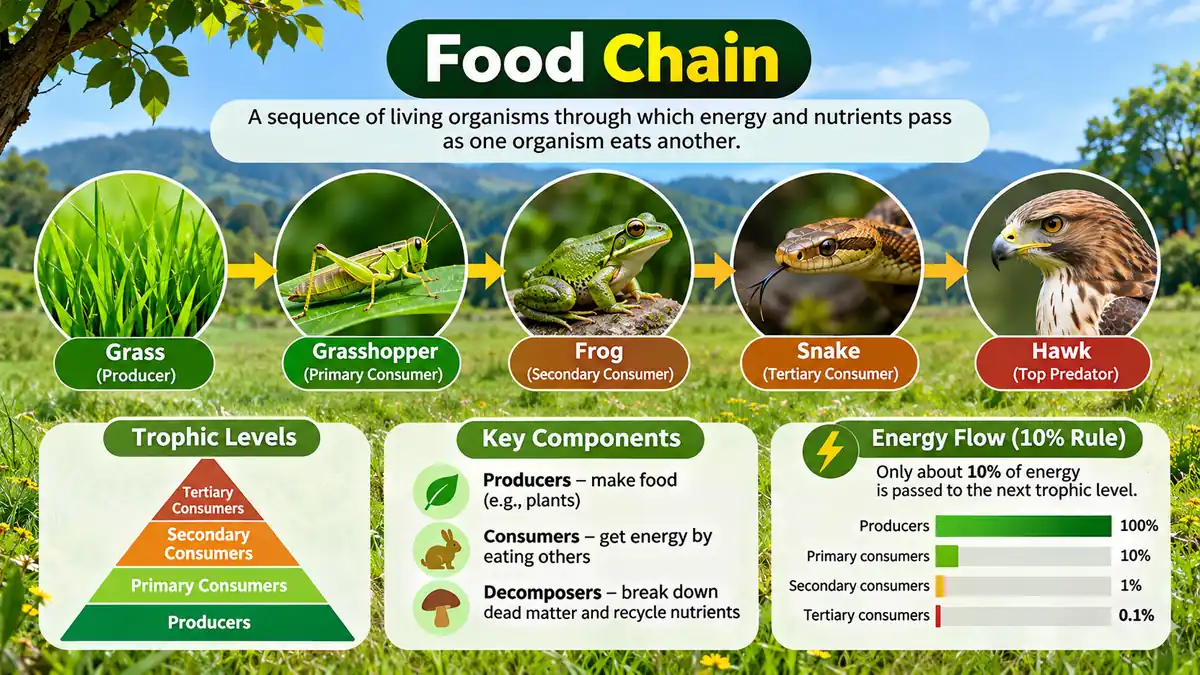
Every living organism needs energy to survive, but where does that energy come from? In nature, plants capture sunlight, herbivores eat plants, and predators feed on other animals. These feeding relationships form a food chain, one of the fundamental concepts of ecology.
A food chain is a sequence of living organisms through which energy and nutrients pass as one organism eats another. It usually begins with a producer, such as grass or algae, followed by primary, secondary, and sometimes tertiary consumers. Decomposers recycle nutrients from dead organisms back into the ecosystem.
Understanding food chains helps explain how ecosystems function, why predators and prey depend on one another, and how environmental changes can affect entire communities.
What Is a food chain in Biology?
In biology, a food chain represents a single pathway of energy transfer between organisms in an ecosystem. Each organism occupies a feeding position called a trophic level.
The simplest example is:
🌱
Grass
🦗
Grasshopper
🐸
Frog
🐍
Snake
🦅
Hawk
An illustrative grassland food chain. Arrows indicate the direction of energy transfer.
In this example, grass produces food through photosynthesis. A grasshopper eats the grass, a frog eats the grasshopper, a snake eats the frog, and a hawk eats the snake.
Each feeding interaction transfers some stored chemical energy to the next organism.
According to National Geographic Society, food chains describe possible pathways through which energy and nutrients move within ecosystems. National Geographic Education+1
Main characteristics of a food chain
A typical food chain has several defining features:
- It shows feeding relationships between organisms.
- Energy flows from food sources toward the organisms that consume them.
- Producers generally form the first trophic level.
- Consumers occupy successive feeding levels.
- Decomposers act on organic matter from multiple levels.
- Available energy generally decreases at higher trophic levels.
- Multiple food chains overlap to form a food web.
Although diagrams often show a straight line, real ecosystems contain much more complicated feeding relationships.
The Main Components and Trophic Levels of a food chain
A trophic level describes an organism’s position in a feeding sequence. Producers form the foundation, while consumers occupy higher positions.
Simplified trophic pyramid showing how the available energy generally decreases toward the top.
1. Producers: The first trophic level
Producers, also called autotrophs, manufacture their own organic food from inorganic substances.
Most producers use photosynthesis, which converts sunlight into chemical energy stored in molecules such as glucose.
Examples include grass, trees, algae, phytoplankton, and cyanobacteria.
Photosynthesis uses carbon dioxide and water to produce sugars, releasing oxygen as a byproduct.
Some microorganisms use chemosynthesis instead, obtaining energy from chemical reactions rather than sunlight. Chemosynthetic bacteria and archaea are especially important in environments such as deep-sea hydrothermal vents.
2. Primary consumers: The second trophic level
Primary consumers feed directly on producers. Most are herbivores.
Common examples include rabbits eating grass, deer browsing leaves, caterpillars eating plants, and zooplankton consuming phytoplankton.
Primary consumers transfer energy captured by producers into animal biomass, making it available to higher-level consumers.
3. Secondary consumers: The third trophic level
Secondary consumers eat primary consumers.
Examples include frogs feeding on grasshoppers, small fish eating herbivorous zooplankton, and insect-eating birds consuming caterpillars.
Secondary consumers are often carnivores, although omnivores can occupy this trophic level when they eat herbivores.
4. Tertiary consumers: The fourth trophic level
Tertiary consumers feed on secondary consumers.
Examples may include snakes eating insect-eating frogs, larger fish consuming smaller predatory fish, and birds of prey hunting smaller carnivores.
Some ecosystems contain additional consumer levels. An organism’s trophic position can also change depending on what it eats.
5. Decomposers and detritivores
Decomposers break down dead organic material and release nutrients into the environment.
Important decomposers include bacteria and fungi.
Detritivores, such as earthworms, woodlice, and certain insects, consume dead organic matter and help fragment it into smaller particles.
Decomposers are not simply the last step of every food chain. They process material from producers and consumers at all trophic levels, making them essential to nutrient recycling. National Geographic Education+1
Types of Food Chains
Ecologists commonly distinguish between grazing food chains and detritus food chains. Chemosynthesis-based chains provide another important example of how feeding relationships can begin without sunlight.
Grazing food chain
A grazing food chain starts with living producers and continues through organisms that consume them.
Example:
Grass → Grasshopper → Frog → Snake
This type is common in grasslands, agricultural fields, freshwater habitats, and marine environments.
The original energy source is usually sunlight.
Detritus food chain
A detritus food chain begins with dead organic material rather than living plants.
Example:
Dead leaves → Earthworm → Bird → Hawk
The earthworm feeds on decomposing plant material, and the bird consumes the earthworm.
Detritus-based pathways are particularly important in forest soils, wetlands, and aquatic sediments.
Chemosynthesis-based food chain
Some ecosystems depend on microorganisms that obtain energy from chemical compounds.
For example:
Chemosynthetic bacteria → Grazing invertebrates → Predatory animals
At hydrothermal vents, microorganisms use chemical energy from substances such as hydrogen sulfide to produce organic matter.
These communities demonstrate that sunlight is not required for every ecosystem’s primary production.
Examples of Food Chains in Different Ecosystems
Food chains vary depending on climate, habitat, available producers, and the organisms living in an area.
The following examples are simplified feeding pathways rather than complete representations of each ecosystem.
Grassland food chain
field of green grass and blue sky
Nature Today | Natuurjournaal 15 augustus 2022
4
Grass → Grasshopper → Frog → Snake → Hawk
Grasslands contain grasses and other vegetation that support herbivorous insects and mammals.
These herbivores provide food for insectivores and predators, including reptiles and birds.
Forest food chain
50,000+ Trees Planted Through #SaveTheStave® | Midwest Barrel Co.
Caterpillar eating basil, extreme close-up, Thailand
4
Tree leaves → Caterpillar → Small bird → Hawk
Trees capture solar energy, while caterpillars consume leaves. Insect-eating birds feed on caterpillars, and larger birds of prey may hunt smaller birds.
Forest ecosystems also contain extensive detritus-based feeding networks involving fallen leaves, fungi, insects, and soil organisms.
Pond food chain
Phytoplankton → Zooplankton → Small fish → Large fish → Fish-eating bird
Phytoplankton are microscopic photosynthetic organisms that form the foundation of many aquatic feeding relationships.
Zooplankton consume phytoplankton, small fish eat zooplankton, and larger predators feed on fish.
Actual pond diets vary by species and life stage.
Ocean food chain
Phenomenal Phytoplankton: Scientists Uncover Cellular Process Behind Oxygen Production
Havsutsikt, en tidskrift om havsmiljön och svensk havsforskning
Feueralarm im Körper: Antientzündliche Ernährung | PTA-Forum
4
Phytoplankton → Krill → Small fish → Tuna
Marine phytoplankton capture sunlight in the ocean’s illuminated surface waters.
Krill and other zooplankton feed on microscopic producers, supporting fish, seabirds, and marine mammals.
Some large predators, including certain sharks, occupy high trophic levels in marine food webs.
Desert food chain
Desert plants → Grasshopper → Lizard → Snake → Hawk
Desert ecosystems have relatively limited water availability. Plants such as shrubs and grasses support herbivorous insects, which become food for reptiles and birds.
Energy transfer follows the same basic ecological principles as in wetter environments, even though productivity and species composition differ.
Agricultural food chain
Wheat → Mouse → Snake → Owl
Crop plants provide food for herbivorous or seed-eating animals. Those animals may then be eaten by predators.
Agricultural food chains demonstrate why pest populations and natural predators can influence one another.
How Energy Flows Through a food chain
Energy transfer is one of the most important principles of ecosystem ecology.
Producers capture energy, consumers obtain some of that energy by feeding, and organisms use energy for respiration, movement, growth, reproduction, and other biological processes.
Not all consumed energy becomes new biomass.
Some energy is lost as heat during metabolism, while some remains in uneaten material or is eliminated as waste.
The 10% rule of energy transfer
The ecological 10% rule is a simplified guideline stating that approximately 10% of the energy stored as biomass at one trophic level becomes biomass at the next level over a comparable period.
The remaining energy is not all simply wasted. Much is used in metabolism and released as heat, while other portions remain in material that is not consumed or assimilated.
For example:
Illustrative energy pyramid
Producers
10,000 units
Primary consumers
1,000 units
Secondary consumers
100 units
Tertiary consumers
10 units
Hypothetical energy availability, assuming 10% transfer efficiency at each level.
The actual transfer efficiency varies considerably between ecosystems and organisms. The 10% rule is useful for understanding broad patterns, not as an exact prediction.
This decline in energy availability helps explain why food chains are generally short and why ecosystems can support fewer large predators than organisms at lower trophic levels. Khan Academy+1
Why are food chains usually short?
Food chains commonly contain approximately three to six trophic levels.
As energy becomes less available at successive levels, supporting additional populations of consumers becomes increasingly difficult.
Other factors, including ecosystem productivity, organism size, feeding behavior, and environmental conditions, also influence chain length.
Ecological pyramids
Scientists use ecological pyramids to compare trophic levels.
| Pyramid type | What it measures |
|---|---|
| Pyramid of energy | Energy flow through trophic levels per unit area and time |
| Pyramid of biomass | Total living biomass at each trophic level |
| Pyramid of numbers | Number of organisms at each trophic level |
Energy pyramids are upright because energy transfer is inefficient. Biomass and numbers pyramids can sometimes be inverted, depending on the ecosystem.
For instance, a single tree can support many insects, producing an inverted pyramid of numbers.
Food Chain vs. Food Web: What’s the Difference?
A food chain represents one feeding pathway, while a food web shows multiple interconnected feeding pathways.
| Feature | Food chain | Food web |
|---|---|---|
| Structure | Linear sequence | Interconnected network |
| Energy pathways | One illustrated route | Multiple routes |
| Complexity | Simple | More realistic |
| Organism relationships | Limited feeding connections | Multiple feeding connections |
| Ecological usefulness | Explains basic energy transfer | Helps analyze ecosystem interactions |
| Example | Grass → Rabbit → Fox | Grass, seeds, rabbits, mice, foxes, and hawks connected |
A rabbit may eat grass and other plants. A fox may consume rabbits, rodents, insects, and other available food.
Consequently, the rabbit and fox can participate in several food chains simultaneously.
A food web captures these overlapping relationships and provides a more realistic picture of ecological communities. National Geographic Education+1
Why are food webs more realistic?
Natural organisms rarely depend on only one food source.
Predators may switch prey when food availability changes, while herbivores often consume several plant species.
These connections can sometimes buffer ecosystems against disturbances because alternative food sources remain available.
However, highly connected food webs can also transmit disturbances across many species.
Why Are Food Chains Important?
Food chains help scientists understand how organisms depend on one another and how changes in one population may influence others.
Maintaining ecological balance
Predators can regulate prey populations, while herbivores influence vegetation growth.
If predator numbers decline, certain prey populations may increase, potentially changing plant abundance and habitat conditions.
These indirect effects are known as trophic cascades.
The exact outcome depends on the ecosystem and the strength of its feeding relationships. National Oceanic and Atmospheric Administration+1
Supporting biodiversity
Different organisms occupy different ecological roles.
Producers provide the foundation for food production, consumers transfer energy, and decomposers recycle nutrients.
A diverse community may contain multiple species performing similar roles, potentially helping maintain ecosystem functions when conditions change.
Nutrient cycling
Energy and nutrients behave differently in ecosystems.
Energy flows through trophic levels and is eventually dissipated as heat.
Nutrients, including carbon, nitrogen, and phosphorus, move through organisms and the environment in biogeochemical cycles.
Decomposers play a major role in returning nutrients to forms that producers can reuse.
Understanding environmental damage
Food-chain analysis can help scientists investigate pollution, habitat destruction, invasive species, and climate-related ecological changes.
It also helps identify organisms that may be particularly vulnerable to disruptions in food availability.
What Happens When a Food Chain Is Disrupted?
A food chain becomes disrupted when a change affects the abundance, distribution, or feeding relationships of its organisms.
The effects can extend beyond the species directly affected.
Loss of producers
If drought, pollution, or habitat destruction reduces plant growth, herbivores may experience food shortages.
Predators that depend on those herbivores may subsequently decline or move elsewhere.
Removal of predators
When predators disappear, prey populations may increase.
If those prey consume large amounts of vegetation, plant communities can change, affecting other species that rely on the same habitat.
This is one possible form of trophic cascade.
Invasive species
An invasive predator may consume native organisms that have few effective defenses.
An invasive herbivore may damage vegetation, reducing food availability for native species.
Some invasive organisms also compete directly with native consumers for resources.
Pollution and biomagnification
Certain persistent contaminants can accumulate in organisms and become more concentrated at higher trophic levels.
This process is called biomagnification.
For example, methylmercury can increase in concentration through aquatic food webs, creating risks for large predatory fish and animals that consume them.
Not every pollutant biomagnifies. The process depends on chemical properties, environmental conditions, and how organisms absorb and eliminate the substance.
Climate change
Changes in temperature, rainfall, ocean conditions, and seasonal timing can alter feeding relationships.
For example, a mismatch between the timing of insect emergence and bird breeding may reduce food availability for young birds.
In marine ecosystems, changes in plankton abundance or distribution can affect fish and other consumers.
How to Draw and Identify a Food Chain
Constructing a food-chain diagram is a practical way to understand trophic levels.
Follow these steps:
- Choose an ecosystem. Select a forest, grassland, pond, ocean, or desert.
- Identify a producer. Find a plant, alga, or other organism capable of primary production.
- Find a primary consumer. Identify an organism that eats the producer.
- Add higher-level consumers. Include predators that feed on the previous organisms.
- Draw arrows in the correct direction. Each arrow points from the food source toward the organism that consumes it.
- Consider decomposers. Show how dead organic matter from different trophic levels enters decomposition pathways.
Common mistakes to avoid
One common mistake is drawing arrows toward the organism being eaten.
In a food chain, arrows represent energy transfer, so they point toward the consumer.
Another mistake is assuming that every predator occupies only one trophic level. Omnivores and flexible predators may feed at several levels.
Students also sometimes describe decomposers as the final consumer in a single straight line. In reality, decomposition occurs throughout the ecosystem.
Finally, the Sun is often included in diagrams as the original energy source. It is not itself a trophic level because it is not a living organism.
Where Do Humans Fit in a Food Chain?
Humans are omnivores, meaning they can consume both plant and animal foods.
Their trophic position depends on what they eat.
When humans eat vegetables, fruits, or grains, they act as primary consumers.
When they eat herbivorous animals, they act as secondary consumers. Eating predatory fish can place them at a higher trophic level for that feeding pathway.
For example:
Wheat → Human
Grass → Cow → Human
Phytoplankton → Zooplankton → Small fish → Large fish → Human
Human diets often include foods from several trophic levels, so humans do not occupy one fixed position in every food chain.
Agriculture, fishing, and food production also connect human activities to natural ecosystems.
Can a Food Chain Exist Without Sunlight?
Yes. Some food chains depend on chemosynthesis rather than photosynthesis.
In deep-sea hydrothermal vent ecosystems, certain bacteria and archaea obtain energy by oxidizing inorganic compounds.
They use this energy to fix carbon and produce organic matter that supports other organisms.
Some vent animals have symbiotic relationships with chemosynthetic microorganisms, while others feed on microorganisms or other animals.
These ecosystems show that chemical energy can support primary production even in permanently dark environments.
However, most ecosystems on Earth depend directly or indirectly on solar energy captured through photosynthesis.
Key Takeaways About the food chain
A food chain explains how feeding relationships transfer energy and matter among living organisms.
Its essential components include producers, primary consumers, secondary consumers, higher-level predators, and organisms involved in decomposition.
Energy transfer becomes less efficient at higher trophic levels, which helps explain the limited length of most food chains. Nutrients, unlike energy, can be recycled through decomposition and other ecological processes.
Food chains are useful simplified models, while food webs reveal the more complex relationships found in real ecosystems.
The next time you observe a plant, insect, bird, or predator, consider what it eats and what might eat it. Those relationships connect individual organisms to the wider ecosystem and help explain how life is sustained.