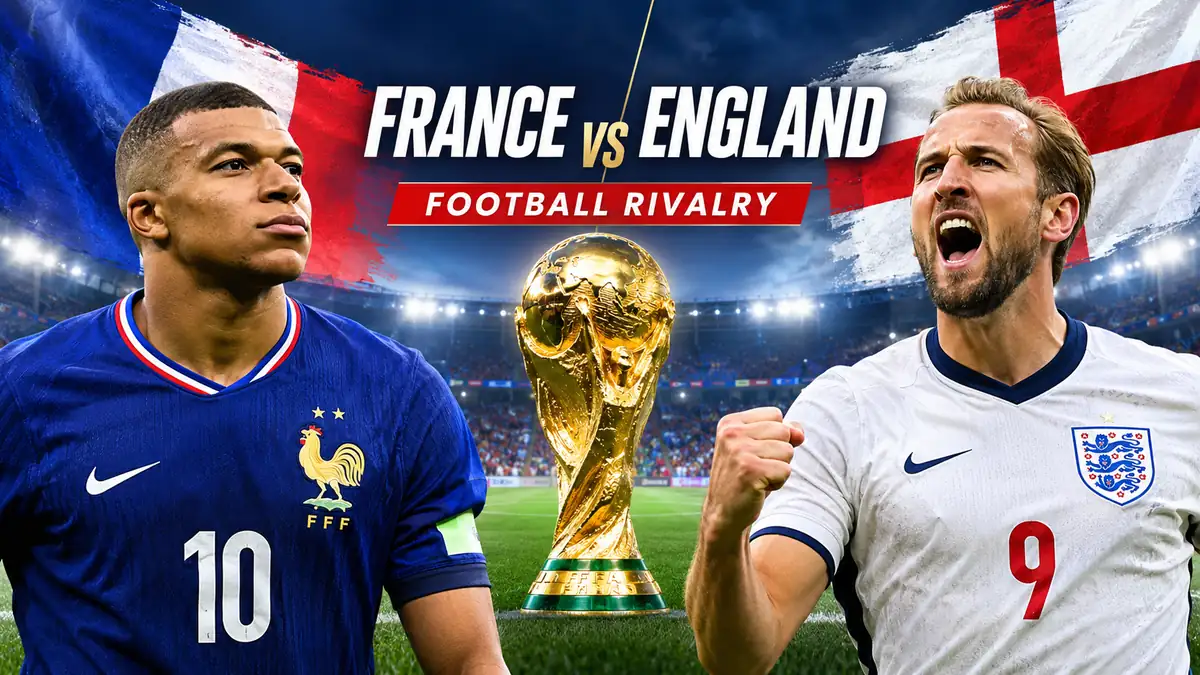
Few international football matchups combine geography, history, and sporting prestige quite like France against England. Both nations have won the FIFA World Cup, produced generations of elite players, and built national teams capable of challenging the world’s strongest opponents.
The france vs england football rivalry is a long-running contest between two European national teams. England won the 1966 FIFA World Cup, while France lifted the trophy in 1998 and 2018. Their meetings include friendlies, European Championship fixtures, and memorable World Cup encounters, most notably France’s 2–1 quarter-final victory in 2022.
Although the rivalry is sometimes overshadowed by England’s encounters with Germany or France’s meetings with Italy, it has its own distinctive character. The English Channel separates the countries geographically, but their football histories have been closely connected for more than a century.
france vs england: Head-to-Head Record and Rivalry Overview
England and France first met in an official senior men’s international in 1923. England dominated many early encounters, but France became increasingly competitive as its football infrastructure and international talent developed.
The balance of the rivalry has changed considerably across generations.
| Category | France | England |
|---|---|---|
| Governing body | French Football Federation (FFF) | The Football Association (FA) |
| FIFA World Cup titles | 2 (1998, 2018) | 1 (1966) |
| UEFA European Championship titles | 2 (1984, 2000) | 0 |
| First men’s international against each other | 1923 | 1923 |
| Home stadium | Stade de France, traditional main venue | Wembley Stadium |
| World Cup 2022 meeting | Won 2–1 | Lost 1–2 |
| Notable players | Zinedine Zidane, Thierry Henry, Kylian Mbappé | Bobby Charlton, Wayne Rooney, Harry Kane |
These achievements highlight an important distinction: England enjoyed greater success during the rivalry’s early decades, while France has accumulated more major international trophies in the modern era.
Who has won more matches between France and England?
Historically, England has held the advantage in the overall men’s head-to-head record, largely because of its dominance in the first half of the twentieth century.
However, France has enjoyed greater success in several important modern encounters, including the 2004 European Championship group-stage meeting and the 2022 World Cup quarter-final.
Head-to-head totals can vary depending on the cutoff date and whether particular historical matches are included. For an exact current record, the fixture list should be checked against official football association archives.
Why is this rivalry significant?
The rivalry extends beyond the number of victories. Both countries have strong domestic leagues, influential football academies, and supporters with high expectations.
England’s Premier League and France’s Ligue 1 have also created close connections between players from both countries. French footballers have played important roles at English clubs, while English players have increasingly gained experience in French football.
As a result, international meetings often feature opponents who already understand each other’s strengths from club competitions.
History of France vs England Football Matches
The early years: England’s dominance
The first meeting took place on May 10, 1923, when England defeated France 4–1 in Paris.
During this period, England possessed a more established professional football system. France was still developing its domestic football structure and international competitiveness.
England’s superior experience contributed to a series of convincing early victories.
The gap gradually narrowed as French football matured and European international competitions became more organized.
The 1966 World Cup encounter
One of the most historically significant meetings occurred during the 1966 FIFA World Cup in England.
England defeated France 2–0 in the group stage, with Roger Hunt scoring both goals.
That victory contributed to England’s progress toward its first and, so far, only men’s World Cup title.
Under manager Alf Ramsey, England went on to defeat West Germany 4–2 after extra time in the final at Wembley.
For England supporters, the France match remains part of the country’s most successful World Cup campaign.
The 1982 World Cup meeting
England and France met again at the 1982 FIFA World Cup in Spain.
England secured a 3–1 group-stage victory, with Bryan Robson scoring twice and Paul Mariner adding another goal. Gérard Soler scored for France.
Robson’s opening goal came after approximately 27 seconds, making it one of the fastest goals in World Cup history.
Despite losing to England, France advanced further in the tournament and eventually finished fourth.
This illustrates why individual head-to-head results do not necessarily predict overall tournament performance.
France’s rise during the 1990s and 2000s
France’s emergence as a major international force transformed the competitive relationship.
The country’s 1998 World Cup victory, inspired by Zinedine Zidane and a highly organized defensive unit, established France among football’s elite.
Two years later, France won UEFA Euro 2000, becoming the reigning world and European champion.
England continued to produce outstanding players, including David Beckham, Michael Owen, Steven Gerrard, and Frank Lampard, but struggled to turn individual talent into major international trophies.
France’s success demonstrated the value of tactical balance, midfield control, and effective tournament management.
Memorable france vs england Matches
Several encounters stand out because of their dramatic moments, influential players, or tournament consequences.
| Date | Competition | Result | Defining moment |
|---|---|---|---|
| May 10, 1923 | Friendly | France 1–4 England | First senior meeting |
| July 20, 1966 | FIFA World Cup | England 2–0 France | Roger Hunt scored twice |
| June 16, 1982 | FIFA World Cup | England 3–1 France | Bryan Robson’s rapid opening goal |
| June 13, 2004 | UEFA Euro | France 2–1 England | Zidane scored twice in stoppage time |
| June 11, 2012 | UEFA Euro | France 1–1 England | Nasri equalized after Lescott’s opener |
| June 13, 2017 | Friendly | France 3–2 England | France won despite playing with ten men |
| December 10, 2022 | FIFA World Cup | England 1–2 France | Giroud winner and Kane’s missed penalty |
Euro 2004: Zidane’s dramatic comeback
The group-stage match at UEFA Euro 2004 in Lisbon remains one of the rivalry’s most dramatic encounters.
England took the lead through Frank Lampard and appeared set to secure a valuable victory.
However, France captain Zinedine Zidane transformed the match during stoppage time.
He scored a free kick to equalize before converting a penalty to give France a remarkable 2–1 victory.
The result demonstrated France’s ability to remain dangerous even when facing defeat.
It also reinforced Zidane’s reputation as a player capable of deciding major international matches under extraordinary pressure.
Euro 2012: A balanced contest
At UEFA Euro 2012, England and France drew 1–1 in Donetsk, Ukraine.
Joleon Lescott headed England into the lead before Samir Nasri equalized with a powerful shot from outside the penalty area.
Neither team established lasting dominance.
The match reflected two relatively cautious approaches, with both sides prioritizing defensive organization and avoiding an opening-game defeat.
The 2017 friendly in Paris
France defeated England 3–2 at the Stade de France in June 2017.
Harry Kane scored twice for England, while Samuel Umtiti, Djibril Sidibé, and Ousmane Dembélé scored for France.
France also played much of the second half with ten men after Raphaël Varane was sent off.
Despite the numerical disadvantage, France continued attacking and secured victory through Dembélé.
The match offered an early glimpse of the young French talent that would contribute to the country’s 2018 World Cup success.
2022 FIFA World Cup: France’s Quarter-Final Victory
The 2022 World Cup quarter-final in Qatar was one of the most consequential matches in the modern rivalry.
Played on December 10 at Al Bayt Stadium, the encounter brought together two teams with genuine ambitions of winning the tournament.
First half: Tchouaméni puts France ahead
France opened the scoring in the 17th minute when Aurélien Tchouaméni struck from outside the penalty area.
England responded by increasing its attacking pressure, with Bukayo Saka and Harry Kane posing significant threats.
France goalkeeper Hugo Lloris made important saves to preserve the advantage.
Second half: Kane equalizes
England received a penalty after Saka was fouled by Tchouaméni.
Kane converted in the 54th minute, bringing England level at 1–1.
The match became increasingly open, with both teams creating opportunities.
In the 78th minute, Olivier Giroud headed France back into the lead following Antoine Griezmann’s cross.
England received another penalty late in the match after a foul on Mason Mount.
This time, Kane sent his attempt over the crossbar.
France held on for a 2–1 victory and advanced to the semi-finals. FIFA+1
What decided the match?
France’s victory reflected several factors:
- Clinical finishing: France converted decisive opportunities despite periods of English pressure.
- Midfield contributions: Tchouaméni provided an important goal, while Griezmann created the winner.
- Defensive resilience: France survived difficult passages without conceding from open play.
- Penalty execution: Kane converted his first penalty but missed the second.
England’s elimination did not mean it had been comprehensively outplayed. The match was competitive, and small moments ultimately determined the outcome.
The Latest france vs england Match: World Cup 2026
FIFA WORLD CUP 2026 · THIRD-PLACE MATCH
July 18, 2026
Fédération Francaise de Football (FFF) – Am Ball
France
4–6
Full time
England vs Croatia Prediction: AI 1-0, England 52% | WC 2026
England
Hard Rock Stadium, Miami Gardens, Florida
The most recent men’s international between the two countries took place at the 2026 FIFA World Cup, when England defeated France 6–4 in a remarkable third-place playoff.
England built a four-goal first-half advantage through Declan Rice, Ezri Konsa, and two goals from Bukayo Saka.
France responded after halftime through Kylian Mbappé and Bradley Barcola. Mbappé scored twice, helping turn what had appeared to be a comfortable England victory into an intense contest.
Saka completed his hat-trick from the penalty spot before late goals from Ousmane Dembélé and Jude Bellingham completed the ten-goal encounter.
The victory gave England third place and its best-ever men’s World Cup finish outside its home country. https://www.englandfootball.com+1
Updated head-to-head record
One historical database records the following results through July 2026:
| Result | Matches |
|---|---|
| England victories | 18 |
| France victories | 10 |
| Draws | 5 |
| Total meetings | 33 |
England therefore leads the overall historical record in this dataset, although France has enjoyed substantial success in more recent decades.
Some football databases use different historical inclusion criteria, so totals should always be compared using the same definition of an international fixture. England Expects+1
France vs England: Playing Styles and Tactical Differences
Both countries have developed distinct football identities, although their tactical approaches have evolved with different managers and generations of players.
France: Athleticism, transitions, and tactical flexibility
France’s most successful modern teams have often combined disciplined defensive structures with exceptional individual attacking talent.
Under Didier Deschamps, France became particularly effective at absorbing pressure and exploiting space during transitions.
Its strengths have included rapid wide attackers, physically strong midfielders, technically skilled playmakers, and experienced defenders.
The 2018 World Cup-winning team demonstrated this approach through players such as N’Golo Kanté, Paul Pogba, Antoine Griezmann, and Kylian Mbappé.
Rather than relying entirely on possession, France frequently prioritized controlling dangerous areas and creating high-quality scoring opportunities.
England: Width, technical development, and attacking combinations
England’s football identity has changed considerably from the traditional emphasis on direct passing and physical play.
Modern England teams increasingly feature technically accomplished midfielders and versatile attacking players.
Harry Kane’s ability to drop into deeper positions, Jude Bellingham’s movement between midfield and attack, and Bukayo Saka’s effectiveness on the right wing illustrate this evolution.
England’s strengths include structured buildup, attacking width, set-piece organization, and combinations around the penalty area.
However, tactical execution can vary substantially depending on the manager, available players, and opposition.
Tactical comparison
| Tactical feature | France | England |
|---|---|---|
| Traditional modern strength | Counterattacking and transitions | Structured buildup and wide attacks |
| Midfield approach | Physical balance and technical creativity | Passing combinations and movement |
| Attacking threat | Pace, individual skill, direct running | Wide play, combinations, finishing |
| Defensive approach | Compact organization | Structured positioning and pressing |
| Common challenge | Creating chances against deep defenses | Breaking down organized opponents |
These are broad historical tendencies rather than fixed characteristics. Both teams can adjust their formations and strategies to suit individual matches.
Legendary Players Who Shaped the Rivalry
The history of France and England is closely connected to some of international football’s most influential players.
Fussball: EM 2004 in Portugal, FRA-ENG
Zinedine Zidane — France
Zidane’s two stoppage-time goals against England at Euro 2004 remain among the most famous moments in this fixture. His passing, control, and ability to perform under pressure defined an outstanding international career.
Thierry Henry — France
Henry was a key figure in France’s golden generation. His pace, finishing, and creativity also made him one of the Premier League’s most celebrated players during his Arsenal career.
The FFF Store – Official Store
Kylian Mbappé — France
Mbappé represents France’s modern attacking identity, combining acceleration, movement, and finishing. His two goals in the 2026 World Cup third-place match demonstrated his continuing influence.
Harry Kane — England
Kane scored twice against France in the 2017 friendly and converted one penalty in the 2022 World Cup quarter-final. His finishing and link-up play have been central to England’s modern attack.
England player profile: Bukayo Saka
Bukayo Saka — England
Saka’s movement and dribbling caused France problems in 2022. Four years later, his hat-trick in the World Cup bronze-medal match became a defining individual performance in the rivalry.
Other important figures include Michel Platini, Bobby Charlton, David Beckham, Wayne Rooney, Frank Lampard, Steven Gerrard, Olivier Giroud, and Antoine Griezmann.
Each contributed to the broader development of international football, even when their most celebrated achievements came in matches against other opponents.
Which Country Has the Better Football History?
The answer depends on how success is measured.
France has won more major men’s international championships, while England has a longer history of organized football and played a foundational role in the sport’s development.
FIFA World Cup achievements
FRANCE
2
World Cup titles1998, 2018
ENGLAND
1
World Cup title1966
France has reached four men’s World Cup finals, winning twice and finishing runner-up in 2006 and 2022.
England has reached one men’s World Cup final, winning it in 1966. Its third-place finish in 2026 was another significant achievement.
European Championship achievements
France won the European Championship in 1984 and 2000.
England has never won the men’s European Championship, although it reached consecutive finals in 2020 and 2024, losing to Italy and Spain respectively.
France therefore holds the stronger record in the two principal senior men’s international tournaments.
Does domestic league strength determine national team success?
Not necessarily.
England’s Premier League is among the most commercially successful and internationally followed football competitions.
France’s Ligue 1 has developed many outstanding players, and the French academy system has contributed significantly to international football.
However, domestic league quality does not translate directly into national team results.
Premier League clubs employ players from around the world, while many French internationals play outside France.
International success depends on the available national player pool, coaching, tactical cohesion, squad depth, and tournament performance.
Youth Development and Football Academies
Youth development is one of the most important factors behind the long-term competitiveness of both national teams.
France’s academy system
France has established a strong reputation for developing technically skilled and athletically capable players.
The Clairefontaine national football institute is one of the country’s best-known development centers.
French football also benefits from professional club academies and extensive youth scouting networks.
Players developed through French football have gone on to represent major European clubs and national teams.
The system’s strength lies partly in identifying talent early and providing structured technical education.
England’s academy development
England has invested heavily in youth development through professional clubs and national football programs.
The Elite Player Performance Plan, introduced in 2012, sought to improve academy standards and player development.
St George’s Park, the FA’s national football center, has also played an important role in supporting coaching and national teams.
England’s youth-level international successes have reflected improvements in technical development and coaching infrastructure.
Why academy development matters
Strong academies help national teams maintain competitive squads across generations.
They can improve technical skills, tactical understanding, physical preparation, and the transition into professional football.
However, youth success does not guarantee senior international trophies. Players must continue developing through meaningful club competition and adapt to the demands of international tournaments.
How france vs england Compares Across Competitions
The significance of a result depends heavily on the competition.
A friendly offers an opportunity to experiment with formations and personnel, while a World Cup knockout match can end a team’s championship ambitions.
| Competition | Historical significance |
|---|---|
| FIFA World Cup | Highest-stakes meetings, including 1966, 1982, 2022, and 2026 |
| UEFA European Championship | Important group-stage matches and qualification encounters |
| International friendlies | Opportunities to test players and tactics |
| Youth international tournaments | Indicators of future talent and development |
Who has the better World Cup head-to-head record?
England has won three of the four men’s World Cup encounters against France.
England defeated France in 1966 and 1982, France won the 2022 quarter-final, and England won the 2026 third-place match.
The World Cup head-to-head record therefore favors England, despite France having won more World Cup titles overall. FIFA+1
Why do friendly results matter less?
Friendly matches often involve experimental lineups, substitutions, and tactical adjustments.
Managers may prioritize player development and fitness over the immediate result.
Consequently, friendly outcomes should be interpreted differently from competitive tournament fixtures.
Nevertheless, friendlies can still reveal emerging talent, tactical changes, and the relative strengths of two squads.
What Makes France and England Difficult Opponents?
Both teams possess the resources and footballing traditions necessary to compete at the highest international level.
France has repeatedly demonstrated its ability to combine elite attacking talent with tournament experience.
England has developed a deep pool of technically capable players and become increasingly competitive in major competitions.
The most difficult challenge for either side is often converting individual quality into collective performance.
A team may dominate possession without creating clear scoring opportunities. Conversely, an opponent may defend for long periods and still win through a small number of decisive attacks.
This is particularly relevant when France and England meet because both possess players capable of changing a match with a single moment of skill.
Does home advantage make a difference?
Home advantage can influence crowd support, familiarity, travel demands, and preparation.
Wembley Stadium has historically been an important venue for England, while the Stade de France has hosted major French international fixtures.
However, many of their most significant encounters have occurred at neutral venues during international tournaments.
In those matches, tactical preparation, player fitness, and decision-making often become more important than familiarity with the stadium.
Why the Rivalry Continues to Matter
The rivalry remains relevant because France and England are consistently associated with high expectations.
Their supporters follow major tournaments closely, and both national teams regularly feature players from leading European clubs.
The connection between the Premier League and French football adds another dimension. Players may be teammates at club level but opponents when representing their countries.
The 2022 and 2026 World Cup encounters illustrate how quickly the balance can change.
France’s narrow quarter-final victory in Qatar emphasized composure and finishing under pressure. England’s ten-goal third-place victory in 2026 demonstrated its attacking potential and resilience in an unusually open contest.
Neither result alone defines the overall rivalry.
Final Thoughts on france vs england
The france vs england football rivalry combines more than a century of international history with contrasting periods of success.
England leads the historical men’s head-to-head record in widely cited databases, while France holds the stronger overall record in major international championships.
From Roger Hunt’s goals in 1966 and Zidane’s dramatic Euro 2004 comeback to the 2022 World Cup quarter-final and England’s extraordinary 6–4 victory in 2026, the fixture has produced memorable moments across different generations.
The clearest way to understand the rivalry is to consider three separate measures: historical head-to-head results, major tournament achievements, and the performance of each generation of players. Together, they provide a more complete picture than any single scoreline.