Boiling eggs sounds simple until you crack one open and discover a runny center when you wanted it firm, a chalky yolk, or a shell that refuses to peel. The difference between perfectly cooked eggs and disappointing ones often comes down to timing, temperature, and cooling.
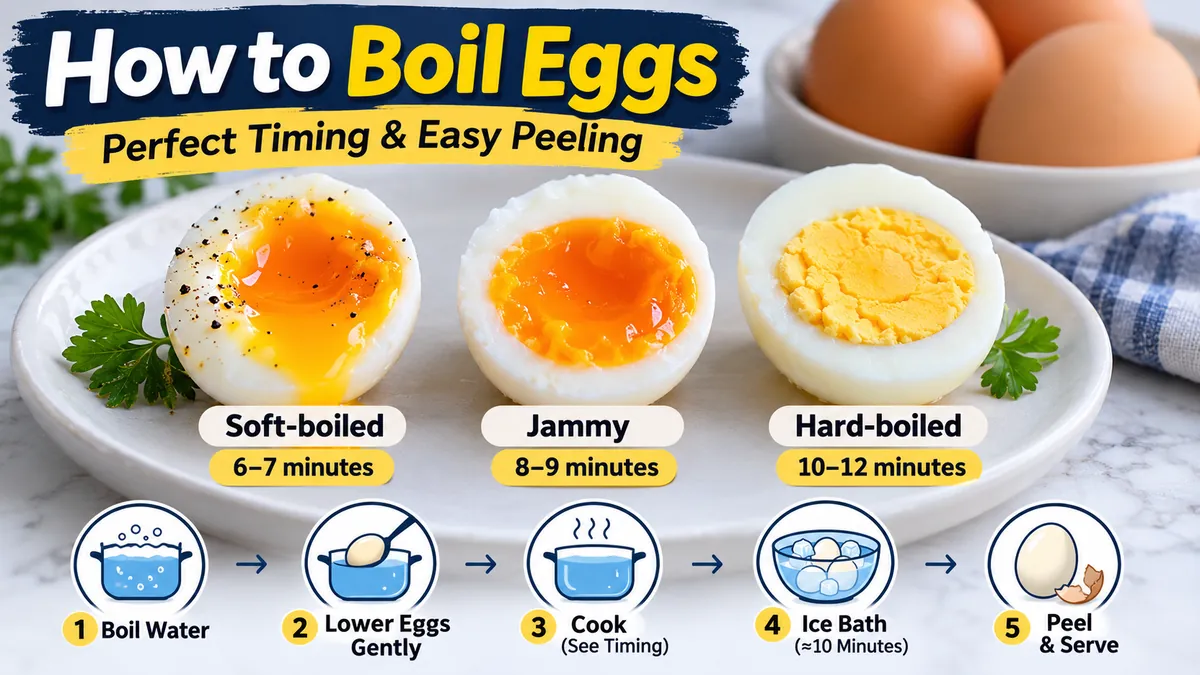
Learning how to boil eggs is easy once you understand a few basic techniques. Place eggs in boiling water, reduce the heat to maintain a gentle boil, and cook for 6–7 minutes for soft-boiled eggs, 8–9 minutes for jammy yolks, or 10–12 minutes for hard-boiled eggs. Transfer them immediately to ice water to stop cooking and make peeling easier.
The method works for breakfast eggs, salads, sandwiches, meal preparation, and recipes that require fully cooked yolks.
How to Boil Eggs Step by Step
The most reliable approach is to use a timer and start with water that is already boiling. This gives you a clear starting point instead of guessing how long the water takes to heat up.
What You Need
- Large chicken eggs
- A saucepan with enough room for a single layer
- Water to cover the eggs by approximately 1 inch
- A slotted spoon
- A kitchen timer
- A bowl of cold water and ice
You do not need vinegar, baking soda, or salt to cook eggs successfully. These ingredients are sometimes suggested for easier peeling or reducing leaks, but consistent timing and proper cooling matter more.
Step 1: Bring Water to a Boil
Fill a saucepan with enough water to cover the eggs completely. Heat it over medium-high heat until the water reaches a steady boil.
Using boiling water as the starting point makes cooking times more predictable.
Step 2: Lower the Eggs Carefully
Use a slotted spoon to lower each egg into the hot water. Avoid dropping eggs directly into the saucepan because sudden impacts can crack their shells.
Eggs taken straight from the refrigerator can be cooked this way, although the temperature difference may occasionally cause cracking.
Step 3: Reduce the Heat
Once the eggs are in the water, adjust the heat to maintain a gentle boil.
A violent rolling boil can cause eggs to bounce against the saucepan and each other, increasing the chance of cracked shells.
Start your timer as soon as the eggs enter the boiling water.
Step 4: Cook According to Your Preferred Yolk
For large chicken eggs, use the following approximate cooking times.
| Cooking time | Yolk texture | Best uses |
|---|---|---|
| 6 minutes | Very soft, runny center | Toast, breakfast |
| 7 minutes | Soft, slightly thickened yolk | Ramen, toast |
| 8 minutes | Jammy, creamy center | Grain bowls |
| 9 minutes | Mostly set, slightly soft center | Salads, snacks |
| 10 minutes | Firm but moist yolk | Sandwiches |
| 11–12 minutes | Fully set yolk | Egg salad, deviled eggs |
| 13–14 minutes | Very firm yolk | Recipes requiring extra-firm eggs |
These times are guidelines rather than guarantees. Egg size, starting temperature, altitude, and how vigorously the water boils can affect the result.
Step 5: Transfer Eggs to Ice Water
As soon as the timer finishes, remove the eggs with a slotted spoon and place them in an ice bath.
For hard-boiled eggs, leave them in the ice water for approximately 10 minutes or until thoroughly cooled.
This rapidly reduces residual cooking and helps prevent the yolks from becoming excessively firm.
Step 6: Peel and Serve
Gently tap the cooled egg on a countertop, then roll it lightly to create small cracks in the shell.
Begin peeling near the wider end, where an air pocket is often present.
Peeling under cool running water can help separate the shell and membrane from the egg white.
How Long Does It Take to Boil Eggs?
The ideal cooking time depends on whether you prefer a liquid, creamy, or fully firm yolk.
Soft-boiled
6–7 minutes
These Soft-Boiled Eggs Are the Most Consistent Thing in My Life | Bon Appétit
Jammy
8–9 minutes
つるんっとむける固ゆで卵 レシピ・作り方 by 月のおと (お返しレポゆっくりです) – 楽天レシピ
Hard-boiled
10–12 minutes
Soft-Boiled Eggs: 6–7 Minutes
Soft-boiled eggs have firm or nearly firm whites with a liquid yolk.
They are commonly served with toast, breakfast bowls, and noodle dishes.
For a particularly runny center, begin with six minutes. If you prefer a thicker yolk that still flows when cut, try seven minutes.
Medium-Boiled Eggs: 8–9 Minutes
Medium-boiled eggs offer a balance between soft and hard textures.
The whites are set, while the yolk develops a creamy, jam-like consistency.
This texture works especially well in ramen, rice bowls, and salads where a soft center adds richness.
Hard-Boiled Eggs: 10–12 Minutes
Hard-boiled eggs have fully cooked whites and firm yolks.
They are suitable for egg salad, potato salad, sandwiches, and deviled eggs.
Cooking for approximately 11–12 minutes generally produces a fully set yolk in a large egg. Avoid unnecessarily extending the cooking time, as prolonged heat can create a dry or crumbly texture.
How to Boil Eggs Using the Cold-Water Method
Starting eggs in cold water is another widely used technique.
Unlike the boiling-water method, eggs and water heat together, which can reduce the initial temperature shock.
To use this approach:
- Arrange the eggs in a single layer in a saucepan.
- Add cold water until the eggs are covered by about one inch.
- Heat the saucepan until the water reaches a full boil.
- Remove the pan from the heat and cover it with a lid.
- Let the eggs stand in the hot water until cooked to your preference.
- Transfer the eggs to an ice bath.
For large eggs, a covered rest of approximately 10–12 minutes is a reasonable starting point for firm yolks, although the exact timing depends on the saucepan, water volume, and heat retention.
The cold-water method is convenient, but it can be less consistent because different pans and stoves retain heat differently.
For repeatable results, the boiling-water method with a timer is generally easier to standardize.
How to Boil Eggs Without Cracking the Shells
Cracked eggs are common, particularly when refrigerated eggs are placed into rapidly boiling water.
Several small adjustments can reduce the problem.
Avoid Overcrowding
Keep eggs in a single layer rather than stacking them.
This prevents excessive movement and collisions while the water boils.
Lower Eggs Gently
A slotted spoon provides more control than dropping eggs directly into the pan.
Lower each egg carefully to minimize impact against the bottom.
Maintain a Gentle Boil
Once the eggs are submerged, reduce the heat slightly.
The water should continue bubbling without tossing the eggs around.
Check for Existing Cracks
Inspect eggs before cooking. A damaged shell is more likely to leak when heated.
If an egg cracks during cooking, some white may escape into the water. A small cooking crack does not automatically make the egg unsafe, provided it is cooked thoroughly and handled safely.
Discard eggs that were already cracked before cooking, especially when their storage history is uncertain.
How to Peel Boiled Eggs Easily
Peeling is often more frustrating than cooking.
Fresh eggs can be especially difficult to peel because the egg white may adhere more strongly to the shell membrane.
As eggs age, changes in the egg white and internal air space can make peeling easier.
Cool Eggs Immediately
Placing cooked eggs in ice water helps stop the cooking process and makes the shells more comfortable to handle.
Cooling can also assist peeling, although it does not guarantee that every shell will come away cleanly.
Crack the Entire Shell
Instead of making one large crack, gently tap the egg in several places.
Roll it lightly across a hard surface to loosen the shell.
Start at the Wide End
The broader end of an egg usually contains an air cell.
Beginning here may help you get underneath the thin membrane separating the shell from the egg white.
Peel Under Water
Peeling under running water or in a bowl of water allows moisture to reach beneath the membrane.
This can make stubborn shell fragments easier to remove.
Do Older Eggs Peel Better?
Generally, yes. Eggs that have been refrigerated for several days may peel more easily than extremely fresh eggs.
However, egg age is only one factor. Cooking method, cooling, and individual shell characteristics also influence the result.
Common Mistakes When Boiling Eggs
Even a simple cooking method can produce inconsistent results when a few details are overlooked.
Cooking Eggs for Too Long
Overcooked eggs often develop dry whites and chalky yolks.
Sometimes a gray-green ring forms around the yolk.
This discoloration results from a reaction involving sulfur in the egg white and iron in the yolk, producing iron sulfide near their boundary.
The ring is generally harmless, but it often indicates excessive heating or slow cooling.
Skipping the Ice Bath
Eggs retain heat after being removed from boiling water.
Without rapid cooling, residual heat can continue firming the yolk, particularly in soft- and medium-boiled eggs.
Using the Same Time for Every Egg Size
Small, medium, large, extra-large, and jumbo eggs do not necessarily cook at the same rate.
Larger eggs generally require more time to reach a similar yolk consistency.
The timing recommendations in this guide assume large eggs.
Boiling Too Aggressively
A strong rolling boil can cause eggs to strike the pan and crack.
Gentle boiling provides sufficient heat while reducing unnecessary movement.
Guessing Instead of Timing
Even a difference of one or two minutes can noticeably change the yolk.
A kitchen timer makes it easier to reproduce your preferred texture.
How to Boil Eggs for Different Recipes
The best egg texture depends on how you plan to use it.
Eggs for Breakfast
Soft-boiled eggs are a popular breakfast choice because the liquid yolk pairs well with toast.
Cook large eggs for approximately 6–7 minutes, then cool them briefly before serving.
For a fully cooked breakfast egg, use 10–12 minutes instead.
Eggs for Ramen
Ramen eggs are commonly prepared with jammy yolks.
Cooking for approximately 7–8 minutes produces a creamy center that works well with noodles and broth.
After cooling and peeling, the eggs can be marinated in a refrigerated mixture of soy sauce, water, and seasonings.
Eggs for Egg Salad
Egg salad requires fully cooked yolks that can be mashed and mixed with other ingredients.
Boil large eggs for approximately 11–12 minutes, cool completely, and peel.
Chop or mash the eggs before combining them with mayonnaise, mustard, or preferred seasonings.
Eggs for Deviled Eggs
Deviled eggs require firm whites that hold their shape when halved.
A cooking time of approximately 11–12 minutes is a useful starting point.
Cooling thoroughly before slicing makes the eggs easier to handle and helps preserve a clean appearance.
How to Boil Eggs at High Altitudes
Altitude affects the temperature at which water boils.
At sea level, water boils at approximately 212°F (100°C). At higher elevations, atmospheric pressure decreases, causing water to boil at a lower temperature.
Because the boiling water is cooler, eggs may take longer to cook.
For example, at an elevation of approximately 5,000 feet (1,524 meters), water boils near 203°F (95°C).
If you live at a high altitude, begin by adding roughly one or two minutes to your usual cooking time, then adjust based on the results. At very high elevations, larger adjustments may be necessary.
There is no universal adjustment that works for every altitude, egg size, and cooking method.
How to Store Boiled Eggs Safely
Proper storage is essential, particularly when preparing several eggs in advance.
According to the U.S. Food and Drug Administration (FDA), hard-cooked eggs should be refrigerated and consumed within one week of cooking. This applies to both peeled and unpeeled eggs. FDA+1
Refrigerating Hard-Boiled Eggs
Allow cooked eggs to cool promptly, then place them in the refrigerator.
Keep the refrigerator at 40°F (4°C) or below.
Store peeled eggs in a clean, covered container to protect them from contamination and drying.
Unpeeled eggs can also be refrigerated in a clean container.
Labeling the container with the cooking date makes it easier to track freshness.
How Long Can Boiled Eggs Stay Out?
The FDA recommends that cooked eggs should not remain unrefrigerated for more than two hours.
When the surrounding temperature exceeds 90°F (32°C), that limit drops to one hour. FDA
These guidelines matter when packing eggs for lunch, picnics, or outdoor activities.
Use an insulated cooler with ice packs when refrigeration is unavailable.
Can You Freeze Boiled Eggs?
Freezing whole hard-boiled eggs is generally not recommended.
The whites can become rubbery, watery, or unpleasantly textured after thawing.
For best quality, prepare only the quantity you expect to consume within the recommended refrigerated storage period.
Are Soft-Boiled Eggs Safe to Eat?
Soft-boiled eggs have partially cooked or liquid yolks, which carry more food-safety risk than fully cooked eggs.
The FDA recommends cooking eggs until both the whites and yolks are firm. Young children, older adults, pregnant people, and individuals with weakened immune systems should be especially cautious about undercooked eggs.
If a recipe requires a runny yolk, pasteurized shell eggs can reduce the risk associated with Salmonella, although safe handling remains essential. FDA+1
How to Tell When Boiled Eggs Are Done
Unlike some foods, eggs are difficult to inspect internally without opening them.
A timer is the most practical way to estimate doneness.
Check the Yolk Texture
If you are testing a cooking method for the first time, remove one egg, cool it briefly, and cut it in half.
A soft-boiled egg should have set whites and a liquid center.
A medium-boiled egg should have a thick, creamy yolk.
A hard-boiled egg should have a fully opaque, firm center.
If the result is not what you expected, adjust your cooking time for the next batch.
Can You Tell If an Egg Is Boiled by Spinning It?
A spinning test can help distinguish raw eggs from hard-boiled eggs.
Place an egg on a flat surface and spin it gently.
A hard-boiled egg usually spins more smoothly because its interior is solid. A raw egg often wobbles because the liquid contents continue moving.
However, this test cannot reliably distinguish a jammy yolk from a fully firm one, and it is not a food-safety test.
Can You Boil Eggs Again If They Are Undercooked?
Yes, an egg that has just been cooked and is still too soft can be returned to hot water for additional cooking.
The result may be less uniform than cooking it correctly the first time, particularly if the egg has already cooled.
If the egg has been sitting unrefrigerated beyond safe time limits, reheating should not be used as a way to make it safe again.
Does Egg Size Affect Boiling Time?
Egg size influences how quickly heat reaches the center.
A small egg generally cooks faster than a jumbo egg under the same conditions.
The following adjustments are useful starting estimates when using a boiling-water method.
| Egg size | Suggested adjustment |
|---|---|
| Small | Subtract 1–2 minutes |
| Medium | Subtract about 30–60 seconds |
| Large | Use standard cooking times |
| Extra-large | Add approximately 1 minute |
| Jumbo | Add approximately 1–2 minutes |
These adjustments are approximate. The actual results depend on egg temperature, boiling intensity, and preferred yolk consistency.
For consistent cooking, use eggs of similar sizes in the same batch.
Boiling Eggs for Meal Prep
Hard-boiled eggs are convenient for preparing breakfasts, snacks, and lunches ahead of time.
They require little preparation, are easy to portion, and can be added to a variety of dishes.
A large hard-boiled egg provides approximately 6 grams of protein, along with nutrients such as vitamin B12, selenium, and choline.
Preparing Multiple Eggs
Use a saucepan large enough to accommodate all the eggs in one layer.
Ensure the water covers them completely and maintain a gentle boil.
A larger batch does not necessarily require a longer cooking time once the water has returned to the appropriate temperature. However, adding many cold eggs can temporarily lower the water temperature.
For consistent results, avoid overcrowding and use a sufficiently large pot.
Keeping Prepared Eggs Fresh
Cool the eggs promptly and refrigerate them in clean containers.
For hard-boiled eggs, use the FDA’s one-week refrigerated storage guideline.
If the eggs are mixed into a prepared dish such as egg salad, follow the shorter storage guidance for that finished dish rather than assuming it will last a full week.
Final Thoughts on how to boil eggs
Learning how to boil eggs successfully comes down to three essentials: a consistent starting temperature, accurate timing, and prompt cooling.
For large eggs placed in boiling water, approximately 6–7 minutes produces a soft center, 8–9 minutes creates a jammy yolk, and 10–12 minutes gives you a firm hard-boiled egg.
Use a gentle boil to reduce cracking, transfer cooked eggs to ice water, and adjust the timing slightly for egg size and altitude.
Once you find the timing that produces your preferred texture, use the same saucepan, method, and egg size whenever possible. That consistency is the simplest way to make reliably cooked eggs every time.