In the Bay of Bengal lies an island whose inhabitants have maintained their independence from the outside world for generations. There are no tourist resorts, public roads, or visitor facilities. Outsiders are prohibited from approaching its shores.
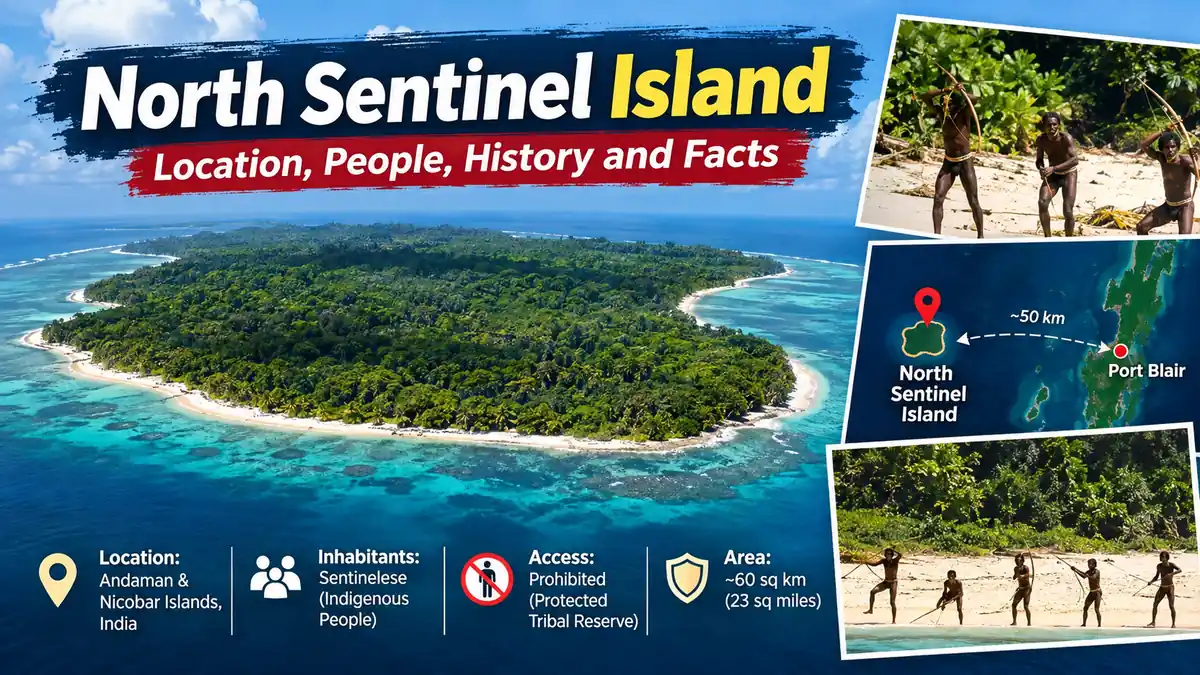
north sentinel island is a small, forest-covered island in India’s Andaman and Nicobar Islands, inhabited by the Sentinelese, an Indigenous people who reject most outside contact. Indian law restricts access to protect their health, safety, land, and autonomy. Much about their language, population, and daily lives remains unknown.
The island attracts worldwide curiosity because of its isolation, but its significance goes far beyond mystery. It raises important questions about Indigenous rights, disease prevention, cultural survival, and the responsibility to respect communities that do not want contact.
Where Is North Sentinel Island Located?
North Sentinel Island is situated in the northeastern Indian Ocean, within the Bay of Bengal. It belongs to the Andaman Islands, part of the Indian union territory of the Andaman and Nicobar Islands.
The island lies west of South Andaman Island and is surrounded by coral reefs and shallow coastal waters.
Its approximate geographical coordinates are 11.56° north latitude and 92.24° east longitude.
Location and geographical facts
| Feature | Details |
|---|---|
| Country | India |
| Union territory | Andaman and Nicobar Islands |
| Ocean | Indian Ocean |
| Sea | Bay of Bengal |
| Approximate area | 60 square kilometers (23 square miles) |
| Terrain | Dense tropical forest and coastal beaches |
| Surrounding waters | Coral reefs and shallow seas |
| Indigenous inhabitants | Sentinelese |
| Public access | Prohibited without government authorization |
The island has a roughly rectangular shape and is covered predominantly by tropical vegetation. Its beaches form a narrow boundary between the forest and surrounding reefs.
Unlike many inhabited islands, North Sentinel has no publicly documented modern infrastructure such as airports, paved highways, commercial ports, or hotels.
How far is North Sentinel Island from Port Blair?
North Sentinel Island is approximately 50 kilometers west of Port Blair, now officially known as Sri Vijaya Puram, the capital of the Andaman and Nicobar Islands.
Although the geographical distance is relatively short, the island is not an ordinary destination accessible through passenger ferries or organized excursions.
Its legal protection and the wishes of its inhabitants take precedence over tourism.
Who Are the Sentinelese People?
The Sentinelese are an Indigenous community whose ancestral home is North Sentinel Island.
They are widely described as one of the world’s most isolated Indigenous populations because they have consistently resisted sustained contact with outsiders.
However, calling them completely uncontacted can be misleading. Historical encounters have occurred, and the community is aware of the existence of people beyond the island.
What distinguishes the Sentinelese is their continued refusal to establish regular relationships with outside societies.
What do we know about their way of life?
Observations from a distance and limited historical encounters suggest that the Sentinelese practice hunting, gathering, and fishing.
Their documented activities include:
- Fishing in shallow coastal waters.
- Hunting wildlife using bows, arrows, and spears.
- Collecting edible plants and other forest resources.
- Constructing shelters using locally available materials.
- Using small watercraft in protected coastal areas.
- Making tools from natural materials and recovered metal.
These observations provide only a partial picture of their society.
Researchers do not have reliable information about their complete social organization, religious beliefs, family structures, oral traditions, or cultural practices.
The absence of such information should not be interpreted as evidence that these traditions do not exist.
What language do the Sentinelese speak?
The Sentinelese speak a language generally referred to as Sentinelese.
It remains largely undocumented, and its relationship to other Andamanese languages has not been conclusively established.
The neighboring Onge and Jarawa communities speak languages associated with the Andaman Islands, but this does not establish that their languages are mutually intelligible with Sentinelese.
There is no reliable Sentinelese dictionary, comprehensive grammar, or established translation system available to the public.
As a result, outsiders cannot confidently interpret the community’s spoken language.
How many Sentinelese live on the island?
The exact population is unknown.
Historical estimates have varied considerably, with figures ranging from a few dozen to potentially more than a hundred people. These numbers should not be treated as verified contemporary population totals.
India’s 2011 census recorded 15 Sentinelese, but that figure was based on limited observation rather than a complete household census.
Dense forest, restricted access, and the community’s rejection of contact make accurate population measurement exceptionally difficult.
The most accurate answer is that nobody outside the community knows how many Sentinelese currently live on North Sentinel Island.
Why Is North Sentinel Island Forbidden to Visitors?
North Sentinel Island is legally protected because outside contact could threaten the survival and independence of its inhabitants.
Under the Andaman and Nicobar Islands (Protection of Aboriginal Tribes) Regulation, 1956, the island and surrounding coastal waters are designated as a tribal reserve.
The Indian government has confirmed that the protected area includes the entire island and the sea extending five kilometers from its high-water mark. Unauthorized entry is prohibited. Press Information Bureau+1
The danger of infectious diseases
One of the greatest risks to the Sentinelese is exposure to infectious diseases introduced by outsiders.
Communities with limited historical exposure to certain pathogens may be particularly vulnerable to outbreaks.
Potential threats include influenza, measles, and respiratory infections.
An ordinary illness carried by a visitor could have serious consequences in a small community with limited access to modern medical care.
This is not merely a theoretical concern. Other Indigenous populations in the Andaman Islands experienced severe population losses following colonial contact, disease exposure, and displacement. Survival International+1
Protecting Indigenous autonomy
The restrictions also recognize the Sentinelese people’s right to determine how they interact with the outside world.
They have repeatedly demonstrated that they do not welcome uninvited visitors.
India’s stated policy has been described as an eyes-on, hands-off approach: authorities monitor the area and discourage intrusions without attempting regular contact.
This policy acknowledges that a community does not need to participate in global society to deserve protection.
What happens if someone enters illegally?
Unauthorized visitors risk arrest and prosecution under applicable Indian laws.
They may also face serious physical danger if they approach the island.
The Indian Coast Guard, police, and other authorities monitor the surrounding waters to prevent trespassing, illegal fishing, and unwanted contact.
Even when broader travel restrictions in the Andaman Islands have been relaxed, separate protections for North Sentinel Island have remained in place. Digital Sansad+1
The History of North Sentinel Island and Outside Contact
The Sentinelese have a long history in the Andaman Islands, although their exact ancestry and the length of continuous settlement on North Sentinel Island remain uncertain.
Popular accounts sometimes claim that the community has lived unchanged for 60,000 years.
That claim oversimplifies the evidence.
Human populations have inhabited the broader Andaman region for tens of thousands of years, but this does not establish an exact settlement date for North Sentinel or mean its inhabitants have never changed their technologies or customs.
Historical records provide a clearer picture of encounters between the islanders and outsiders over the last few centuries.
Early European observations
One of the earliest recorded European observations dates to 1771, when a British surveyor reported seeing lights on the island at night.
During the nineteenth century, British colonial expansion increased outside interest in the Andaman Islands.
The Sentinelese generally avoided or resisted unwanted approaches.
The 1880 British colonial expedition
In 1880, British colonial officer Maurice Vidal Portman led an expedition to North Sentinel Island.
His party encountered an elderly couple and four children and forcibly took them to Port Blair.
The elderly adults became ill and died. The children were subsequently returned to the island with gifts.
This incident illustrates the dangers of forced contact, particularly disease exposure and the removal of people from their community.
The precise consequences for the wider Sentinelese population remain unknown. Survival International+1
Contact expeditions during the twentieth century
After Indian independence, government and research teams periodically attempted to establish communication.
Some expeditions left coconuts, metal objects, and other items on beaches.
The Sentinelese reacted differently across encounters. Sometimes they collected gifts, while on other occasions they warned visitors away using bows and arrows.
These varied reactions demonstrate that the community’s relationship with outsiders cannot be reduced to a single encounter.
The peaceful contact of 1991
One of the most significant documented encounters occurred in January 1991.
A team that included anthropologist Madhumala Chattopadhyay approached the island and offered coconuts.
Several Sentinelese entered shallow water and accepted the gifts without the confrontations that had characterized many earlier visits.
This was a rare moment of relatively peaceful interaction.
However, it did not establish permission for future visits or indicate that the community wanted sustained contact.
Regular contact expeditions were eventually discontinued in the 1990s as the risks and ethical concerns became clearer.
Timeline of significant events
| Year | Event |
|---|---|
| 1771 | Early recorded European observation of lights on the island |
| 1880 | British colonial expedition forcibly removes six islanders |
| 1956 | Legal framework established for protecting Indigenous tribal reserves |
| 1970s–1980s | Periodic government contact expeditions and gift exchanges |
| 1991 | Rare peaceful encounters involving coconut exchanges |
| 1996 | Regular gift-dropping missions discontinued |
| 2004 | Indian Ocean tsunami; distant observations confirm survivors |
| 2006 | Two fishermen die after their boat drifts onto the island |
| 2018 | American missionary John Allen Chau is killed during an unauthorized visit |
| 2025 | American visitor arrested following an illegal landing |
The timeline shows a gradual change in official policy from attempted contact toward protection through non-interference.
What Happened on North Sentinel Island in 2018?
In November 2018, American missionary John Allen Chau traveled to North Sentinel Island with the intention of contacting the Sentinelese and sharing his Christian faith.
His visit was unauthorized and violated restrictions protecting the island.
Chau reportedly arranged transportation with local fishermen and attempted to approach the community.
During an earlier encounter, islanders warned him away. He subsequently returned and was killed.
The incident attracted international attention and generated debate about religious missions, personal responsibility, Indigenous rights, and the consequences of violating protected boundaries. Sage Journals+1
Why did the Sentinelese attack?
Nobody can establish the precise thoughts or motivations of the people involved.
However, the community has a documented history of resisting unauthorized landings.
Their response is widely understood in the context of defending their territory against unwanted intrusion.
Describing the Sentinelese as inherently violent ignores the fact that these incidents occurred when outsiders approached or entered their homeland.
Their defensive behavior does not justify unauthorized contact, and their isolation should not be treated as a challenge for adventurers.
The 2006 fishermen incident
In 2006, two Indian fishermen, Sunder Raj and Pandit Tiwari, were killed after their boat drifted onto North Sentinel Island.
Reports indicate that they had been fishing illegally in the surrounding waters and that their vessel broke loose while they slept.
The incident further demonstrated the dangers of entering protected territory.
What happened in 2025?
In March 2025, American national Mykhailo Viktorovych Polyakov illegally landed on North Sentinel Island.
According to reports, he spent a short period ashore, left a coconut and a can of cola, and attempted to attract the attention of islanders.
He did not report meeting any Sentinelese and was subsequently arrested by Indian authorities.
The incident renewed concerns about social media-driven trespassing and the potential introduction of infectious diseases. Survival International+1
These events reinforce why the island’s restrictions are intended to protect both its inhabitants and outsiders.
How Did North Sentinel Island Survive the 2004 Tsunami?
On December 26, 2004, a powerful undersea earthquake near Sumatra triggered the devastating Indian Ocean tsunami.
The disaster affected coastal communities across Indonesia, India, Sri Lanka, Thailand, and other countries.
North Sentinel Island was situated within the affected region, raising concerns about the survival of its inhabitants.
What did rescue teams discover?
Following the tsunami, Indian authorities conducted aerial observations to assess the situation.
During one helicopter flight, a Sentinelese man appeared on the beach and fired an arrow toward the aircraft.
The encounter became one of the most widely reported images associated with the island.
It demonstrated that at least some community members had survived and remained determined to prevent outsiders from approaching.
However, these observations could not establish the total number of survivors or whether anyone had been injured or killed. ESA+1
Did the tsunami change the island’s geography?
The earthquake and tsunami altered coastal environments throughout the Andaman and Nicobar Islands.
Satellite observations indicated changes to North Sentinel’s shoreline, shallow-water areas, and surrounding reefs.
Such changes could affect fishing grounds, coastal access, and marine ecosystems.
The European Space Agency documented the island using satellite imagery in 2005, providing valuable evidence of its geography after the disaster. ESA
The Sentinelese continued living on their island, but the full ecological and social effects of the tsunami remain unknown.
How Do the Sentinelese Survive Without Modern Infrastructure?
The Sentinelese rely on knowledge of their local environment, practical technologies, and resources available from the forest and sea.
Their way of life is sometimes inaccurately described as frozen in the Stone Age.
In reality, they use tools, adapt materials, and respond to environmental conditions, just as other human societies do.
Hunting, fishing, and gathering
The surrounding rainforest and coastal ecosystem provide important food resources.
Observations suggest that fishing and hunting form significant parts of their subsistence activities.
They use bows, arrows, and spears and navigate shallow coastal waters in narrow canoes.
These watercraft are generally propelled with poles rather than used for long-distance ocean voyages.
The community also gathers forest foods, although the complete range of plants and animals in its diet is not documented. Survival International
Do the Sentinelese use metal tools?
Yes. Observations indicate that the Sentinelese use metal recovered from shipwrecks or materials that reach the island.
They have been documented incorporating iron into tools and arrowheads.
This is an important distinction because the absence of industrial manufacturing does not mean a society lacks technological knowledge.
Their tools are adapted to their particular environment and needs.
What kinds of homes do they build?
Historical observations describe both larger communal shelters and smaller temporary structures.
Some larger shelters appear to accommodate several family groups, while smaller structures have been observed near beaches.
Because detailed research is restricted, outsiders do not know how housing arrangements vary throughout the island or across seasons.
Do they practice agriculture?
There is no reliable evidence of large-scale agriculture on North Sentinel Island.
Available observations point primarily toward hunting, gathering, and fishing.
However, the limited information available does not justify absolute claims about every food-production practice the community might use.
How do they obtain drinking water?
The island receives tropical rainfall and supports dense vegetation.
Freshwater sources are therefore likely important to its inhabitants, but the precise methods used to collect, store, and manage drinking water have not been systematically documented.
Claims about specific wells, streams, or water-storage systems should be treated cautiously unless supported by reliable observations.
What Makes North Sentinel Island Different From Other Andaman Islands?
The Andaman and Nicobar Islands are home to several Indigenous communities with distinct histories, languages, and relationships with the outside world.
These include the Jarawa, Onge, Great Andamanese, Shompen, and Sentinelese.
Although they are sometimes grouped together in popular articles, they should not be treated as a single culture.
| Community | General location | Relationship with outsiders |
|---|---|---|
| Sentinelese | North Sentinel Island | Reject sustained outside contact |
| Jarawa | South and Middle Andaman | Have experienced increasing outside contact |
| Onge | Little Andaman | Maintain contact with government services |
| Great Andamanese | Strait Island and other areas historically | Experienced extensive colonial contact and population decline |
| Shompen | Great Nicobar Island | Some groups maintain very limited outside contact |
These communities have experienced different pressures from settlement, disease, development, and government policies.
Why is isolation especially important?
The Sentinelese occupy an island that remains geographically separated from the larger population centers of the archipelago.
Unlike Indigenous communities living near major roads or settlements, they have not experienced the same degree of sustained integration with outside institutions.
This isolation has helped preserve their autonomy, although it does not eliminate threats from illegal fishing, unauthorized visitors, or environmental change.
Are the Sentinelese the last uncontacted people?
No.
Other Indigenous peoples around the world also maintain limited or no sustained contact with outside societies, particularly in parts of the Amazon rainforest and on New Guinea.
The Sentinelese are notable because they occupy an island with no known permanent non-Sentinelese residents and have repeatedly rejected outside approaches.
Their circumstances are unusual, but they are not the world’s only people living in voluntary isolation.
Can You Visit North Sentinel Island or See It on Google Maps?
North Sentinel Island is visible on digital maps and satellite imagery, but it is not legally accessible as a tourist destination.
🏝️
Use two fingers to move the map
Use ctrl + scroll to zoom the map
Is North Sentinel Island open to tourists?
No. Unauthorized visits are prohibited.
There are no legitimate public sightseeing excursions, beach tours, overnight stays, or visitor permits for ordinary tourism on the island.
Travelers visiting other parts of the Andaman and Nicobar Islands must respect the protected boundaries.
Can you see the island from space?
Yes.
Satellite images show the island’s forest canopy, beaches, and surrounding coral reefs.
Services such as Google Maps and Google Earth allow users to examine its geographical features remotely.
However, satellite imagery cannot provide a reliable picture of the community’s complete population, social structure, or daily activities.
The forest canopy also obscures much of the land surface.
Why are there so few photographs?
There are relatively few detailed photographs because access is restricted and most historical observations occurred from boats or aircraft.
Ethical concerns also discourage intrusive photography.
The limited number of images should not be interpreted as evidence of secret settlements or unexplained structures.
The island is geographically real and has been documented through scientific observation, historical records, and satellite mapping.
Myths and Misconceptions About North Sentinel Island
The island’s isolation has encouraged sensational stories, but several popular claims misrepresent the Sentinelese.
Myth: The Sentinelese are cannibals
There is no credible evidence establishing that the Sentinelese practice cannibalism.
Such claims often originate from speculation, sensational media coverage, or stereotypes about isolated Indigenous peoples.
Their documented resistance to outsiders does not support assumptions about their diet or cultural practices.
Myth: Nobody has ever contacted them
Historical contact attempts are well documented.
The 1880 colonial expedition, twentieth-century gift exchanges, and 1991 encounters all demonstrate that outside interactions have occurred.
The more accurate description is that the Sentinelese have rejected sustained outside contact.
Myth: They have lived exactly the same way for 60,000 years
This claim is unsupported.
While the Andaman Islands have a very long history of human habitation, there is no evidence that Sentinelese society has remained unchanged for a specific number of millennia.
Their use of recovered metal demonstrates adaptation and technological choice.
Myth: They are unaware of the modern world
The Sentinelese have encountered boats, helicopters, and other outside objects.
These experiences indicate awareness of outsiders, although the extent of their understanding of global society is unknown.
Choosing not to engage with outsiders is different from being unaware that outsiders exist.
Myth: The island contains a hidden modern civilization
There is no credible evidence of underground cities, secret military facilities, or advanced hidden infrastructure on North Sentinel Island.
Such stories are speculative and unsupported by established research.
What Threats Does North Sentinel Island Face Today?
Despite its protected status, North Sentinel Island faces risks associated with unauthorized human activity and environmental change.
Illegal fishing and poaching
Fishing vessels entering protected waters may compete for marine resources and increase the likelihood of unwanted contact.
Illegal harvesting of turtles, lobsters, and other marine species has been identified as a concern in the region.
Effective enforcement helps protect both the community and its surrounding ecosystem.
Disease exposure
Unauthorized landings remain a major public-health concern.
A visitor may carry an infectious illness without recognizing the risk.
For a relatively small, isolated population, a serious outbreak could have disproportionate consequences.
Climate change and coastal hazards
Low-lying coastal areas and coral reefs can be affected by rising sea levels, changing ocean temperatures, severe storms, and marine ecosystem disruption.
North Sentinel Island is not exempt from these environmental pressures.
However, detailed assessments of the island’s current climate vulnerability are limited.
It would be inaccurate to claim that the island is already disappearing or that its inhabitants face a precisely measured climate threat without supporting data.
Intrusive tourism and online attention
Internet curiosity can encourage individuals to attempt unauthorized visits.
The 2025 trespassing incident illustrates how attention-seeking behavior can create risks for an isolated community.
Public interest should be directed toward understanding Indigenous rights and conservation rather than attempting personal encounters.
How Is the Indian Government Protecting the Sentinelese?
India’s protection strategy combines legal restrictions, maritime monitoring, and a policy of avoiding unnecessary direct contact.
The Sentinelese are recognized within India’s framework for protecting Particularly Vulnerable Tribal Groups (PVTGs).
The legal framework includes the Andaman and Nicobar Islands (Protection of Aboriginal Tribes) Regulation, 1956.
Government statements identify several protective measures:
- Maintaining the island and its surrounding coastal waters as a protected tribal reserve.
- Restricting unauthorized entry by Indian citizens and foreign nationals.
- Conducting maritime surveillance to discourage illegal approaches.
- Protecting coastal resources from unauthorized exploitation.
- Avoiding routine contact expeditions that could expose the community to disease.
The Ministry of Home Affairs has described this policy as respecting the Sentinelese way of life while monitoring the surrounding area. Press Information Bureau
Why not send doctors, teachers, or development workers?
Medical care, education, and infrastructure can provide enormous benefits when communities choose to access them.
However, imposing these services on a community that rejects contact creates ethical and practical problems.
Medical intervention could itself introduce infectious diseases. Establishing permanent facilities could disrupt local social arrangements and undermine control over ancestral land.
The central issue is not whether modern services have value. It is whether outsiders have the right to impose contact without consent.
Should scientists study the island?
Research can improve understanding of ecosystems, human history, and Indigenous cultures.
Nevertheless, scientific curiosity does not automatically justify entering protected territory.
Non-intrusive approaches, including analysis of existing records and responsibly obtained satellite imagery, can provide information without direct contact.
Even remote observation should be evaluated for potential effects on the community.
Why North Sentinel Island Matters
North Sentinel Island is more than an unusual geographical location.
It demonstrates that different human societies can maintain distinct ways of life within an interconnected world.
Its significance extends across anthropology, conservation, public health, and human rights.
The Sentinelese have maintained their relationship with their ancestral homeland despite colonial encounters, attempted contact expeditions, natural disasters, and unauthorized visitors.
Their continued independence challenges the assumption that every society must follow the same path of technological development or social integration.
It also highlights a broader conservation principle: protecting Indigenous land rights can help protect natural ecosystems.
The island’s forests, reefs, and coastal resources form an interconnected environment on which the community depends.
Protecting those resources is therefore inseparable from protecting the people who live there.
The Future of North Sentinel Island
The future of North Sentinel Island will depend partly on the effectiveness of legal protections and the ability of authorities to prevent unauthorized contact.
It will also be influenced by broader environmental conditions in the Bay of Bengal.
Outsiders cannot accurately predict how Sentinelese society will change over coming generations.
Like every human community, its members may adapt their tools, social practices, and relationships with their environment.
Those changes should not be confused with an obligation to accept outside visitors.
The most meaningful way to respect north sentinel island is to recognize that its inhabitants have the right to remain undisturbed.
Its story is not simply about isolation or mystery. It is about the survival of an Indigenous community, the protection of ancestral territory, and the importance of allowing people to determine their own future.