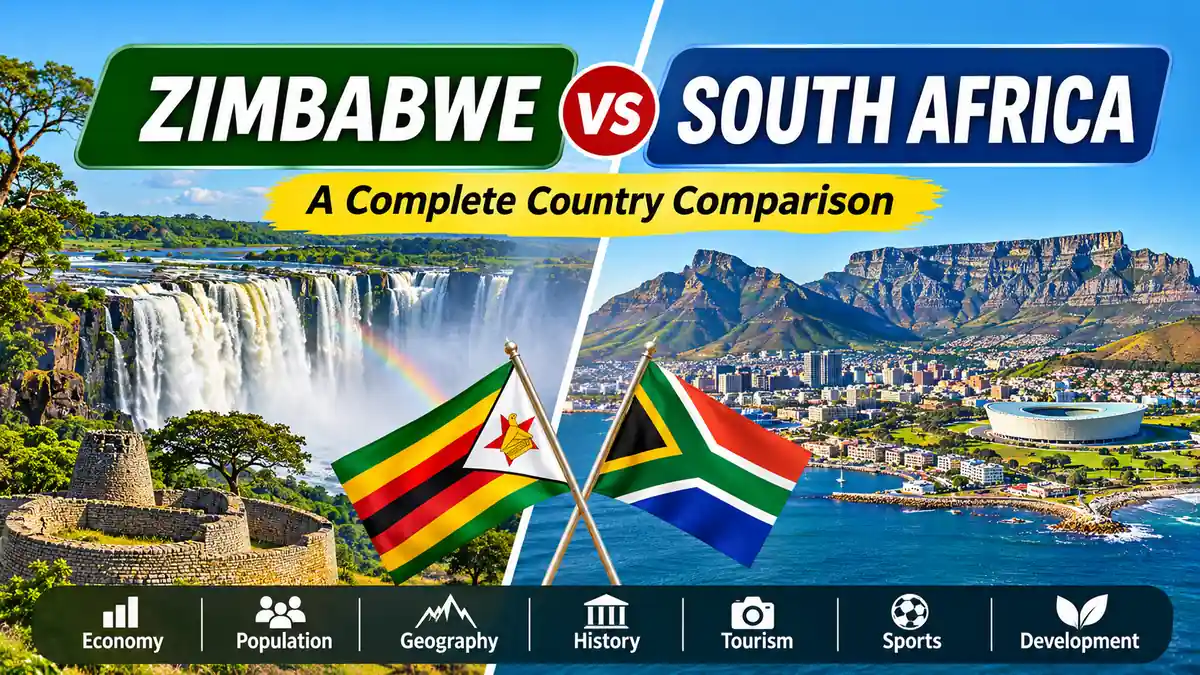
Zimbabwe and South Africa are neighboring countries in Southern Africa, but they differ considerably in economic size, population, infrastructure, tourism, and everyday living conditions. Both have rich histories, remarkable wildlife, diverse cultures, and important roles in the region.
When comparing zimbabwe vs south africa, South Africa has the larger economy, population, and industrial base, while Zimbabwe is known for Victoria Falls, Great Zimbabwe, mineral resources, and extensive natural landscapes. South Africa generally offers more developed infrastructure and a broader employment market, although both countries face economic and social challenges.
Understanding these differences requires looking beyond national rankings. Geography, historical events, currencies, public services, and cultural traditions all influence what makes each country distinctive.
zimbabwe vs south africa: Quick Comparison
The following table summarizes the major differences between the two countries.
| Feature | Zimbabwe | South Africa |
|---|---|---|
| Official name | Republic of Zimbabwe | Republic of South Africa |
| Location | Southern Africa | Southern tip of Africa |
| Capital | Harare | Pretoria, Cape Town, and Bloemfontein serve different capital functions |
| Population | Approximately 17 million | Approximately 63 million |
| Area | 390,757 km² | Approximately 1.22 million km² |
| Currency | Zimbabwe Gold (ZiG), officially ZWG, alongside permitted foreign currencies | South African rand (ZAR) |
| Official languages | 16 constitutionally recognized languages | 12 official languages |
| Independence milestone | 1980 | Democratic transition in 1994 |
| Largest city | Harare | Johannesburg |
| Major tourist attraction | Victoria Falls | Kruger National Park and Cape Town |
| Economic profile | Mining, agriculture, services, and trade | Diversified industry, mining, finance, manufacturing, and services |
| Coastline | Landlocked | Atlantic and Indian Ocean coastlines |
Population figures are rounded estimates and vary by reference year. Economic and currency conditions can change over time.
South Africa is approximately three times larger than Zimbabwe in land area and has nearly four times its population. These differences help explain its larger domestic market, extensive transport networks, and greater industrial capacity.
However, population and economic size alone do not determine quality of life, environmental conditions, or cultural importance.
Geography and Location: How Do Zimbabwe and South Africa Differ?
Go Over Big | National Geographic
Cape Town and the 12 Apostels from above
Zimbabwe and South Africa share a border along the Limpopo River. Both belong to the Southern African region and participate in the Southern African Development Community (SADC).
Their landscapes, however, are quite different.
Zimbabwe’s Geography and Natural Environment
Zimbabwe is a landlocked country bordered by Zambia, Mozambique, South Africa, and Botswana.
Much of the country consists of elevated plateaus, with the central Highveld forming an important agricultural and population region.
Its major geographical features include:
- Victoria Falls on the Zambezi River
- Lake Kariba, a major reservoir shared with Zambia
- The Eastern Highlands along the Mozambique border
- Hwange National Park, known for elephants and other wildlife
- The Limpopo River along parts of the southern border
Mount Nyangani, at approximately 2,592 meters, is Zimbabwe’s highest mountain.
The country has a tropical climate moderated by elevation, with a rainy season generally occurring from November to March and a cooler dry season during the Southern Hemisphere winter.
South Africa’s Geography and Natural Environment
South Africa occupies the southern end of the African continent and has coastlines along both the Atlantic and Indian Oceans.
Its landscapes include mountains, grasslands, deserts, forests, and coastal plains.
Major geographical features include the Drakensberg Mountains, the Great Escarpment, the Karoo, the Kalahari region, and the Cape Peninsula.
South Africa also surrounds the independent country of Lesotho and borders Eswatini, Mozambique, Zimbabwe, Botswana, and Namibia.
Unlike Zimbabwe, South Africa has several major seaports, including Durban, Cape Town, and Gqeberha. Maritime access supports international trade and industrial development.
Which Country Has the Better Climate?
Neither country has a universally better climate.
Zimbabwe generally experiences warm summers, seasonal rainfall, and dry winters. Harare’s elevation makes its temperatures more moderate than those of many lower-lying tropical cities.
South Africa has greater climatic variation. Cape Town experiences a Mediterranean climate with winter rainfall, while Johannesburg has summer rainfall and relatively dry winters. Durban has a humid subtropical climate.
People who prefer consistent inland conditions may appreciate Zimbabwe’s highland climate. Those seeking coastal weather or a wider variety of climatic zones may prefer South Africa.
Population, Languages, and Cultural Diversity
Population size is one of the clearest differences between the two countries.
South Africa has approximately 63 million residents, compared with roughly 17 million in Zimbabwe, using rounded mid-2020s estimates.
Both societies are multilingual and culturally diverse, but their demographic structures and urban systems differ.
Languages Spoken in Zimbabwe
Zimbabwe recognizes 16 languages under its constitution.
English, Shona, and Ndebele are especially prominent in administration, education, business, and everyday communication.
Shona is widely spoken across much of the country, while Ndebele is particularly important in the western regions.
Other recognized languages include Tonga, Kalanga, Venda, Nambya, Sotho, Tswana, Chewa, Shangani, and sign language.
English remains important in formal education and government documentation.
Languages Spoken in South Africa
South Africa recognizes 12 official languages, including South African Sign Language, which received official status in 2023.
Widely spoken languages include isiZulu, isiXhosa, Afrikaans, English, Sepedi, Setswana, and Sesotho.
English is commonly used in national business, higher education, and communication between speakers of different home languages.
South Africa’s linguistic diversity reflects its complex history of indigenous African communities, European settlement, migration, and cultural exchange.
Cultural Traditions and Identity
Zimbabwe is internationally recognized for its Shona stone sculpture, traditional music, mbira instruments, and historical stone architecture.
The Great Zimbabwe ruins represent an important part of the country’s precolonial history and cultural identity.
South Africa is often described as the Rainbow Nation, a phrase associated with its multicultural identity after apartheid.
Its cultural landscape includes Zulu, Xhosa, Sotho, Tswana, Afrikaans, Indian South African, and many other traditions.
Both countries celebrate music, dance, storytelling, traditional food, and community gatherings.
Their cultures cannot be reduced to a single national identity because regional, linguistic, and family traditions vary considerably.
Economy: Is South Africa Richer Than Zimbabwe?
South Africa has a substantially larger and more diversified economy than Zimbabwe. Its financial services, manufacturing, telecommunications, mining, and international trade sectors give it a stronger industrial base.
Zimbabwe’s economy depends more heavily on agriculture, mineral production, trade, and services, with economic performance influenced by rainfall, exchange-rate stability, and investment conditions.
GDP and Economic Growth Comparison
According to World Bank data for 2025, the economic differences are significant. Data+2
| Economic indicator (2025) | Zimbabwe | South Africa |
|---|---|---|
| GDP, current US dollars | $51.22 billion | $427.18 billion |
| GDP per capita | $3,021 | $6,598 |
| Annual GDP growth | 8.1% | 1.1% |
| Population | 16.95 million | 64.75 million |
| Modeled unemployment rate | 9.3% | 32.4% |
South Africa’s economy was approximately 8.3 times larger than Zimbabwe’s in nominal GDP terms in 2025.
Its GDP per capita was also more than twice Zimbabwe’s, indicating a higher average economic output per resident.
However, GDP per capita is not the same as household income. It does not show how evenly wealth is distributed or how much purchasing power individuals actually have.
Zimbabwe recorded stronger GDP growth in 2025, illustrating why economic size and annual growth should be considered separately.
Zimbabwe’s Main Industries
Zimbabwe has substantial natural resources and a long agricultural history.
Important industries include gold mining, platinum production, lithium extraction, tobacco farming, and tourism.
Gold is a particularly important export commodity. Platinum-group metals and lithium also contribute to Zimbabwe’s role in international mineral supply chains.
Agriculture supports rural livelihoods and domestic food production, although droughts and changing rainfall patterns create significant risks.
The country has opportunities in mineral processing, renewable energy, agricultural modernization, and regional trade.
Its main economic constraints include financing difficulties, infrastructure gaps, currency uncertainty, and limited industrial investment.
South Africa’s Main Industries
South Africa has one of the most diversified economies in Sub-Saharan Africa.
Its major sectors include:
- Financial services and banking
- Automotive manufacturing
- Mining and mineral processing
- Retail and wholesale trade
- Telecommunications and technology
- Agriculture and food processing
- Tourism and hospitality
Johannesburg is a major financial and commercial center, while Cape Town has significant tourism, technology, and creative industries.
Durban is an important logistics and manufacturing hub.
South Africa produces platinum-group metals, gold, chromium, manganese, and coal. Its automotive industry also connects the country to international manufacturing supply chains.
Despite these advantages, South Africa faces persistent unemployment, inequality, infrastructure constraints, and relatively slow economic growth.
Currency and Inflation Differences
Currency stability is another major consideration in the zimbabwe vs south africa economic comparison.
South Africa uses the South African rand, abbreviated ZAR. Its monetary policy is managed by the South African Reserve Bank.
Zimbabwe has experienced several currency reforms following periods of severe inflation and monetary instability.
In April 2024, the Reserve Bank of Zimbabwe introduced Zimbabwe Gold, commonly called ZiG. Its international currency code is ZWG. RBZ+1
Zimbabwe also operates a multicurrency system in which permitted foreign currencies, particularly the US dollar, are used alongside the domestic currency.
In April 2026, the Reserve Bank began introducing upgraded ZiG banknotes as part of its monetary policy framework. RBZ+1
For businesses and households, these currency arrangements affect pricing, savings, imports, and financial planning.
Cost of Living and Quality of Life
Is Zimbabwe cheaper than South Africa?
The answer depends on location, household income, spending habits, and access to goods and services.
Zimbabwe may offer lower costs for certain locally produced foods, informal services, and accommodation outside major urban centers.
However, imported products, electricity alternatives, fuel, and specialized services can be expensive relative to local earnings.
South Africa generally has a larger formal retail market, more extensive distribution networks, and a wider range of consumer products.
Housing and Everyday Expenses
Housing costs vary substantially within both countries.
In Zimbabwe, Harare and Bulawayo are important urban housing markets. Rental prices depend on neighborhood, property condition, water availability, and electricity reliability.
In South Africa, Johannesburg, Pretoria, Cape Town, and Durban offer different housing markets.
Cape Town’s desirable coastal and central neighborhoods can be particularly expensive, while smaller towns may provide more affordable alternatives.
A useful comparison should consider total monthly expenses rather than rent alone.
| Expense category | Zimbabwe | South Africa |
|---|---|---|
| Housing | Varies widely by city and neighborhood | Wide range, with expensive major-city areas |
| Groceries | Local goods may be affordable; imports can be costly | Extensive supermarket and retail networks |
| Electricity | Reliability varies; backup systems may be needed | Broad access, with local reliability differences |
| Transport | Shared taxis, minibuses, buses, private vehicles | Minibus taxis, buses, private cars, limited urban rail |
| Healthcare | Public and private options, with resource constraints | Larger public and private healthcare network |
| Education | Public and private institutions | Extensive public and private education systems |
These are qualitative comparisons, not fixed price rankings. Exchange rates and local market conditions can change the relative cost of living.
Healthcare Systems
Both countries have public and private healthcare providers.
Zimbabwe’s public healthcare system faces challenges involving staffing, medical equipment, medicine availability, and funding.
Private hospitals and clinics are available, particularly in larger cities, but affordability can be a barrier.
South Africa has a more extensive healthcare infrastructure, including major specialist hospitals and medical training institutions.
However, the difference between public and private healthcare access is substantial.
Public facilities face demand and resource pressures, while private healthcare can be expensive without suitable insurance or medical aid coverage.
Education and Universities
Zimbabwe has a strong educational tradition, with institutions such as the University of Zimbabwe, Midlands State University, and the National University of Science and Technology.
South Africa has a larger higher-education sector, including the University of Cape Town, University of the Witwatersrand, Stellenbosch University, and University of Pretoria.
South African universities generally offer a broader range of research facilities and postgraduate opportunities, although access and affordability differ by institution.
Zimbabwe also has respected academic institutions and graduates working throughout the Southern African region.
For students comparing the countries, tuition fees, academic programs, accreditation, living expenses, and admission requirements matter more than national reputation alone.
Tourism: Zimbabwe vs South Africa for Travelers
The magnificence of Victoria Falls, Zimbabwe.
Zimbabwe: Waterfalls, wildlife, and heritage
Zimbabwe is particularly attractive to travelers interested in Victoria Falls, safari experiences, archaeological heritage, and quieter wilderness destinations.
Popular places include Victoria Falls, Hwange National Park, Mana Pools National Park, and Great Zimbabwe.
Spot the ‘Big Five’ on an 8-Night South Africa Getaway 🐘 🦒
South Africa: Diverse landscapes and cities
South Africa offers a broader combination of wildlife tourism, beaches, mountains, cities, vineyards, and historical attractions.
Popular destinations include Cape Town, Kruger National Park, the Garden Route, and the Drakensberg Mountains.
Wildlife and Safari Experiences
Both countries offer opportunities to see elephants, lions, leopards, buffalo, and rhinoceroses, collectively known as the Big Five.
Zimbabwe’s Hwange National Park is especially well known for elephants and large wildlife populations.
Mana Pools, a UNESCO World Heritage Site, is famous for its Zambezi River landscapes and walking safari experiences.
South Africa’s Kruger National Park is one of the continent’s best-known wildlife reserves. Its road network, accommodation options, and established tourism facilities make it accessible to different types of travelers.
Private reserves adjacent to Kruger also provide guided safari experiences.
Neither country guarantees wildlife sightings. Animal movements vary with season, rainfall, habitat, and other environmental factors.
Natural Attractions and Outdoor Activities
Zimbabwe’s best-known attraction is Victoria Falls, called Mosi-oa-Tunya, meaning The Smoke That Thunders.
The waterfall lies on the Zambezi River between Zimbabwe and Zambia and is among the world’s most spectacular waterfall systems.
Visitors can explore rainforest viewpoints, river activities, and surrounding national parks.
South Africa offers Table Mountain, the Cape of Good Hope region, the Garden Route, Blyde River Canyon, and extensive beaches.
It also has established wine-producing regions around Stellenbosch, Franschhoek, and Paarl.
For visitors who enjoy varied landscapes within one country, South Africa has a particularly broad range of options.
Which Country Is Better for Tourism?
Zimbabwe may be especially appealing for a trip focused on Victoria Falls, wildlife, and historical sites.
South Africa may be more suitable for travelers who want to combine safari activities with major cities, coastal drives, restaurants, museums, and beaches.
Both countries offer memorable experiences, and the better destination depends on the traveler’s interests.
History and Political Development
Zimbabwe and South Africa share histories shaped by colonial rule, racial inequality, independence movements, and political transformation.
However, their paths toward majority-rule democracy were different.
Zimbabwe’s Independence in 1980
Zimbabwe was formerly known as Southern Rhodesia and later Rhodesia.
British colonial influence and white-minority rule shaped much of its twentieth-century political history.
Following a prolonged liberation struggle and political negotiations, Zimbabwe became internationally recognized as independent on April 18, 1980.
Robert Mugabe became the country’s first prime minister and later president.
His political leadership continued until 2017, when Emmerson Mnangagwa assumed the presidency.
Zimbabwe’s post-independence history includes land reform, economic crises, political disputes, and efforts to rebuild economic stability.
The country’s historical identity also extends far beyond colonialism.
Great Zimbabwe, a medieval stone-built city associated with the ancestors of Shona-speaking communities, demonstrates the region’s long history of organized settlement, trade, and architectural achievement.
South Africa’s Transition From Apartheid
South Africa’s modern political history was heavily influenced by apartheid, the system of institutionalized racial segregation introduced by the National Party government in 1948.
Apartheid restricted political rights, movement, residence, education, and economic opportunities along racial lines.
Resistance movements, including the African National Congress, played major roles in challenging the system.
Nelson Mandela became an internationally recognized symbol of resistance and reconciliation.
In 1994, South Africa held its first national democratic elections based on universal adult suffrage.
Mandela became the country’s first Black president.
The democratic transition marked a major historical turning point, although the social and economic effects of apartheid remain visible in contemporary inequalities.
Government and Regional Cooperation
Both Zimbabwe and South Africa are republics with elected political institutions.
Zimbabwe has a presidential system, while South Africa has a parliamentary system in which the National Assembly elects the president.
Both participate in the African Union and SADC.
South Africa is also a member of BRICS and the G20, reflecting its substantial international economic and diplomatic role.
Regional cooperation between the two countries involves trade, migration, infrastructure, security, and development.
Infrastructure, Employment, and Migration
Infrastructure and employment opportunities influence everyday living conditions and cross-border movement.
South Africa generally has a larger network of paved roads, airports, universities, hospitals, financial institutions, and industrial facilities.
Zimbabwe has important road, rail, and energy infrastructure, but maintenance and investment needs remain significant.
Transport and Connectivity
South Africa has major international airports serving Johannesburg, Cape Town, and Durban.
Its ports connect regional businesses with international shipping routes.
Zimbabwe’s major airports include Robert Gabriel Mugabe International Airport in Harare and Victoria Falls International Airport.
Road connections through Beitbridge are particularly important for trade between Zimbabwe and South Africa.
The Beitbridge border crossing is one of the region’s key commercial transport routes.
Both countries face challenges involving road maintenance, public transportation, and logistics efficiency.
Employment Opportunities
South Africa has a larger formal employment market in finance, engineering, healthcare, retail, technology, and manufacturing.
However, its unemployment rate remains exceptionally high.
World Bank modeled estimates place South African unemployment at approximately 32.4% in 2025. Data
Zimbabwe’s labor market includes formal employment, agriculture, informal trading, self-employment, and cross-border business activity.
Its modeled unemployment rate is lower, but this does not necessarily indicate stronger job security or higher wages.
In countries with large informal economies, many people work without regular salaries, formal contracts, or comprehensive social protection.
Therefore, employment comparisons should examine job quality, income stability, underemployment, and labor-force participation alongside unemployment statistics.
Migration Between Zimbabwe and South Africa
South Africa has long been an important destination for Zimbabwean migrants.
Economic opportunities, family connections, education, and regional proximity contribute to cross-border movement.
Zimbabwean communities are present in major South African cities and economic centers.
Migration also creates challenges involving immigration documentation, access to services, employment conditions, and social integration.
Both countries have responsibilities concerning lawful migration, labor protections, and the safety of residents and visitors.
Zimbabwe vs South Africa in Sports
Sports provide another important connection between the two countries.
Football, cricket, rugby, athletics, and other sports contribute to national identity and regional competition.
Football Rivalry
Zimbabwe’s national football team is known as the Warriors, while South Africa’s team is called Bafana Bafana.
Both participate in competitions organized by the Confederation of African Football (CAF), including the Africa Cup of Nations (AFCON) and FIFA World Cup qualification.
South Africa won AFCON in 1996 and hosted the FIFA World Cup in 2010, becoming the first African country to host the tournament.
Zimbabwe has qualified for several AFCON tournaments but has not won the continental championship.
In their December 29, 2025 AFCON meeting, South Africa defeated Zimbabwe 3–2. 11v11
The rivalry remains meaningful because of geographical proximity, shared sporting history, and supporters living across the two countries.
Cricket Comparison
Zimbabwe and South Africa are both full members of the International Cricket Council (ICC).
South Africa’s national team, known as the Proteas, has historically been more competitive across international cricket formats.
Its cricketing history includes internationally recognized players such as Jacques Kallis, AB de Villiers, Dale Steyn, and Kagiso Rabada.
Zimbabwe has also produced notable cricketers, including Andy Flower, Heath Streak, Brendan Taylor, and Sikandar Raza.
The two teams have competed in Test cricket, One Day Internationals, and Twenty20 Internationals.
South Africa has generally held the stronger historical record, but individual matches can still be competitive.
Rugby and Other Sports
South Africa is one of the world’s leading rugby nations.
The Springboks have won the Rugby World Cup four times, in 1995, 2007, 2019, and 2023.
Zimbabwe also has a rugby tradition, although its international achievements and professional resources have been more limited.
Both countries participate in athletics and regional sporting competitions.
Sports exchanges help strengthen cultural connections and regional relationships.
Which Country Is More Developed?
South Africa is generally more developed than Zimbabwe when comparing economic diversification, average income, industrial capacity, and access to advanced infrastructure.
However, development is multidimensional.
A country can have a large economy while experiencing severe inequality, unemployment, and poverty.
Likewise, a smaller economy may possess significant natural resources, educational strengths, and cultural assets.
Economic Development
South Africa’s higher GDP per capita indicates greater average economic output.
Its financial system, manufacturing capacity, and international trade connections are more extensive.
Zimbabwe has considerable mineral and agricultural resources, but economic instability and investment constraints have affected development.
Human Development and Social Conditions
The United Nations Development Programme’s Human Development Index (HDI) evaluates development through health, education, and income indicators.
South Africa generally ranks higher than Zimbabwe on this measure.
Nevertheless, both countries face challenges involving unequal opportunities, poverty, and access to essential services.
Life expectancy, educational attainment, healthcare availability, and household income should all be considered when evaluating living standards.
Safety and Security
Safety conditions vary considerably by city, neighborhood, and activity.
South Africa experiences serious violent-crime challenges, although risks differ substantially across locations.
Zimbabwe also experiences crime, including theft, fraud, and other offenses, but the countries’ security conditions should not be compared using stereotypes.
Travelers and residents should consult current official safety information, assess local conditions, and take practical precautions.
A national crime statistic cannot reliably describe the safety of every community.
Trade and Economic Relations Between Zimbabwe and South Africa
Zimbabwe and South Africa have closely connected economies.
South Africa is an important source of manufactured goods, machinery, consumer products, and industrial inputs for Zimbabwe.
Zimbabwe exports minerals, agricultural products, and other commodities through regional markets.
Cross-border trade supports businesses, transport operators, wholesalers, retailers, and households.
Why South Africa Matters to Zimbabwe’s Trade
South Africa’s manufacturing base and transport infrastructure make it a significant regional trading partner.
Zimbabwean businesses import goods through South African suppliers and logistics networks.
The Beitbridge corridor links Zimbabwe with South African transport routes and ports.
Commercial relationships also extend into banking, retail, telecommunications, and professional services.
Regional Organizations and Agreements
Both countries participate in SADC and the African Continental Free Trade Area (AfCFTA).
These frameworks aim to support regional economic integration and improve trade opportunities.
However, practical trade conditions still depend on customs procedures, infrastructure, product standards, and national regulations.
Economic cooperation can benefit both countries through improved transport, energy connections, investment, and market access.
Environmental Challenges and Natural Resources
Zimbabwe and South Africa both face environmental pressures related to climate change, water availability, mining, agriculture, and biodiversity conservation.
Water and Climate Risks
Zimbabwe depends heavily on seasonal rainfall for agriculture and water resources.
Droughts can affect crop production, hydroelectric power generation, and household water supplies.
Lake Kariba is particularly important because its water levels influence hydroelectric generation.
South Africa also faces recurring droughts, water infrastructure challenges, and regional water scarcity.
Climate conditions vary considerably across the country, making water management a major national priority.
Mining and Environmental Protection
Mining contributes substantially to both economies.
Zimbabwe’s gold, platinum, and lithium industries create employment and export opportunities, but mining can also affect water quality, land use, and ecosystems.
South Africa’s mining industry faces similar environmental issues, including land rehabilitation, water contamination, and emissions.
Responsible resource management requires effective regulation, environmental monitoring, and long-term rehabilitation.
Wildlife Conservation
Both countries contain internationally important wildlife habitats.
Zimbabwe’s national parks and conservation areas support elephants, lions, wild dogs, and numerous other species.
South Africa’s protected areas include major ecosystems supporting rhinos, elephants, predators, and diverse birdlife.
Conservation efforts must address habitat fragmentation, illegal wildlife trade, human-wildlife conflict, and climate pressures.
Cross-border conservation initiatives are particularly important because wildlife populations do not follow national boundaries.
Final Verdict: Zimbabwe vs South Africa
The zimbabwe vs south africa comparison reveals two neighboring countries with shared regional connections but different economic structures, geographical advantages, and development experiences.
South Africa has the larger economy, higher GDP per capita, broader industrial base, and more extensive transport and financial infrastructure. It also offers a wider variety of major cities, coastal destinations, and established tourism facilities.
Zimbabwe stands out for Victoria Falls, Great Zimbabwe, major wildlife habitats, mineral resources, and a rich cultural heritage. Its economy is smaller and faces significant structural challenges, but it remains an important contributor to Southern Africa’s agriculture, mining, tourism, and regional trade.
South Africa leads on most measures of economic scale and infrastructure, while Zimbabwe has distinctive natural, historical, and cultural strengths. Understanding both countries requires considering their individual circumstances rather than treating one as universally better than the other.