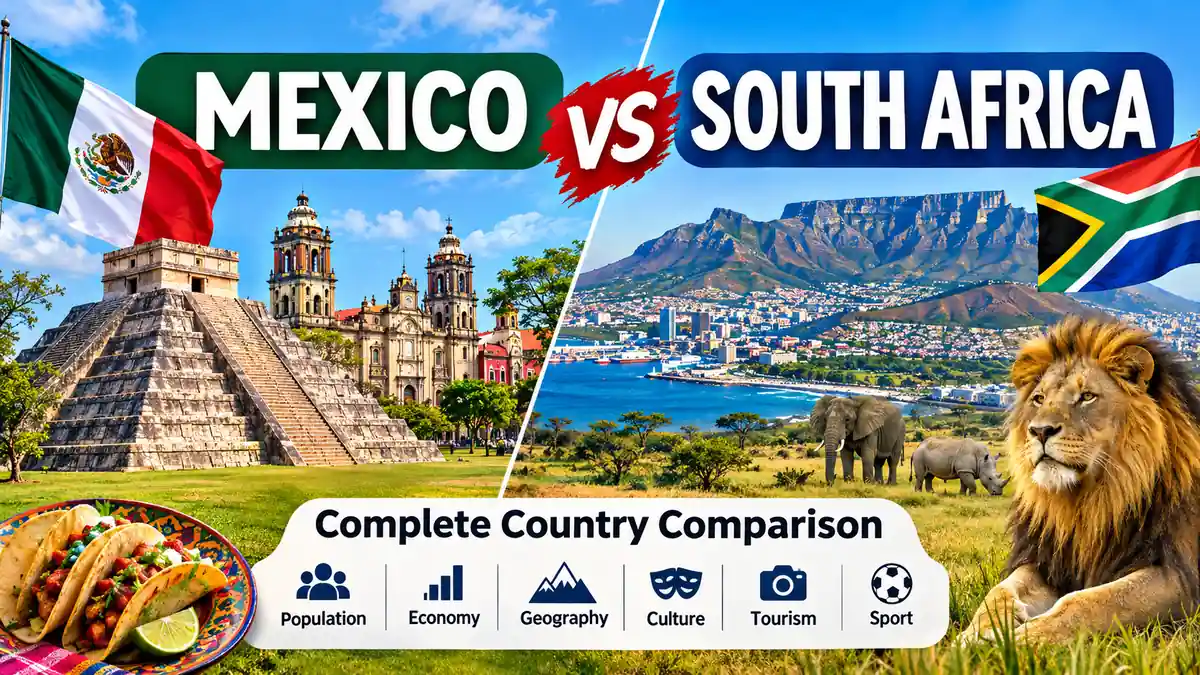
Mexico and South Africa are two influential countries on different continents, each known for its cultural diversity, remarkable landscapes, economic importance, and complex history. Although they share several characteristics as emerging economies, their populations, industries, living conditions, and geographical environments differ considerably.
In the mexico vs south africa comparison, Mexico leads in population, land area, total economic output, and GDP per capita. South Africa stands out for its mineral resources, multilingual society, wildlife tourism, and strategic position in African trade. Both countries offer distinctive cultural experiences, but face different economic and social challenges.
Understanding these differences helps explain how each country has developed and what makes it significant globally.
mexico vs south africa: Key Differences at a Glance
The following table compares major geographical, demographic, and economic indicators.
| Category | Mexico | South Africa |
|---|---|---|
| Continent | North America | Africa |
| Capital | Mexico City | Pretoria, Cape Town, and Bloemfontein (different government functions) |
| Land and water area | Approximately 1.96 million km² | Approximately 1.22 million km² |
| Population (2025) | 131.9 million | Approximately 64.7 million |
| GDP (2025, nominal) | $1.83 trillion | $427.2 billion |
| GDP per capita (2025) | $13,889 | $6,598 |
| Currency | Mexican peso (MXN) | South African rand (ZAR) |
| Major languages | Spanish and Indigenous languages | 12 official languages |
| Government | Federal presidential republic | Parliamentary republic |
| Major industries | Manufacturing, automotive, services, tourism | Mining, finance, manufacturing, tourism |
| Famous landmarks | Chichén Itzá, Teotihuacán | Table Mountain, Kruger National Park |
| Life expectancy (2024) | Approximately 75.3 years | Approximately 66.3 years |
Population, GDP, GDP per capita, and life expectancy figures are drawn from World Bank data and country comparisons. Data+2
The most striking difference is economic scale. Mexico produces more than four times South Africa’s nominal GDP, although that does not mean every Mexican household enjoys a higher standard of living.
Geography and Climate: How Do Mexico and South Africa Compare?
Location and geographical size
Mexico occupies the southern portion of North America. It borders the United States to the north and Guatemala and Belize to the southeast. Its coastlines extend along the Pacific Ocean, Gulf of Mexico, and Caribbean Sea.
South Africa lies at the southern end of the African continent. It borders Namibia, Botswana, Zimbabwe, Mozambique, and Eswatini, and surrounds the independent country of Lesotho.
Mexico covers approximately 1,957,000 square kilometers, compared with South Africa’s 1,220,000 square kilometers. Mexico is therefore about 60% larger by surface area.
Despite their different sizes, both countries contain mountains, plateaus, coastal plains, forests, and dry regions.
Climate and seasons
Mexico’s climate varies substantially by latitude and altitude.
Coastal destinations such as Cancún and Puerto Vallarta generally experience warm tropical or subtropical conditions. Northern Mexico includes extensive deserts, while higher-elevation cities such as Mexico City enjoy comparatively mild temperatures.
South Africa also has varied climatic regions.
Cape Town has a Mediterranean-type climate, with relatively dry summers and wetter winters. Johannesburg experiences warm, rainy summers and cooler, dry winters, while the country’s western interior includes semi-arid and desert environments.
One important distinction concerns the seasons. Mexico lies in the Northern Hemisphere, while South Africa lies in the Southern Hemisphere.
Consequently, July is generally summer in Mexico but winter in South Africa.
Natural landscapes
Mexico: Chichén Itzá
Südafrika Urlaub: Big Five erleben | Berge & Meer
South Africa: Table Mountain
Mexico is particularly famous for its volcanic mountains, cenotes, tropical beaches, and archaeological landscapes. The Sierra Madre mountain systems and Trans-Mexican Volcanic Belt are major geographical features.
South Africa is known for the Drakensberg mountains, the Karoo, the Cape Floristic Region, and its savanna ecosystems.
Both countries are biodiversity-rich, but their wildlife differs considerably. Mexico supports jaguars, howler monkeys, and numerous tropical species, whereas South Africa is famous for elephants, lions, rhinoceroses, leopards, and buffalo.
Quick takeaway: Mexico is larger and offers extensive tropical and volcanic landscapes. South Africa is especially distinctive for its savannas, safari ecosystems, and dramatic coastal scenery.
Population, Languages, and Cultural Diversity
Which country has the larger population?
Mexico has approximately twice the population of South Africa.
According to 2025 World Bank figures, Mexico had about 131.9 million residents, compared with approximately 64.7 million in South Africa. Data+1
Population comparison (2025)
Millions of people, approximate
0 million35 million70 million105 million140 millionMexicoSouth Africa
Mexico’s population is concentrated in major metropolitan areas, including Mexico City, Guadalajara, and Monterrey.
South Africa’s major urban centers include Johannesburg, Cape Town, Durban, and Pretoria.
Population distribution affects housing demand, transportation systems, employment opportunities, and public services in both countries.
Languages spoken
Spanish is the dominant language in Mexico, although numerous Indigenous languages are spoken throughout the country, including Nahuatl and several Mayan languages.
South Africa has a particularly diverse linguistic system, recognizing 12 official languages. These include isiZulu, isiXhosa, Afrikaans, English, Sesotho, and South African Sign Language.
English plays an important role in South African business, higher education, government, and tourism.
For English-speaking visitors, South Africa may present fewer everyday language barriers, although local language use varies significantly by region.
Religion and cultural traditions
Christianity is the largest religious tradition in both countries, but their cultural histories differ.
Mexico’s traditions reflect Indigenous civilizations, Spanish colonial influence, and centuries of cultural exchange.
Celebrations such as Día de los Muertos (Day of the Dead) demonstrate the relationship between Indigenous beliefs and Catholic traditions.
South African culture reflects the traditions of numerous African communities alongside European and Asian influences.
The country is often called the Rainbow Nation, a phrase associated with its post-apartheid commitment to national unity and diversity.
Music, dance, storytelling, religious ceremonies, and traditional clothing remain important expressions of identity in both societies.
Economy: Is Mexico Richer Than South Africa?
Mexico has a substantially larger economy than South Africa, both in total nominal GDP and average output per person.
However, understanding economic strength requires examining more than national income alone.
GDP and GDP per capita
According to the World Bank’s 2025 data:
Nominal GDP (US dollars)
Mexico
$1.83T
South Africa
$427.2B
Mexico’s GDP per capita was approximately $13,889, while South Africa’s was approximately $6,598. Data+1
This means Mexico’s nominal GDP per person was roughly 2.1 times South Africa’s.
GDP per capita is an average economic measure, not an individual’s salary or disposable income. It does not capture wealth distribution, housing affordability, or the quality of public services.
Major industries in Mexico
Mexico has a diversified economy closely connected to international manufacturing and trade.
Its principal industries include:
- Automotive manufacturing and vehicle components
- Electronics and electrical equipment
- Aerospace manufacturing
- Agriculture and food processing
- Oil and energy
- Tourism, retail, and financial services
Mexico benefits from extensive manufacturing integration with the United States and Canada through the United States–Mexico–Canada Agreement (USMCA).
Its geographical proximity to the United States also supports cross-border supply chains and industrial investment.
Major industries in South Africa
South Africa has one of Africa’s most diversified industrial economies.
Its important sectors include mining, finance, manufacturing, agriculture, logistics, and tourism.
The country is particularly significant in the production of platinum-group metals, gold, chromium, and manganese.
Johannesburg is a major financial center, while Durban and Cape Town are important commercial and logistics hubs.
The World Bank identifies South Africa’s diversified production base and developed financial sector as major strengths, while emphasizing persistent infrastructure and employment challenges. World Bank Group
Employment and economic challenges
Mexico’s modeled unemployment rate was approximately 2.7% in 2025, compared with around 32.4% in South Africa, according to World Bank indicators. Data+1
These figures represent a major difference, but they should not be interpreted without context.
Mexico has a substantial informal employment sector, meaning low measured unemployment does not necessarily indicate high wages or secure working conditions.
South Africa faces structural unemployment, skills mismatches, and long-standing inequalities associated with its economic history.
Both countries must also address regional disparities and unequal access to opportunities.
Quick takeaway: Mexico leads in total GDP, GDP per capita, and measured employment outcomes. South Africa remains a major African economic center with important mineral, financial, and industrial capabilities.
Cost of Living and Quality of Life
Comparing living expenses in Mexico and South Africa is more complicated than simply converting prices into US dollars.
Housing, transportation, healthcare, utilities, and groceries can vary dramatically between cities and neighborhoods.
Housing and everyday expenses
Mexico offers a wide range of living environments, from large metropolitan areas to smaller colonial towns and coastal communities.
Mexico City and popular tourist destinations can be relatively expensive, particularly in neighborhoods attracting international residents.
Smaller cities may offer considerably lower housing and transportation costs.
South Africa shows similar regional differences.
Cape Town has substantial demand for housing in desirable coastal and central neighborhoods, while Johannesburg, Pretoria, and smaller urban centers offer different price structures.
In both countries, household budgets depend heavily on location, income, family size, and lifestyle.
It is therefore misleading to declare either country universally cheaper without comparing specific cities and spending categories.
Healthcare systems
Mexico has a mixed healthcare system consisting of public institutions and private medical providers.
Major public institutions include the Mexican Social Security Institute (IMSS) and IMSS-Bienestar.
Private hospitals are widely available in larger cities, although medical costs and quality vary between facilities.
South Africa also operates public and private healthcare systems.
Its private healthcare sector includes advanced medical facilities, especially in major metropolitan areas. However, private insurance and treatment can be expensive relative to local incomes.
Public healthcare services face capacity and resource pressures, with access varying by province and facility.
Education and universities
Mexico has a large higher education system that includes the National Autonomous University of Mexico (UNAM), one of Latin America’s best-known universities.
Other institutions include Tecnológico de Monterrey and the National Polytechnic Institute.
South Africa’s prominent universities include the University of Cape Town, University of the Witwatersrand, and Stellenbosch University.
Both countries have internationally recognized research institutions, although access, tuition, language requirements, and educational outcomes differ.
Life expectancy and living standards
World Bank data for 2024 indicates life expectancy at birth of approximately 75.3 years in Mexico and 66.3 years in South Africa. comparison of key data · NationsTree
This difference reflects broader public-health and socioeconomic conditions rather than a single cause.
South Africa continues to confront major challenges associated with inequality, communicable diseases, and uneven healthcare access.
Mexico faces its own difficulties, including chronic diseases, regional healthcare disparities, and differences in access to medical services.
Life expectancy is useful for understanding national conditions, but it cannot predict an individual person’s lifespan or healthcare experience.
Tourism: Mexico vs South Africa for Travelers
Both countries are major international tourism destinations, but they appeal to different travel interests.
Mexico is particularly associated with beaches, archaeological sites, historic cities, and culinary tourism.
South Africa is internationally recognized for wildlife safaris, mountain landscapes, coastal scenery, and wine-producing regions.
Famous destinations in Mexico
Cancún
Caribbean beaches, resorts, and access to the Yucatán Peninsula.
Mexico City
Museums, historic neighborhoods, architecture, and food culture.
Temple of Kukulkan in Chichen Itza, Yucatan, Mexico
Chichén Itzá
A celebrated archaeological site associated with the ancient Maya civilization.
Things to know before going to Oaxaca City, Mexico – Lonely Planet
Oaxaca
Traditional cuisine, Indigenous heritage, crafts, and festivals.
Other well-known destinations include Puerto Vallarta, Los Cabos, Guanajuato, and the Riviera Maya.
Mexico’s tourism industry benefits from its proximity to the United States, extensive accommodation infrastructure, and variety of cultural and natural attractions.
Famous destinations in South Africa
Cape Town
Table Mountain, coastal scenery, cultural attractions, and nearby vineyards.
Selfie-taking tourists are putting endangered species at risk with poachers, experts say – ABC News
Kruger National Park
Wildlife safaris and opportunities to observe Africa’s iconic large mammals.
Garden Route Road Trip Itinerary 2025 — Cape Town to Addo in 7 Days | Beyond Africa Safaris
Garden Route
Forests, beaches, coastal towns, and scenic driving routes.
Südafrika Reisedauer: Wie lange sollte man bleiben? | Tourlane
Drakensberg Mountains
Mountain hiking, dramatic cliffs, and protected natural landscapes.
Johannesburg is also important for understanding South Africa’s political and cultural history, particularly through attractions connected to apartheid and the country’s democratic transition.
Which country is better for tourism?
The answer depends on the travel experience.
| Travel interest | Strong option |
|---|---|
| Caribbean beaches | Mexico |
| Traditional African wildlife safaris | South Africa |
| Ancient Mesoamerican archaeological sites | Mexico |
| Mountain and coastal road trips | Both |
| Wine tourism | South Africa |
| Mexican cuisine and cultural festivals | Mexico |
| Big Five wildlife viewing | South Africa |
| Historical museums and cultural heritage | Both |
Mexico is an especially attractive destination for travelers interested in ancient civilizations, beaches, and regional food traditions.
South Africa is particularly appealing to travelers seeking wildlife encounters, diverse natural scenery, and African cultural experiences.
Neither country is inherently the better destination for everyone.
Safety, Infrastructure, and Transportation
Safety is a major consideration when comparing Mexico and South Africa, especially for travelers and people considering relocation.
Both countries experience significant crime problems, but risks differ by city, neighborhood, and type of activity.
Safety in Mexico
Mexico faces challenges involving organized crime, violent crime, theft, and regional security disparities.
Some areas experience considerably higher risks than others.
Tourist districts may have dedicated security infrastructure, but their popularity does not eliminate the possibility of crime.
Travelers should research current conditions for their intended destinations rather than assuming that an entire state or city has one uniform risk level.
Safety in South Africa
South Africa experiences high levels of violent crime, including robbery and homicide, alongside property crime.
Security conditions vary substantially between neighborhoods and communities.
Visitors should pay particular attention to transportation arrangements, accommodation security, and local guidance.
In both countries, practical precautions include using established transportation services, avoiding unnecessary displays of valuables, and checking official travel advisories.
A national crime statistic cannot reliably determine the safety of an individual street, hotel, or travel itinerary.
Transportation infrastructure
Mexico has extensive road networks, major international airports, freight rail connections, and urban public transportation systems.
Mexico City’s Metro is among the country’s most important public transportation networks.
South Africa has major road corridors, international airports, commercial ports, and urban rail and bus services.
The Gautrain provides rail connections in parts of Gauteng, including Johannesburg, Pretoria, and the airport corridor.
However, South Africa has experienced infrastructure and public transportation challenges, including problems affecting rail services and electricity supply.
The World Bank reports improvements in electricity availability and logistics operations, although structural constraints remain. World Bank Group
History, Government, and International Relations
Mexico and South Africa have distinct historical experiences that continue to influence their political institutions and social structures.
Mexico’s historical development
Before Spanish colonization, the territory of modern Mexico was home to major Indigenous civilizations, including the Maya and Mexica (Aztec).
Spanish conquest began in the early 16th century, profoundly transforming the region’s political, religious, and economic systems.
Mexico’s independence movement began in 1810, and independence was achieved in 1821.
The Mexican Revolution, beginning in 1910, subsequently reshaped the country’s political institutions and land policies.
Today, Mexico operates as a federal presidential republic consisting of 31 states and Mexico City.
Its economy and foreign policy are closely connected to North America, particularly through trade with the United States and Canada.
South Africa’s historical development
South Africa’s history includes numerous Indigenous societies, European colonization, the development of mining industries, and struggles over land and political rights.
The Union of South Africa was established in 1910, and the country became a republic in 1961.
Apartheid, the institutionalized system of racial segregation and discrimination, was formally implemented beginning in 1948.
Following decades of resistance and negotiations, South Africa held its first democratic national elections based on universal adult suffrage in 1994.
Nelson Mandela became the country’s first Black president.
South Africa is now a constitutional democracy with a parliamentary system in which the National Assembly elects the president.
International influence
Mexico participates in organizations and economic arrangements including the United Nations, G20, OECD, and USMCA.
Its international significance is closely tied to manufacturing, trade, migration, and diplomatic relationships across the Americas.
South Africa is a member of the United Nations, G20, African Union, and BRICS.
It also plays an important diplomatic and economic role in Southern Africa and the wider African continent.
Both countries are influential middle powers, but their regional priorities and international relationships differ.
Food, Sports, and Everyday Culture
Mexican cuisine
Mexican tacos al pastor, tortillas with pork and vegetables in Mexico City
8
Mexican cuisine is internationally celebrated for its use of corn, beans, chili peppers, tomatoes, herbs, and regional cooking traditions.
Popular foods include tacos, tamales, mole, pozole, and enchiladas.
Traditional Mexican cuisine was recognized by UNESCO as part of the Intangible Cultural Heritage of Humanity in 2010.
Food traditions differ significantly between regions, with Oaxaca, Puebla, Yucatán, and northern Mexico offering distinctive culinary styles.
South African cuisine
South African food reflects Indigenous African, Dutch, British, Malay, and Indian influences.
Well-known dishes include bobotie, boerewors, pap, bunny chow, and potjiekos.
Braai, the South African tradition of cooking food over an open fire or coals, is an important social custom.
Regional food culture is closely connected to the country’s linguistic and historical diversity.
Popular sports
Football is extremely popular in both Mexico and South Africa.
Mexico also has strong traditions in boxing, baseball, and motorsport.
South Africa is particularly prominent in rugby union and cricket, alongside football.
The South African national rugby team, the Springboks, has won multiple Rugby World Cups.
Mexico’s national football team, commonly known as El Tri, has a long history of participation in the FIFA World Cup.
These sporting traditions are an important part of national identity and international recognition.
mexico vs south africa: FIFA World Cup History and Head-to-Head
The football rivalry between Mexico and South Africa is particularly memorable because the two national teams opened both the 2010 and 2026 FIFA World Cups.
The 2010 World Cup opening match
On June 11, 2010, South Africa hosted Mexico at Soccer City in Johannesburg.
The match ended in a 1–1 draw.
Siphiwe Tshabalala gave South Africa the lead with a memorable second-half goal, before Rafael Márquez equalized for Mexico.
The match was historically significant because it opened the first FIFA World Cup held on the African continent.
South Africa ultimately exited in the group stage, while Mexico advanced to the round of 16.
The 2026 World Cup opening match
On June 11, 2026, the teams met again in the opening match of the FIFA World Cup, this time at Mexico City Stadium.
FIFA WORLD CUP 2026 · GROUP A
11 June 2026
Mexico
2
–
South Africa
0
Goalscorers: Julián Quiñones (9′), Raúl Jiménez (67′)
Venue: Mexico City Stadium, Mexico City
Attendance: 80,824Source: FIFA official full-time match report. FIFA Football Data Platform
Mexico’s victory was an important result for the co-hosts and marked a successful beginning to their 2026 tournament.
The fixture also repeated a World Cup opening matchup exactly 16 years after the original encounter. Concacaf
Which team has the stronger World Cup history?
Mexico has a more extensive men’s FIFA World Cup record.
It has participated in significantly more tournaments and reached the quarterfinals in 1970 and 1986.
South Africa qualified for the men’s World Cup in 1998, 2002, 2010, and 2026. Its national team has not advanced beyond the group stage.
Before the 2026 opening match, Mexico had recorded two victories, one defeat, and one draw in four meetings with South Africa. The 2026 result extended Mexico’s advantage. Al Jazeera+1
Mexico therefore has the stronger historical World Cup record, although South Africa remains an important footballing nation within Africa.
Which Country Is More Developed: Mexico or South Africa?
Economic development cannot be measured using GDP alone.
A meaningful comparison should consider income, employment, healthcare, education, infrastructure, inequality, and access to essential services.
Mexico performs better on several major economic and social indicators, including GDP per capita, life expectancy, and measured unemployment.
South Africa has substantial strengths in finance, mineral resources, higher education, and industrial infrastructure, but faces particularly severe challenges involving unemployment and inequality.
Neither country can be accurately described as uniformly prosperous or disadvantaged.
Both contain economically advanced urban areas alongside communities facing poverty and inadequate services.
Mexico’s principal strengths and challenges
Mexico benefits from a large domestic market, substantial manufacturing capacity, established international trade relationships, and a major tourism sector.
Its challenges include regional inequality, informal employment, organized crime, water stress, and uneven public service provision.
South Africa’s principal strengths and challenges
South Africa benefits from important natural resources, sophisticated financial institutions, diverse industries, and a strategic regional location.
Its challenges include high unemployment, unequal income distribution, infrastructure limitations, and uneven access to economic opportunities.
For people comparing development outcomes, the most useful approach is to examine specific indicators rather than assigning a single overall label.
Final Verdict: Mexico vs South Africa
The mexico vs south africa comparison highlights two countries with different geographical advantages, economic structures, histories, and cultural identities.
Mexico has the larger population, greater land area, higher nominal GDP, and higher GDP per capita. Its manufacturing economy, North American trade connections, and tourism industry contribute substantially to its international importance.
South Africa stands out for its mineral resources, financial sector, multilingual society, remarkable wildlife, and influential position within Africa.
For tourism, Mexico is particularly attractive for archaeological sites, beaches, and Mexican cuisine, while South Africa is especially appealing for safaris, dramatic landscapes, and diverse cultural experiences.
In football, Mexico has the stronger historical FIFA World Cup record and won the countries’ 2026 opening-match encounter.
Ultimately, Mexico leads on several measurable economic and demographic indicators, but neither country is universally better. The most useful comparison depends on whether the priority is economic performance, cultural experiences, education, travel, safety, or quality of life.