One letter can completely change the meaning of a sentence. The words affect and effect look similar, sound similar, and both relate to change, yet they perform different grammatical jobs.
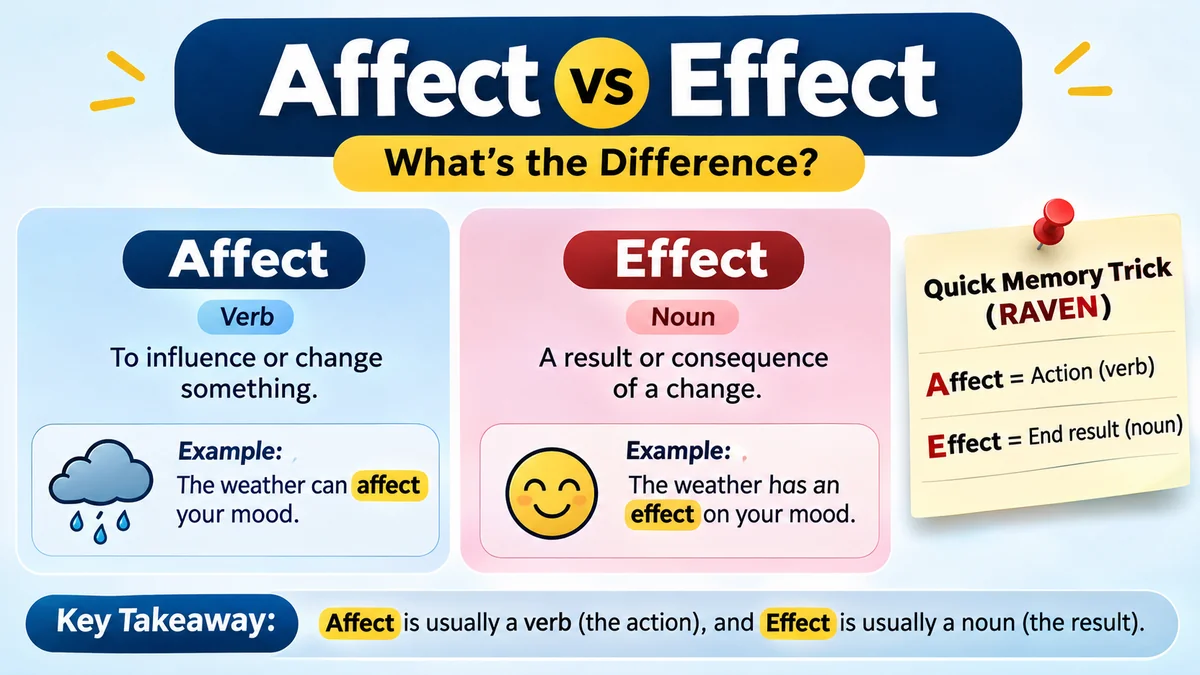
The simplest way to understand affect vs effect is to remember that affect is usually a verb meaning to influence or change something, while effect is usually a noun meaning the result of a change. For example, stress can affect your sleep, and poor sleep can have an effect on your health.
Once you understand the difference between an action and its result, choosing the correct word becomes much easier.
Affect vs Effect: The Main Difference
The distinction comes down to how each word functions in a sentence.
- Affect (verb): To influence, change, or make a difference to something.
- Effect (noun): A result, consequence, or outcome caused by an action or event.
Consider these sentences:
- The weather can affect your mood.
- The weather has an effect on your mood.
Both sentences communicate a similar idea, but their grammatical structures are different.
In the first sentence, affect describes what the weather does. In the second, effect names the result or influence associated with the weather.
| Feature | Affect | Effect |
|---|---|---|
| Most common part of speech | Verb | Noun |
| Basic meaning | To influence or change | A result or consequence |
| Main grammatical role | Describes an action | Names an outcome |
| Example | Noise affects concentration. | Noise has an effect on concentration. |
| Common pattern | Affect something | Have an effect on something |
| Memory trick | A = Action | E = End result |
The distinction applies in academic writing, professional communication, everyday conversations, and standardized English tests.
When to Use Affect in a Sentence
Affect is most commonly used as a verb. It describes how one person, event, condition, or action influences another.
Affect Means to Influence Something
Use affect when the sentence describes something causing a change or having an influence.
Examples:
- Lack of sleep can affect your memory.
- Rising temperatures affect agricultural production.
- Her decision will affect the entire team.
- Regular exercise can positively affect your mood.
- The new policy may affect thousands of employees.
In each example, affect communicates influence rather than naming the resulting outcome.
A useful test is to replace affect with influence.
Original:
The weather affects our travel plans.
Replacement:
The weather influences our travel plans.
Because the replacement makes sense, affect is the correct choice.
Affect, Affects, Affected, and Affecting
Like other regular verbs, affect changes form according to tense and subject.
| Verb form | Example |
|---|---|
| Affect | Changes in temperature affect plant growth. |
| Affects | Pollution affects air quality. |
| Affected | The storm affected several towns. |
| Affecting | Rising costs are affecting families. |
The present-tense form affects is used with third-person singular subjects, such as he, she, it, or a singular noun.
For example:
- Technology affects communication.
- New technologies affect communication.
The verb also works in passive constructions:
- Several roads were affected by flooding.
- The final decision could be affected by new evidence.
Common Phrases Using Affect
You will frequently encounter affect in discussions involving health, education, economics, science, and personal behavior.
Common combinations include:
- Affect performance
- Affect health
- Affect behavior
- Affect the outcome
- Affect the environment
- Affect productivity
- Affect someone’s decision
- Negatively affect
- Significantly affect
For instance, the phrase negatively affect means to influence something in an unfavorable way.
Example:
Excessive screen time may negatively affect sleep quality.
The word negatively describes the nature of the influence, while affect remains the main verb.
When to Use Effect in a Sentence
Effect is usually a noun referring to something that happens because of an action, decision, condition, or event.
It answers a different question from affect.
While affect asks what influences something, effect asks what happens as a result.
Effect Means a Result or Consequence
Examples:
- The medicine had a positive effect on her symptoms.
- The new law produced several unexpected effects.
- Regular practice has a noticeable effect on performance.
- The economic crisis had a lasting effect on employment.
- The teacher explained the effects of pollution.
In these sentences, effect identifies an outcome or consequence.
You can often replace effect with result or consequence.
Original:
The medication had a significant effect.
Replacement:
The medication had a significant result.
Although the replacement is less natural stylistically, it illustrates that effect functions as a noun. A smoother alternative is, “The medication produced a significant result.”
Effect and Effects: Singular and Plural
The noun effect can be singular or plural.
Use effect when discussing one result or an overall influence:
The announcement had an immediate effect on the market.
Use effects when discussing multiple results:
Scientists studied the effects of air pollution on human health.
Some effects may be beneficial, while others may be harmful.
For example, exercise can have several effects on the body, including changes in cardiovascular fitness, muscular strength, and energy expenditure.
Common Phrases Using Effect
Several established expressions use effect as a noun.
| Expression | Meaning | Example |
|---|---|---|
| Side effect | An additional, often unwanted result | Drowsiness is a possible side effect. |
| Positive effect | A beneficial outcome | Reading has a positive effect on vocabulary development. |
| Negative effect | A harmful outcome | Pollution has a negative effect on ecosystems. |
| Long-term effect | A result lasting over time | The long-term effects remain uncertain. |
| Take effect | Begin operating or applying | The regulation takes effect tomorrow. |
| In effect | Currently operating or effectively true | The restrictions remain in effect. |
| Cause and effect | Relationship between an action and its result | Students examined cause and effect. |
| Ripple effect | A series of spreading consequences | The closure created a ripple effect across local businesses. |
Understanding these expressions makes it easier to recognize effect in natural English.
Affect vs Effect Examples in Everyday English
Comparing the two words in similar situations is one of the most effective ways to learn their differences.
Health and Lifestyle
Affect:
Poor nutrition can affect physical development.
Effect:
Poor nutrition can have an effect on physical development.
The first sentence describes an influence. The second names that influence as an effect.
Education and Learning
Affect:
Classroom noise can affect students’ concentration.
Effect:
Classroom noise can have a negative effect on students’ concentration.
Both sentences discuss the same relationship, but the grammatical construction changes.
Weather and Climate
Affect:
Heavy rainfall may affect transportation.
Effect:
Heavy rainfall may have several effects on transportation.
The noun effects could refer to road closures, delayed services, and reduced visibility.
Business and Economics
Affect:
Higher interest rates can affect consumer spending.
Effect:
Higher interest rates can have an effect on consumer spending.
The verb focuses on the action of influencing spending, while the noun identifies the resulting impact.
Technology and Communication
Affect:
Social media can affect how people communicate.
Effect:
Social media has had a noticeable effect on communication habits.
These examples demonstrate that both words can appear in discussions about the same subject without being interchangeable.
How to Remember Affect vs Effect
The easiest memory technique is the RAVEN rule, a widely taught mnemonic for distinguishing the two words.
A
Affect
Action (verb)
E
Effect
End result (noun)
The basic distinction: an action influences something and produces a result.
RAVEN stands for:
- R — Remember
- A — Affect
- V — Verb
- E — Effect
- N — Noun
This mnemonic covers the most common uses of both words.
The Action and Result Trick
Think of affect as the action and effect as the result.
Example:
The storm affected the city, and its effects lasted for several days.
Here, affected describes what the storm did. Effects refers to the consequences it left behind.
The Replacement Test
When uncertain, try replacing the word with a synonym.
If influence works as a verb, choose affect.
If result or consequence works as a noun, choose effect.
For example:
How will the decision affect employees?
You could say:
How will the decision influence employees?
Therefore, affect is appropriate.
Now consider:
What effect will the decision have?
You could ask:
What consequence will the decision have?
Therefore, effect is appropriate.
These tests are reliable for everyday usage, although both words have less common grammatical meanings.
Can Affect Be a Noun and Effect Be a Verb?
Yes. Although the usual rule is affect = verb and effect = noun, both words have less common meanings that reverse their grammatical roles.
These exceptions are especially relevant in psychology, medicine, academic research, and formal writing. English meaning – Cambridge Dictionary+1
Affect as a Noun in Psychology
In psychology and psychiatry, affect refers to a person’s emotional expression or observable emotional state.
For example:
The clinician observed that the patient displayed a flat affect.
A flat affect means a noticeably reduced outward expression of emotion. It does not necessarily mean the person experiences no emotions.
Other expressions include:
- Blunted affect: A reduction in the intensity of emotional expression.
- Restricted affect: A limited range of observable emotional expression.
- Labile affect: Emotional expression that changes rapidly or unpredictably.
- Positive affect: Pleasant emotional experiences or expressions, depending on the research context.
- Negative affect: Unpleasant emotional experiences or expressions.
When used as a psychological noun, affect is commonly pronounced AF-ekt, with stress on the first syllable.
This differs from the usual verb pronunciation, which stresses the second syllable.
Effect as a Verb Meaning to Bring About
Effect can also function as a verb meaning to bring about, accomplish, or cause something to happen.
For example:
The organization worked to effect meaningful change.
Here, effect means to make change happen, not merely to influence an existing situation.
Compare:
- The new manager affected company policies.
- The new manager effected changes in company policies.
The first sentence means the manager influenced the policies.
The second means the manager brought about changes.
This distinction is recognized in formal English usage, including the guidance from BBC Learning English. downloads.bbc.co.uk+1
Affect as a Verb Meaning to Pretend
Another less common meaning of affect is to pretend to have a particular feeling, characteristic, or manner.
For example:
He affected an air of confidence despite feeling nervous.
This means he deliberately presented himself as confident.
Similarly:
She affected a British accent during the performance.
In this context, affected means adopted or imitated rather than influenced.
The distinction is useful when reading literature or formal descriptive writing.
Affect vs Effect in Academic and Professional Writing
The two words appear frequently in essays, scientific papers, research reports, and business documents.
Choosing the correct one improves grammatical precision and helps communicate cause-and-effect relationships.
Scientific Research
Scientific writing often distinguishes between variables that influence an outcome and the effects researchers observe.
Consider:
Temperature affects the rate of a chemical reaction.
Here, temperature is the influencing factor.
Now compare:
Researchers measured the effect of temperature on the reaction rate.
In this sentence, effect refers to the relationship being investigated or measured.
In experimental research, an independent variable is manipulated or selected to examine its relationship with a dependent variable.
For example, a researcher might study how the amount of sunlight affects plant growth and then measure the effect through changes in plant height.
The grammar helps separate the influencing factor from the observed result.
Academic Essays
Students frequently use these words when explaining causes, consequences, and relationships.
Correct examples:
- Social inequality can affect educational opportunities.
- Economic development has several effects on urban communities.
- The author’s argument affected how readers interpreted the evidence.
- The study examined the effects of prolonged stress on memory.
In an academic paper, the phrase the effect of X on Y is particularly common.
Examples include:
- The effect of temperature on enzyme activity
- The effect of technology on education
- The effect of exercise on cognitive performance
- The effect of economic policy on employment
When describing what X does to Y, however, use the verb affect.
Business Communication
Professional emails and reports also rely on this distinction.
Incorrect:
The delay will effect our delivery schedule.
Correct:
The delay will affect our delivery schedule.
The sentence describes an influence on an existing schedule, not the creation of a new schedule.
Another example:
The revised procedure will take effect on Monday.
Here, take effect means the procedure will begin to apply.
Understanding these differences prevents confusion in workplace communication.
Common Affect vs Effect Grammar Mistakes
Many errors occur because writers focus on the meanings of the words without considering their grammatical functions.
The following examples show frequent mistakes and their corrections.
| Incorrect sentence | Correct sentence | Explanation |
|---|---|---|
| The weather will effect our plans. | The weather will affect our plans. | A verb meaning influence is needed. |
| Stress has a negative affect on sleep. | Stress has a negative effect on sleep. | A noun meaning result or impact is needed. |
| How does this effect you? | How does this affect you? | The sentence asks about influence. |
| The changes had several affects. | The changes had several effects. | The plural noun is required. |
| The new rules will take affect tomorrow. | The new rules will take effect tomorrow. | Take effect is the established expression. |
| Pollution effects human health. | Pollution affects human health. | Affect is the normal verb for influence. |
Is It Affect Me or Effect Me?
In ordinary English, affect me is correct when something influences you.
Example:
The criticism did not affect me.
The phrase effect me would not normally express this meaning.
The verb effect means to bring something about, and it is generally used with an object such as change, reform, or improvement.
Is It Affected By or Effected By?
Both constructions are grammatically possible, but they mean different things.
Affected by means influenced or changed by something.
The neighborhood was affected by the flood.
Effected by means brought about or accomplished by something.
The reforms were effected by the new administration.
The second construction is relatively formal and less common in everyday communication.
Is It Positive Affect or Positive Effect?
Both expressions exist, but they refer to different concepts.
A positive effect is a beneficial outcome.
Exercise can have a positive effect on physical fitness.
In psychology, positive affect refers to pleasant emotional states or their expression.
Researchers measured participants’ positive affect after the activity.
For general writing about benefits, positive effect is usually the intended phrase.
Is It Cause and Affect or Cause and Effect?
The correct expression is cause and effect.
A cause is something that produces an outcome. An effect is the outcome produced.
Example:
The teacher explained the relationship between cause and effect.
This expression is widely used in science, history, philosophy, reading comprehension, and critical thinking.
Affect vs Effect Pronunciation and Word Forms
Pronunciation alone is not a reliable way to distinguish these words because their sounds are very similar in many English accents.
The usual pronunciations are:
| Word | Common pronunciation | Stress |
|---|---|---|
| Affect (verb) | /əˈfekt/ | Second syllable |
| Effect (noun) | /ɪˈfekt/ or /əˈfekt/ | Second syllable |
| Affect (psychology noun) | /ˈæfekt/ | First syllable |
The pronunciation of effect varies across accents and speakers. Some pronounce its initial vowel distinctly, while others pronounce it almost identically to the verb affect. downloads.bbc.co.uk+1
Related Words: Effective, Affective, and Effectiveness
Understanding related words can also help distinguish their meanings.
Effective means successful in producing an intended result.
The new teaching method was effective.
Effectiveness refers to the degree to which something achieves its intended outcome.
Researchers evaluated the effectiveness of the training program.
Affective refers to feelings, emotions, or emotional responses.
The study explored the affective aspects of learning.
Affecting can describe something emotionally moving.
The documentary included an affecting account of the family’s experience.
Although these words share similar roots, they are not interchangeable.
For example, effective learning describes learning that produces successful results, while affective learning concerns emotional dimensions of learning.
Test Your Understanding of Affect vs Effect
Practice is a useful way to turn the grammar rule into a habit.
Choose affect, effect, affects, or effects to complete each sentence.
Grammar practice
0 of 6 answered
1. The weather may ___ our travel plans.affecteffect
2. The medicine had a positive ___ on her recovery.affecteffect
3. Noise ___ concentration in busy classrooms.affectseffects
4. The researchers examined the ___ of climate change.affectseffects
5. The new policy will take ___ next week.affecteffect
6. The organization hopes to ___ meaningful reform.affecteffect
Check answersReset
The key is to identify whether the sentence describes an action, an outcome, or one of the less common grammatical exceptions.
Final Thoughts on Affect vs Effect
The difference between affect vs effect becomes straightforward when you focus on sentence structure.
Use affect as a verb when describing how something influences another person, situation, or outcome. Use effect as a noun when naming the result or consequence of that influence.
Remember the RAVEN mnemonic: Affect is a Verb; Effect is a Noun.
For more advanced writing, remember the exceptions: effect can be a formal verb meaning to bring about change, while affect can be a psychology noun referring to emotional expression or experience.
Whenever you are uncertain, try the replacement test: use influence for the verb and result for the noun. With regular practice, choosing the correct word becomes a natural part of writing clear, accurate English.