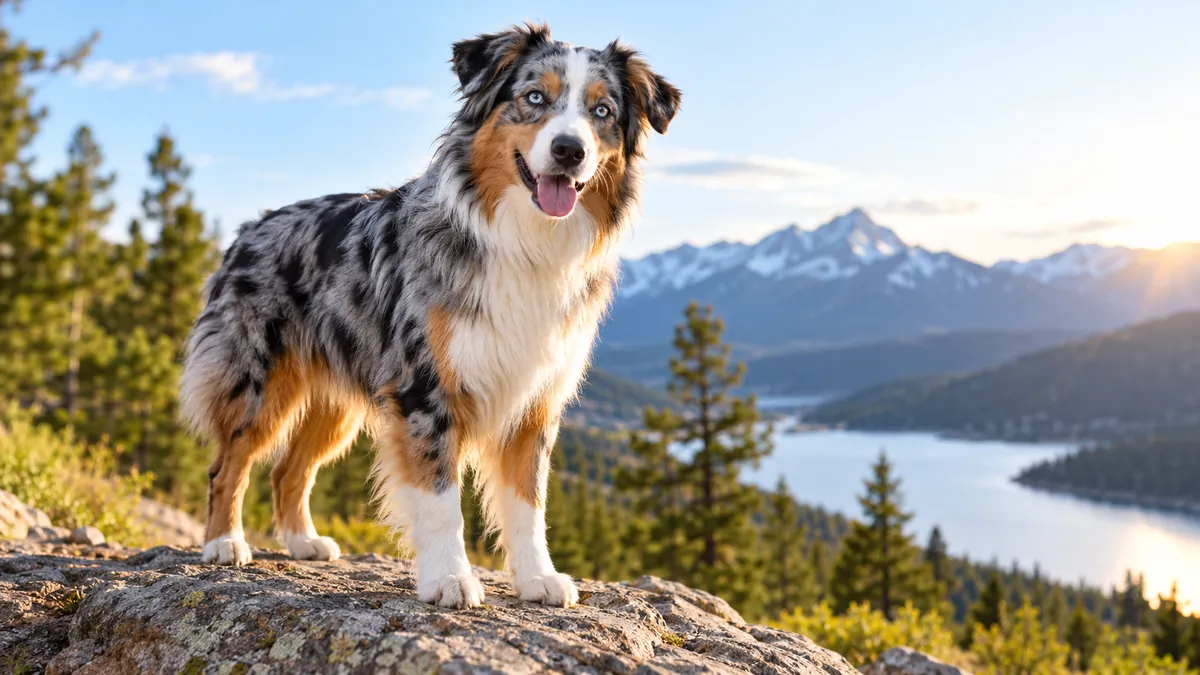
Few dogs combine intelligence, athleticism, loyalty, and working instinct as intensely as the australian shepherd. Often called the Aussie, this medium-sized herding breed is famous for striking blue merle and red merle coats, bright eyes, and an almost endless willingness to work.
That combination can make an Aussie an outstanding companion—but it also explains why the breed is not an effortless pet. Australian Shepherds need meaningful physical exercise, mental stimulation, consistent training, and plenty of interaction with their people.
The australian shepherd is a medium-sized, highly intelligent herding dog developed largely in the United States. Aussies typically stand about 18–23 inches tall, weigh roughly 40–65 pounds, and live around 12–15 years. They are energetic, trainable, loyal dogs best suited to households that can provide daily exercise, mental challenges, training, and companionship.
| Australian Shepherd at a Glance | Typical Characteristics |
|---|---|
| Breed group | Herding |
| Height | About 18–23 inches |
| Weight | About 40–65 pounds |
| Lifespan | Around 12–15 years |
| Coat | Medium-length double coat |
| Common colors | Black, red, blue merle, red merle |
| Energy level | Very high |
| Intelligence | Very high |
| Shedding | Moderate to heavy |
| Training needs | High |
| Best suited for | Active, engaged households |
| Common activities | Herding, agility, obedience, hiking, running |
Individual dogs vary considerably, so these figures describe the breed rather than predicting exactly how one particular Aussie will behave.
What Is an Australian Shepherd?
The australian shepherd is a versatile working and herding dog traditionally associated with ranches, livestock, cowboys, and the American West.
Aussies were bred to think while working. A useful stockdog cannot simply wait for instructions every second; it needs to notice movement, respond quickly, and stay engaged with both livestock and its handler.
That working background still shapes the modern breed.
An Aussie may notice a person walking toward the house before everyone else does. It may try to control the movement of another dog. Some attempt to herd running children. Many learn household routines remarkably quickly.
Their intelligence is therefore more than an ability to memorize tricks. It is paired with observation, drive, stamina, and problem-solving.
Why Is It Called an Australian Shepherd?
The name is one of the most confusing things about the breed because the Australian Shepherd is generally regarded as having been developed into the breed we recognize today in the United States rather than Australia.
The breed became closely associated with American ranching and cowboy culture. Historical accounts connect its ancestry and name with shepherds and dogs that traveled through Australia before reaching the United States. The exact development of the breed is more complicated than the name suggests, so describing it simply as an Australian dog is misleading.
The Australian Shepherd Club of America (ASCA), established in 1957, became an important breed organization and registry. The American Kennel Club later recognized the Australian Shepherd in 1993.
Australian Shepherd Size and Appearance
An adult Australian Shepherd has a balanced, athletic build designed for movement rather than bulk.
According to AKC breed information, adults are generally around 18–23 inches tall and 40–65 pounds, with males typically larger than females.
An Aussie should look capable of working for extended periods. The body is agile and muscular without the exaggerated heaviness seen in some larger breeds.
Male vs. Female Australian Shepherd Size
There is overlap between males and females, but males are generally taller and heavier.
| Trait | Male | Female |
|---|---|---|
| Typical height | 20–23 inches | 18–21 inches |
| General build | Larger, heavier | Usually lighter, smaller |
| Breed type | Medium-sized | Medium-sized |
Weight is influenced by sex, genetics, build, activity, diet, and overall health. A healthy body condition matters more than trying to make a dog match one number on a chart.
Coat and Colors
One of the breed’s most recognizable characteristics is its medium-length double coat.
Standard coat colors include:
- Black
- Red
- Blue merle
- Red merle
Dogs can also have white markings and/or tan points.
Merle produces irregular areas of darker and lighter pigmentation rather than a single uniform coat color. Blue merle usually combines black and gray tones, while red merle combines shades based on red/brown pigmentation.
Eye colors can also vary. Aussies may have brown, blue, amber, or differently colored eyes, and some have more than one color within an eye.
Blue eyes themselves should not automatically be treated as evidence of deafness or eye disease. The Australian Shepherd Health & Genetics Institute (ASHGI) notes that blue eyes can be more sensitive to bright light but are not inherently more susceptible to eye disease.
Australian Shepherd Temperament and Personality
The typical Australian Shepherd temperament can be summarized with four words: intelligent, energetic, devoted, and driven.
That description sounds ideal, but each quality has another side.
Intelligence means an Aussie learns desired behaviors quickly—but it can learn unwanted routines just as fast. Loyalty can become excessive attachment if independence is never taught. Herding instinct can produce chasing or nipping behaviors. High energy can become frustration when the dog lacks appropriate outlets.
Are Australian Shepherds Affectionate?
Many Aussies form very strong relationships with their families and want to stay close to their people.
This is generally not a breed that thrives when routinely isolated from the household. Breed guidance emphasizes their strong desire for human companionship.
Affection varies between individuals. Some are physically cuddly; others show attachment by following their owner, watching what is happening, bringing toys, or waiting for the next activity.
Are Australian Shepherds Aggressive?
Aggression should not be considered a defining feature of a well-adjusted Australian Shepherd.
However, Aussies may be naturally watchful or somewhat reserved with unfamiliar people. Herding and guarding tendencies can also make them more environmentally alert than an indiscriminately social breed.
Poor socialization, fear, chronic frustration, pain, genetics, and inappropriate handling can contribute to behavioral problems in any dog.
Early positive exposure matters. Puppies should gradually experience different people, surfaces, sounds, environments, handling, friendly dogs, vehicles, and everyday situations without being overwhelmed.
The Herding Instinct Matters
An Australian Shepherd may attempt to herd:
- Children
- Other dogs
- Cats
- Birds
- Running people
- Bicycles or moving objects
Herding behavior can include staring, circling, chasing, blocking movement, and occasionally nipping at heels.
That does not mean the dog is being malicious. It means a working behavior is appearing in an inappropriate context.
The solution is not simply to exhaust the dog. Teach impulse control, recall, settling, appropriate play, and alternative behaviors while providing safe outlets for its working instincts.
Are Australian Shepherds Good Family Dogs?
Yes, an Australian Shepherd can be an excellent family dog for the right family.
Aussies often become closely bonded to household members and can live successfully with children. The important qualification is that their energy and herding behavior require management. AKC guidance specifically notes that Aussies may attempt to herd children.
A home with young children should teach both sides of the relationship.
Children need to understand that a dog should not be climbed on, cornered, disturbed while sleeping, or bothered while eating. The dog needs to learn calm behavior around running, shouting, toys, visitors, and household excitement.
Adult supervision remains essential, especially with young children.
Are Australian Shepherds Good With Other Dogs?
Many are.
Early socialization and good introductions make a substantial difference. An individual dog’s genetics, previous experiences, age, sex, and social skills also affect compatibility.
Because Aussies can be intense during play, a calm dog may not always appreciate an energetic Aussie repeatedly trying to initiate interaction.
Living successfully with cats is also possible, particularly when the dog is raised around them, but chasing and herding tendencies should be addressed rather than ignored.
How Much Exercise Does an Australian Shepherd Need?
This is one of the most important questions prospective owners should ask.
Australian Shepherds are high-energy working dogs, not dogs bred primarily for a sedentary companion lifestyle. They need substantial daily activity along with opportunities to use their brains. AKC and Purina breed guidance both emphasize their high activity level and suitability for activities such as herding, agility, walking, hiking, and running.
There is no universally correct number of exercise minutes for every Aussie. A young working-line adult may need considerably more activity than a senior companion.
The better question is whether the dog receives an appropriate combination of:
- Physical movement
- Mental work
- Training
- Social interaction
- Rest
Exercise That Actually Works
Simply putting an Aussie in a large yard often isn’t enough.
A yard provides space, but space does not automatically provide purposeful activity.
Useful options include brisk walks, hiking, structured games, retrieving, swimming where appropriate, scent work, obedience exercises, herding activities, and dog sports.
Australian Shepherds commonly participate in agility, obedience, rally, tracking, scent work, dock jumping, and stockdog events. ASCA operates performance programs across several of these disciplines.
Mental Exercise Is Just as Important
A common mistake is trying to solve every behavioral problem by adding more running.
That can produce a dog with even greater physical endurance without teaching it how to settle.
Instead, combine physical exercise with tasks such as:
- Short training sessions
- Food puzzles
- Hide-and-seek
- Scent searches
- Retrieving specific objects
- Place/mat training
- Recall games
- Trick training
- Controlled tug
- Obedience sequences
Five or ten focused minutes of learning can sometimes leave an intelligent dog more satisfied than wandering around a yard for much longer.
Quick Takeaway: An Australian Shepherd needs more than exercise. The best routine challenges the body and brain while also teaching the dog that calm downtime is part of everyday life.
Australian Shepherd Training
Australian Shepherd training can be extremely rewarding because these dogs generally learn quickly and enjoy interacting with their handlers.
The challenge is staying one step ahead.
An intelligent puppy can discover that jumping opens doors, barking starts games, stealing objects triggers a chase, or pulling on the leash gets it somewhere faster.
Consistency from the beginning prevents many of these habits.
Start Training Early
AKC puppy guidance recommends beginning with fundamentals such as name recognition, sit, down, recall, and polite leash walking while puppies are still young.
Prioritize practical life skills:
- Name response
- Reliable recall
- Loose-leash walking
- Sit and down
- Leave it
- Drop it
- Stay/wait
- Settle on a mat
- Comfortable handling
- Calm greetings
Reward-based training is particularly useful with a bright, engaged working breed because it clearly communicates which behaviors earn reinforcement.
Socialization Does Not Mean Meeting Everyone
Good socialization is often misunderstood.
The goal isn’t to make your puppy greet every person and dog. It is to teach the puppy that unfamiliar sights, sounds, animals, people, and environments can exist without requiring fear or overexcitement.
A well-socialized adult should be capable of remaining composed around ordinary life.
Teach an Off-Switch
This may be one of the most valuable lessons for an Aussie.
Owners sometimes accidentally teach puppies that every waking moment involves entertainment. Later, the dog demands constant activity.
Build calmness deliberately.
Reward lying quietly. Use a mat or bed. Provide appropriate chew activities. Keep predictable rest periods. Teach the dog that nothing happening is normal.
A dog capable of relaxing after its needs are met is much easier to live with than one expecting continuous stimulation.
Australian Shepherd Grooming and Shedding
Does an Australian Shepherd shed?
Yes.
Aussies have a double coat and shed throughout the year, with heavier shedding periods when the undercoat changes seasonally.
Regular brushing removes loose fur, helps prevent tangles and mats, distributes natural oils, and gives owners an opportunity to check the skin.
Breed-care guidance recommends approximately weekly brushing, with additional undercoat removal during heavier shedding periods.
Basic Grooming Routine
A practical routine includes:
| Grooming Task | General Approach |
|---|---|
| Brushing | At least weekly; more during heavy shedding |
| Bathing | As needed based on dirt and lifestyle |
| Nails | Trim regularly |
| Teeth | Brush routinely |
| Ears | Check for dirt, irritation, odor, or discharge |
| Coat | Check for mats, burrs, ticks, and skin changes |
Dogs spending time hiking, working livestock, or running through brush should receive quick coat and paw checks after outings.
Should You Shave an Australian Shepherd?
Routine shaving is generally unnecessary for a healthy double-coated Aussie.
Regular brushing and undercoat management are usually more appropriate. There can be medical or severe matting situations where clipping is required, but those are different from shaving a healthy dog simply because the weather is warm.
A veterinarian or experienced professional groomer can advise when there is a medical or coat-management reason for clipping.
Australian Shepherd Health and Lifespan
The typical Australian Shepherd lifespan is around 12–15 years.
The breed is generally robust, but responsible ownership means understanding inherited and acquired conditions that can occur.
Health concerns associated with Australian Shepherds include:
- Hip dysplasia
- Elbow problems
- Epilepsy
- Cataracts and other eye disorders
- MDR1-related drug sensitivity
- Certain hereditary eye conditions
- Congenital deafness in some dogs
- Merle-associated problems in double-merle dogs
This list does not mean every Aussie will develop these conditions.
Hip Dysplasia
Hip dysplasia involves abnormal hip joint development and can eventually contribute to joint degeneration and arthritis.
ASCA describes it as multifactorial, meaning genetics are important but environmental factors such as nutrition and exercise can influence development and progression.
Signs can include stiffness, difficulty rising, reluctance to jump, altered gait, reduced activity, or hind-limb discomfort, although some affected dogs show few obvious symptoms.
Maintaining an appropriate body condition and avoiding excessive repetitive impact during puppy development are sensible preventive management practices.
Epilepsy
Epilepsy is another recognized health concern within the breed. Seizures warrant veterinary investigation because seizures can have several possible causes and should not automatically be assumed to be inherited epilepsy.
Eye Conditions
Australian Shepherds can be affected by several eye disorders, making appropriate eye screening valuable in breeding programs.
When considering a puppy, don’t rely on statements such as “the parents can see fine.” Formal health screening provides far more useful information than appearance alone.
MDR1 Drug Sensitivity
MDR1-related drug sensitivity deserves special attention in herding breeds.
A mutation involving the MDR1 gene can alter how affected dogs process certain medications. ASCA notes that carrying even one copy can make a dog sensitive to some drugs, potentially resulting in serious neurological effects.
Owners should discuss MDR1 status with their veterinarian. Genetic testing can identify a dog’s status, allowing medication choices and dosages to be managed appropriately.
Never withhold a medically necessary drug based solely on something read online; medication decisions belong with the treating veterinarian.
Merle Genetics and the Double-Merle Risk
The merle coat is beautiful, but coat-color genetics are more than an aesthetic issue.
A normal merle dog generally carries one copy of the merle variant. The serious concern arises when a puppy inherits two merle copies—commonly called a double merle.
ASHGI reports that double-merle Australian Shepherds commonly have abnormal eye development and may experience severe vision impairment or blindness. Deafness can also occur because of insufficient pigment in the inner ear.
This is why knowledgeable breeding programs avoid intentionally pairing merle dogs in ways that can produce double-merle puppies.
Does Merle Automatically Mean an Unhealthy Dog?
No.
A normally pigmented single-merle Australian Shepherd should not be treated as unhealthy simply because it has a merle coat.
The distinction between single merle and double merle matters.
Similarly, blue eyes alone do not mean an Aussie is deaf. Congenital pigment-associated deafness is more strongly associated with excessive white around the head and ears and with double-merle genetics. A BAER test can objectively evaluate hearing.
This is an area where accurate genetics is much more useful than judging a puppy by appearance.
Health Testing and Responsible Breeding
When evaluating an Australian Shepherd breeder, health testing should go beyond a routine veterinary examination.
The Orthopedic Foundation for Animals’ Canine Health Information Center (CHIC) works with breed parent clubs to establish breed-specific screening protocols and makes qualifying results publicly available. A CHIC number indicates that the required screenings were completed and disclosed; it does not mean that every test necessarily produced a normal result.
That distinction matters.
Prospective owners should verify actual results rather than treating the phrase “health tested” as sufficient.
A responsible breeder should also be willing to discuss temperament, longevity, epilepsy, orthopedic health, eye health, MDR1 status, and problems that have appeared in the wider pedigree.
No breeding program can guarantee a puppy will never develop a disease. Good breeding reduces avoidable risk through informed selection and transparent health information.
Feeding an Australian Shepherd
Australian Shepherd nutrition should be based on the individual dog’s age, body condition, activity, reproductive status, and health.
A working stockdog burning substantial energy every day may have very different calorie requirements from a neutered household companion.
Instead of feeding according to appetite alone, watch body condition.
You should generally be able to feel the ribs without pushing through a thick layer of fat, while the dog should have a visible waist when viewed from above.
Puppies require nutritionally complete food formulated for growth. Adults need an appropriate maintenance diet, while seniors may need adjustments as activity, muscle mass, or health changes.
Fresh water should always be available.
For individual calorie requirements, growth concerns, allergies, chronic disease, or unexplained weight changes, consult a veterinarian rather than relying on a generic breed feeding chart.
Australian Shepherd Puppy Care
An Australian Shepherd puppy can look like a fluffy, manageable bundle of energy. The adult working instincts are already developing underneath.
The first year should focus less on creating an endurance athlete and more on creating a stable companion.
During Puppyhood, Prioritize:
- Positive socialization
- Recall
- Leash skills
- Handling and grooming
- House training
- Crate or safe-space training
- Bite inhibition
- Calmness
- Appropriate interaction with children and animals
- Short mental challenges
- Confidence in different environments
Avoid excessive forced exercise while bones and joints are developing. Long repetitive runs, repeated high jumping, and demanding impact work are different from normal self-directed puppy play.
Ask your veterinarian about appropriate exercise as your puppy grows.
Don’t Wait for Problems Before Training
Aussies learn patterns rapidly.
If a puppy spends six months rehearsing barking at windows, chasing children, pulling toward dogs, or ignoring recalls, those behaviors become practiced habits.
Teaching the desired alternative early is easier than trying to erase a heavily reinforced habit later.
Can an Australian Shepherd Live in an Apartment?
Yes—but apartment living raises the management requirement.
Square footage alone does not determine whether an Aussie is happy. An Australian Shepherd in an apartment that receives appropriate exercise, training, enrichment, companionship, and outdoor activity can have a better life than one left bored in a large backyard.
The practical challenges are more significant, however.
Aussies can be active, alert, vocal, and sensitive to movement. Hallway noises, elevators, neighboring dogs, windows, and limited outdoor access may require additional training.
Apartment owners should realistically assess whether they can provide multiple daily outings and mental engagement regardless of weather or schedule.
A yard is convenient. It is not a substitute for involvement.
Can Australian Shepherds Be Left Alone?
Every dog needs to learn some independence, but Australian Shepherds tend to be strongly people-oriented.
Regularly leaving a high-energy Aussie isolated for very long periods without adequate exercise or enrichment can contribute to barking, destructive behavior, escape attempts, pacing, or other signs of frustration.
Build alone time gradually during puppyhood.
Give the dog a safe environment and teach relaxation before expecting long periods of independence. Exercise and bathroom needs should be addressed appropriately, but don’t create a routine in which the dog can settle only after complete physical exhaustion.
Is an Australian Shepherd Good for First-Time Owners?
An Australian Shepherd can be a first dog, but it is not usually one of the easiest first breeds.
AKC guidance describes the breed as potentially challenging for first-time owners because of its high energy, intelligence, and need for ongoing training and stimulation.
A motivated beginner who enjoys training, outdoor activities, and learning about dog behavior may do very well with an Aussie.
Someone wanting a naturally low-energy dog that is satisfied with short walks and minimal training is likely to find the breed frustrating.
Experience matters less than commitment, but commitment must be realistic.
Australian Shepherd vs. Miniature American Shepherd
The terms can cause confusion.
A Miniature American Shepherd is a separate recognized breed, not simply the official name for any unusually small Australian Shepherd.
The breeds share historical connections and can look similar, but they have separate breed standards.
This distinction matters when researching expected adult size, health testing, pedigree information, and breeders.
Terms such as “mini Aussie” are commonly used informally, but prospective owners should understand what breed or breeding program is actually being discussed rather than assuming every small merle herding dog is an Australian Shepherd.
Common Australian Shepherd Behavior Problems
Many problems associated with Aussies are predictable consequences of their original purpose rather than random bad behavior.
Chasing and Herding
Movement can trigger instinctive responses.
Teach recalls, impulse control, disengagement from moving objects, and appropriate outlets. Don’t allow repeated chasing of children, bicycles, livestock, wildlife, or vehicles to become a game.
Excessive Barking
Alertness plus boredom can create a noisy dog.
First identify the trigger. The solution for territorial window barking may differ from barking caused by isolation, frustration, excitement, or insufficient stimulation.
Destructive Behavior
An under-stimulated adolescent Aussie can become remarkably creative.
Prevent access to inappropriate objects, provide suitable chewing opportunities, increase meaningful engagement, and train calm behaviors rather than waiting for destruction and then punishing the dog.
Jumping
Fast, athletic dogs can find jumping highly rewarding.
Teach four paws on the floor and reward calm greetings before the puppy grows into a powerful adult.
Pulling on the Leash
Aussies are quick and environmentally aware, so loose-leash skills should begin early.
Reward the position and behavior you want rather than letting pulling repeatedly move the dog toward exciting destinations.
Quick Takeaway: Many Aussie behavior problems improve when owners combine management, reward-based training, mental work, appropriate physical activity, and sufficient rest instead of relying on exercise alone.
What Is It Really Like to Live With an Australian Shepherd?
The attractive coat is often what first catches people’s attention. The working personality is what determines whether living with one succeeds.
A typical day with an Aussie may involve a morning walk, several minutes of obedience or scent work, household companionship, another active outing later, play, grooming checks, and short training opportunities throughout the day.
They notice routines.
They learn where toys are stored, what shoes mean a walk is coming, which cupboard contains treats, and what sequence of events predicts someone leaving the house.
This sensitivity makes training rewarding but also means inconsistency is quickly noticed.
Aussies generally do best when given clear expectations rather than constant correction.
Who Should Get an Australian Shepherd?
An Australian Shepherd is most likely to suit someone who:
- Enjoys an active lifestyle
- Has time for daily interaction
- Likes training dogs
- Wants an intelligent working companion
- Can provide mental stimulation
- Accepts regular shedding
- Understands herding behavior
- Is willing to socialize and train consistently
- Wants the dog integrated into family life
People interested in hiking, running, obedience, agility, scent work, herding, or other dog sports often find plenty to enjoy with this breed.
Who Should Think Twice?
The breed may be a poor match if you:
- Want a low-energy companion
- Dislike regular shedding
- Have very little time for training
- Routinely leave your dog alone for extended periods
- Expect a backyard to provide enough exercise
- Don’t want to manage chasing or herding instincts
- Prefer a dog requiring minimal mental engagement
This does not make Australian Shepherds “difficult” dogs.
It means they were developed for a purpose, and their needs reflect that purpose.
How to Choose a Healthy, Well-Suited Australian Shepherd
Appearance should never be the only consideration.
A spectacular blue merle coat cannot tell you whether a dog’s temperament fits your household or whether its family has appropriate health screening.
When evaluating a puppy or adult, focus on:
- Temperament: Look for a dog whose confidence and activity level fit your lifestyle.
- Health history: Ask about orthopedic disease, epilepsy, eye disorders, MDR1, hearing, and longevity.
- Documented screening: Verify results rather than accepting “vet checked” as equivalent to genetic and orthopedic testing.
- Parents and pedigree: Learn about close relatives, not only the puppy.
- Early environment: Puppies benefit from appropriate handling, social exposure, and enrichment.
- Breeding choices: Understand merle genetics and why merle-to-merle breeding can create serious preventable risks.
- Lifetime support: Knowledgeable breeders and reputable rescue organizations should care where their dogs ultimately live.
If adopting an adult Australian Shepherd, ask about behavior around people, children, dogs, cats, livestock, handling, food, toys, being left alone, and unfamiliar environments.
An adult dog can actually offer one advantage: its mature size, coat, energy, and much of its personality are already visible.
Final Thoughts on the australian shepherd
The australian shepherd is a remarkable combination of intelligence, athletic ability, loyalty, and working instinct. Its 12–15-year typical lifespan, medium size, beautiful double coat, and strong relationship with people make it easy to understand the breed’s popularity.
But the best reason to choose an Aussie is not its blue eyes or merle coloring. It is because you genuinely want the lifestyle that comes with an energetic herding dog.
Give an Australian Shepherd thoughtful training, appropriate exercise, mental challenges, socialization, companionship, preventive veterinary care, and time to relax, and those intense working traits can become its greatest strengths.
Before bringing one home, evaluate your daily routine rather than just your yard size. If you have room in your schedule for an intelligent dog that wants to learn, move, participate, and stay involved with its people, the Australian Shepherd can be an exceptionally rewarding companion.