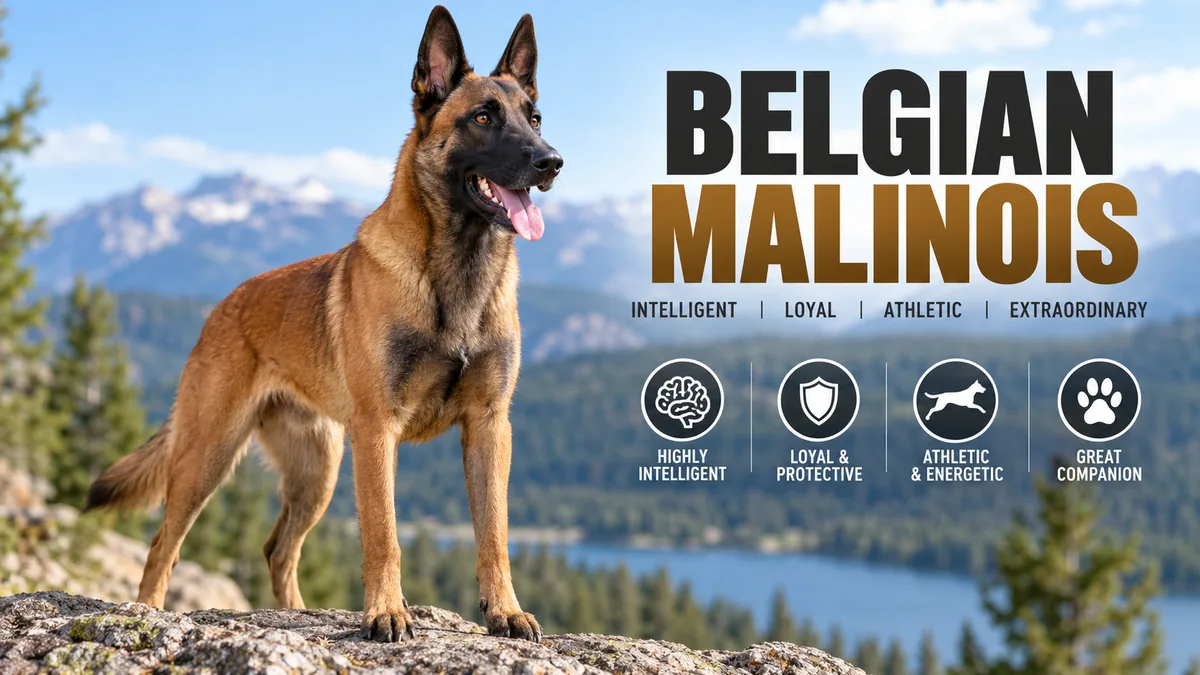
Few dogs combine intelligence, speed, athleticism, and working drive as intensely as the Belgian Malinois. Famous for police and military work, this alert Belgian herding dog can also become a deeply loyal companion—but only in a home prepared for its demanding physical and mental needs.
The belgian malinois is an intelligent, athletic, highly trainable herding breed developed in Belgium. Typically standing 22–26 inches tall and weighing about 40–80 pounds, the breed is known for loyalty, confidence, protective instincts, and exceptional working drive. It needs substantial daily exercise, structured training, mental stimulation, and close involvement with its handler.
A Malinois can learn astonishingly quickly. That ability, however, works both ways: an under-stimulated dog can learn unwanted behaviors just as efficiently as useful ones. Understanding the breed’s history, temperament, exercise requirements, health, and training needs is therefore essential before deciding whether one fits your lifestyle.
What Is a Belgian Malinois?
The Belgian Malinois is a medium-to-large working and herding dog originating in Belgium. Its name comes from Malines, the French name for the Belgian city of Mechelen, where the variety became associated with dedicated working-dog breeders. The breed was originally developed for livestock herding rather than modern protection work.
That agricultural background explains much of the modern Malinois personality. Herding dogs needed stamina, awareness, responsiveness, speed, independence, and the ability to react rapidly to movement. Those same characteristics now make the breed valuable in demanding working environments.
The Fédération Cynologique Internationale (FCI) treats the Malinois as one of four varieties of the Belgian Shepherd Dog:
- Malinois
- Tervueren
- Groenendael
- Laekenois
The FCI places the Belgian Shepherd Dog in Group 1, covering sheepdogs and cattle dogs other than Swiss cattle dogs, and identifies Belgium as the country of origin.
Classification differs in the United States. The American Kennel Club recognizes the Belgian Malinois as its own breed and places it in the Herding Group. AKC recognition as a distinct breed came in 1959.
Belgian Malinois at a Glance
| Characteristic | Typical Belgian Malinois |
|---|---|
| Origin | Belgium |
| Original purpose | Livestock herding |
| AKC group | Herding Group |
| Height | About 22–26 inches |
| Weight | About 40–80 pounds |
| Coat | Short, weather-resistant double coat |
| Common coloring | Fawn to mahogany with black shading/mask |
| Energy level | Very high |
| Trainability | Very high |
| Shedding | Moderate, heavier seasonally |
| Temperament | Alert, intelligent, confident, loyal, work-driven |
| Best suited to | Experienced, highly active handlers |
| Common modern roles | Police, military, detection, search and rescue, dog sports, companionship |
Individual dogs vary considerably. Working-line breeding, genetics, early experiences, training, socialization, health, and environment can all influence behavior.
Belgian Malinois History and Working Heritage
The Belgian Malinois was developed during the late 19th century as Belgian breeders began organizing and standardizing their native shepherd dogs.
These dogs were expected to do real work. They needed enough endurance to remain active around livestock, enough intelligence to respond to a handler, and enough confidence to operate in challenging situations.
The short-coated Malinois became associated particularly with the area around Malines. Although modern audiences often associate the breed with tactical work, its roots are firmly agricultural.
As traditional herding requirements changed, the dog’s abilities found new applications.
Today, Belgian Malinois can be seen in:
- livestock herding
- obedience
- agility
- tracking
- scent detection
- search and rescue
- police work
- military work
- protection sports
- other working-dog competitions
Their combination of athleticism, trainability, speed, environmental awareness, and motivation makes them particularly adaptable to jobs requiring close cooperation with a human handler.
One well-known military Malinois was Cairo, who participated with U.S. Navy SEAL personnel in the 2011 operation against Osama bin Laden. The breed’s military reputation, however, should not obscure an important point: highly trained operational dogs represent extensive selection and professional training, not the automatic behavior of every pet Malinois.
Quick Takeaway: The Malinois did not originate as an attack or police dog. It began as a Belgian livestock herder. Modern working roles capitalize on characteristics that were already useful for herding: intelligence, endurance, responsiveness, confidence, and intense willingness to work.
Belgian Malinois Size and Appearance
A Belgian Malinois has a lean, athletic appearance. Compared with heavier working breeds, it generally looks agile rather than bulky.
AKC information places adult dogs at approximately 22–26 inches tall and 40–80 pounds overall. Males commonly stand 24–26 inches, while females are generally 22–24 inches.
Male vs. Female Belgian Malinois Size
| Sex | Typical Height | Typical Weight |
|---|---|---|
| Male | 24–26 inches | 60–80 pounds |
| Female | 22–24 inches | 40–60 pounds |
These figures describe typical adult ranges rather than a puppy growth target.
The Malinois has erect triangular ears, an alert expression, a relatively square and balanced body, and a strong but elegant outline. Its structure supports efficient movement and endurance rather than excessive mass.
Belgian Malinois Coat and Colors
The breed has a short double coat that offers protection from weather. The hair tends to be somewhat longer around areas such as the neck and tail while remaining comparatively short over most of the body.
Fawn and mahogany are standard AKC colors, with characteristic black-tipped hairs and dark facial features contributing to the familiar Malinois appearance.
The dark mask, erect ears, and fawn body are among the reasons people sometimes mistake the breed for a German Shepherd.
Belgian Malinois Temperament and Personality
Belgian Malinois temperament is one of the most important aspects of the breed to understand.
A well-adjusted Malinois should be confident, alert, intelligent, responsive, energetic, and strongly connected to its handler. The breed can be reserved with strangers and naturally watchful without appropriate temperament requiring indiscriminate aggression.
The AKC breed-standard description emphasizes an alert, inquisitive, confident dog that should show neither fear nor inappropriate aggression. It also describes strong loyalty, responsiveness to the owner, and suitability as a watchdog and working partner.
Intelligence
Malinois learn patterns rapidly.
This is valuable in obedience, tracking, scent work, agility, herding, and professional working environments. But intelligence should not be confused with being easy to own.
A clever dog with insufficient structure may invent its own entertainment. That can mean chewing, digging, chasing movement, repeatedly barking, escaping, or obsessing over particular activities.
Loyalty and Handler Attachment
Many Malinois develop extremely strong relationships with their people. They tend to thrive when training and activity happen alongside the handler rather than when simply given access to a large yard.
That distinction matters.
Space does not replace engagement.
Protective Instinct
The breed is naturally vigilant and can be protective of its household. Proper temperament is not the same as uncontrolled aggression, however.
Trying to deliberately make a pet Malinois suspicious or aggressive can create serious behavioral problems. Most owners need neutrality, confidence, reliable obedience, and appropriate social behavior—not a dog encouraged to perceive ordinary people as threats.
Prey and Movement Drive
Many Malinois respond intensely to movement.
Running animals, bicycles, vehicles, toys, and even fast-moving children can trigger chasing or herding behavior. AKC guidance specifically highlights the breed’s strong prey drive and the importance of redirecting inappropriate chasing through early training.
This is one reason impulse control should be developed from puppyhood.
Is a belgian malinois a Good Family Dog?
A belgian malinois can live successfully as a family companion, but it is not automatically suitable for every family.
The best match is usually an active household with substantial dog-handling experience, enough time for daily training and exercise, and realistic expectations about a working breed.
A well-socialized Malinois can be affectionate and devoted with household members. However, its energy, strength, herding tendencies, protective instincts, and sensitivity to movement require careful management.
AKC guidance suggests that the breed may be easier to manage in families with older, responsible children and recommends supervision around children.
Belgian Malinois and Children
Malinois are not inherently unsuitable around children, but individual temperament and training matter enormously.
Potential challenges include:
- chasing running children
- nipping during herding behavior
- becoming overexcited during rough play
- accidentally knocking over a small child
- guarding valued objects
- reacting strongly to unfamiliar visitors
Children should also be taught appropriate dog interaction. They should not climb on the dog, interfere while it is eating or sleeping, grab toys from its mouth, or turn high-arousal chasing games into a daily habit.
No dog, regardless of breed or training, should be expected to supervise itself around very young children.
Belgian Malinois and Other Pets
Compatibility with other dogs and household animals varies.
Early socialization can help, but strong prey or chase drive may complicate life with cats or smaller animals in some individuals. Introductions should be gradual and controlled rather than based on the assumption that all well-trained dogs automatically accept every animal.
Quick Takeaway: A good Malinois family home provides structure, activity, training, supervision, and meaningful interaction. Affection alone cannot meet the needs of a high-drive working dog.
How Much Exercise Does a Belgian Malinois Need?
Exercise is where many prospective owners underestimate the breed.
A casual walk around the neighborhood usually does not provide enough physical or mental activity for an adult Malinois. Both AKC and veterinary guidance describe the breed as exceptionally active and emphasize substantial exercise combined with engagement.
The exact amount should not be reduced to a universal number of minutes. Age, physical condition, working drive, health, climate, and the intensity of the activity all matter.
A balanced routine might combine:
- structured walking or hiking
- obedience exercises
- controlled running once physically mature
- scent work and tracking
- retrieving or tug with rules
- agility or other dog sports
- problem-solving games
- calmness and settling practice
Mental Stimulation Matters as Much as Running
Trying to solve every behavior problem by making a Malinois run farther can backfire.
Constant physical conditioning can simply create a fitter dog that still has no off-switch.
Mental work provides a different kind of satisfaction. Searching for hidden objects, following scent trails, learning positions, practicing impulse control, solving food puzzles, and performing structured tasks require concentration.
The goal is not to keep the dog excited from morning until night. A useful routine alternates activity with the ability to settle.
What Happens When a Malinois Is Bored?
Under-stimulated Malinois may develop destructive or disruptive behavior. Veterinary guidance notes behaviors such as chewing household items, digging, damaging furnishings, or finding their own activities when sufficient exercise and stimulation are missing.
A fenced backyard by itself is therefore not an exercise program.
The breed generally wants interaction and purposeful activity with its person.
belgian malinois Training: What Actually Works
Training should start immediately and continue throughout the dog’s life.
Malinois are exceptionally capable learners, but their speed, intensity, and environmental awareness mean inconsistent handling can produce equally rapid unwanted learning.
Start With Engagement
Before expecting advanced obedience, teach the puppy that paying attention to the handler is rewarding.
Useful foundations include:
- responding to its name
- recall
- loose-leash walking
- sit and down
- place or mat training
- leave it
- drop it
- waiting at doors
- accepting handling
- settling quietly
- focusing around distractions
Use Positive Reinforcement
Food, toys, play, praise, and access to activities can all function as rewards.
AKC guidance recommends frequent, consistent training rooted in positive reinforcement while keeping both the dog’s mind and body engaged.
The practical key is timing. Reward the behavior you actually want instead of accidentally reinforcing jumping, frantic barking, leash pulling, or demanding play.
Keep Sessions Purposeful
A Malinois does not necessarily need hour-long obedience drills.
Several focused sessions throughout the day can be more productive. End while the dog is still engaged, then incorporate learned behaviors into normal life.
For example, recall training can happen during outdoor play, impulse control before retrieving a toy, and place training while the family eats dinner.
Socialization Is More Than Meeting People
Socialization is often misunderstood as encouraging a puppy to greet every stranger and dog.
A better goal is teaching the puppy to remain confident and manageable around normal life.
That includes controlled exposure to:
- people of different appearances
- calm dogs
- vehicles
- bicycles
- household noises
- different walking surfaces
- veterinary handling
- grooming
- public environments
- visitors
- unfamiliar objects
A socially stable adult should not need to interact with everything it sees.
Neutrality is often more valuable.
Teach an Off-Switch
This is one of the most overlooked Malinois skills.
A dog that can perform exciting obedience but cannot relax in the house can be exhausting to live with. Reward quiet behavior, use mat training, create predictable rest periods, and avoid turning every interaction into high-intensity play.
Are Belgian Malinois Good for First-Time Owners?
Usually, they are not the easiest choice.
The issue is not that new owners are incapable of learning. The problem is that mistakes involving a powerful, fast, highly motivated dog can become difficult to correct.
AKC specifically notes that the breed’s energy and prey drive generally make it a poor choice for first-time owners.
A prospective owner should realistically consider:
- How much time can I devote every day?
- Do I enjoy dog training itself?
- Can I manage a strong dog around distractions?
- Can I provide structured physical exercise?
- Do I understand canine body language?
- Can I continue training for years rather than weeks?
- What will the dog do while I work?
- Do I have access to an experienced trainer if problems arise?
Watching highly trained Malinois perform spectacular tasks online can create unrealistic expectations. Those performances are often the result of genetics, careful selection, skilled handling, and hundreds or thousands of repetitions.
The same intensity that looks impressive during working-dog demonstrations must also be managed at home on an ordinary Tuesday.
Belgian Malinois vs. German Shepherd
The Belgian Malinois and German Shepherd Dog are frequently confused because both have erect ears, working backgrounds, shepherd ancestry, and major roles in police and military work.
They are nevertheless distinct breeds.
| Trait | Belgian Malinois | German Shepherd |
|---|---|---|
| Origin | Belgium | Germany |
| General build | Lean, light, athletic | Usually heavier and more substantial |
| Typical Malinois weight | 40–80 lb | Generally heavier overall |
| Coat | Short | Short-to-medium depending on dog |
| Working drive | Often extremely intense | High, varies substantially by line |
| Energy | Very high | High |
| Training needs | Extensive | Extensive |
| Common work | Police, military, detection, sport | Police, service, detection, sport, companionship |
AKC comparisons describe the Malinois as generally lighter than the German Shepherd and emphasize its energetic, inquisitive nature and intense desire to work.
Neither breed should be selected solely because of appearance.
Working line, temperament, health, breeder priorities, and the individual dog can matter more to day-to-day ownership than broad breed comparisons.
Belgian Malinois Grooming and Shedding
Compared with its exercise and training requirements, grooming a Belgian Malinois is relatively straightforward.
The short coat generally needs regular brushing to remove loose hair and distribute natural oils. AKC guidance notes that heavier shedding occurs seasonally and that more frequent brushing during those periods helps control loose hair.
Basic Grooming Routine
A sensible routine includes:
- brushing weekly, more frequently during heavy shedding
- trimming nails before they become excessively long
- checking ears for irritation or debris
- brushing teeth regularly
- inspecting paws after strenuous outdoor activity
- checking the skin and coat for unusual lumps, irritation, parasites, or wounds
Bathing can be done as needed rather than according to an unnecessarily frequent schedule.
Working and highly active dogs deserve extra paw and nail attention because running over rough ground can cause cuts, abrasions, cracked pads, or nail injuries.
Belgian Malinois Health and Lifespan
Belgian Malinois are generally athletic dogs, but no breed is free from inherited or acquired health problems.
PetMD lists a lifespan of approximately 14–16 years for the breed, although the lifespan of an individual dog depends on genetics, preventive care, body condition, accidents, disease, nutrition, and many other factors.
Potential health concerns associated with the breed include orthopedic, neurological, and eye conditions.
Hip and Elbow Dysplasia
Hip dysplasia involves abnormal development or fit of the hip joint and can contribute to pain and arthritis.
Elbow dysplasia describes several developmental abnormalities affecting the elbow joint. Responsible breeding programs use orthopedic health screening to reduce the likelihood of passing serious joint problems to future generations.
AKC guidance specifically recommends health screening for hip and elbow dysplasia when evaluating responsibly bred Malinois.
Eye Health
Eye examinations are another relevant component of breed health screening. Prospective puppy owners should ask for verifiable health-testing results rather than accepting vague statements that the parents “have never had problems.”
Epilepsy
Seizure disorders, including epilepsy, can occur in Belgian Malinois. A dog experiencing a first seizure, repeated seizures, or a prolonged seizure needs veterinary evaluation.
Bloat and Gastric Emergencies
Gastric dilatation-volvulus, commonly called GDV or bloat, is an emergency in which the stomach becomes enlarged and may twist.
Warning signs can include an enlarged abdomen, repeated attempts to vomit without producing much, excessive drooling, restlessness, weakness, or collapse.
Suspected GDV requires emergency veterinary care. It is not something to monitor at home while waiting to see whether the dog improves.
Maintaining Long-Term Health
Good preventive care includes:
- routine veterinary examinations
- appropriate vaccination and parasite prevention
- maintaining a healthy body condition
- balanced nutrition appropriate to life stage
- dental care
- age-appropriate exercise
- monitoring mobility and behavior
- prompt evaluation of unusual symptoms
For an athletic dog, maintaining appropriate body condition is particularly valuable. Excess body weight adds unnecessary stress to joints during running, jumping, and training.
Feeding a Belgian Malinois
There is no single food or feeding quantity appropriate for every Malinois.
A growing puppy, active working dog, moderately active household companion, pregnant female, and senior dog have different nutritional and energy requirements.
Feed a complete and balanced diet appropriate for the dog’s life stage and adjust portions according to body condition, activity, age, and veterinary guidance.
Treats used during training also count toward daily calorie intake.
Because Malinois often work enthusiastically for food, owners can use part of the dog’s normal food allowance for obedience exercises, enrichment toys, and scent games rather than continually adding extra calories.
Fresh water should always be available, particularly during exercise and hot weather.
Living With a Belgian Malinois Day to Day
The biggest question is not whether a Malinois is impressive. It clearly is.
The better question is whether its natural characteristics match your normal lifestyle.
A Malinois May Suit You If:
- you already understand active working dogs
- training dogs is something you genuinely enjoy
- you have substantial time every day
- you want an athletic outdoor companion
- you enjoy obedience, tracking, agility, herding, or another structured activity
- you can provide mental stimulation as well as exercise
- you are comfortable managing prey and chase drive
- you want a dog that works closely with you
Think Carefully If:
- you primarily want a calm household pet
- you are away from home for long periods every day
- you expect a backyard to provide enough stimulation
- you dislike daily training
- you want a dog mainly because police or military Malinois look impressive
- you have no plan for managing a high-drive adolescent dog
- you expect exercise alone to solve behavioral problems
The Malinois is often happiest when its daily life has purpose.
That purpose does not need to involve police or protection work. Competitive obedience, nose work, tracking, agility, herding, hiking, advanced trick training, and other structured activities can all provide productive outlets.
Choosing a Belgian Malinois Puppy or Adult Dog
Temperament and health deserve more attention than dramatic appearance, coat shade, or promises of “extreme drive.”
If obtaining a puppy from a breeder, investigate the breeding program carefully.
Ask about:
- health testing of both parents
- hip and elbow evaluations
- eye examinations
- temperament
- working or performance history
- previous litters
- puppy socialization
- how puppies are matched to homes
- breeder support after placement
The American Belgian Malinois Club participates in breed-health initiatives associated with the Orthopedic Foundation for Animals and CHIC health programs, illustrating the role of documented breed-appropriate testing in responsible breeding.
Documentation matters more than verbal assurances.
An adult Malinois from a reputable rescue can also be a good option for the right household. An adult dog’s energy level, sociability, environmental confidence, and behavioral tendencies may already be easier to evaluate than those of a young puppy.
Common Belgian Malinois Ownership Mistakes
Choosing the Breed for Its Image
Police and military videos show what carefully selected and extensively trained dogs can accomplish.
They do not show the daily management behind that performance.
A Malinois should never be purchased simply because it looks tough or impressive.
Providing Exercise Without Structure
Endless ball throwing may tire the dog temporarily while reinforcing obsessive arousal.
Combine physical exercise with obedience, scent work, impulse control, problem solving, and relaxation.
Waiting Too Long to Train
Do not wait until adolescence to establish household rules.
Recall, leash manners, handling, settling, engagement, and impulse control are easier to build before unwanted behaviors have been rehearsed hundreds of times.
Encouraging Suspicion
A naturally watchful dog rarely needs encouragement to become more suspicious.
Develop confidence and neutrality instead. Specialized protection training, where appropriate, belongs with qualified professionals rather than improvised home exercises.
Neglecting Rest
Puppies and adults both need downtime.
More stimulation is not always better. A dog that never learns to settle can become increasingly demanding and difficult to regulate.
Assuming Intelligence Means Easy
This may be the biggest misconception surrounding the breed.
The Belgian Malinois is easy to teach but demanding to manage well. Those are different things.
What Makes the Belgian Malinois Such an Exceptional Working Dog?
The breed’s reputation comes from a rare combination of characteristics rather than intelligence alone.
A capable working Malinois may combine:
- rapid learning
- athletic movement
- endurance
- environmental confidence
- strong toy or food motivation
- persistence
- scenting ability
- handler engagement
- responsiveness
- compact physical size
- willingness to repeat tasks
Police and military organizations use Belgian Malinois for roles such as detection and operational work, while civilian handlers frequently participate with them in obedience, agility, tracking, herding, and protection sports.
But working potential varies substantially between individuals.
Breed name alone does not guarantee stable nerves, exceptional working ability, sociability, health, or suitability for a particular job.
Is the Belgian Malinois Right for You?
The belgian malinois is a remarkable combination of intelligence, loyalty, athleticism, trainability, and working drive. Developed from Belgian herding dogs, it has become one of the world’s most recognizable working breeds while retaining the fundamental need to stay mentally and physically engaged.
For an experienced owner who enjoys daily training, structured exercise, outdoor activity, and close partnership with a dog, the Malinois can be an extraordinary companion.
For someone looking for a low-maintenance pet that is satisfied with occasional walks and long periods alone, it is usually a poor match.
Before bringing one home, spend time around adult Malinois—not just puppies or highly trained dogs in videos. Talk with experienced owners, trainers, responsible breeders, or breed-specific rescues, and evaluate the ordinary daily routine the dog will actually have.
The right question is not simply, “Do I want a Belgian Malinois?”
It is: Can I give this working dog the structure, training, exercise, mental engagement, and long-term commitment it needs to thrive?