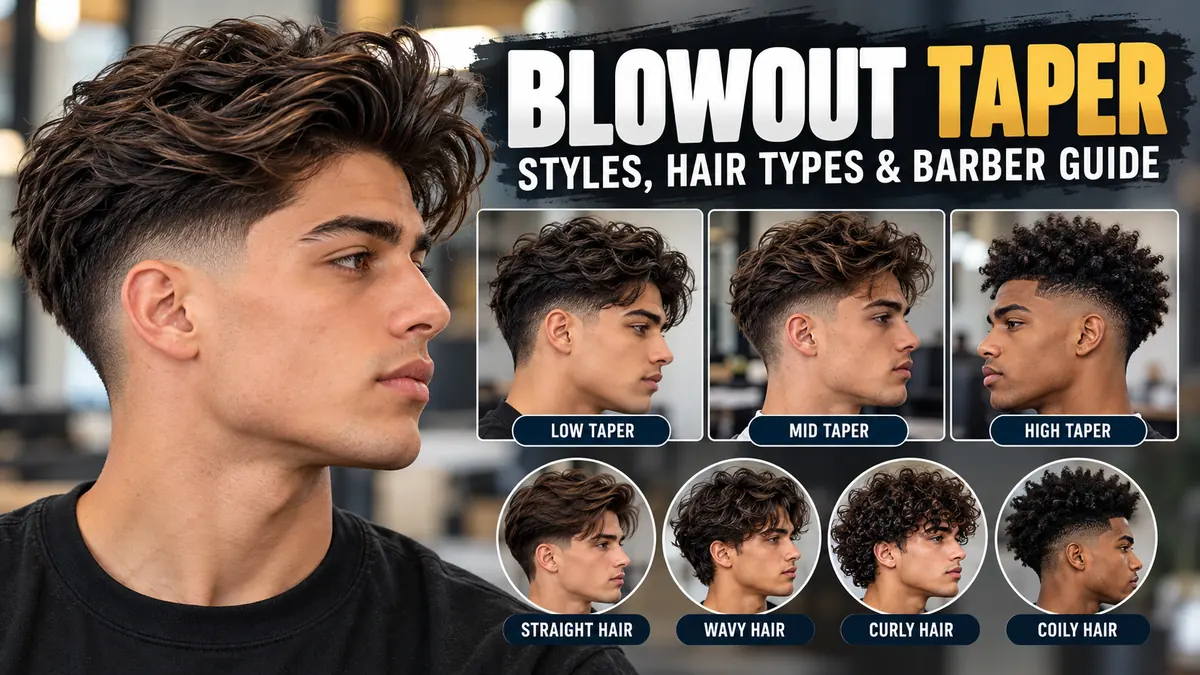
The blowout taper combines two features that work especially well together: noticeable volume through the top and a clean, gradually shortened finish around the hairline. The result can look polished without feeling overly sharp, while still leaving enough length for texture and movement.
A blowout taper is a haircut that preserves length and volume on top while gradually shortening the hair around the temples, sideburns, and neckline. The “blowout” refers to the lifted, airy shape of the longer hair, while the taper creates a cleaner perimeter without necessarily fading the entire side of the head.
The basic idea is simple, but there is no single universal version of this haircut. The taper can sit low, mid, or relatively high, while the top can be pushed backward, upward, forward, or allowed to follow natural waves and curls.
That flexibility is one reason reference photos and clear instructions matter more than simply telling a barber, “Give me a blowout taper.”
What Is a Blowout Taper?
A blowout taper consists of two distinct elements.
The taper gradually reduces the hair around selected edges of the haircut. This commonly includes the temples, sideburns, and nape of the neck. Unlike a broad fade, a restrained taper can leave considerable fullness above the ears.
The blowout describes the shape of the longer hair. Rather than lying flat, the top has lift, separation, movement, or outward volume.
Current barber guides consistently describe the haircut as a combination of a localized taper and a fuller top rather than one rigid cutting formula.
That distinction explains why two people asking for exactly the same haircut name can leave different barbershops with noticeably different results.
Blowout Taper at a Glance
| Feature | Typical Approach |
|---|---|
| Top | Longer and full |
| Temples | Gradually tapered |
| Sideburns | Clean and progressively shorter |
| Neckline | Usually tapered |
| Upper sides | Often retain weight and fullness |
| Taper height | Low, mid, or high |
| Styling | Lifted, textured, curly, forward, or swept back |
| Hair textures | Straight, wavy, curly, and coily |
| Main styling tool | Blow dryer; diffuser may suit curls |
| Maintenance | Depends on taper length and desired sharpness |
The exact measurements are customizable. Someone wanting a dramatic fluffy silhouette needs considerably more length than someone seeking a short, controlled version.
Blowout Taper vs Fade: What Is the Difference?
This is one of the most useful distinctions to understand before visiting a barber.
A traditional taper generally concentrates the shortest transition around the edges of the haircut. A fade typically creates a larger short-to-long gradient across more of the sides and back.
That means a blowout taper can retain considerable weight above the ears, while a blowout fade may expose more scalp and create stronger contrast.
| Feature | Blowout Taper | Blowout Fade |
|---|---|---|
| Shortest area | Mostly around perimeter | Covers more of sides/back |
| Side fullness | More commonly retained | More commonly removed |
| Contrast | Soft to moderate | Moderate to strong |
| Scalp exposure | Usually less | Can be greater |
| Grow-out appearance | Generally softer | Short areas become noticeable sooner |
| Top volume | Retained | Retained |
Terminology varies between barbers, however.
One barber may interpret “taper fade” as a very small transition around the temple. Another may take the fade considerably higher.
Instead of relying entirely on the haircut’s name, explain how much hair you want removed.
Low Blowout Taper
The low blowout taper keeps the transition close to the hairline.
Most of the sides remain relatively full, while the area around the sideburns, temples, and neckline becomes progressively shorter.
This creates a softer transition between the voluminous top and the edges.
A low taper is useful when preserving side weight is part of the desired silhouette. It can also complement curly or wavy hair because more natural texture remains visible around the head.
The key instruction is simple: keep the taper low and avoid carrying the shortest section too far upward.
Who May Prefer a Low Blowout Taper?
Consider this variation if you want:
- substantial fullness around the sides;
- a softer transition;
- less exposed scalp;
- natural curls or waves preserved;
- a haircut that does not resemble a high fade.
Because relatively little hair is removed from the upper sides, the difference between the blown-out top and tapered perimeter can look more gradual.
Mid Blowout Taper
A mid blowout taper creates more visible separation between the longer hair and shorter perimeter.
The transition typically begins around the temple area rather than remaining extremely close to the lowest part of the hairline. Current haircut guides describe it as sitting between the subtle appearance of a low taper and the stronger contrast of a higher variation.
It is particularly useful for someone who wants the taper to be clearly noticeable without turning the haircut into a broad skin fade.
The top can still be customized considerably.
Straight hair may be blown upward and backward. Wavy hair can retain loose movement. Curly hair can maintain curl definition while the temples remain clean.
High Blowout Taper
A high blowout taper creates stronger contrast.
The short transition reaches farther upward around the temple region, making the longer hair above it appear more prominent.
This version can produce a sharper silhouette, but there is a tradeoff: removing too much weight from the upper sides can change the characteristic rounded or expanded blowout shape.
That is why “high” should not automatically mean shaving most of the sides.
If you want significant volume around the top and upper sides, make that clear before the barber starts removing weight.
Blowout Taper Fade
The terms blowout taper and blowout taper fade are frequently used interchangeably online, but they can describe different amounts of side coverage.
A blowout taper fade usually introduces a more obvious fade into the haircut. The shortest portion may reach skin or near-skin length and cover more area than a conservative taper.
The top remains full.
What changes is the contrast underneath it.
A skin-finished version produces a much sharper transition, while a taper that ends at short stubble gives a softer appearance.
Before choosing one, ask yourself whether you actually want visible scalp.
If the answer is no, tell your barber to leave the bottom longer rather than simply requesting a “taper fade.”
Blowout Taper for Straight Hair
Straight hair makes it relatively easy to create a smooth, expanded blowout shape because the styling direction is highly controllable.
The challenge is getting enough root lift.
If straight hair naturally lies flat, simply applying styling product will not necessarily create the characteristic shape. The hair needs to be lifted while drying.
Start with damp rather than soaking-wet hair.
Apply a lightweight pre-styler if needed, then direct warm air toward the roots while lifting sections upward with your fingers or a brush.
Once the basic shape has formed, finish with a small amount of matte paste, clay, or another lightweight styling product.
Heavy product can undo the volume you just created.
Blowout Taper for Wavy Hair
Wavy hair naturally provides movement, making it particularly adaptable to this haircut.
Instead of forcing every strand into a perfectly uniform shape, use the existing wave pattern.
The top can be styled:
- upward for maximum height;
- backward for a cleaner finish;
- forward for a textured fringe;
- outward for a fuller silhouette.
Avoid excessive brushing after the waves have formed. Constantly manipulating the hair can turn defined movement into unwanted frizz.
A lightweight styling cream, mousse, or texture product can provide control without making the hair look rigid.
Blowout Taper for Curly Hair
A blowout taper curly hair style does not require straightening the curls.
This is an important misconception.
The blowout concept can simply mean creating an expanded, voluminous silhouette while allowing natural curls to remain visible.
Keeping more length above the ears can give curls enough room to form while the taper cleans the temples, sideburns, and neckline.
For defined curls, a diffuser is often more practical than aggressively brushing the hair.
Apply an appropriate curl product to damp hair, then dry with controlled airflow. Excessive heat or repeatedly disturbing the curls can increase frizz.
The final result should still look like your natural texture—just shaped more deliberately.
Blowout Taper for Coily Hair
Coily hair can create a distinctive version because natural volume is already present.
Instead of depending heavily on a round brush to manufacture height, styling can focus on shaping, definition, and controlling the overall silhouette.
The barber should consider shrinkage before deciding how much length to remove.
Cutting the top too short while the hair is stretched can produce a much shorter appearance once the coils return to their natural state.
A taper around the temples and neckline can provide definition while leaving the majority of the texture untouched.
Moisture also matters. Products appropriate for the individual’s curl pattern can help maintain definition without flattening the hair.
Textured Blowout Taper
A textured version deliberately avoids an overly smooth finish.
The barber may use point cutting, careful layering, or controlled weight removal to encourage separation through the longer sections.
Styling then emphasizes individual pieces rather than creating one solid shape.
This approach works particularly well when the goal is a loose, slightly messy finish.
But there is a difference between texture and excessive thinning.
Removing too much internal weight can make it difficult to maintain the full silhouette associated with a blowout. Some contemporary blowout styles deliberately preserve considerable density for this reason.
Blowout Taper With Textured Fringe
Not every blowout has to move backward.
A blowout taper with textured fringe keeps the top voluminous but directs more hair toward the forehead.
The fringe may fall naturally, separate into pieces, or curl forward depending on texture.
This variation changes the overall balance of the haircut considerably.
A traditional backward blowout exposes more of the forehead. A forward fringe covers part of it and creates a more relaxed appearance.
When requesting this style, explain the desired fringe length before the barber cuts the front.
Remember that hair often appears shorter once it gains volume or curls.
How Much Hair Do You Need for a Blowout Taper?
There is no universal minimum because the required length depends on texture and the desired shape.
Recent haircut guides commonly describe several inches of top length for a clearly visible blowout, with some styles retaining roughly three to four inches or more.
More important than a specific measurement is whether the hair can hold the intended shape.
Very short hair can still be tapered and styled upward, but it will not create the same expanded silhouette as medium-length hair.
If you are growing toward this haircut, avoid repeatedly cutting the top short.
Clean up the perimeter while allowing the top—and potentially the upper sides—to develop enough length and weight.
How to Ask Your Barber for a Blowout Taper
Do not rely on the words “blowout taper” alone.
Describe the actual result.
A useful request would be:
“I want a blowout taper with plenty of length and volume on top. Keep the taper concentrated around the temples, sideburns, and neckline, and don’t take the sides too high. I want enough weight left to style the top upward and outward.”
Then clarify four things.
1. Taper Height
Choose low, mid, or high.
If you want a subtle haircut, specifically tell the barber to keep the taper low.
2. Shortest Length
Decide whether you want:
- skin;
- extremely short stubble;
- a visible clipper length;
- a softer scissor-finished transition.
Do not assume the barber knows which one you mean.
3. Top Length
Tell the barber you need enough length for volume.
If you already have the ideal top length, ask for shaping and texture rather than automatically requesting several inches removed.
4. Styling Direction
Explain whether you normally wear your hair:
- up and back;
- forward;
- outward;
- naturally curly;
- loosely textured.
This helps the barber cut according to how the hair will actually be worn.
Most importantly, bring a reference image showing the haircut from a useful angle. Barber terminology overlaps considerably, and a visual reference can prevent a low taper from accidentally becoming a high fade.
How to Style a Blowout Taper
The haircut establishes the foundation, but daily styling creates much of the finished blowout effect.
Step 1: Start With Damp Hair
After washing or wetting the hair, towel-dry gently.
The hair should remain slightly damp rather than dripping wet.
Starting at this stage gives you more control over the drying direction.
Step 2: Apply Pre-Styling Product
Product choice depends on texture.
Fine straight hair generally needs something lightweight. Thick or curly hair may benefit from additional control or moisture.
If using heated styling tools, follow the directions of an appropriate heat-protection product.
Step 3: Create Root Lift
This is the most important part.
Point the airflow in the direction you want the hair to move while lifting from the roots.
For a classic shape, work upward and backward.
For a forward blowout, direct the hair forward while maintaining root elevation.
Step 4: Shape the Longer Sections
Use your fingers for a looser result.
A brush can provide more controlled tension and a smoother shape. Curly hair may respond better to a diffuser if preserving curl definition is the goal.
Step 5: Finish Lightly
Once the hair is dry, apply only enough finishing product to maintain the shape.
Too much wax, clay, pomade, or cream can add weight and collapse the volume.
Current styling guides emphasize that drying technique—not simply applying product—is central to recreating the blowout after leaving the barbershop.
Best Styling Products for a Blowout Taper
There is no single product that works for everyone.
Choose according to hair texture, density, and desired finish.
| Product Type | Useful For |
|---|---|
| Volumizing mousse | Lightweight lift |
| Sea-salt or texture spray | Separation and loose texture |
| Matte paste | Flexible definition |
| Matte clay | Stronger control |
| Styling cream | Softer control and movement |
| Curl cream | Curl definition |
| Heat protectant | Heat-styling routines |
| Light hairspray | Additional hold after styling |
Fine hair usually benefits from lighter products.
Thick hair may tolerate stronger products without collapsing.
Curly and coily hair should be approached according to moisture needs and curl pattern rather than automatically using products designed for straight hair.
Common Blowout Taper Mistakes
A good haircut can still miss the intended look if the proportions are wrong.
Taking the Sides Too High
One of the most common mistakes is turning a taper into a large fade.
Once too much hair has been removed from the sides, you cannot recreate the fuller silhouette until it grows back.
Removing Too Much Top Length
The haircut needs enough hair to create lift.
If dramatic volume is the goal, cutting the top extremely short works against it.
Over-Thinning Thick Hair
Thick hair can certainly require weight management, but indiscriminate thinning may remove the structure needed for a full blowout.
Ask for controlled texture rather than automatically requesting maximum thinning.
Using Too Much Product
More product does not necessarily mean more hold.
Heavy styling products can drag the roots downward and make the haircut look flat.
Start with a small amount and add more only if necessary.
Ignoring Natural Texture
Straight, wavy, curly, and coily hair behave differently.
Trying to reproduce a reference photo from a completely different texture without adapting the cut can lead to unrealistic expectations.
Use reference photos with a hair texture reasonably similar to yours whenever possible.
Expecting the Barber’s Finish to Last Without Styling
The haircut may look dramatically fuller immediately after the appointment because it has been professionally blow-dried.
After washing, that shape needs to be recreated.
The “blowout” is partly a haircut and partly a styling routine.
Which Blowout Taper Works With Different Face Shapes?
Face shape can influence how you distribute volume, but it should not be treated as a rigid rule.
The same haircut can be adjusted by changing height, width, fringe length, and side fullness.
Round Face
More vertical height can create a longer-looking silhouette.
Keeping excessive width away from the widest part of the face may also change the visual balance.
Oval Face
An oval face generally provides flexibility because volume can be moved forward, backward, or upward without drastically changing the overall proportions.
Square Face
A textured top can soften an extremely structured finish, while cleaner edges can emphasize the jawline.
The desired effect determines which direction makes more sense.
Long or Oblong Face
Extreme vertical height can make an already long face appear even longer.
A lower blowout with more side fullness or a forward fringe may create more balanced proportions.
Heart or Triangle-Shaped Face
Preserving some side volume can help distribute visual weight rather than concentrating everything at the top.
These are styling principles rather than rules. Hairline, density, head shape, facial hair, glasses, and personal preference can matter just as much as the basic face-shape category.
How Often Does a Blowout Taper Need Maintenance?
The answer depends on how sharp you expect the perimeter to remain.
The shortest areas around the temples and neckline reveal new growth first. A skin-finished taper therefore loses its freshly cut appearance sooner than a softer, longer taper.
Current guides commonly place professional maintenance somewhere around every two to four weeks for many versions, while higher-contrast skin fades may need earlier cleanup if you want them continuously sharp.
You do not necessarily need to remove significant top length at every appointment.
A maintenance visit can focus on:
- cleaning the neckline;
- refreshing the temple taper;
- tidying sideburns;
- balancing excess weight;
- lightly reshaping the top;
- removing damaged ends.
This preserves the haircut without constantly resetting your progress.
Does a Blowout Taper Grow Out Well?
Generally, a restrained taper can grow out more softly than an aggressive skin fade because the shortest section occupies a smaller area.
The top simply becomes longer and heavier.
Eventually, however, that extra weight can make the blowout harder to style.
The sides may also lose their deliberate shape as the tapered edges grow.
Rather than automatically cutting everything shorter, ask the barber to rebalance the shape while preserving useful length.
Can You Get a Blowout Taper Without Using a Blow Dryer?
Technically, yes—but the result may look different.
Some naturally curly, coily, thick, or highly voluminous hair can develop substantial lift without traditional round-brush blow-drying.
For many straight and wavy hairstyles, however, the dryer provides the root lift that creates the recognizable blown-out shape.
Air-drying may leave the top flatter.
If you prefer minimal daily styling, tell your barber before the haircut. They can design a version that works more naturally with your growth pattern rather than creating a shape that requires extensive heat styling every morning.
Is a Blowout Taper the Same as a Temple Fade?
Not exactly.
A temple fade, sometimes called a temp fade, primarily describes where the fading occurs: around the temple region.
A blowout taper describes a broader combination of perimeter tapering and volume through the longer hair.
You can therefore have a temple fade without a blowout.
Likewise, a blowout taper can include both temple and neckline tapering.
This is another reason haircut names should be treated as useful shorthand rather than exact technical specifications.
Blowout Taper vs Classic Taper
A classic taper does not require a voluminous top.
It simply describes hair becoming progressively shorter toward areas such as the sideburns and neckline.
The top might be side-parted, brushed backward, textured, cropped, or styled in many other ways.
The blowout taper adds a recognizable volume-focused silhouette.
If you like the clean perimeter but do not want to style substantial height, a classic taper with a shorter textured top may require less daily work.
Blowout Taper vs Pompadour
Both hairstyles can create significant volume, but their shapes are different.
A traditional pompadour generally concentrates height and controlled sweep through the front, often with a more deliberate backward direction.
A modern blowout can be much looser.
The hair may move upward, backward, forward, or outward, and individual pieces can remain visibly textured.
The blowout therefore tends to emphasize airiness and movement rather than the sculpted structure commonly associated with a pompadour.
Blowout Taper vs Quiff
A quiff emphasizes the front portion of the hair.
The fringe is usually lifted upward and backward while the remaining top can sit somewhat flatter.
A blowout generally distributes volume across a larger portion of the top and may preserve additional fullness through the upper sides.
There is considerable overlap, however.
A haircut can easily combine elements of both.
The more useful question is not which label technically applies, but where you want the volume concentrated.
Is the Blowout Taper High Maintenance?
It depends on what you consider maintenance.
The haircut itself can have a relatively forgiving grow-out when the taper is soft and localized. The styling, however, may require daily attention if you want a pronounced blown-out finish.
Someone with naturally voluminous curls may need only a short refresh.
Someone with very straight, fine hair may need to wet, pre-style, blow-dry, shape, and finish the hair regularly.
There is also a practical reality that reference photos rarely show: humidity, rain, exercise, hats, and sleep can reduce carefully created volume.
If you dislike styling your hair, request a softer version that works with your natural texture rather than choosing the most dramatic blowout possible.
How to Choose the Right Blowout Taper
Start with your actual hair rather than a trend photo.
Consider four things:
Hair texture: Straight hair, waves, curls, and coils create volume differently.
Density: Thick hair can support a substantial silhouette but may require careful weight control. Fine hair needs strategic length and lightweight styling.
Daily routine: A dramatic blowout can require regular drying and shaping.
Desired contrast: A low taper looks considerably softer than a skin-finished high taper fade.
Then choose the smallest amount of tapering that achieves the look you want.
You can always go shorter during the appointment.
You cannot immediately put removed hair back.
Final Takeaway
The blowout taper works because it balances two contrasting ideas: fullness through the longer hair and precision around the perimeter.
A low version preserves more side weight, a mid taper increases definition, and a higher or skin-finished variation creates stronger contrast. Straight, wavy, curly, and coily hair can all work with the concept when the cutting and styling techniques are adapted to the natural texture.
The most important step happens before the clippers start. Decide how much volume you want, where the taper should begin, how short its lowest point should be, and whether you want the top pushed back, forward, upward, or left naturally textured.
Then show your barber a reference image and describe those details instead of relying on the haircut name alone. That is the most reliable way to turn “blowout taper” from a broad trend into a haircut that actually matches the result you have in mind.