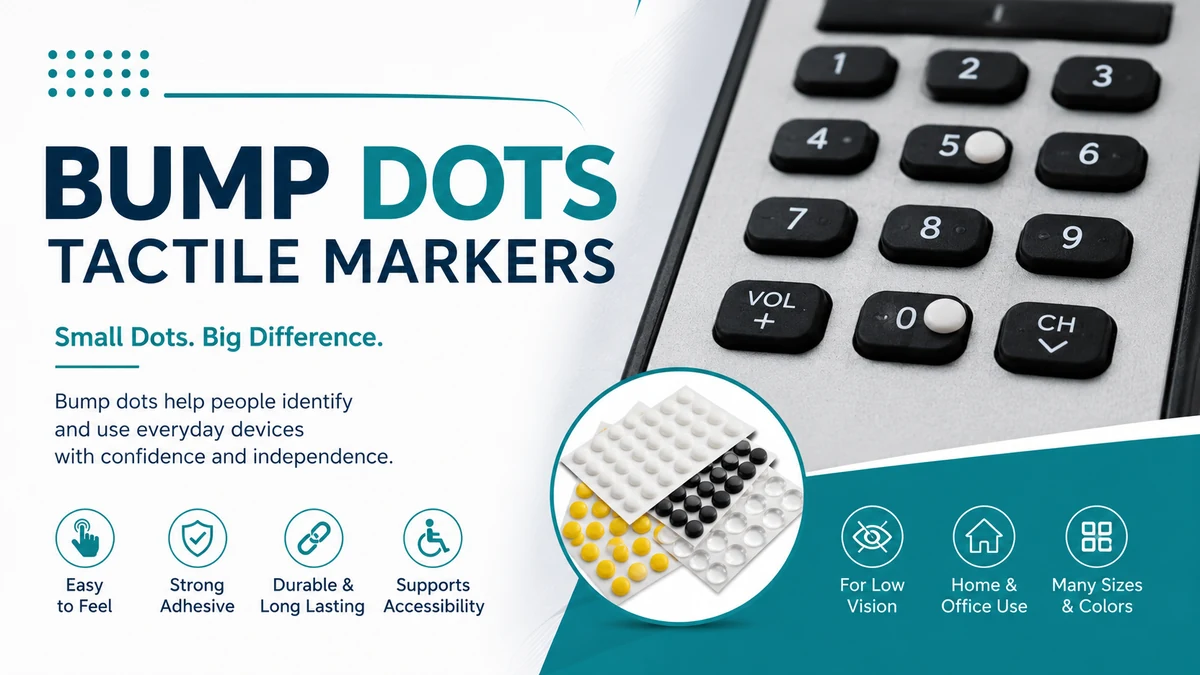
A tiny raised dot can make an ordinary microwave, keyboard, washing machine, or remote control considerably easier to navigate by touch. That simple idea explains why people searching for bumpdots.com often encounter information about bump dots, tactile markers, and accessibility solutions for people who are blind or have low vision.
Bump dots are small raised markers placed on buttons, controls, switches, and other objects to create an identifiable touchpoint. They require no batteries or complicated setup. Instead, they provide tactile information that can help a person locate a frequently used control, distinguish between similar objects, or orient a hand before performing a task. Accessibility organizations describe tactile markers as useful across appliances, computers, phones, keyboards, and other everyday equipment.
What Is bumpdots.com?
The keyword bumpdots.com is closely associated in current search results with bump dots and tactile accessibility. The broader topic centers on simple raised markers that make everyday objects easier to identify through touch.
That distinction matters because a bump dot is not a sophisticated electronic assistive device. It is essentially a tactile reference point.
For example, someone might place:
- one dot on the microwave’s Start button;
- two dots beside a frequently used cooking setting;
- a marker on the number 5 of a keypad;
- a small dot near a computer port;
- a textured marker on a washing-machine setting;
- a raised dot on the most-used button of a remote control.
The Wisconsin Council of the Blind & Visually Impaired describes practical uses ranging from microwave and laundry controls to computer USB ports, security keypads, touch screens, and plugs.
This simplicity is the main reason tactile marking remains useful even as household technology becomes more advanced.
What Are Bump Dots?
Bump dots are small, raised tactile markers, usually attached using an adhesive backing. Depending on the product, they may be made from materials such as plastic, silicone, or rubber and can come in different sizes, shapes, textures, heights, and colors.
Their purpose is straightforward: create a physical landmark that a person can identify with a fingertip.
Think about the raised marks already present on many keyboards. The F and J keys typically have tactile indicators that help users position their hands without looking directly at the keyboard.
The same basic principle can be extended to other objects.
Instead of visually searching an appliance panel for the correct button every time, a user can locate a deliberately positioned tactile marker.
Bump Dots, Tactile Dots, and Tactile Markers
You may see several related terms while researching bumpdots.com, including:
| Term | General Meaning |
|---|---|
| Bump dots | Small raised adhesive markers |
| Tactile dots | Raised dots designed to be identified by touch |
| Tactile markers | Broader category of touch-based identification markers |
| Touch dots | Another term for raised tactile reference points |
| Braille labels | Labels containing readable Braille characters |
| Tactile marking liquid | Material that creates raised dots or lines after application |
| Loc-Dots | Small, relatively flat tactile location markers |
These products can serve similar purposes, but they are not necessarily interchangeable.
Guide Dogs UK, for example, distinguishes tactile stickers, tactile dots, Braille labels, marking products, and other labeling methods. It also notes that the appropriate marker can depend on the object being labeled.
Why Are Tactile Markers Useful?
Vision provides an enormous amount of information about everyday controls.
You can glance at an oven and identify the temperature dial. You can look at a remote and find the volume button. You can see which setting is selected on a washing machine.
When visual information is unavailable or difficult to perceive, another reliable reference system becomes useful.
Touch can provide one.
They Create Consistent Reference Points
A well-positioned tactile dot tells the user, in effect, “this is the location you need.”
That reference point can reduce the need to repeatedly search an entire control panel.
For example, rather than marking every button on a microwave, a person might mark only the controls needed for the routine they actually use.
This keeps the tactile layout simple.
They Can Support Independent Daily Tasks
Tactile markers can be useful for routine activities involving:
- cooking;
- laundry;
- entertainment devices;
- computers;
- telephones;
- thermostats;
- household organization;
- workplace equipment.
Perkins School for the Blind includes bump dots and other tactile markers among environmental modifications that can assist with identifying kitchen appliances, cabinets, toiletries, and other objects.
They Require Little Technology
Another practical advantage is simplicity.
A conventional adhesive tactile marker does not require:
- charging;
- Wi-Fi;
- Bluetooth;
- an app;
- software updates;
- a screen;
- a power supply.
Once an appropriate location is identified, the marker can simply be attached to the surface.
That doesn’t make bump dots a replacement for more advanced assistive technology. It makes them a useful low-tech option for situations where a physical reference point solves the problem.
Common Uses of Bump Dots Around the Home
One of the most useful ways to understand bumpdots.com and tactile markers is to look at real situations in which a raised reference point can make a difference.
Kitchen Appliances
The kitchen contains numerous visually labeled controls.
Bump dots may be used on:
- microwaves;
- ovens;
- dishwashers;
- coffee makers;
- toasters;
- appliance control panels.
A user doesn’t necessarily need to mark every possible setting.
Suppose someone usually heats food using the same microwave controls. Marking the relevant buttons can create a simple tactile sequence that is easier to learn.
The Wisconsin Council of the Blind & Visually Impaired documents an example in which tactile dots were placed on microwave controls for a person with severe vision loss, as well as on washing-machine and dryer controls.
Washing Machines and Dryers
Modern laundry machines can contain multiple buttons and dial positions.
A tactile marker can identify a preferred wash program, start button, temperature position, or another frequently used control.
The key is consistency. Once the user learns what each tactile landmark means, moving markers unnecessarily can create confusion.
Remote Controls
Remote controls are particularly suited to tactile marking because many buttons have similar shapes.
Instead of covering the remote with markers, identify the few controls that matter most.
For instance:
- one distinctive dot for Power;
- another for Volume Up;
- a different texture for a frequently used function.
The goal is orientation rather than decoration.
Thermostats and Household Controls
A tactile point may help identify a preferred thermostat position or another household setting.
However, the specific method should fit the control. A touch screen, physical dial, flat membrane panel, and mechanical switch present different challenges.
Using bumpdots.com Concepts With Computers and Technology
Bump dots aren’t limited to household appliances.
Computers and office equipment contain many locations where a tactile reference can be useful.
Keyboards
Most standard keyboards already demonstrate the effectiveness of tactile orientation.
Additional markers may be useful when a particular key or function needs to be located quickly.
But excessive marking can make a keyboard harder rather than easier to interpret.
Use the minimum number of markers necessary.
Computer Ports and Cables
Ports can be difficult to identify by touch, especially when positioned behind a computer.
The Wisconsin Council of the Blind & Visually Impaired reports an accessibility specialist using bump dots around USB ports to help clients reconnect equipment.
A marker may also indicate the correct orientation of an object where that can be done safely.
Phones and Keypads
The number 5 on many numeric keypads already functions as an orientation point.
The same principle can be adapted where an additional tactile reference is genuinely useful.
Choosing the Right Type of Bump Dot
Not every tactile marker feels the same.
This is one area where selecting carefully matters more than simply buying the largest assortment available.
Size
Larger dots may be easier to locate, but they also occupy more space.
A large marker could work well on an appliance but interfere with nearby buttons on a compact remote.
Small dots are more discreet and better suited to tight control layouts.
Height
Height determines how prominently the marker stands above the surrounding surface.
A pronounced marker may be easier to identify, while a lower-profile dot can work better where fingers need to slide smoothly across a panel.
Guide Dogs UK notes, for example, that some Loc-Dots are only around 2 mm high and may suit smaller objects where a flatter marker is preferable.
Shape
Round dots are common, but tactile markers can also come in other shapes.
Using different shapes can create a simple coding system.
For example:
- round = start;
- square = stop;
- long marker = preferred setting.
The exact meanings don’t matter as much as making them consistent and memorable for the person using them.
Texture and Firmness
Some markers feel hard and smooth, while others may be softer.
People have different levels of tactile sensitivity, so a marker that works perfectly for one person may be difficult for another to distinguish.
This is why experimentation can be valuable.
Color and Contrast
Bump dots aren’t useful only through touch.
People with usable residual vision may benefit from high-contrast colors as well.
A brightly colored marker against a contrasting surface can combine visual and tactile information.
Clear markers, meanwhile, can provide tactile feedback while changing the appearance of the object less noticeably.
How to Place Bump Dots Effectively
Good placement is more important than the number of dots you use.
1. Identify the Actual Problem
Start by asking what is difficult to locate.
Don’t mark an entire appliance simply because markers are available.
Maybe only the Start button is difficult to identify. If so, one tactile dot may solve the problem.
2. Clean the Surface
Adhesive markers generally perform better when applied to a suitable clean, dry surface.
Dust, grease, or moisture can interfere with adhesion.
3. Test the Position
Before creating a complete tactile system, test the proposed location.
Ask:
- Can the marker be found naturally?
- Does it obstruct the control?
- Could it accidentally cause a button press?
- Is it easy to distinguish from nearby features?
- Does its meaning remain obvious?
4. Keep the System Simple
One of the easiest mistakes is over-marking.
If every button has an identical dot, the markers no longer provide much useful differentiation.
Create a small number of meaningful landmarks instead.
5. Use Consistent Meanings
If one shape represents “Start” on one appliance, consider keeping that meaning elsewhere when practical.
Consistency reduces the amount of information a user has to remember.
6. Reassess After Real Use
A layout that sounds logical may feel awkward in practice.
Use the system for several everyday tasks and adjust it if necessary.
Accessibility should adapt to the individual—not force the individual to adapt to a complicated labeling system.
Where Tactile Markers Can Be Most Helpful
The potential applications extend beyond the obvious kitchen and remote-control examples.
| Environment | Possible Tactile Reference |
|---|---|
| Kitchen | Microwave or oven controls |
| Laundry room | Preferred washer/dryer settings |
| Living room | Remote-control buttons |
| Home office | Keyboard keys or ports |
| Workplace | Shared equipment or keypads |
| Bedroom | Alarm controls |
| Utility area | Frequently used switches |
| Electronics | Ports and orientation points |
Real accessibility practice can be surprisingly creative.
Examples documented by vision professionals include tactile references near apartment doors, on security keypads, around computer ports, on office microwaves, and around plugs.
The lesson is that tactile marking isn’t limited to a predetermined list of products. It is a technique for creating usable landmarks.
Are Bump Dots the Same as Braille?
No.
This is an important distinction when researching bumpdots.com.
Braille is a structured reading and writing system in which specific patterns of raised dots represent letters, numbers, punctuation, and other information.
A conventional bump dot is usually a location marker.
A single tactile marker might communicate something personally defined, such as:
“This is the Start button.”
That does not make it Braille.
Braille labels are more appropriate when the user needs to identify detailed textual information rather than simply locate a control.
Bump Dots vs. Braille Labels
The best choice depends on how much information needs to be communicated.
| Need | Bump Dot | Braille Label |
|---|---|---|
| Locate one button | Excellent | Usually unnecessary |
| Mark a preferred setting | Excellent | Sometimes |
| Identify several similar containers | Possible | Often more informative |
| Communicate words or numbers | Limited | Excellent for Braille readers |
| Create a quick reference point | Excellent | Possible |
| Minimal space required | Usually | Depends on label |
There is no universal winner.
A useful accessibility setup may combine tactile dots, Braille, high-contrast labels, organization strategies, and assistive technology.
Who Can Benefit From Tactile Markers?
Bump dots are commonly discussed in connection with people who are blind or have low vision, but individual needs vary considerably.
They may be useful for someone who:
- cannot reliably read small control labels;
- benefits from tactile orientation;
- has difficulty distinguishing similar buttons visually;
- wants a consistent landmark on frequently used equipment;
- combines residual vision with touch.
They can also be relevant in homes, schools, workplaces, rehabilitation settings, and other environments where accessible controls are needed.
The Job Accommodation Network lists tactile dots and markers as solutions that provide information through touch for people with vision impairment.
What Are the Limitations of Bump Dots?
Simple accessibility tools still have limitations.
Understanding them is just as important as understanding their benefits.
Adhesion Depends on the Surface
Not every adhesive performs equally well on every material.
Heat, moisture, texture, frequent cleaning, and repeated contact may affect how well a marker remains attached.
Too Many Markers Create Confusion
More isn’t always better.
A control panel covered in identical dots can become difficult to interpret.
The marker needs a clear purpose.
Touch Screens Present Challenges
Traditional bump dots work most naturally with physical controls.
Touch screens can be more complicated because controls may move when the interface changes. A marker attached directly over an active screen area could also interfere with operation.
In some situations, tactile reference points placed around the edge may provide orientation without covering the interface. Vision professionals have documented such adaptations, but the correct solution depends on the device and user.
Tactile Sensitivity Varies
Not everyone can easily distinguish very small or shallow dots.
Age, neurological factors, hand conditions, and individual sensory differences can influence what feels comfortable and identifiable.
Trying different sizes, shapes, or textures may be necessary.
They Don’t Replace Every Accessibility Solution
Bump dots are one tool.
Some situations may be better addressed through:
- Braille;
- large-print labels;
- high-contrast markings;
- screen readers;
- voice-controlled devices;
- tactile marking liquid;
- accessible appliance interfaces;
- consistent environmental organization.
The best solution is the one that matches the person’s actual task.
Practical Mistakes to Avoid
A few mistakes can make an otherwise useful tactile system frustrating.
Marking everything. Start with the controls that actually cause difficulty.
Using identical dots for different meanings. If several controls need marking, use position, texture, size, or shape to differentiate them.
Ignoring existing tactile features. Some devices already contain raised lines, recessed buttons, or other landmarks. Use those before adding unnecessary markers.
Changing the system frequently. Consistency is essential once a tactile layout has been learned.
Choosing appearance over usability. A nearly invisible marker may look better but be difficult for a particular person to feel.
Assuming one solution works for everyone. Accessibility is individual. What feels obvious to one user may not work for another.
How Bump Dots Fit Into a Broader Accessibility Strategy
The biggest lesson behind bumpdots.com isn’t really about adhesive dots.
It’s about designing environments so that information can be obtained in more than one way.
A control that communicates only through tiny printed text depends almost entirely on vision.
Add a tactile marker, and the same control can communicate through touch.
Add strong visual contrast, and it may become easier for someone with low vision.
Add speech output, and auditory information becomes available too.
This is why small environmental modifications can complement larger accessibility strategies.
Perkins School for the Blind emphasizes tactile labeling alongside environmental consistency and organization, while Guide Dogs UK discusses multiple tactile labeling methods rather than treating one product as the answer to every situation.
Are Bump Dots Worth Using?
For the right task, they can be remarkably practical.
Their strength lies in solving a very specific problem with minimal complexity: creating a point that can be reliably located by touch.
They are especially worth considering when:
- only a few controls need identification;
- the equipment has a stable physical layout;
- a tactile reference is easier than repeatedly reading a label;
- the marker can be placed without interfering with operation;
- the user can comfortably distinguish its texture or shape.
For more complicated information, another accessibility method may be more appropriate.
Final Thoughts on bumpdots.com
bumpdots.com is associated in current search results with a simple but valuable accessibility concept: using raised tactile markers to make everyday objects easier to identify and operate through touch.
Bump dots can provide reference points on appliances, remote controls, keyboards, computers, switches, keypads, and other equipment. Their usefulness comes not from sophisticated technology but from thoughtful placement, consistent meanings, and choosing a marker that matches the user’s tactile or visual needs.
The most effective approach is rarely to cover everything with dots. Start with one real accessibility problem, identify the control or location causing difficulty, and create the simplest tactile reference that solves it.
A tiny physical marker may seem insignificant. In the right place, however, it can turn an uncertain interaction into a familiar, repeatable task.