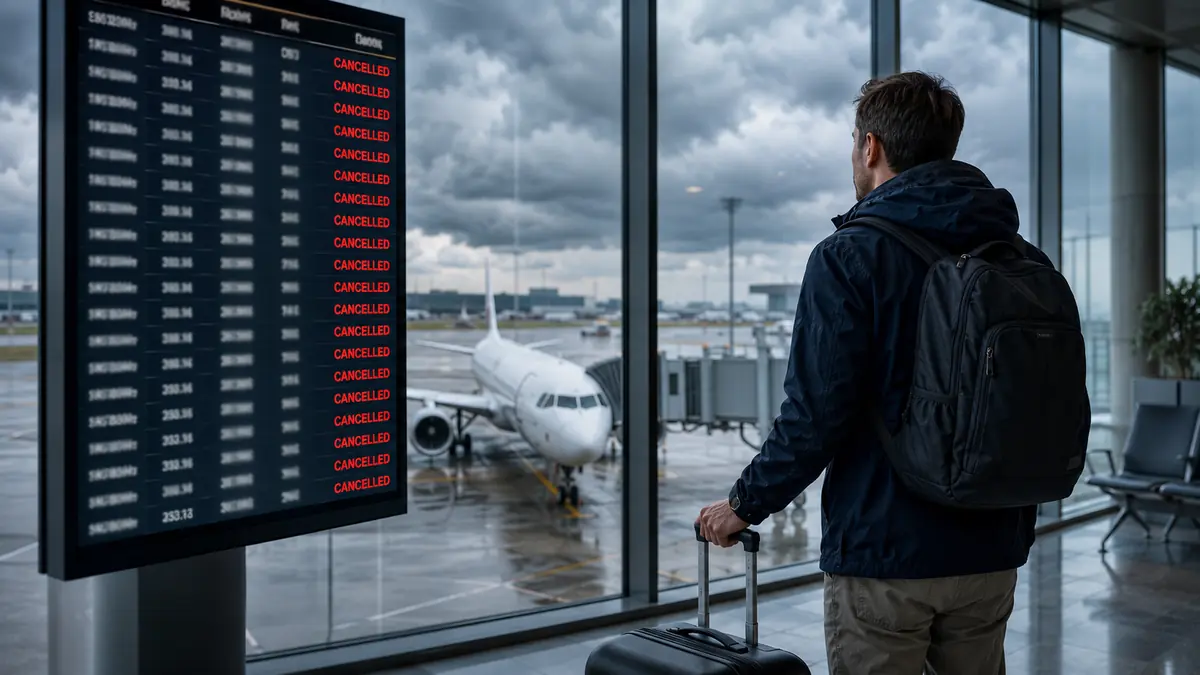
A cancelled flight can derail an entire journey in minutes. Your best response is to confirm the cancellation, understand the reason, compare rebooking with a refund, preserve every document, and contact the airline through several channels before alternative seats disappear.
Flight cancellations occur when an airline decides not to operate a scheduled service. Affected passengers can generally choose between alternative transportation and a refund, but eligibility for meals, accommodation, and cash compensation depends on the route, applicable law, notice period, and cause of the disruption.
Why Do Airlines Cancel Flights?
Airlines cancel services for operational, safety, commercial, and regulatory reasons. The stated cause matters because it may determine whether the carrier owes only a refund or rebooking—or must also provide care and compensation.
Severe weather
Thunderstorms, hurricanes, snow, ice, fog, strong winds, and poor visibility can make takeoff, landing, or ground operations unsafe. Weather at another airport may also affect your flight when the incoming aircraft or crew cannot arrive.
Conditions do not need to close an airport completely. Air traffic control may reduce arrival and departure capacity, forcing airlines to cancel selected services.
Weather-related disruption is normally considered outside the airline’s control. Passengers may still have refund or rerouting rights, but statutory cash compensation often does not apply.
Air traffic control restrictions
Congested airspace, runway closures, equipment failures, staffing limitations, and emergency restrictions can disrupt several airlines simultaneously. These events frequently produce rolling delays followed by cancellations as aircraft and crews fall out of position.
Mechanical and technical problems
Airlines cannot legally operate an aircraft that fails required safety checks. A mechanical defect might be repaired quickly, but cancellation becomes more likely when replacement parts, engineers, or another aircraft are unavailable.
The legal treatment of technical problems varies. Some jurisdictions regard routine mechanical faults as within the airline’s control, while exceptional manufacturing defects, security concerns, or mandatory fleet-wide inspections may be treated differently.
Crew scheduling problems
Pilots and cabin crew have regulated limits on working and flying hours. A delayed crew may “time out,” leaving the airline unable to operate the service legally.
Crew illness, rostering failures, labor action, or disruption elsewhere in the network can have the same result. Whether these circumstances qualify for compensation depends on who caused the problem and which passenger-protection rules govern the flight.
Security and airport emergencies
Security alerts, political instability, natural disasters, airport evacuations, and infrastructure failures can stop operations without warning. Airlines usually classify these as extraordinary circumstances beyond their reasonable control.
Airline schedule changes
A carrier may cancel a route because of weak demand, network restructuring, aircraft availability, or a timetable change. These cancellations are often announced days or months before departure.
Advance notice gives travelers more time to rearrange plans, but it does not remove the basic obligation to provide an appropriate refund or alternative itinerary where applicable.
What to Do Immediately After a Flight Is Cancelled
Seats on the next available departures can disappear quickly during widespread disruption. Act in a deliberate order rather than waiting in a single airport queue.
- Verify the cancellation. Check the airline’s app, website, departure board, email, and text notifications. Confirm whether the entire itinerary or only one segment is affected.
- Find the stated reason. Take a screenshot of the cancellation notice and ask an airline representative to record the cause in writing. Avoid relying solely on a vague label such as “operational reasons.”
- Check automatic rebooking. The airline may already have moved you to another service. Review the date, airport, connections, cabin, and arrival time before accepting it.
- Search alternative flights yourself. Look for seats on the same airline, its alliance partners, and reasonable nearby routes. Giving an agent a specific flight number can make rebooking faster.
- Contact the carrier through multiple channels. Use the app, telephone line, online chat, social support, airport service desk, and lounge staff if you have access. Stay courteous and state the remedy you want clearly.
- Protect connecting arrangements. Notify hotels, rental-car providers, cruise operators, tour companies, and anyone meeting you. Ask whether reservations can be moved without penalty.
- Keep every receipt. Save evidence for meals, transport, accommodation, replacement tickets, and essential purchases. Itemized receipts are stronger than card statements alone.
Quick takeaway: Do not cancel the booking yourself unless the airline instructs you to do so. A voluntary cancellation can affect refund and compensation rights.
Rebooking or Refund: Which Should You Choose?
When an airline cancels your flight, the two main remedies are alternative transportation and reimbursement. The better option depends on whether you still need to travel.
| Option | Best when | What to verify |
|---|---|---|
| Rebooking as soon as possible | You must reach the destination | Arrival time, airport, connections, cabin and baggage transfer |
| Travel on a later date | The trip can be postponed | Ticket validity, fare difference and date restrictions |
| Cash refund | The journey no longer serves its purpose | Refund covers unused ticket and eligible extras |
| Travel credit or voucher | You genuinely expect to use the airline again | Expiry date, transferability, blackout dates and restrictions |
Choosing rebooking
Ask for the earliest reasonable route to your final destination. This might involve another flight operated by the same carrier, a partner airline, or a different airport.
Do not assume that “next available flight” means the first flight with an empty seat visible online. Inventory available to airport agents may differ, and airline policies on transferring passengers to competitors vary.
Before accepting, check whether the alternative changes:
- Your departure or arrival airport
- The number or length of connections
- Your travel class
- Accessibility arrangements
- Checked-baggage handling
- Your final arrival time
If the airline moves you to another airport, ask who will pay for transportation between airports or to the originally booked destination.
Choosing a refund
A refund is usually more suitable when the cancellation defeats the purpose of your trip or the proposed replacement arrives too late. Request money returned to the original form of payment unless you knowingly prefer a voucher.
In the United States, passengers are entitled to an automatic refund when an airline cancels a flight and they reject rebooking or other alternative transportation. The refund generally covers the unused ticket and fees for services not provided, such as seat selection or checked baggage. Current details are available from the U.S. Department of Transportation.
Accepting and traveling on a replacement flight normally means you cannot also claim a full refund for that used portion of the journey.
What happens to connecting flights?
Flights issued under one ticket are generally treated as a single itinerary. If cancellation of the first segment makes the remaining journey unusable, ask the airline to reroute you to the ticketed final destination.
You may also qualify for a refund of unused segments and, under some passenger-rights regimes, a return flight to your original departure point.
Separate tickets create more risk. The second carrier may treat you as a no-show even when the first airline caused the missed connection. Contact both carriers immediately, and check whether travel insurance or credit-card coverage protects self-connected itineraries.
Passenger Rights for Flight Cancellations
There is no single worldwide passenger-rights system. The operating airline, departure country, destination, ticket structure, and cause of cancellation can all affect what you receive.
| Region | Core protection when the airline cancels | Possible additional rights |
|---|---|---|
| United States | Refund if you reject alternative transportation | Airline-promised meals, hotel or rebooking for controllable disruption |
| European Union | Refund or rerouting | Care and possible compensation under Regulation (EC) No 261/2004 |
| United Kingdom | Refund or rerouting | Care and possible compensation under UK261 |
| Other countries | Varies by national law and contract | Compensation, care or alternative transport where local rules provide it |
United States
U.S. rules distinguish between the right to a refund and additional assistance.
If the carrier cancels a flight, it must provide a refund when the passenger does not accept rebooking, a voucher, or another alternative. Refund eligibility does not depend on whether weather, maintenance, or another event caused the cancellation.
Meals, hotels, ground transportation, and rebooking on another carrier are different. Federal rules do not provide a universal cash-compensation system comparable to EU261. Instead, airlines publish customer-service commitments for disruptions within their control.
The DOT’s Airline Cancellation and Delay Dashboard allows passengers to compare participating U.S. airlines’ commitments. Policies may cover:
- Complimentary rebooking on the same airline
- Rebooking on a partner carrier
- Meal vouchers after a specified wait
- Hotel accommodation for overnight disruption
- Transportation between the airport and hotel
These commitments usually apply to controllable events such as certain maintenance or crew problems—not severe weather or air traffic control restrictions.
European Union
Regulation (EC) No 261/2004, commonly called EU261 or EC261, provides a structured set of rights. It generally covers flights departing from an EU airport and certain flights arriving in the EU when operated by an EU carrier.
After a cancellation, passengers must usually be offered a choice among:
- Reimbursement of the unused ticket
- Rerouting to the final destination at the earliest opportunity
- Rerouting on a later date, subject to seat availability
While awaiting rerouting, eligible travelers are entitled to care, which can include reasonable meals, refreshments, communication, hotel accommodation, and transport between the airport and hotel.
Cash compensation may also apply when cancellation occurs with less than 14 days’ notice and the airline cannot rely on an exemption or qualifying alternative schedule. Compensation traditionally depends on distance and may reach €250, €400, or €600 under the applicable criteria.
European passenger-rights legislation has been subject to reform negotiations, so travelers should verify the rules in force for their travel date through the European Commission’s passenger-rights portal.
United Kingdom
UK261 retained many protections associated with EU261 following Brexit. Covered passengers are generally entitled to choose a refund or rerouting and may receive care while waiting.
Compensation depends on factors including the notice provided, the proposed replacement schedule, flight distance, arrival delay, and whether the carrier could have avoided the cancellation by taking reasonable measures.
The UK Civil Aviation Authority explains the current requirements and claims process.
When Does a Cancelled Flight Qualify for Compensation?
A refund and compensation are not the same thing.
A refund returns money paid for transportation you will not use. Compensation is an additional fixed or calculated payment for the inconvenience caused by a qualifying disruption.
Under EU and UK rules, compensation may be available when:
- The flight falls within the regulation’s geographical scope
- The cancellation was announced less than 14 days before departure
- The replacement itinerary does not fall within permitted timing exceptions
- The cause was within the airline’s responsibility
- The passenger had a confirmed booking and met check-in requirements
What are extraordinary circumstances?
Extraordinary circumstances are events the airline generally could not have prevented even if it had taken reasonable measures. Examples may include:
- Dangerous weather
- Air traffic management restrictions
- Security risks
- Political instability
- Certain airport closures
- Some external strikes
- Hidden aircraft manufacturing defects
The label alone is not decisive. An airline should be able to identify the actual event and explain how it affected the flight. Routine technical faults or internal staffing failures are not automatically extraordinary merely because the carrier describes them as unexpected.
Even when extraordinary circumstances remove the right to cash compensation, covered EU and UK passengers generally retain their rights to rerouting or reimbursement and reasonable care.
Meals, Hotels, and Other Expenses
Whether an airline must pay expenses depends on the governing law and the reason for the cancellation.
Under EU261 and UK261, the duty of care can continue during lengthy waits for rerouting—even when severe weather caused the disruption. Assistance should be proportionate to the waiting time and may include food, refreshments, communication, accommodation, and hotel transfers.
In the United States, expense coverage commonly depends on the airline’s published commitments and whether the disruption was controllable.
If staff cannot provide vouchers or accommodation, ask for written authorization before making your own arrangements. When immediate help is unavailable, choose reasonable options and retain:
- Itemized receipts
- Boarding passes and booking confirmations
- Screenshots of notices and app messages
- Chat transcripts and emails
- Names or reference numbers supplied by agents
- Proof of the cancellation reason
Luxury hotels, alcohol, premium transportation, and unnecessary purchases are harder to recover. The practical test is whether the cost was necessary, proportionate, and directly caused by the disruption.
How to File a Refund, Reimbursement, or Compensation Claim
Submit separate claims if the carrier treats ticket refunds, expense reimbursement, and statutory compensation as different processes.
1. Assemble the evidence
Record the flight number, scheduled date and time, booking reference, ticket number, route, cancellation notice, stated cause, replacement itinerary, and actual arrival time.
2. Identify the correct operating carrier
Passenger-rights claims are often handled by the airline that was scheduled to operate the flight, not necessarily the company or travel agency that sold the ticket.
A travel agent may still need to process a refund when it acted as the merchant. If the airline and agent refer you back and forth, ask each party to confirm in writing who holds the payment and who has refund authority.
3. State the remedy clearly
Do not submit a vague complaint. Specify whether you seek:
- A ticket refund
- Reimbursement of reasonable expenses
- Statutory compensation
- Restoration of points or miles
- Refund of baggage, seat, Wi-Fi, or upgrade fees
- Correction of an improperly issued voucher
List each amount and attach its supporting document.
4. Cite the applicable protection
Reference the relevant law, regulator guidance, airline customer-service plan, contract of carriage, travel-insurance policy, or credit-card benefit. Keep the explanation factual and concise.
5. Escalate if necessary
If the airline rejects or ignores a valid claim, follow its formal complaint procedure. Depending on the jurisdiction, the next step may involve an aviation regulator, national enforcement body, approved alternative dispute resolution provider, consumer-protection agency, or court.
Avoid rushing to a claims company before trying the airline directly. Such firms may simplify the process but commonly retain a portion of any compensation recovered.
How Travel Insurance and Credit Cards Can Help
Passenger-rights laws do not cover every financial loss. Travel insurance may pay expenses that an airline does not owe, including unused accommodation, missed events, replacement transportation, or additional meals.
Trip-cancellation and trip-interruption policies are different. Airline cancellation after a journey begins is usually considered an interruption or travel-delay event, though policy definitions vary.
Credit cards used to purchase the ticket may include similar benefits. Coverage often requires:
- A qualifying reason
- Payment with the eligible card
- A minimum delay
- Documentation from the airline
- Timely notice and claim submission
- Receipts for every claimed expense
Do not assume insurance will cover any cancellation. Known events, labor disputes, insufficient connection time, separate-ticket problems, and voluntary travel changes may be excluded.
How to Reduce the Impact of Future Flight Cancellations
No strategy can eliminate disruption, but a few booking decisions make recovery easier.
Choose earlier departures
Morning flights are less exposed to delays accumulated across the day. They also leave more same-day rebooking options if something goes wrong.
Prefer nonstop itineraries
Every connection creates another opportunity for weather, crew, baggage, or scheduling problems. If a connection is necessary, avoid the last onward flight of the day.
Book the complete journey on one ticket
A protected connection gives the airline responsibility for rerouting when an earlier segment causes a missed flight. Self-connecting tickets can be cheaper, but they transfer much of that risk to the traveler.
Allow time around critical events
For weddings, cruises, interviews, medical appointments, and international tours, arriving a day early can be more valuable than choosing the lowest fare.
Enable airline notifications
Add accurate contact information to the reservation and enable email, text, and app alerts. Early notice can give you a head start on limited alternative seats.
Save essential items in hand luggage
Keep medication, identification, charging cables, valuables, basic toiletries, and one change of clothes accessible. Checked baggage may follow a different route after rebooking.
Know the difference between airline and passenger cancellations
When the airline cancels, statutory refund protections may apply. When the passenger decides not to travel while the flight still operates, the fare rules usually control the outcome unless a waiver, insurance policy, or consumer law says otherwise.
The Bottom Line on flight cancellations
Flight cancellations are easier to manage when you separate four possible remedies: rebooking, ticket refund, reasonable care, and compensation. They are related, but they do not arise under identical rules.
Confirm the cause, decide whether you still need to travel, preserve written evidence, and request the exact remedy that applies. Check the law governing the route rather than assuming another country’s rules apply. If you spend your own money during the disruption, keep costs reasonable and retain every receipt until the case is fully resolved.