Building a Florence itinerary for the first time usually starts the same way: three days, a list of names you can barely pronounce — Brunelleschi, Botticelli, Bargello — and a nagging feeling you’re going to miss something important. The good news is that a well-paced Florence itinerary is easy to pull off, because this city is small enough to actually “do” properly in three days, as long as you don’t try to see everything.
Three days in Florence is enough time to see the Uffizi Gallery, Accademia (David), the full Duomo complex, Ponte Vecchio, and Oltrarno, plus one Tuscan day trip to Siena, Pisa, or Chianti. Book Uffizi and Accademia tickets at least two to four weeks ahead for peak season (April–October).
I’ve lived in and out of this city long enough to know where the plan you find online falls apart in real life — the itinerary that looks perfect on paper but has you standing in a ticket line for two hours instead of standing in front of a Botticelli. Here’s the version that actually holds up.
How Many Days Does Your Florence Itinerary Actually Need?
Short answer: three, if this is your only Italy stop. Two, if you’re ruthless about cutting one major museum. Four, if you want a proper Tuscan day trip without rushing back for dinner.
Florence’s historic center is genuinely tiny — you can walk from the train station to the far edge of Oltrarno in about 25 minutes. That compactness is exactly why people underestimate how long things take. The queues, not the distances, eat your day.
| Days | What you’ll realistically cover | Best for |
|---|---|---|
| 2 days | Duomo complex + Uffizi or Accademia, Oltrarno on foot | Tight itineraries, add-on to a Rome/Venice trip |
| 3 days | Duomo, Uffizi, Accademia, Oltrarno, plus one day trip | First-time visitors — the sweet spot |
| 4 days | Everything above, unrushed, plus Boboli Gardens and a second day trip | Repeat visitors, slower travelers |
Quick takeaway: if you only have two days, skip the Accademia and see the replica David for free in Piazza della Signoria instead. It’s a genuinely reasonable trade-off.
Florence Itinerary Day 1: Renaissance Icons and the Historic Center
Start early — 8:15 AM if you can manage it. This single decision will do more for your Florence trip than any packing list.
Morning: Uffizi Gallery. Book ahead. Inside, you’re walking through the former headquarters of the Medici banking empire, now stacked with Botticelli, Leonardo, Caravaggio, and Titian in one building. Give it two to three focused hours — enough for the Botticelli rooms, a couple of Leonardos, and the Tribune’s ancient sculptures, without gallery fatigue setting in by hour four.
Midday: Piazza della Signoria. A five-minute walk from the Uffizi exit puts you in one of Florence’s great outdoor rooms — Palazzo Vecchio on one side, a replica David standing where the original once stood, and the Loggia dei Lanzi’s sculpture collection along the edge. Cellini’s Perseus with the Head of Medusa is worth stopping for.
Lunch: Grab a schiacciata sandwich at All’Antico Vinaio, or skip the famous line and get an equally good version at a nearby alternative — the fillings (pecorino cream, artichoke cream, spicy eggplant) are the point, not the queue.
Afternoon: Cross Ponte Vecchio, Florence’s shop-lined medieval bridge, at a relaxed pace — mid-afternoon or dusk both work well, since this bridge gets crowded at all hours. Continue into Oltrarno for a first look at the “other side” neighborhood you’ll explore properly on Day 2.
Quick takeaway: don’t try to add the Accademia to Day 1. Two major museums in one day is the single most common way first-time visitors burn out by 3 PM.
Florence Itinerary Day 2: The Duomo Complex and Oltrarno
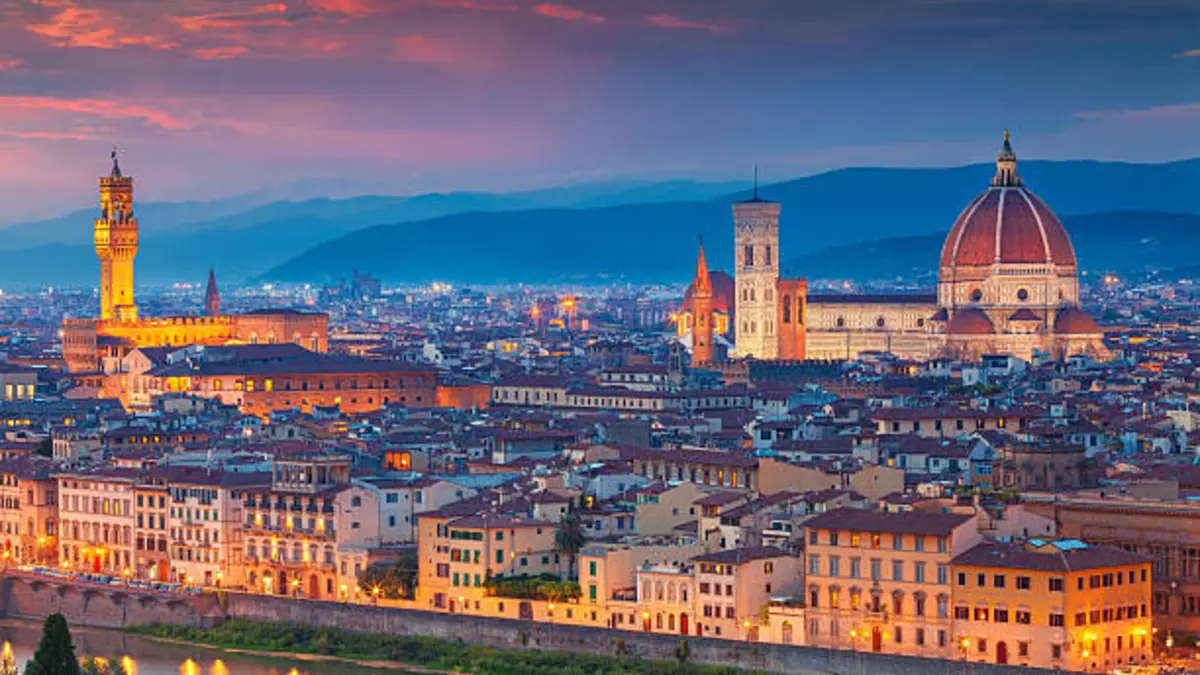
Morning: The Duomo complex. This isn’t one attraction — it’s five: the cathedral itself, Brunelleschi’s Dome climb, Giotto’s Bell Tower, the Baptistery, and the Duomo Museum. Climbing the dome takes real stamina (expect a narrow, steep staircase) but the reward is a rooftop view of terracotta rooftops that no photo does justice to. A combined pass covering all five sites is the efficient way to handle this.
Late morning: Accademia Gallery. This is where Michelangelo’s David actually lives. The museum itself is compact — 45 minutes to 1.5 hours is enough — but arrive either right at opening or later in the afternoon. Midday visits routinely turn into chaos outside the entrance.
Afternoon: Oltrarno. Cross back over the Arno and spend real time here — this is where the artisan workshops, quieter piazzas, and better-value restaurants live. It’s also where you escape the tour-group density of the historic core.
Evening: Piazzale Michelangelo. Walk or taxi up for sunset. Check the sunset time before you go — it swings from around 4:30 PM in December to 9 PM in June — so this step of your itinerary genuinely depends on when you’re visiting.
Florence Itinerary Day 3: A Day Trip Into Tuscany
This is the day most 2-day itineraries sacrifice, and it’s the one I’d protect hardest. Florence is a genuinely useful home base for the surrounding region, and all three of the following options are reachable without a car.
Siena — Gothic architecture, the shell-shaped Piazza del Campo, a completely different medieval atmosphere from Florence’s Renaissance core. About 1.5 hours away by bus or train.
Pisa — Yes, just for the Tower, and that’s fine. About one hour by train, easily done as a half-day if you’d rather split your third day.
Chianti — Rolling vineyards, a wine tasting, and a slower pace after two museum-heavy days. Best done as an organized tour or with a rental car, since public transit here is limited.
Bologna — About 35 minutes by high-speed train, and genuinely underrated if food is your priority over landscape.
| Day trip | Travel time | Best for |
|---|---|---|
| Siena | ~1.5 hrs | Architecture and medieval atmosphere |
| Pisa | ~1 hr | A quick iconic photo stop |
| Chianti | Varies (tour-dependent) | Wine, countryside, slower pace |
| Bologna | ~35 min | Food-focused travelers |
Where to Stay for Your Florence Itinerary
Two neighborhoods consistently outperform the rest for first-time visitors:
- The historic center (near the Duomo and Piazza della Signoria) — maximum convenience, walkable to everything, but pricier and busier.
- Oltrarno — a genuine local feel, still a short walk from the main sights, generally better value for the same star rating.
If you’re arriving by train, Santa Maria Novella station sits right at the edge of the historic center, so staying within a 20-minute walk of it keeps every option on the table.
Budget, Tickets, and Booking Logistics
This is the part most itineraries gloss over, and it’s where trips go over budget or off schedule.
2026 Uffizi ticket prices (confirm current pricing at uffizi.it before booking):
- Standard online ticket: around €29 (includes booking fee)
- Standard walk-up ticket: around €25
- Afternoon discount (entry from 4 PM): around €16–€20 — introduced in January 2026 and still underused by most visitors
- Under-18s: free with ID
Accademia follows a similar structure — book online whenever your dates are firm, especially April through October, when day-of tickets can sell out by mid-morning.
Is the Firenze Card worth it? It bundles priority entry to dozens of sites over 72 hours for a flat fee, but it only pays off if you’re genuinely visiting several paid museums a day. For a standard 3-day itinerary focused on the Uffizi, Accademia, and Duomo complex, buying individual tickets is usually cheaper.
If you’re renting a car: don’t drive into the historic center. It’s covered by a ZTL (restricted traffic zone), and cameras issue fines automatically — sometimes arriving by mail months later. Park outside the zone or drop your rental at the train station instead.
Rough daily budget per person (mid-range travel): €80–€150/day covering a 3-star hotel share, two museum tickets, meals, and incidentals — excluding flights and any guided tours.
Practical Tips: Weather, Dress Code, and Rainy Days
Dress code: Florence’s major churches — the Duomo, Santa Croce, Baptistery — enforce a modest dress code. Shoulders and knees covered, for everyone, no exceptions at the door. Carry a light scarf even in summer.
Rainy day backup: The Uffizi, Accademia, Bargello, and Palazzo Vecchio are all indoor and can absorb a full rained-out day without adjusting your plan much. Mercato Centrale also works well as a rainy-afternoon fallback — food stalls under one roof.
Best time to visit: April–May and September–October give you the best balance of weather and crowd levels. July–August is hot (30s°C) and busiest; November–February is quieter and cheaper but with shorter museum hours and a higher chance of closures around Christmas.
Sundays and Mondays: many sites either close or run shorter hours, and the first Sunday of each month brings free entry — which sounds appealing but means dramatically longer queues. Plan around it rather than for it, unless you’re arriving before 7:30 AM.
Florence rewards a loosely-held plan more than a rigid one. Book your two or three unmissable, sell-out-prone tickets in advance — Uffizi, Accademia, the Duomo dome climb — and leave real room around them for the wandering that makes this city stick with you. If you’re ready to lock in dates, start with those three bookings first; everything else in this itinerary can be arranged once you’re on the ground.
For more expert travel tips and itineraries, explore our travel planning resources.
FAQ Section
How many days do you need in Florence?
Three days is the realistic minimum for first-time visitors who want to see the Uffizi, Accademia, and the Duomo complex without rushing. Two days works if you’re willing to cut one major museum; four days lets you add a second day trip.
Is 3 days enough for Florence?
Yes, for most travelers. Three days covers the essential sights plus one Tuscan day trip. You won’t see every museum, but you’ll avoid the exhaustion that comes from cramming everything into 48 hours.
Do I need to book Uffizi and Accademia tickets in advance?
For visits between April and October, yes — book two to four weeks ahead, since day-of tickets regularly sell out by mid-morning. From November through March, walk-up tickets are usually available with less notice.
What’s the best day trip from Florence?
Siena for architecture and atmosphere, Pisa for a quick iconic stop, and Chianti for wine and countryside. All three are doable in a single day without a car, except Chianti, which is easiest with a tour or rental.
Is Florence walkable?
Yes — the historic center is compact enough to cross on foot in about 25 minutes, and most visitors don’t need public transport beyond the occasional bus to Piazzale Michelangelo.
What should I not miss in Florence?
The Uffizi Gallery, Michelangelo’s David at the Accademia, the Duomo complex (especially the dome climb), Ponte Vecchio, and a sunset at Piazzale Michelangelo are the five that come up on every serious itinerary.
What should I wear to visit Florence’s churches?
Shoulders and knees covered, for both men and women — this is enforced at the door of the Duomo, Santa Croce, and the Baptistery. A light scarf or shawl works well even in summer heat.
Can I drive into central Florence?
No — the historic center is a ZTL (restricted traffic zone), and cameras issue automatic fines to non-resident vehicles. If you’re renting a car for day trips, drop it at the train station area instead of driving into the center.