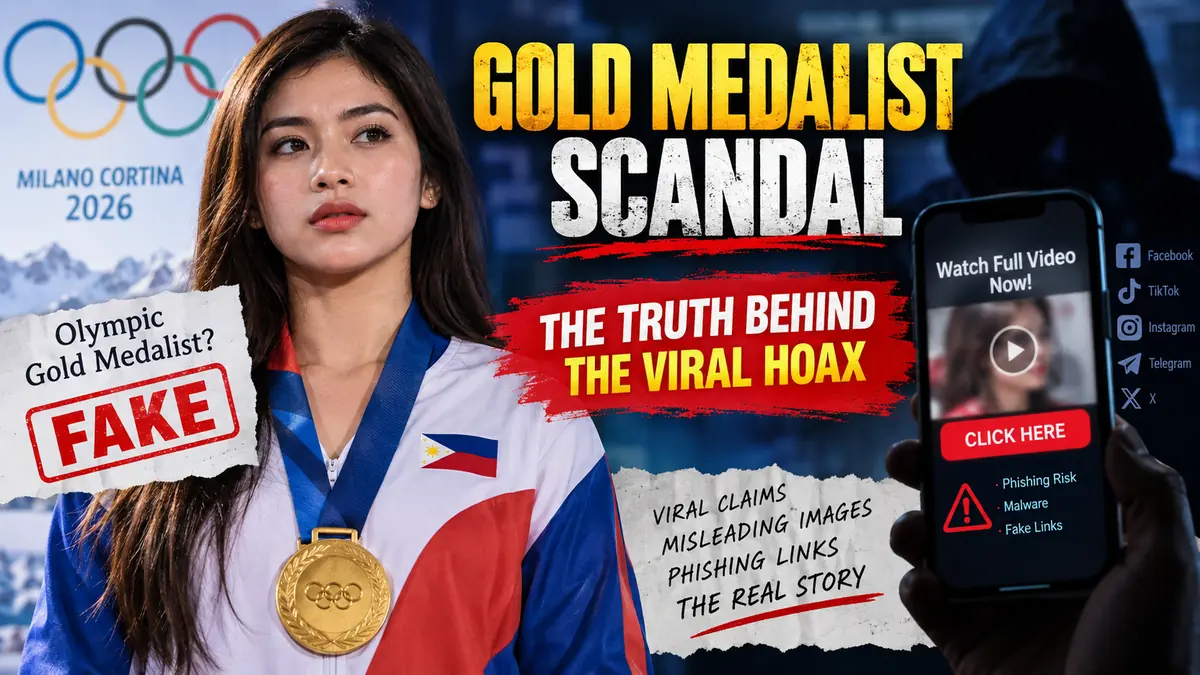
Searches for the gold medalist scandal surged after social-media posts began circulating claims about a supposed Filipina Olympic champion and an alleged leaked private video. The posts looked convincing enough to spread quickly, but reporting on the trend found a very different story: the “gold medalist” identity was manufactured, while many links promoted alongside it were associated with phishing and malware traps.
The quick answer: The gold medalist scandal refers primarily to a viral 2026 internet hoax involving Filipino content creator Zyan Cabrera, also known online as Jerriel Cry4zee. There is no credible evidence that Cabrera is an Olympic gold medalist, and the supposed scandal was amplified through misleading images, unverified video claims, and potentially dangerous links.
Understanding that distinction matters because this story is less about an athlete behaving badly and more about how viral misinformation can turn someone’s identity into bait for clicks, account theft, malware, and fabricated online drama.
What Is the Gold Medalist Scandal?
The phrase gold medalist scandal became attached to posts circulating primarily around Facebook, Telegram, X, Instagram, and TikTok in February 2026. Many posts showed or referenced a young Filipina woman while promising access to a supposedly leaked or private video.
The woman widely identified in coverage was Zyan Cabrera, who has also appeared online under the name Jerriel Cry4zee or similar spellings.
There was one major problem with the story: Cabrera was not established as the Olympic champion the viral posts claimed she was.
Multiple reports examining the trend found no evidence that she had competed at the Olympics or won an Olympic gold medal. Instead, she was described as a social-media content creator whose existing photos and videos were repurposed within misleading posts.
The “gold medalist” description therefore should not be read as a verified biographical fact.
| Viral claim | What available reporting found |
|---|---|
| Zyan Cabrera is an Olympic gold medalist | No credible evidence supports this |
| She competed at the Olympics | No verified Olympic participation was identified |
| A genuine scandal video was confirmed | Claims remained unverified or misleading |
| Viral medal images prove she is an athlete | At least prominent circulating images were reported as AI-manipulated |
| “Full video” links are safe | Reports warned of phishing and malware risks |
The key distinction is simple: a viral label is not evidence of an athletic achievement or a real scandal.
Is Zyan Cabrera Really an Olympic Gold Medalist?
No credible evidence found in reporting on the story establishes Zyan Cabrera as an Olympian or Olympic gold medalist.
Fact-check coverage described Cabrera as a digital content creator rather than a professional athlete and concluded that the sporting identity attached to her was fabricated.
This matters because the word “gold medalist” gives the story instant credibility.
Olympic champions are public figures whose competition results are normally documented. A real Olympic gold medal creates a trail of information: the Games, event, result, national team, medal table, competition records, and coverage from established sports organizations and media outlets.
The viral narrative around Cabrera did not have that supporting record.
Instead, reports found her social-media identity being connected to Olympic terminology without evidence that she had actually participated in the Games.
Why Was She Called a “Gold Medalist”?
Timing appears to be an important part of the answer.
The campaign spread during the Milano Cortina 2026 Winter Olympics, when Olympic-related searches and social-media discussions were receiving unusually high attention. Reports examining the hoax described the use of “gold medalist” terminology as a way of exploiting interest surrounding the Games.
That technique resembles what is commonly called trend hijacking or SEO poisoning.
Instead of waiting for users to search for an obscure scam, bad actors attach their content to something people are already searching for.
In this case, the formula was especially effective:
Olympics + gold medalist + alleged scandal + viral video
Each component creates curiosity. Combined, they can generate considerably more attention than an ordinary spam link.
Why the Gold Medalist Scandal Went Viral
The story demonstrates how modern viral scams are constructed.
The scammers did not need everyone to believe every detail. They only needed enough people to become curious enough to click, search, comment, or share.
Several psychological and technical tactics appear repeatedly in reporting about the campaign.
1. A recognizable person’s face
Real social-media material associated with Cabrera gave the posts an appearance of authenticity.
Someone encountering her face repeatedly might reasonably assume there was a real news story behind the trend.
2. Sensational scandal language
Posts reportedly promised a private or “full” video.
This type of wording creates an information gap: people know just enough to become curious but not enough to understand what happened.
3. Blurred or suggestive thumbnails
Some posts paired ordinary images with blurred or unrelated suggestive imagery.
That does not establish that the people shown in separate images are connected.
The technique is essentially visual bait-and-switch.
4. Social proof
When thousands of people search, comment, tag friends, or ask for a link, other users can interpret that activity as evidence that the underlying story must be genuine.
But popularity verifies only that something is popular.
It does not verify the claim itself.
5. Urgency and FOMO
Posts suggesting that “everyone” had already watched a video can create fear of missing out.
That reduces the amount of time people spend checking whether a claim is legitimate before clicking.
Quick takeaway: Viral engagement can become part of the scam. Comments asking for a link may unintentionally make a false story appear more credible and push it toward additional users.
Is the Gold Medalist Scandal Video Real?
This is where careful wording is essential.
Reporting on the viral campaign found no reliable evidence establishing the sensational story being promoted by scam posts as genuine. Claims that an authentic private video featuring Cabrera was available through circulating “full video” links were described as unverified, misleading, or part of a scam operation.
That distinction is more accurate than trying to authenticate every file uploaded under the phrase.
Once a search term becomes viral, unrelated material can be renamed and reposted using the same title.
A file labeled “gold medalist scandal video” could therefore be:
- an unrelated video,
- an edited clip,
- stolen content involving somebody else,
- an AI-generated or manipulated image or video,
- a redirect page,
- an advertisement,
- a phishing page,
- or a malicious download.
A filename, caption, hashtag, or Telegram message does not establish who appears in a video.
How AI Images Added to the Confusion
Artificial intelligence made the story even harder for casual users to evaluate.
A later viral image presented Cabrera alongside another creator, Vera Hill, also referred to online as “ChiChi,” in a supposed “Choose Your Fighter” face-off.
Fact-check reporting concluded that this image had been manipulated with AI. The analysis pointed to a visible AI-related watermark and visual inconsistencies involving the medal, lighting, textures, and other elements.
This illustrates a broader problem with viral scandals.
Historically, seeing a photograph offered at least some evidentiary value. Today, an apparently convincing image may have been generated, face-swapped, altered, or assembled from unrelated sources.
That means visual evidence needs context.
Ask:
Where did the original image come from? Who published it first? Is there an independently verifiable original? Does a credible organization confirm what the image supposedly depicts?
If those questions cannot be answered, the image should not be treated as proof.
Jerriel Cry4zee, ChiChi and the Expanding Viral Narrative
As the original gold medalist scandal gained attention, additional names and storylines began appearing around it.
One involved Vera Hill, identified in reports by the nickname ChiChi.
Viral posts eventually portrayed Cabrera and Hill as participants in a manufactured online rivalry. LatestLY’s fact-checking described the widely circulated face-off image as AI-generated rather than evidence of an actual confrontation.
This expansion is typical of engagement-driven misinformation.
A simple rumor eventually develops “characters,” sequels, supposed new evidence, reaction posts, comparison images, and additional leaked-video claims.
Each new development provides another reason for people to search for the story.
The resulting volume can make the narrative appear increasingly credible even though the underlying evidence has not improved.
The Bigger Danger: Phishing Behind the Gold Medalist Scandal
The most significant part of the story is not celebrity gossip.
It is cybersecurity.
Reports investigating gold medalist scandal links described pages promising users access to a supposedly complete video. Instead of providing verified footage, some links reportedly redirected users toward deceptive pages designed to capture login information or encourage unsafe downloads.
A typical version of the attack works like this:
- A sensational post appears on social media.
- The post promises a “full video.”
- A shortened or unfamiliar URL is provided.
- The visitor is redirected to another website.
- The site asks the visitor to log in, register, or verify their age.
- A familiar Facebook or Google-style login screen may appear.
- The victim enters an email address and password.
- Those credentials can then be captured by the attacker.
Another variation asks users to install an application, browser component, or supposed video player.
Reporting on the campaign warned that such downloads could expose users to malware or spyware rather than providing the promised content.
Why fake login pages are effective
A phishing page does not necessarily look suspicious.
Attackers can imitate familiar branding, buttons, login boxes, fonts, and page layouts. A person focused on reaching a promised video may pay less attention to the actual domain displayed in the browser.
That is why the safest approach is not simply “look carefully before entering your password.”
It is better to avoid entering account credentials into a page reached through an unsolicited viral-video link at all.
What Is SEO Poisoning?
The gold medalist story also provides a useful example of SEO poisoning.
SEO poisoning broadly refers to attempts to manipulate search visibility so malicious, deceptive, or unwanted pages appear when people search for popular topics.
A scammer first identifies something generating large numbers of searches.
In February 2026, the Winter Olympics provided an obvious opportunity.
The attacker can then combine trending phrases with highly clickable terms:
gold medalist + scandal + leaked video + viral
Those phrases may appear in social posts, page titles, hashtags, filenames, captions, or automatically generated pages.
The goal is not necessarily to build a trustworthy website that ranks for years. The scam may need visibility for only a few hours or days to generate substantial traffic.
That makes breaking news, celebrity rumors, sporting events, disasters, product launches, and viral controversies particularly attractive targets.
How to Recognize a Fake Viral-Video Link
You do not need advanced cybersecurity knowledge to identify many warning signs.
A supposed scandal deserves extra scrutiny when several of these characteristics appear together:
| Warning sign | Why it matters |
|---|---|
| Shortened or unfamiliar URL | Hides the final destination |
| “Login to watch” requirement | May be credential phishing |
| “Verify age with Facebook” | Legitimate verification rarely requires handing credentials to an unknown site |
| Forced app or player download | Potential malware delivery |
| Blurred sensational thumbnail | Common curiosity-bait technique |
| No credible original reporting | The underlying claim may be fabricated |
| Artificial urgency | Designed to prevent careful checking |
| Constant redirects | Common characteristic of malicious or advertising networks |
| Requests to share before viewing | Helps propagate the campaign |
No single sign automatically proves malicious intent.
Several appearing together should be treated as a strong warning.
What to Do If You Clicked a Gold Medalist Scandal Link
Simply opening a webpage does not automatically mean an account has been compromised. The appropriate response depends on what happened afterward.
If you only opened the page
Close it.
Do not download anything, grant browser permissions, allow notifications, or enter personal information.
If you entered a password
Change that password from the service’s legitimate website or official app.
If the same password is used elsewhere, change those accounts as well. Password reuse can turn the compromise of one account into several.
Enable multi-factor authentication where available.
Then review active sessions or logged-in devices and sign out unfamiliar ones.
If you downloaded a file
Do not open it if you have not already done so.
Delete suspicious downloads and run an updated security scan.
If an unknown application was installed, remove it and review its permissions.
If your social account starts posting the link
Assume the account may have been compromised.
Change the password, terminate unknown sessions, enable multi-factor authentication, and remove unfamiliar connected applications.
Warn contacts not to click anything recently sent from the account.
This last step matters because compromised accounts provide scammers with something extremely valuable: trust.
A suspicious link from a stranger is easy to ignore.
The same link apparently sent by a friend is much more convincing.
Why You Shouldn’t Share Alleged Private Videos
There is another dimension to the story beyond cybersecurity: privacy.
Even when an alleged intimate video genuinely exists, redistributing it can seriously harm the people involved and may create legal consequences.
In the Philippines, Republic Act No. 9995, the Anti-Photo and Video Voyeurism Act of 2009, addresses specified acts involving non-consensual intimate images and recordings. Among other provisions, the law prohibits certain copying, distribution, publication, broadcasting, showing, or exhibition of covered intimate material without the required consent.
The law provides penalties for violations, including imprisonment and fines where its statutory requirements are met.
The practical lesson is straightforward.
Do not download, request, repost, sell, or forward alleged private sexual material simply because it is trending.
That remains good practice even before considering whether the material is genuine, manipulated, stolen, or completely fabricated.
How to Fact-Check a Viral Scandal Before Sharing It
The gold medalist scandal illustrates why searching for the original source is more useful than searching repeatedly for the alleged video.
A simple verification process can prevent most mistakes.
1. Separate the claims
Do not treat the entire viral story as one question.
For example:
- Is this person actually an Olympic athlete?
- Did the person win a gold medal?
- Is the circulating photograph authentic?
- Has the alleged video been independently authenticated?
- Is the website distributing it trustworthy?
Each claim requires separate evidence.
2. Check official records when possible
A claim that someone is an Olympic gold medalist should be independently verifiable through established sporting records and credible reporting.
If dozens of anonymous posts make the claim but legitimate sporting records do not support it, that discrepancy matters.
3. Reverse-check the narrative
Look for the earliest credible reporting rather than the most-shared repost.
Scams frequently copy one another, meaning ten websites repeating a rumor may ultimately trace back to the same unsupported social-media post.
4. Treat screenshots cautiously
Screenshots are easy to alter.
They also remove valuable context such as the original URL, publication date, account identity, replies, edits, and surrounding conversation.
5. Distinguish “unverified” from “false”
This is especially important when dealing with real people.
If evidence does not establish that a particular person appears in a circulating clip, the responsible description is that the identification is unverified.
Do not turn uncertainty into an accusation.
Why Viral Scandal Searches Are Attractive to Cybercriminals
People searching for controversial material behave differently from people performing routine searches.
They often want immediate access.
That urgency creates several vulnerabilities.
Users may tolerate strange websites because they expect unofficial content to appear on unofficial platforms. They may ignore browser warnings, click shortened URLs, join unknown Telegram groups, download unfamiliar files, or enter credentials into pages they would normally distrust.
Cybercriminals can exploit that behavior.
The scandal itself therefore does not have to be convincing forever.
It only has to produce one impulsive click.
That is why these campaigns frequently attach themselves to influencers, celebrities, sporting events, and other high-interest topics.
The Difference Between a Real Scandal and Manufactured Clickbait
A genuine public controversy usually produces independently verifiable information.
There may be official statements, identifiable sources, reporting from multiple credible organizations, documented events, public records, or authenticated material.
Manufactured scandal campaigns often work in reverse.
They produce enormous engagement but very little original evidence.
You may see:
- hundreds of reposts,
- thousands of comments,
- multiple shortened links,
- sensational thumbnails,
- promises of “Part 2” or a “full version,”
- anonymous accounts repeating identical wording,
- and almost no reliable evidence establishing the underlying allegation.
That imbalance should immediately raise skepticism.
Quick takeaway: The number of people discussing a claim measures attention, not accuracy.
What the Gold Medalist Scandal Teaches About AI-Era Misinformation
The most useful lesson from this episode extends far beyond Zyan Cabrera.
AI tools have reduced the effort required to manufacture convincing visual material. At the same time, social platforms can distribute emotionally provocative content at enormous speed.
Combine those developments with phishing infrastructure and trending search terms, and scammers gain a powerful formula:
real person + fabricated identity + manipulated visual + sensational allegation + malicious link.
The real person’s existing online presence provides credibility.
The fabricated story supplies curiosity.
AI-generated imagery provides apparent evidence.
Social-media algorithms provide distribution.
The link creates an opportunity for monetization, credential theft, or malware delivery.
That is why media literacy and cybersecurity increasingly overlap. Evaluating whether a story is true can now directly protect your accounts, passwords, devices, and personal information.
Gold Medalist Scandal: The Bottom Line
The available evidence indicates that the viral gold medalist scandal was not a conventional controversy involving an Olympic champion. Reporting instead identified Zyan Cabrera, also known online as Jerriel Cry4zee, as a social-media creator whose identity became attached to a fabricated “Pinay Gold Medalist” narrative. There is no credible evidence that she is an Olympic gold medalist.
Prominent images connected with the wider narrative were also reported as AI-manipulated, while supposed “full video” links were associated with phishing, fake login pages, malware risks, and other deceptive tactics.
The safest response is therefore simple: do not treat viral captions as proof, do not click unverified scandal links, and do not redistribute alleged private material.
When a sensational story offers plenty of urgency but almost no independently verifiable evidence, verify the claim before becoming part of the chain that spreads it.