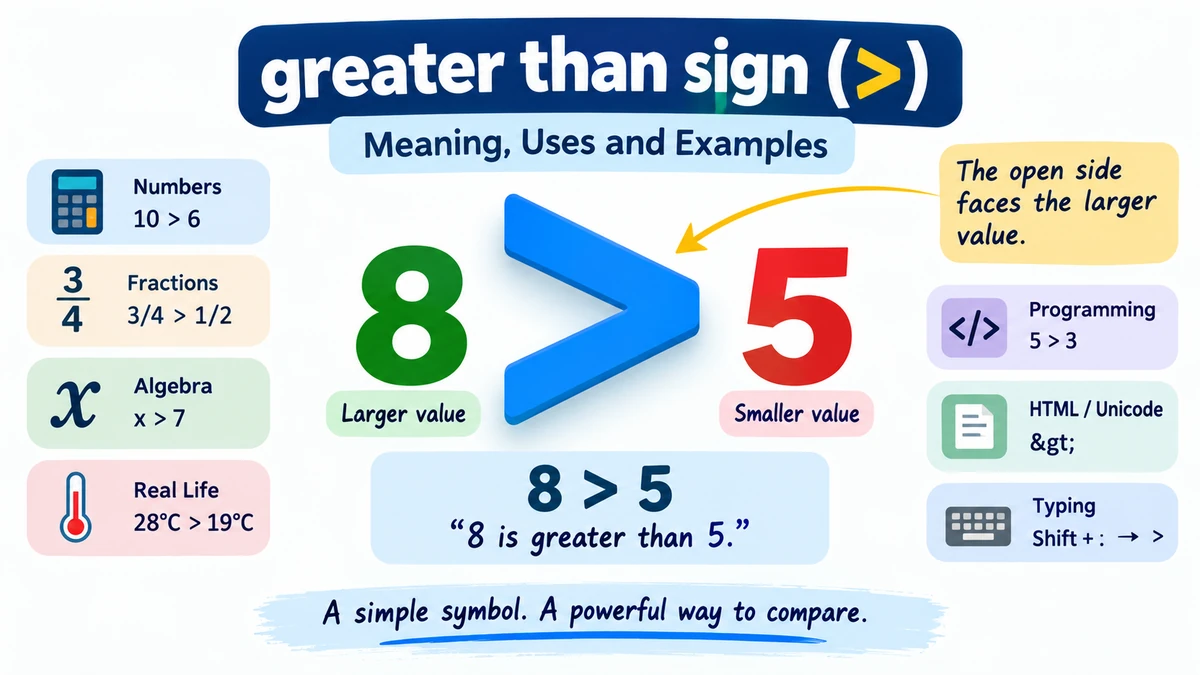
The greater than sign can be confusing because it looks almost identical to the less than sign. The difference comes down to direction: the wide, open side faces the larger value, while the pointed end faces the smaller value.
The greater than sign (>) is a mathematical comparison symbol showing that the value on the left is larger than the value on the right. For example, 8 > 5 is read as “8 is greater than 5.” It is used with numbers, quantities, algebraic expressions, inequalities, measurements, data, and programming comparisons.
What Is the greater than sign?
The greater than sign is:
>
It compares two values and indicates that the value on its left is larger than the value on its right.
For example:
10 > 6
Read this as:
“10 is greater than 6.”
The statement is true because 10 has a higher numerical value than 6. The same basic rule applies when comparing whole numbers, decimals, fractions, negative numbers, variables, and many other mathematical quantities.
A useful way to understand the symbol is to look at its two ends:
- Open side: faces the larger value.
- Pointed side: faces the smaller value.
So in:
12 > 4
the wide opening faces 12 because 12 is larger.
How do you read the > symbol?
The symbol > is normally read as “is greater than.”
For example:
20 > 11
is read:
“Twenty is greater than eleven.”
For variables:
x > 7
is read:
“x is greater than seven.”
This means x can take values above 7, such as 7.1, 8, 20, or 100, but not 7 itself.
Quick Takeaway: In A > B, A must have a greater value than B for the statement to be true.
greater than sign vs. Less Than Sign
The greater than and less than symbols are mirror images, which is why beginners often mix them up.
| Symbol | Meaning | Example | Read as |
|---|---|---|---|
| > | Greater than | 9 > 4 | 9 is greater than 4 |
| < | Less than | 4 < 9 | 4 is less than 9 |
| = | Equal to | 9 = 9 | 9 equals 9 |
| ≥ | Greater than or equal to | x ≥ 9 | x is at least 9 |
| ≤ | Less than or equal to | x ≤ 9 | x is at most 9 |
| ≠ | Not equal to | 8 ≠ 9 | 8 is not equal to 9 |
These are comparison symbols used to describe relationships between values.
Consider:
15 > 5
The left value is larger.
Now reverse the values:
5 < 15
The mathematical relationship has not changed. Five is still the smaller value and 15 is still the larger one; only the direction from which the relationship is written has changed.
Which way does the greater than sign go?
The greater than sign points toward the smaller number.
For example:
25 > 10
The pointed end faces 10.
Another reliable rule is:
BIG > small
and:
small < BIG
The wide side always faces the larger value.
How to Remember the greater than sign
There are several ways to remember whether to use > or <.
1. Look at the open side
The easiest method is to forget the names temporarily and concentrate on the shape.
The wide opening faces the larger number.
For example:
18 > 7
The open part faces 18.
For:
7 < 18
the open part still faces 18.
This technique works regardless of which symbol is required.
2. Follow the pointed end
The narrow point always faces the smaller number.
Consider:
100 > 20
The point faces 20 because 20 is smaller.
3. Use the alligator or crocodile trick
A common classroom memory aid is to imagine < or > as an open mouth that wants to eat the larger number. This is particularly useful for children first learning comparison symbols.
For example:
9 > 3
The imaginary mouth opens toward 9.
The trick is useful, but understanding the mathematical rule is better in the long term:
open side → larger value
pointed side → smaller value
greater than sign Examples
Here are straightforward examples with different kinds of numbers.
Whole numbers
9 > 2
Nine is greater than two.
100 > 99
One hundred is greater than ninety-nine.
Decimals
4.8 > 4.2
Because 4.8 has a greater numerical value.
Another example:
7.01 > 7.001
When decimal numbers look similar, compare corresponding place values rather than simply counting digits.
Fractions
3/4 > 1/2
Three quarters equals 0.75, while one half equals 0.5.
Therefore:
0.75 > 0.5
Negative numbers
Negative numbers are where many learners make mistakes.
Consider:
−2 > −8
This is true.
Although 8 has a greater absolute magnitude than 2, −2 lies farther to the right on the number line and therefore has the greater numerical value.
Similarly:
−5 > −10
A useful rule is that among two negative numbers, the number closer to zero is greater.
Expressions
The symbol can compare expressions rather than individual numbers.
For example:
5 + 4 > 3 + 2
Evaluate both sides:
9 > 5
So the statement is true.
Another example:
2 × 7 > 3 × 4
becomes:
14 > 12
and is therefore true. Similar expression comparisons appear frequently in arithmetic and algebra.
Quick Takeaway: The > symbol compares values, not how long or complicated the expressions look. Calculate each side when necessary before deciding whether the comparison is true.
Using the greater than sign in Algebra and Inequalities
In algebra, > is an inequality sign.
An equation such as:
x = 5
identifies a specific value of x.
An inequality such as:
x > 5
describes a range of possible values.
Here, x can be:
6
7
10
100
5.5
and infinitely many other values greater than 5.
But x cannot equal 5 because > represents a strict inequality.
Strictly greater than
When mathematicians say a value is strictly greater than another, equality is excluded.
For example:
x > 10
means:
x is larger than 10, but x cannot equal 10.
This distinction matters when comparing > with ≥.
Solving a simple greater-than inequality
Consider:
x + 3 > 8
Subtract 3 from both sides:
x > 5
The solution contains all numbers greater than 5.
Another example:
2x > 12
Divide both sides by 2:
x > 6
What happens when multiplying or dividing by a negative number?
This is one of the most important inequality rules.
If you multiply or divide both sides of an inequality by a negative number, reverse the inequality sign.
Suppose:
−2x > 8
Divide both sides by −2:
x < −4
The greater-than symbol changes to a less-than symbol.
Failing to reverse the inequality is a common algebra mistake.
greater than sign vs. Greater Than or Equal To
The symbols > and ≥ do not mean exactly the same thing.
> means strictly greater than.
≥ means greater than or equal to.
Consider:
x > 5
Here, 5 is excluded.
But:
x ≥ 5
includes 5.
| Expression | Meaning | Is 5 included? |
|---|---|---|
| x > 5 | x is greater than 5 | No |
| x ≥ 5 | x is greater than or equal to 5 | Yes |
| x < 5 | x is less than 5 | No |
| x ≤ 5 | x is less than or equal to 5 | Yes |
This distinction becomes especially important in algebra, statistics, programming, eligibility requirements, limits, and data filters.
For example, if a condition says:
age ≥ 18
someone who is exactly 18 satisfies it.
If it says:
age > 18
someone who is exactly 18 does not.
Using the greater than sign on a Number Line
A number line provides a visual explanation of why one number is greater than another.
Values increase as you move to the right.
For example:
8 > 3
because 8 appears to the right of 3.
This becomes especially helpful with negative values.
Consider:
−3 > −7
On a number line, −3 lies to the right of −7, so −3 is greater.
This also explains why:
0 > −5
and:
−1 > −100
Thinking in terms of position on a number line can be more reliable than memorizing rules about negative numbers.
Real-Life Uses of the greater than sign
Comparison symbols are not limited to textbook exercises. They can describe practical conditions involving prices, temperatures, scores, measurements, ages, distances, weights, and other quantities.
Temperature
Suppose one city has a temperature of 28°C and another is at 19°C:
28°C > 19°C
Prices
If one product costs $50 and another costs $35:
$50 > $35
Distance
If Route A is 20 km and Route B is 14 km:
20 km > 14 km
Test scores
Suppose one student scores 92 and another scores 84:
92 > 84
Age
If one person is 30 and another is 25:
30 > 25
The same comparison principle works whenever quantities can be placed in a meaningful numerical order.
Greater Than in Computer Programming
In programming, > commonly acts as a comparison or relational operator.
Instead of merely writing a mathematical relationship, a program can evaluate whether the relationship is true or false.
For example:
5 > 3evaluates to true in many programming languages.
By contrast:
3 > 5evaluates to false.
Languages such as JavaScript, Java, and C use comparison operators including >, <, >=, and <=.
For example, a program might conceptually check:
age > 18If the age is 25, the condition is true.
If the age is 18, it is false because > does not include equality.
> in JavaScript
JavaScript’s greater-than operator returns true when its left operand compares greater than its right operand and false otherwise. JavaScript can also compare strings and different numeric types, so its detailed behavior goes beyond ordinary school arithmetic.
For example:
console.log(5 > 3); // true
console.log(3 > 5); // false
console.log(3 > 3); // false
The last comparison demonstrates the difference between > and >=.
Comparison operators in programming
| Operator | Typical meaning |
|---|---|
> | Greater than |
< | Less than |
>= | Greater than or equal to |
<= | Less than or equal to |
== | Equal comparison in many languages |
!= | Not equal in many languages |
The exact rules can vary by programming language, particularly when different data types are compared.
greater than sign in HTML, Unicode, and LaTeX
The greater-than character also has standardized representations in digital text and markup.
The ordinary symbol is:
>
Its Unicode code point is:
U+003E
A common HTML entity representation is:
>Its numeric HTML character reference can also be written as:
>For the greater-than-or-equal symbol ≥, the Unicode code point is U+2265. In LaTeX mathematical typesetting, greater than or equal to is commonly written using \ge or \geq.
These representations matter when writing mathematics for websites, software, technical documentation, or typeset academic material.
How to Type the greater than sign
On a standard English keyboard, the > character normally shares a key with the period (.).
A common method is:
Shift + .
That produces:
>
The exact method can vary with keyboard layout, operating system, language settings, or mobile keyboard.
On smartphones and tablets, open the numbers or symbols keyboard and locate > among the available mathematical or punctuation characters.
For quick reference, the symbol itself is:
>
Common Mistakes With the greater than sign
Most errors involving > come from a handful of misunderstandings.
Reversing > and <
Incorrect:
3 > 10
Correct:
3 < 10
Remember that the wide opening must face 10 because 10 is larger.
Assuming > includes equality
The statement:
x > 5
does not include 5.
Use:
x ≥ 5
when equality should also be allowed.
Comparing negative numbers incorrectly
Incorrect:
−10 > −3
Correct:
−3 > −10
Use a number line when unsure. The value farther to the right is greater.
Forgetting to reverse an inequality
When multiplying or dividing an inequality by a negative number, its direction must reverse.
For example:
−x > 5
Multiply both sides by −1:
x < −5
Confusing >= with => in programming
In many programming languages:
>=means greater than or equal to.
But => can have a completely different purpose. For example, JavaScript uses => as part of arrow-function syntax rather than as a comparison operator.
Practice Examples
Try choosing the correct comparison symbol before checking the answers.
Example 1
15 __ 9
Since 15 is larger:
15 > 9
Example 2
22 __ 40
Since 22 is smaller:
22 < 40
Example 3
17 __ 17
Both values are identical:
17 = 17
Example 4
−4 __ −9
−4 is closer to zero and lies farther right on the number line:
−4 > −9
Example 5
0.75 __ 0.7
Write 0.7 as 0.70:
0.75 > 0.70
Therefore:
0.75 > 0.7
Example 6
3/4 __ 2/4
The denominators are equal, so compare the numerators:
3/4 > 2/4
Example 7
If:
x > 20
could x equal 20?
No. The greater than sign represents strict inequality, so x must have a value above 20.
Why the greater than sign Matters
The greater than sign is one of the basic comparison symbols used throughout mathematics. It appears in early number comparison and continues into algebra, inequalities, geometry, statistics, data analysis, computer science, and programming.
The core rule is simple:
A > B means A is greater than B.
Remember that the open side faces the larger value and the pointed side faces the smaller value. For example, 12 > 5 means “12 is greater than 5.” When equality is also allowed, use ≥ instead of >.
Once that visual rule becomes familiar, distinguishing >, <, ≥, and ≤ becomes much easier.