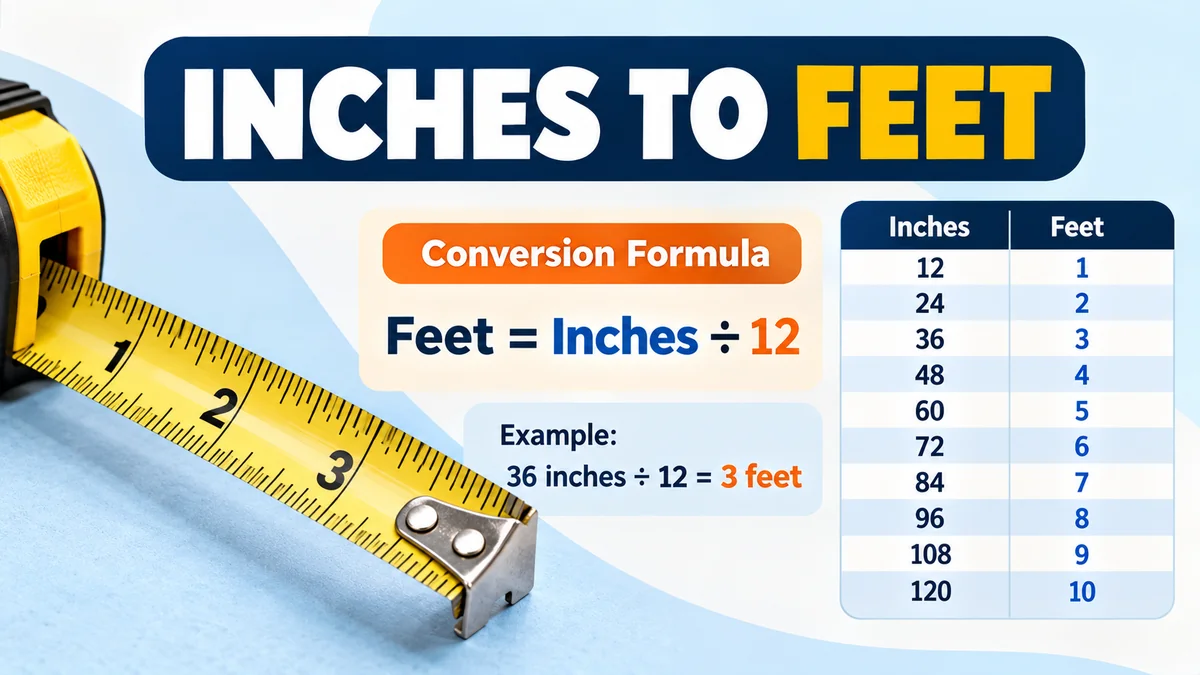
Converting inches to feet is straightforward once you know one basic relationship: 12 inches equals 1 foot. That means any measurement in inches can be converted to feet simply by dividing the number of inches by 12. This works for whole numbers, decimals, fractions, heights, construction measurements, and everyday length calculations. RapidTables
Quick answer: To convert inches to feet, divide the number of inches by 12. The formula is feet = inches ÷ 12. For example, 36 inches ÷ 12 = 3 feet, while 30 inches ÷ 12 = 2.5 feet. The conversion ratio is exact because one foot contains exactly 12 inches. Inch Calculator
How to Convert inches to feet
The standard inches to feet formula is:
Feet = Inches ÷ 12
This formula comes directly from the relationship:
1 foot = 12 inches
Therefore:
1 inch = 1/12 foot
or:
1 inch = 0.083333… feet
So there are two mathematically equivalent ways to perform the conversion:
Feet = Inches ÷ 12
or:
Feet = Inches × 0.083333…
Dividing by 12 is usually easier and avoids unnecessary rounding during the calculation. RapidTables
Simple Example
Suppose you have a board that measures 48 inches long.
Divide 48 by 12:
48 ÷ 12 = 4
Therefore:
48 inches = 4 feet
The same method works for values that do not convert to a whole number.
For example:
50 ÷ 12 = 4.1667
So:
50 inches ≈ 4.1667 feet
The decimal appears because 50 is not evenly divisible by 12.
inches to feet Conversion Chart
A conversion chart is useful when you need a common measurement without performing the calculation yourself.
| Inches | Decimal Feet | Feet + Inches |
|---|---|---|
| 1 in | 0.0833 ft | 0 ft 1 in |
| 2 in | 0.1667 ft | 0 ft 2 in |
| 3 in | 0.25 ft | 0 ft 3 in |
| 4 in | 0.3333 ft | 0 ft 4 in |
| 5 in | 0.4167 ft | 0 ft 5 in |
| 6 in | 0.5 ft | 0 ft 6 in |
| 7 in | 0.5833 ft | 0 ft 7 in |
| 8 in | 0.6667 ft | 0 ft 8 in |
| 9 in | 0.75 ft | 0 ft 9 in |
| 10 in | 0.8333 ft | 0 ft 10 in |
| 11 in | 0.9167 ft | 0 ft 11 in |
| 12 in | 1 ft | 1 ft 0 in |
| 18 in | 1.5 ft | 1 ft 6 in |
| 24 in | 2 ft | 2 ft 0 in |
| 30 in | 2.5 ft | 2 ft 6 in |
| 36 in | 3 ft | 3 ft 0 in |
| 42 in | 3.5 ft | 3 ft 6 in |
| 48 in | 4 ft | 4 ft 0 in |
| 60 in | 5 ft | 5 ft 0 in |
| 66 in | 5.5 ft | 5 ft 6 in |
| 72 in | 6 ft | 6 ft 0 in |
| 78 in | 6.5 ft | 6 ft 6 in |
| 84 in | 7 ft | 7 ft 0 in |
| 96 in | 8 ft | 8 ft 0 in |
| 108 in | 9 ft | 9 ft 0 in |
| 120 in | 10 ft | 10 ft 0 in |
These values follow the exact 12-inches-per-foot relationship. TabUtils
Converting Inches to Feet and Inches
Sometimes decimal feet are useful, but in everyday measurements you may want the answer expressed as feet and remaining inches.
Consider 41 inches.
First, determine how many complete groups of 12 fit into 41:
41 ÷ 12 = 3 remainder 5
Three complete groups represent 3 feet, and the remainder represents 5 inches.
Therefore:
41 inches = 3 feet 5 inches
This method is especially useful for human height, furniture, construction projects, room dimensions, and other measurements commonly written using both units. Civil Info
Another Example: 67 Inches
Divide 67 by 12:
67 ÷ 12 = 5 remainder 7
Therefore:
67 inches = 5 feet 7 inches
In decimal form:
67 ÷ 12 = 5.5833 feet
Both answers describe the same length:
67 in = 5 ft 7 in ≈ 5.5833 ft Rapid Measurement
Decimal Feet and Feet-and-Inches Are Not the Same Notation
This distinction causes a surprisingly common mistake.
For example:
5.5 feet = 5 feet 6 inches
It does not mean 5 feet 5 inches.
Why?
The decimal portion represents a fraction of a foot:
0.5 × 12 = 6 inches
Similarly:
5.25 feet = 5 feet 3 inches
because:
0.25 × 12 = 3 inches
Quick Takeaway: A decimal after the number of feet represents a fraction of a foot, not a direct number of inches.
Common inches to feet Examples
Working through a few measurements makes the conversion easier to remember.
18 Inches to Feet
18 ÷ 12 = 1.5
Therefore:
18 inches = 1.5 feet
In feet-and-inches notation:
18 inches = 1 ft 6 in Inch Calculator
24 Inches to Feet
24 ÷ 12 = 2
Therefore:
24 inches = 2 feet
30 Inches to Feet
30 ÷ 12 = 2.5
Therefore:
30 inches = 2.5 feet
That can also be written as:
30 inches = 2 ft 6 in ByteTools
36 Inches to Feet
36 ÷ 12 = 3
Therefore:
36 inches = 3 feet
Because 36 inches also equals one yard:
36 inches = 3 feet = 1 yard MetricsCalculator
48 Inches to Feet
48 ÷ 12 = 4
Therefore:
48 inches = 4 feet
60 Inches to Feet
60 ÷ 12 = 5
Therefore:
60 inches = 5 feet
72 Inches to Feet
72 ÷ 12 = 6
Therefore:
72 inches = 6 feet iConverters
100 Inches to Feet
100 ÷ 12 = 8.3333…
Therefore:
100 inches ≈ 8.3333 feet
As feet and inches:
100 inches = 8 ft 4 in TabUtils
How Many Feet Are in One Inch?
One inch equals exactly 1/12 of a foot.
As a decimal:
1 inch = 0.083333… feet
The 3 continues indefinitely because 1 divided by 12 produces a repeating decimal.
For practical calculations, it might be displayed as:
0.0833 ft
or:
0.083333 ft
The displayed value is rounded, but the underlying relationship of 12 inches = 1 foot is exact. ACalculator
Why Are There 12 Inches in a Foot?
The inch and foot belong to the U.S. customary and imperial families of length units. For everyday conversion purposes, the critical definition is simply:
1 ft = 12 in
Modern international definitions also connect these units exactly to the metric system.
One inch equals exactly:
25.4 millimeters
or:
2.54 centimeters
Since one foot contains 12 inches:
12 × 2.54 cm = 30.48 cm
Therefore:
1 foot = 30.48 centimeters = 0.3048 meters
These exact metric relationships mean you can move between inches, feet, centimeters, and meters without uncertainty in the conversion factor itself. Civil Info
Inches, Feet, Yards, and Metric Units
Understanding nearby length units can make measurement conversions easier.
| Unit | Equivalent |
|---|---|
| 1 inch | 2.54 cm |
| 12 inches | 1 foot |
| 1 foot | 30.48 cm |
| 3 feet | 1 yard |
| 36 inches | 1 yard |
| 1 foot | 0.3048 m |
These relationships are particularly useful when measurements from U.S. customary units need to be compared with metric dimensions.
For instance, if a piece of material measures 96 inches:
96 ÷ 12 = 8 feet
And because each foot equals 0.3048 meters:
8 × 0.3048 = 2.4384 meters
So the same length can be expressed as:
96 inches = 8 feet = 2.4384 meters
How to Convert Feet Back to Inches
The reverse calculation is just as simple.
Instead of dividing by 12, multiply feet by 12:
Inches = Feet × 12
For example, convert 7 feet to inches:
7 × 12 = 84
Therefore:
7 feet = 84 inches
For 2.5 feet:
2.5 × 12 = 30
Therefore:
2.5 feet = 30 inches RapidTables
This gives you an easy way to check an inches-to-feet calculation. Convert the answer back to inches; if you arrive at the original value, the calculation is correct.
How to Handle Fractional Inches
Real measurements are not always whole inches. Construction, woodworking, manufacturing, and DIY projects commonly use fractions such as:
- 1/2 inch
- 1/4 inch
- 1/8 inch
- 1/16 inch
The same formula still works.
For 1/2 inch:
0.5 ÷ 12 = 0.0416667 feet
For 1/4 inch:
0.25 ÷ 12 = 0.0208333 feet
For 1/8 inch:
0.125 ÷ 12 = 0.0104167 feet
RapidTables, for example, lists 1/2 inch as approximately 0.041667 feet and 1/4 inch as approximately 0.020833 feet. RapidTables
Example With a Mixed Measurement
Suppose a component is 30.5 inches long.
Use the standard formula:
30.5 ÷ 12 = 2.541666… feet
So:
30.5 inches ≈ 2.5417 feet
If you want feet and inches instead, 24 inches make 2 complete feet, leaving 6.5 inches:
30.5 inches = 2 ft 6.5 in
When Should You Round the Answer?
The conversion itself is exact, but decimal feet may produce repeating decimals.
For example:
20 inches ÷ 12 = 1.666666… feet
You might report that as:
- 1.7 ft to one decimal place
- 1.67 ft to two decimal places
- 1.667 ft to three decimal places
- 1 ft 8 in in feet-and-inches notation
Which version you use depends on the situation.
For a quick estimate, one or two decimal places may be enough. For engineering, construction, manufacturing, or other precision-sensitive work, retain enough precision for the task and avoid rounding intermediate calculations unnecessarily.
If the measurement needs to be communicated in traditional building dimensions, feet and inches may be clearer than decimal feet.
Common Mistakes When Converting inches to feet
The arithmetic is simple, but a few mistakes can produce incorrect measurements.
Multiplying Instead of Dividing
When moving from inches to feet, you are moving from a smaller unit to a larger unit.
You should therefore divide by 12.
For example:
72 ÷ 12 = 6 ft
Multiplying 72 by 12 would calculate something entirely different.
Treating Decimal Feet as Inches
As noted earlier:
5.5 ft ≠ 5 ft 5 in
Instead:
0.5 ft × 12 = 6 in
Therefore:
5.5 ft = 5 ft 6 in
Rounding Too Early
Suppose your answer is 5.583333 feet.
Rounding it immediately to 5.6 feet and then using that rounded number in further calculations can introduce avoidable error.
Keep the full value during calculations and round the final answer instead.
Using 10 Inches per Foot
A foot does not use a base-10 subdivision.
There are 12 inches in one foot, not 10.
That means 30 inches is:
30 ÷ 12 = 2.5 feet
not 3 feet.
Where Inches-to-Feet Conversion Is Used
The conversion appears frequently because inches and feet are both common ways to express length.
Human Height
Height is often recorded in total inches but communicated as feet and inches.
For example:
70 inches = 5 ft 10 in
In decimal feet:
70 ÷ 12 ≈ 5.8333 ft ByteTools
Construction and Woodworking
Building materials may be specified in inches while project dimensions are recorded in feet.
A 96-inch board, for example, is exactly:
96 ÷ 12 = 8 feet
That makes switching between units useful when reading plans, measuring lumber, or calculating room dimensions. Rapid Measurement
Furniture and Room Measurements
Furniture dimensions are often listed in inches, while room dimensions are usually discussed in feet.
If a sofa is 84 inches wide:
84 ÷ 12 = 7 feet
That conversion can make it easier to compare the furniture size with the available floor space.
Screen Sizes
Television and monitor sizes are commonly stated as diagonal measurements in inches.
A 55-inch diagonal converts mathematically to:
55 ÷ 12 ≈ 4.583 feet
Keep in mind that this is the diagonal screen measurement, not the physical width of the television. Rapid Measurement
A Fast Mental Method for inches to feet
You do not always need a calculator.
Think in complete groups of 12.
For example, convert 53 inches.
Four groups of 12 equal:
4 × 12 = 48
Subtract that from 53:
53 − 48 = 5
Therefore:
53 inches = 4 ft 5 in
If you need decimal feet instead:
53 ÷ 12 ≈ 4.4167 ft
This quotient-and-remainder method is especially convenient when the desired answer is feet and inches rather than decimal feet.
Quick Takeaway: Count complete groups of 12 for whole feet. Whatever remains is the number of leftover inches.
Decimal Feet to Feet and Inches
You may also encounter the opposite problem: a measurement is already given in decimal feet, but you need traditional feet-and-inches notation.
The process has two steps:
- Keep the whole-number portion as feet.
- Multiply the decimal portion by 12 to find the inches.
Suppose the measurement is 3.75 feet.
The whole-number portion is:
3 feet
The decimal portion is:
0.75
Convert that fraction of a foot to inches:
0.75 × 12 = 9 inches
Therefore:
3.75 feet = 3 ft 9 in RapidTables
Another example:
6.25 feet
Keep 6 as the whole feet:
6 ft
Then:
0.25 × 12 = 3 in
So:
6.25 feet = 6 ft 3 in
The Simplest Way to Remember inches to feet
You only need to remember one number: 12.
There are exactly 12 inches in one foot, so:
Inches → Feet: divide by 12
Feet → Inches: multiply by 12
For measurements that need to stay in feet and inches, divide the total inches by 12 and use the remainder as the leftover inches.
That gives you a reliable inches to feet method for height, construction, furniture, room measurements, woodworking, and everyday length conversions without needing to memorize a long conversion chart.