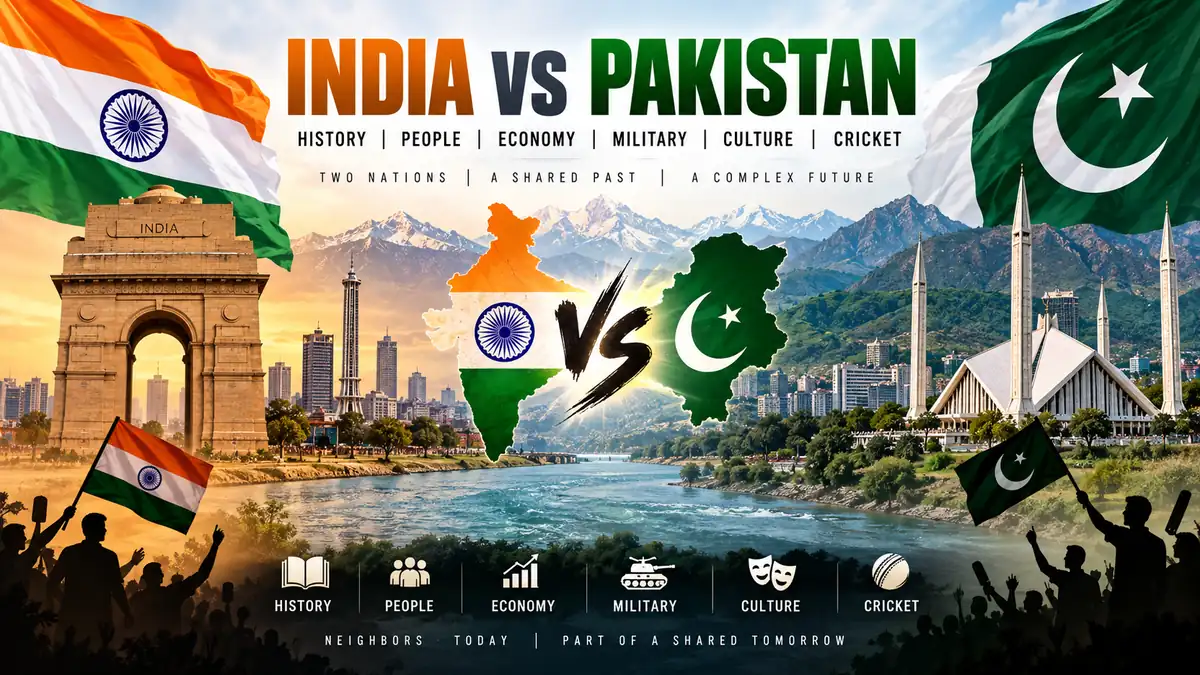
India and Pakistan share a border, centuries of intertwined history, closely connected cultures, and one of the world’s most closely watched geopolitical relationships. Yet the two South Asian countries differ substantially in population, economic scale, geography, political development, and strategic resources.
india vs pakistan is best understood as a comparison between two neighboring nuclear-armed South Asian states created by the 1947 Partition of British India. India is substantially larger in territory, population, and total economic output, while Pakistan has a smaller, younger population. Their relationship is shaped by Kashmir, security disputes, the Indus river system, trade restrictions, shared cultural traditions, and an intense cricket rivalry.
This guide compares the two countries using measurable indicators rather than trying to declare an overall “winner.” Different statistics answer different questions, and political or military outcomes cannot reliably be inferred from simple numerical comparisons.
india vs pakistan at a Glance
The clearest starting point is a side-by-side look at basic national indicators. Recent datasets put India’s population at roughly 1.46 billion and Pakistan’s at roughly 255 million. India’s land area is also several times larger.
| Category | India | Pakistan |
|---|---|---|
| Region | South Asia | South Asia |
| Capital | New Delhi | Islamabad |
| Independence | 1947 | 1947 |
| Population | About 1.46 billion | About 255 million |
| Area | About 3.29 million km² | About 882,000 km² |
| Currency | Indian rupee | Pakistani rupee |
| Largest city by population | Mumbai/Delhi depending on definition | Karachi |
| Major river system | Ganges-Brahmaputra and Indus systems | Indus system |
| Nuclear-armed state | Yes | Yes |
| Major sport | Cricket | Cricket |
The numbers make the difference in physical and demographic scale immediately visible, but they tell only part of the story.
How Did India and Pakistan Become Separate Countries?
Modern India-Pakistan relations cannot be understood without the Partition of 1947.
British colonial rule over the Indian subcontinent ended in August 1947. British India was divided principally into the independent states of India and Pakistan, while princely states faced decisions about accession.
Partition was accompanied by enormous population movements as Muslims, Hindus, Sikhs, and other communities crossed newly established borders. It also produced widespread communal violence and displacement. Estimates of deaths vary considerably because records from the period are incomplete and historians use different methodologies.
Pakistan initially consisted of two geographically separated territories: West Pakistan and East Pakistan. Following the 1971 war, East Pakistan became the independent state of Bangladesh.
Why did Kashmir become such an important issue?
Jammu and Kashmir became the central territorial dispute soon after Partition.
The princely state’s ruler ultimately signed an Instrument of Accession to India during the crisis of 1947, while Pakistan disputed the resulting territorial arrangements. Fighting followed, ending with a ceasefire that left the former princely state divided.
The 1949 Karachi Agreement established a ceasefire line. That dividing line later developed into what is known as the Line of Control, or LoC. India and Pakistan continue to administer different portions of the wider Kashmir region and maintain conflicting positions over its final political status.
Because the issue remains politically contested, descriptions such as India-administered Kashmir and Pakistan-administered Kashmir are useful when discussing present control without treating either government’s broader territorial claim as settled fact.
india vs pakistan Population and Geography
One of the largest differences between the countries is demographic scale.
Recent international datasets place India’s population at approximately 1.46 billion, compared with roughly 255 million in Pakistan. That makes India’s population more than five times larger.
Pakistan, however, has a younger demographic profile. One recent comparison using international datasets estimated median ages of about 20.6 years for Pakistan and 28.8 for India.
Which country is bigger, India or Pakistan?
India is much larger geographically.
India covers approximately 3.29 million square kilometers, while Pakistan covers around 882,000 square kilometers, depending on the territorial definitions used by individual datasets.
Their landscapes are also highly diverse.
India includes the Himalayan mountain system, Indo-Gangetic Plain, Thar Desert, Deccan Plateau and long coastlines along the Arabian Sea, Indian Ocean and Bay of Bengal.
Pakistan includes the Indus Plain, parts of the Himalaya and Karakoram, the Balochistan Plateau, desert regions and an Arabian Sea coastline.
The shared border
India and Pakistan share a long international boundary, in addition to the Line of Control separating areas under their respective administration in Kashmir.
Punjab is divided between the two countries, creating particularly visible cultural connections across the border.
The Wagah-Attari crossing near Lahore and Amritsar is perhaps the best-known border crossing.
India vs Pakistan Economy
Economic scale is another major difference.
Recent World Bank- and IMF-based comparisons place India’s nominal economy at roughly $4 trillion, compared with approximately $400–450 billion for Pakistan, although exact figures change with the reporting year, exchange rates and subsequent revisions.
This means India’s total nominal GDP is roughly nine to ten times Pakistan’s.
GDP per capita shows a smaller gap. One 2025 dataset reported approximately $2,702 per person for India and $1,596 for Pakistan.
These numbers should not be confused with household income. GDP per capita divides economic output by population and does not show how income is distributed among individuals.
Economic structure
Both economies contain large service sectors alongside manufacturing and agriculture.
India has developed major industries in:
- information technology and software services
- pharmaceuticals
- automotive manufacturing
- financial services
- telecommunications
- chemicals and refining
- textiles
- agriculture
Pakistan’s important sectors include:
- textiles and garments
- agriculture
- food processing
- construction
- telecommunications
- financial services
- manufacturing
- information technology and freelance services
Agriculture remains especially significant for employment and water demand across the region.
Economic growth
Recent estimates have generally shown faster real GDP growth in India. One comparison using international data reported 2025 growth of approximately 7.6% for India and 3.7% for Pakistan.
Year-to-year growth can fluctuate considerably, however. Inflation, exchange rates, government borrowing, energy costs, monsoon conditions, investment and global demand all affect economic performance.
Trade between India and Pakistan
Geographic proximity might suggest extensive bilateral trade, but political disputes have repeatedly restricted economic relations.
The relationship deteriorated sharply again following the April-May 2025 crisis. Both countries introduced measures affecting border movement, visas, airspace and trade.
As a result, the economic relationship is much smaller than geography alone might imply.
Political Systems and Government
India and Pakistan are both federal republics with parliamentary political structures, but their political histories have developed differently.
India’s president serves as head of state, while executive authority is primarily exercised by the prime minister and Council of Ministers under its parliamentary system.
Pakistan also has a president as head of state and a prime minister who heads the federal government.
Both have national legislatures and provincial or state-level governments.
A major historical difference is continuity of civilian constitutional government. India has operated under its 1950 Constitution throughout its post-independence history. Pakistan has experienced periods of military rule as well as elected civilian governments and currently operates under its 1973 Constitution.
India vs Pakistan Military and Nuclear Forces
Military comparisons attract considerable attention, but they are also easy to oversimplify.
India spends considerably more on its armed forces in absolute dollar terms. SIPRI-derived data put Indian military expenditure at about $86.1 billion in 2024, compared with approximately $10.2 billion for Pakistan.
India also maintains larger conventional armed forces overall.
However, inventory totals do not establish how a hypothetical conflict would unfold. Geography, logistics, training, intelligence, objectives, alliances, readiness, command decisions, technology and escalation constraints all matter.
Nuclear weapons
Both India and Pakistan possess nuclear weapons.
The SIPRI Yearbook 2026 estimated that, as of January 2026, India possessed approximately 190 nuclear warheads and Pakistan approximately 170. SIPRI emphasizes that nuclear estimates involve uncertainty because governments disclose limited information about their arsenals.
SIPRI also reported that all nine nuclear-armed states continued strengthening or modernizing their nuclear arsenals during 2025.
Why nuclear deterrence matters
Nuclear weapons fundamentally change the strategic relationship.
Even relatively limited conventional hostilities carry escalation risks when both states possess nuclear capabilities. Consequently, analysts generally distinguish between comparing military inventories and predicting the result of an actual conflict.
The first is measurable.
The second depends on circumstances that cannot be reduced to troop, aircraft or warhead counts.
The India-Pakistan Wars and Major Military Crises
The two countries have experienced several major wars and armed confrontations since independence.
1947–48 war
The first war began shortly after Partition and centered on Jammu and Kashmir.
A UN-associated ceasefire arrangement eventually divided areas controlled by the two sides, establishing the basis for the later Line of Control.
1965 war
India and Pakistan fought another major war in 1965, again closely connected to Kashmir.
The conflict ended following international diplomatic efforts and was followed by the Tashkent Declaration in January 1966.
1971 war
The 1971 conflict occurred during the crisis in East Pakistan.
India intervened militarily after months of upheaval and a large refugee flow into India. Pakistani forces in the east surrendered in December 1971, and Bangladesh emerged as an independent country.
Kargil conflict of 1999
Indian and Pakistani forces again fought in the Kargil region in 1999.
The episode was especially significant because both states had publicly tested nuclear weapons the previous year.
2019 crisis
A suicide bombing in Pulwama killed dozens of Indian paramilitary personnel in February 2019. India subsequently conducted an air strike near Balakot in Pakistan, followed by Pakistani air operations and an aerial confrontation.
The 2025 confrontation
Relations deteriorated dramatically after an April 22, 2025 attack near Pahalgam in Indian-administered Kashmir killed 26 people.
India attributed responsibility to actors with links to Pakistan; Pakistan denied involvement and called for an independent investigation. India subsequently launched strikes on May 6–7 against sites in Pakistan and Pakistan-administered Kashmir, while the two sides exchanged military action over several days. Claims concerning individual battlefield losses were disputed.
A ceasefire followed in May 2025. CFR’s Global Conflict Tracker reported in its August 2026 update that the ceasefire had continued, while broader disputes remained unresolved.
Kashmir and the Indus Waters Dispute
Kashmir remains one of the most sensitive subjects in India-Pakistan relations.
India and Pakistan maintain incompatible territorial and political positions, so statements about sovereignty should distinguish between who currently administers territory and who claims it.
Another major issue is water.
What is the Indus Waters Treaty?
The Indus Waters Treaty was signed in 1960 with World Bank involvement and created a framework governing use of the Indus river system.
Broadly, the eastern rivers—Ravi, Beas and Sutlej—were allocated principally to India, while Pakistan received primary rights over the western rivers—Indus, Jhelum and Chenab—subject to specified Indian uses.
The treaty survived decades of hostility and several wars.
Following the April 2025 Pahalgam attack, however, India announced that it was placing the treaty in abeyance. Pakistan rejected the move and warned against interference with its water supply.
Water therefore became an even more prominent element of bilateral tensions.
Culture, Languages and Everyday Similarities
Political rivalry can obscure how much the two societies share.
Centuries of migration, trade, empires and cultural exchange predate the modern border.
Languages
Hindi and Urdu are distinct standardized languages but remain highly mutually intelligible in everyday spoken forms.
Urdu is Pakistan’s national language, while English also plays an important official role. Pakistan additionally has major regional languages including Punjabi, Sindhi, Pashto and Balochi.
India recognizes extensive linguistic diversity. Hindi and English are used for Union government purposes, while languages including Bengali, Telugu, Marathi, Tamil, Gujarati, Urdu, Kannada, Malayalam, Punjabi and many others have major regional communities.
Punjabi culture is particularly notable because Punjab was divided by Partition.
Food
Many foods exist on both sides of the border, although preparation and terminology vary by region.
Shared or closely related dishes include biryani, kebabs, nihari, samosas, jalebi, halwa, kheer, naan, roti and numerous forms of curry.
Food traditions often reflect regional history more closely than modern national boundaries.
Music and entertainment
Indian and Pakistani audiences have historically shared interests in film music, ghazal, qawwali and classical traditions.
Bollywood has had a significant audience in Pakistan, while Pakistani singers, musicians and television dramas have attracted audiences in India and elsewhere in South Asia.
Political tensions periodically restrict these cultural exchanges, but linguistic and artistic similarities remain substantial.
india vs pakistan Cricket Rivalry
For millions of people, “india vs pakistan” immediately means cricket.
The fixture has become one of international cricket’s highest-profile rivalries, partly because bilateral series have become rare.
The teams have not played a men’s bilateral series since Pakistan’s 2012–13 tour of India. Most subsequent meetings have taken place in multinational competitions such as ICC tournaments and the Asia Cup.
India vs Pakistan head-to-head record
Historical totals vary slightly between databases depending on the update date and how ties, abandoned matches and no-results are classified.
One updated 2026 record lists 212 international matches, with Pakistan holding more victories across the complete historical series, largely because of its advantage in older ODI results. India has held a substantial advantage in the more recent period and in men’s T20 internationals.
| Format | Historical pattern |
|---|---|
| Tests | Pakistan has more wins; many matches were drawn |
| ODIs | Pakistan holds the historical win advantage |
| T20Is | India has won substantially more meetings |
| Recent meetings | India has had the stronger recent run |
The last India-Pakistan Test was played in 2007, which explains why the Test head-to-head record has remained unchanged for years.
Why is India vs Pakistan cricket so popular?
Several factors combine to make the fixture unusually prominent:
- Both countries have enormous cricket audiences.
- Their shared history adds emotional significance.
- Bilateral matches are rare.
- ICC and Asia Cup encounters therefore receive exceptional attention.
- Generations of famous players have contributed to the rivalry.
Earlier eras featured names such as Sachin Tendulkar, Wasim Akram, Waqar Younis, Rahul Dravid, Inzamam-ul-Haq, Shahid Afridi and Virender Sehwag.
Later generations continued the sporting rivalry through players such as Virat Kohli, Rohit Sharma and Babar Azam.
The scarcity of fixtures has arguably made individual tournament meetings feel more significant than ordinary bilateral matches.
Education, Technology and Digital Development
Both countries have large and rapidly evolving digital economies, although their scale differs substantially.
India has become a major global center for software development, IT services, digital payments and technology startups. Bengaluru, Hyderabad, Pune, Chennai, Mumbai and the Delhi National Capital Region are major technology centers.
Pakistan’s technology sector is smaller but has expanded through software exports, freelancing, e-commerce and startup activity in cities including Karachi, Lahore and Islamabad.
Internet adoption also differs. One recent international comparison estimated usage at roughly 70% of India’s population and 57% of Pakistan’s, although connectivity estimates change as datasets are updated.
Both countries face the challenge of translating digital expansion into broad access to education, skills, reliable infrastructure and employment.
Living Standards and Human Development
GDP alone cannot describe people’s living conditions.
Health, education, access to sanitation, electricity, internet connectivity, employment, gender disparities and income distribution all matter.
Recent comparative datasets generally show higher life expectancy and GDP per capita in India. One 2025 comparison estimated life expectancy at approximately 72.2 years in India and 67.8 years in Pakistan.
Pakistan’s younger population creates both opportunities and challenges. A large working-age generation can support future economic growth, but only when accompanied by sufficient education, healthcare, infrastructure and employment.
India faces a similar challenge on a much larger numerical scale: converting its enormous population into sustainable improvements in productivity and living standards.
National averages also hide major internal differences. Conditions can vary dramatically between urban and rural areas and among individual Indian states or Pakistani provinces.
What India and Pakistan Have in Common
The political relationship is often defined by disagreement, but a purely rivalry-based description misses much of the regional reality.
Both countries share:
- historical connections extending far beyond 1947
- parts of the Indus river system
- Himalayan geography
- Punjabi cultural heritage
- closely related Hindi-Urdu speech
- Mughal-era architecture and cultural influences
- South Asian food traditions
- cricket culture
- classical and folk music traditions
- large diasporas around the world
- major development and climate challenges
These similarities help explain why interactions between ordinary Indians and Pakistanis can look very different from official diplomatic relations.
Why Simple “Who Is Better?” Comparisons Are Misleading
There is no single meaningful metric that can determine an overall result in an india vs pakistan comparison.
India has a much larger population, territory, economy and absolute military expenditure. Pakistan has a smaller and younger population and a different economic, geographic and strategic structure. Historical cricket records also vary dramatically by format and era.
Military comparisons are even more sensitive to context. Counting soldiers, aircraft, tanks or nuclear warheads cannot establish the outcome of a hypothetical conflict. Modern warfare depends on objectives, readiness, logistics, intelligence, geography, technology, command decisions, international conditions and escalation dynamics.
The presence of nuclear weapons makes simplistic predictions particularly inappropriate.
India vs Pakistan: The Bigger Picture
The india vs pakistan story is ultimately more complex than a scoreboard.
The countries emerged from the same colonial political structure in 1947 and retain deep linguistic, cultural and historical connections. At the same time, Kashmir, security disputes, cross-border militancy allegations, limited diplomatic engagement and water management continue to complicate their relationship. The serious military confrontation of May 2025 demonstrated that escalation risks remain real even decades after Partition.
Measured statistically, India is much larger in population, land area and total economic output. Pakistan remains one of South Asia’s largest countries in its own right and has a particularly young population. Both maintain substantial armed forces, and SIPRI estimates that both possess significant nuclear arsenals.
Cricket provides another dimension entirely: Pakistan retains advantages in parts of the historical head-to-head record, while India has dominated many recent encounters and has a substantial advantage in T20I meetings.
Understanding India and Pakistan therefore requires separating measurable facts from political claims and recognizing how much circumstances change over time. Population and economic figures are updated annually, cricket records change with every fixture, and diplomatic relations can shift rapidly.
What remains constant is the unusual combination of shared heritage and strategic rivalry—two neighboring South Asian societies connected by history, language, culture, geography and sport, while divided by some of the region’s most enduring political disputes.