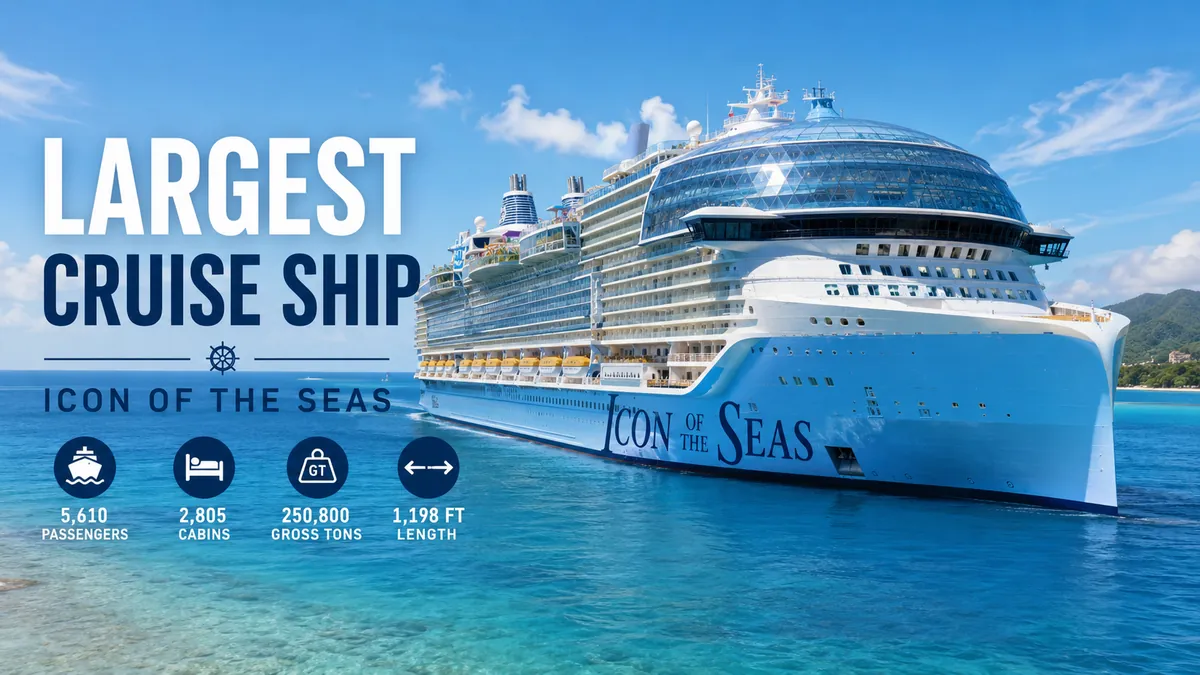
Cruise ships have grown from floating hotels into destinations that can feel like entire resort districts at sea. In 2026, that evolution has reached a new high with Royal Caribbean’s Legend of the Seas, the third vessel in the record-breaking Icon Class.
Legend of the Seas is the largest cruise ship in the world in 2026, edging past sister ships Icon of the Seas and Star of the Seas in overall length. The enormous Icon Class vessel carries thousands of guests across 20 total decks and combines eight neighborhoods, a huge waterpark, pools, entertainment venues, restaurants, bars and family attractions.
The distinction needs a little explanation, however. Cruise-ship size can be measured by gross tonnage, length, passenger capacity and other dimensions. That is why different lists sometimes identify different Icon Class ships as the world’s biggest.
Here is what the numbers actually tell us.
What Is the largest cruise ship in the World?
As of August 2026, Legend of the Seas holds the title of the world’s largest cruise ship. Royal Caribbean took delivery of the vessel from the Meyer Turku shipyard in Finland in June 2026, and it entered passenger service in the Mediterranean in July.
Legend is the third member of Royal Caribbean’s Icon Class, following:
- Icon of the Seas — introduced in 2024
- Star of the Seas — introduced in 2025
- Legend of the Seas — introduced in 2026
The three ships share the same fundamental design, so their dimensions are remarkably close. Cruise Critic reported at delivery that Legend became Royal Caribbean’s biggest vessel by roughly one foot compared with its Icon Class siblings.
Royal Caribbean’s fleet data lists Legend at 248,663 gross tons with estimated double-occupancy capacity of 5,610 guests—the same headline figures listed for Icon and Star in that fleet dataset.
largest cruise ship at a Glance
| Specification | Legend of the Seas |
|---|---|
| Cruise line | Royal Caribbean International |
| Ship class | Icon Class |
| Entered service | 2026 |
| Gross tonnage | Approx. 248,663 GT* |
| Guest capacity | Approx. 5,610 at double occupancy |
| Crew | Approx. 2,350 |
| Total decks | 20 |
| Passenger decks | 18 |
| Shipyard | Meyer Turku |
| Built in | Turku, Finland |
| Initial region | Western Mediterranean |
| Later 2026 region | Caribbean |
| Major feature | Eight-neighborhood layout |
*Royal Caribbean webpages sometimes use rounded or design figures around 250,800 GT for Icon Class ships, while company fleet data and registered specifications may list 248,663 GT. This difference is one reason online rankings can appear inconsistent.
Quick Takeaway: If someone asks which individual vessel currently deserves the largest-ship title, Legend of the Seas is the best answer in 2026. If ships are ranked strictly using certain published gross-tonnage figures, the three Icon Class vessels can appear effectively tied.
How Is the World’s Largest Cruise Ship Measured?
A common mistake is assuming that the biggest ship must simply be the longest.
Cruise ships are usually ranked by gross tonnage (GT) instead.
Despite the name, gross tonnage is not the ship’s weight. It is a measurement related to the volume of enclosed internal spaces. That makes it particularly useful when comparing enormous passenger ships containing thousands of cabins, restaurants, theaters, corridors and public spaces.
Gross tonnage vs. length vs. passenger capacity
These measurements answer different questions:
| Measurement | What It Tells You |
|---|---|
| Gross tonnage | Approximate scale of enclosed internal volume |
| Length | Distance from bow to stern |
| Beam | Ship’s width |
| Passenger capacity | Number of guests the vessel can accommodate |
| Deck count | Number of vertical deck levels |
| Crew capacity | Approximate number of people operating the ship |
A longer ship is therefore not automatically larger by gross tonnage.
Similarly, the vessel carrying the most passengers is not necessarily the world’s largest cruise ship.
This distinction becomes especially important when comparing Icon Class ships because their dimensions are extremely similar.
Why do different websites give different sizes?
You may encounter figures of both 248,663 GT and approximately 250,800 GT for these ships.
For example, Royal Caribbean’s corporate fleet statistics list Icon, Star and Legend at 248,663 gross tons, while some consumer-facing Royal Caribbean material uses 250,800 GT as the size figure for newer Icon Class vessels.
For Star of the Seas specifically, Royal Caribbean’s detailed fact sheet gives 248,663 GT, 1,196 feet (364 meters) in length, 20 total decks, 2,350 crew and 5,610 guests at double occupancy.
When comparing ships, it is therefore smart to check whether a source is using registered tonnage, an approximate design figure or a rounded marketing specification.
Legend of the Seas vs. Icon and Star of the Seas
The story of the largest cruise ship is really the story of Royal Caribbean’s Icon Class.
Icon of the Seas established the basic formula. Star of the Seas followed with refinements, and Legend of the Seas continued that evolution.
| Feature | Icon of the Seas | Star of the Seas | Legend of the Seas |
|---|---|---|---|
| Debut | 2024 | 2025 | 2026 |
| Class | Icon Class | Icon Class | Icon Class |
| Published corporate fleet GT | 248,663 | 248,663 | 248,663 |
| Double occupancy | 5,610 | 5,610 | 5,610* |
| Approx. crew | 2,350 | 2,350 | 2,350 |
| Primary distinction | First Icon Class ship | Second Icon Class ship | Third and newest Icon Class ship |
*Capacity figures can vary slightly between Royal Caribbean materials depending on configuration and how capacity is reported.
Is Legend of the Seas bigger than Icon of the Seas?
Yes, but only marginally by length.
At its June 2026 delivery, Legend was reported as being approximately one foot longer than its two sister ships. The difference is tiny compared with the overall scale of these vessels, but technically enough for Legend to be described as the largest.
In practical terms, passengers should think of all three as ships of essentially the same extraordinary scale.
Is Star of the Seas bigger than Icon of the Seas?
Star and Icon are essentially identical in their major registered specifications.
Royal Caribbean’s Star fact sheet records 248,663 GT, 5,610 guests at double occupancy and a length of 1,196 feet. Cruise comparisons likewise generally place Icon and Star together at the top of the megaship category.
The meaningful differences are more likely to be found in entertainment, restaurants and individual onboard experiences than in physical size.
What Is Inside the largest cruise ship?
The extraordinary thing about Legend of the Seas isn’t simply how much steel went into building it.
It is how Royal Caribbean uses the available space.
Rather than designing one continuous collection of decks and corridors, the Icon Class concept divides the vessel into distinctive neighborhoods. This makes the ship function more like a collection of smaller destinations.
Eight neighborhoods organize the ship
Icon Class introduced eight neighborhood-style areas, including concepts such as Royal Promenade, Central Park, AquaDome, Chill Island, Thrill Island, Surfside and The Hideaway, along with a dedicated suite neighborhood.
Each serves a different purpose.
Central Park creates an open-air setting centered on greenery, dining and quieter spaces. Surfside focuses heavily on families. Thrill Island concentrates high-energy attractions, while Chill Island provides pool areas designed around relaxation.
The approach also has a practical advantage: it spreads passengers across multiple destinations instead of forcing everyone into one central pool deck or promenade.
That matters when a ship can accommodate well over 5,000 passengers.
The AquaDome changes the ship’s profile
One of the most visually distinctive features of the Icon Class is the AquaDome near the front of the ship.
It combines panoramic views with dining, social spaces and AquaTheater entertainment. The enclosed design allows spectacular water-based performances to operate in an environment less dependent on outdoor weather conditions.
The dome also contributes heavily to the futuristic profile that makes Icon Class ships instantly recognizable from shore.
The Pearl
Another signature Icon Class feature is The Pearl, an enormous kinetic art installation located around the Royal Promenade.
It is more than decoration. The structure forms part of the architectural engineering of the space while creating a dramatic visual centerpiece when guests first explore the ship.
Royal Caribbean specifically identified both the Pearl and AquaDome among the major innovations installed during Legend’s construction.
Pools, Waterslides and Thrill Island
One reason modern megaships have become so large is simple: cruise lines are trying to fit attractions aboard that once would have been associated with land-based resorts.
Legend of the Seas pushes that idea particularly far.
Category 6 waterpark
The Icon Class Category 6 waterpark is designed as a major attraction rather than a small collection of traditional cruise-ship slides.
Royal Caribbean describes Legend as featuring the largest waterpark at sea along with seven pools.
The waterpark is part of Thrill Island, the action-focused neighborhood.
That means passengers interested in waterslides and active attractions can spend substantial portions of a sea day in one area without needing to cross the entire vessel.
Crown’s Edge
One of the class’s most recognizable thrill experiences is Crown’s Edge.
The attraction combines elements of an elevated obstacle course and suspended thrill ride near the edge of the ship. Part of the experience takes place high above the ocean, turning the vessel itself into part of the attraction.
It illustrates how megaship design has changed.
A large cruise ship no longer uses additional volume only for more cabins. Designers increasingly turn that space into experiences.
Pools for different moods
Seven pools help distribute guests around the vessel.
Instead of one enormous central swimming area, the neighborhood system creates multiple environments for different groups and moods.
That distribution can make a ship carrying thousands of passengers feel more manageable than the raw capacity figure suggests.
Quick Takeaway: Bigger ships inevitably carry more people, but well-planned circulation matters almost as much as passenger capacity. Multiple pools, neighborhoods, restaurants and entertainment areas give guests reasons to spread out.
Dining on the World’s Biggest Cruise Ship
Feeding thousands of passengers and crew every day is one of the least visible engineering challenges aboard a megaship.
Legend of the Seas turns that necessity into part of the experience.
Royal Caribbean advertises a record-breaking 28 ways to dine aboard Legend, ranging from casual options to specialty experiences.
Royal Railway
One of Legend’s notable dining concepts is Royal Railway.
Rather than functioning as a conventional restaurant, the concept blends food with immersive entertainment, creating the impression of traveling aboard a train.
It demonstrates an increasingly important trend in cruise dining: restaurants are becoming attractions themselves.
Hollywoodland Supper Club
Legend also introduces the Hollywoodland Supper Club, continuing the supper-club concept seen on earlier Icon Class ships while giving it a different theme.
Icon of the Seas has the Empire Supper Club, while Star introduced the Lincoln Park Supper Club. Legend’s version adds another distinctive identity to the same broad concept.
AquaDome Market
The AquaDome area also provides casual dining choices.
This type of distributed dining is important aboard an enormous ship because it reduces dependence on a single buffet or main dining complex.
Instead, guests can eat close to the neighborhood where they are already spending time.
Entertainment on Legend of the Seas
Size creates possibilities that smaller vessels simply cannot reproduce.
The largest cruise ships can support multiple purpose-built entertainment venues operating simultaneously.
Royal Theater
Legend of the Seas features major stage productions in its Royal Theater, including an adaptation of Charlie and the Chocolate Factory announced for the ship.
Productions on this scale require substantial backstage infrastructure, technical equipment and dedicated performance space.
AquaTheater
The AquaDome contains an AquaTheater built around aerial performances, diving, water effects and highly technical production elements.
The ability to combine an observation structure, restaurants and a performance venue in the same forward neighborhood is a good example of how efficiently space is used aboard Icon Class ships.
Absolute Zero
Another signature venue is Absolute Zero, an ice-skating arena.
Ice shows aboard a cruise ship are already an unusual engineering accomplishment. On Icon Class vessels, the venue is designed as a major entertainment destination rather than a small recreational rink.
A megaship can therefore offer a theater production, aquatic performance, ice show, live music and smaller entertainment venues within one floating resort.
How Many People Can the largest cruise ship Carry?
Passenger capacity is more complicated than it initially appears.
Royal Caribbean’s corporate fleet data gives Legend of the Seas an estimated capacity of 5,610 guests, which reflects the standard double-occupancy measurement commonly used across the cruise industry.
That does not mean only 5,610 people can ever sail.
Double occupancy vs. maximum capacity
A cabin designed for a couple may contain extra sleeping arrangements for children or additional guests.
So there are two useful capacity figures:
Double occupancy assumes two guests in the applicable cabins.
Maximum occupancy includes additional berths being used.
This distinction explains why readers sometimes see Icon Class capacity described as around 5,600 guests on one website and approximately 7,600 on another.
Both figures may describe different occupancy assumptions rather than contradictory ship specifications.
What about the crew?
A ship this large also requires a substantial workforce.
Royal Caribbean’s fleet statistics list roughly 2,350 crew members for Legend.
At high passenger occupancy, the combined population of guests and crew can therefore approach that of a small town.
Behind the public areas are crew accommodations, kitchens, storage rooms, laundry facilities, engineering spaces, waste-management systems, medical facilities and logistics corridors needed to keep that temporary population operating.
Does the World’s Largest Cruise Ship Feel Crowded?
A passenger count approaching several thousand sounds intimidating.
But passenger capacity alone is a poor way to predict crowding.
One useful concept is the space ratio, typically calculated by comparing gross tonnage with passenger numbers. It is not a perfect measurement of usable passenger space, but it can help put ship capacity into perspective.
More important in daily use is the ship’s layout.
Icon Class vessels divide activity among:
- Multiple neighborhoods
- Numerous dining locations
- Several pools
- Large entertainment venues
- Children’s areas
- Outdoor attractions
- Adult-oriented spaces
- The Royal Promenade
- Central Park
- AquaDome
- Suite facilities
This distribution can reduce the feeling that every passenger is sharing one central space.
Crowds can still develop.
Elevators may be busy around dinner or after major shows. Popular attractions can have queues. Embarkation, disembarkation and peak breakfast periods can also reveal just how many people are aboard.
A practical approach on any megaship is to avoid moving with the largest crowd whenever possible. Eat slightly outside peak periods, reserve limited-capacity activities where available and learn the ship’s layout early in the voyage.
Legend of the Seas’ 2026 Routes
Legend began its passenger career in Europe.
Following its June 2026 delivery from Meyer Turku, Royal Caribbean prepared the vessel for a summer season of Western Mediterranean cruises, including destinations in Spain, Italy and France.
The Mediterranean season includes departures associated with Barcelona and Civitavecchia, the major cruise gateway for Rome.
The ship is then scheduled to reposition across the Atlantic.
Royal Caribbean says Legend will operate from Fort Lauderdale, Florida, beginning in November 2026, with Caribbean itineraries.
That move puts another Icon Class vessel into the enormous Florida cruise market.
How Legend Compares With Other Giant Cruise Ships
Royal Caribbean dominates the very top of the world’s cruise-ship size rankings, largely because of its Icon and Oasis classes.
But it is not the only company building enormous vessels.
Icon Class vs. Oasis Class
Before Icon of the Seas arrived, Royal Caribbean’s Oasis Class repeatedly broke world records.
Ships from this family include:
- Oasis of the Seas
- Allure of the Seas
- Harmony of the Seas
- Symphony of the Seas
- Wonder of the Seas
- Utopia of the Seas
Utopia of the Seas is roughly 236,500 gross tons in Royal Caribbean’s fleet data, making it enormous by virtually any standard but still smaller than an Icon Class ship.
The Oasis Class pioneered concepts such as large open-air neighborhood spaces, including Central Park, that helped establish the design philosophy later expanded in the Icon Class.
MSC World America
Royal Caribbean’s closest competition at the extreme end of the megaship market comes from MSC Cruises.
MSC World America, delivered in 2025, measures approximately 216,638 GT, placing it among the world’s largest passenger ships but still well below the Icon Class in gross tonnage.
How much bigger is Legend than Titanic?
Comparing a modern megaship with RMS Titanic makes the change in passenger-ship design particularly easy to visualize.
Titanic was approximately 269 meters long. Icon Class vessels are around 364 meters long, meaning a modern Icon Class ship extends roughly another 95 meters.
The difference in internal volume is even more dramatic.
Titanic was approximately 46,000 gross registered tons, whereas the newest Icon Class vessels are well above 240,000 GT.
The measurements come from different eras and tonnage rules have evolved, so it is not a perfectly direct engineering comparison. Still, the scale difference is unmistakable.
Modern ships also dedicate extraordinary amounts of space to entertainment, pools, restaurants, retail, balconies and recreational facilities that early-20th-century ocean liners never attempted to provide.
Why Are Cruise Ships Getting So Big?
Building a vessel the size of Legend of the Seas is expensive and complicated, so why keep making ships larger?
The answer is partly economics and partly passenger expectations.
More experiences in one vessel
A larger platform can support attractions that would be difficult to fit aboard a conventional ship.
Instead of choosing between a waterpark, theater, ice rink, gardens, family area and dozens of restaurants, designers can incorporate all of them.
That turns the ship itself into a major part of the vacation.
More types of cabins
Megaships can also support a broader range of accommodation.
A single vessel can contain compact interior rooms, ocean-view cabins, balcony accommodations, family-oriented layouts and large suites.
This allows thousands of passengers with different preferences to share the same sailing while having very different experiences.
Economies of scale
Large ships also spread certain operating costs across more passengers.
But bigger does not automatically mean cheaper or more efficient in every respect. Large vessels require sophisticated port infrastructure, enormous provisioning operations and complex logistics.
Only ports with suitable channels, terminals, berths and transportation infrastructure can comfortably handle ships at this scale.
Environmental Technology and LNG
The scale of modern cruise ships naturally raises questions about environmental impact.
Icon Class ships use liquefied natural gas (LNG) capable engines as part of their propulsion and energy systems. Star of the Seas, for example, uses dual-fuel generation technology, and Royal Caribbean describes the Icon platform as incorporating a range of efficiency technologies.
LNG can reduce certain conventional air pollutants compared with traditional marine fuels, particularly sulfur oxides and particulate emissions.
It is not a zero-carbon solution.
Methane is itself a powerful greenhouse gas, and methane slip across the fuel lifecycle remains an environmental concern for LNG-powered shipping. For that reason, describing LNG simply as “clean” fuel misses an important part of the picture.
Modern vessels also employ technologies involving wastewater treatment, energy recovery, optimized hull design and increasingly sophisticated onboard energy management.
The challenge is significant: carrying thousands of passengers while reducing the environmental footprint per trip remains one of the cruise industry’s biggest technical issues.
Can Every Port Handle a Ship This Large?
No.
A vessel approaching 365 meters in length needs more than an empty berth.
Ports must consider:
- Channel width and depth
- Turning-basin dimensions
- Berth length
- Water depth alongside the pier
- Passenger terminal capacity
- Security and customs facilities
- Ground transportation
- Provisioning and waste services
This is why the world’s biggest ships tend to operate from major cruise hubs such as PortMiami, Port Canaveral, Fort Lauderdale, Barcelona and Civitavecchia rather than calling indiscriminately at every coastal destination.
Some ports use tender boats when ships cannot dock directly, but tender operations are not always practical for vessels carrying several thousand passengers.
Ship size therefore influences itinerary planning as much as onboard design.
Is a Bigger Cruise Ship Actually Better?
Not automatically.
The world’s largest cruise ship offers a staggering number of things to do, but that does not mean it suits every traveler.
Where megaships excel
A vessel like Legend is particularly strong when passengers value variety.
Families can find dedicated children’s spaces, pools and water attractions. Entertainment-focused travelers get multiple large venues. Groups with different food preferences benefit from numerous restaurants, and passengers who enjoy exploring can spend days discovering different parts of the ship.
Large ships can be especially useful for multigenerational groups because everyone does not need to enjoy the same activity.
Where smaller ships can be better
Smaller ships usually require less walking and can often access ports that megaships cannot.
They may also provide a quieter atmosphere and make it easier to become familiar with the ship quickly.
Travelers primarily interested in unusual destinations rather than onboard attractions may therefore prefer a smaller vessel.
The phrase largest cruise ship describes physical scale—not quality.
The right size depends on what someone wants from a cruise.
What Comes After Legend of the Seas?
Legend will not remain the newest Icon Class vessel forever.
Royal Caribbean is already expanding the series.
The company’s current ship information lists Hero of the Seas as another Icon Class vessel expected in 2027, with consumer-facing specifications around 250,800 GT and capacity exceeding 5,600 guests at double occupancy.
Whether future ships will significantly increase the size record or simply refine the Icon Class formula remains to be seen.
That distinction matters.
Cruise-ship development is no longer only a race to add more tonnage. The next competitive frontier includes energy efficiency, crowd management, family facilities, entertainment technology, dining and better use of existing space.
The largest cruise ship Is Now a Destination in Its Own Right
The largest cruise ship in the world in 2026 is Legend of the Seas, the newest member of Royal Caribbean’s Icon Class and, by a very small dimensional margin, the biggest of its three closely related sister ships.
Its scale is remarkable: roughly a quarter-million gross tons, thousands of passengers, 20 total decks, eight neighborhoods, seven pools, a giant waterpark and enough dining and entertainment options to make the vessel function more like a floating resort complex than a traditional passenger ship.
But the most interesting part of Legend is not the extra foot that gives it the record.
It is what that enormous physical platform makes possible. The AquaDome, Thrill Island, Central Park, Surfside, Royal Promenade, theaters, ice arena, restaurants and water attractions show how dramatically the definition of a cruise ship has changed.
For anyone comparing the world’s biggest ships, remember to look beyond a single number. Gross tonnage, length, passenger capacity and usable space measure different things, and the largest vessel on paper is not automatically the best choice for every traveler.
For now, though, the size crown belongs to Legend of the Seas.