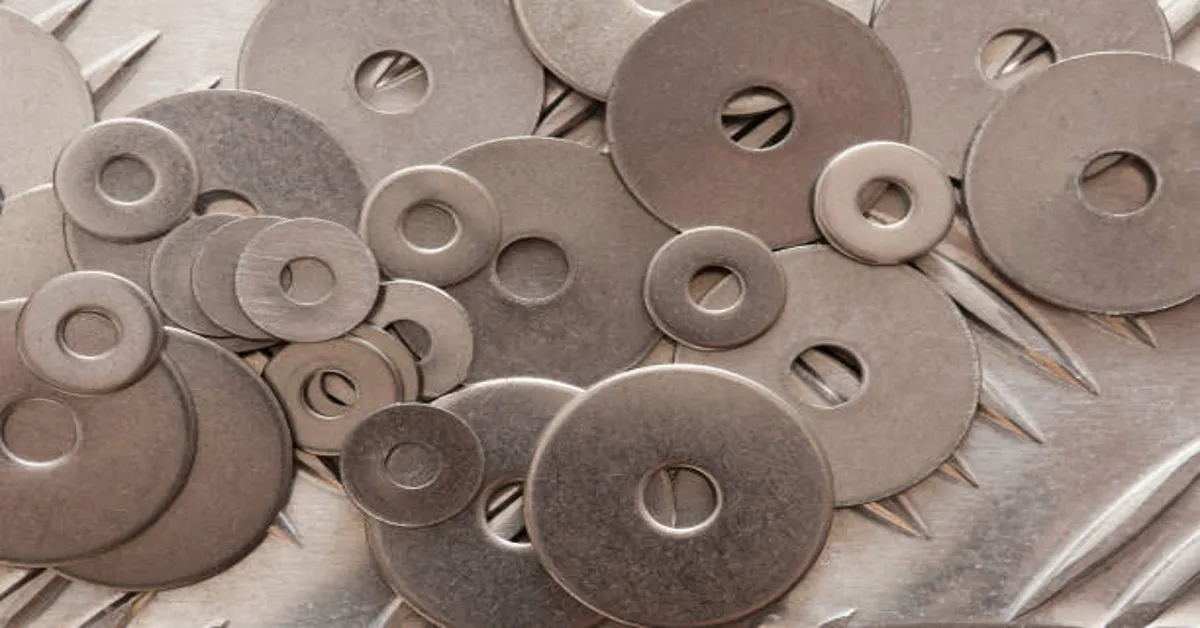
If you’ve ever had a “simple” assembly fail because a washer warped, shifted, or crushed unevenly under load, you already understand why machined washers exist. A washer looks like the least interesting part on a bolt — until it’s the reason your joint loosens, your seal leaks, or your tolerance stack-up falls apart. That’s where machined washers earn their keep.
Unlike the stamped washers you’ll find by the bin at any hardware store, a machined washer is cut from solid bar stock on a CNC lathe or mill, not punched from sheet metal. The result is a part with tighter tolerances, a cleaner surface, and the ability to be made in almost any size, material, or shape a project calls for. In this guide, we’ll walk through what actually separates machined washers from stamped ones, the types and materials you’ll run into, how tight CNC tolerances really get, and how to spec the right washer for your application.
What Is a Machined Washer, Exactly?
A machined washer is a precision-fastening component produced through CNC turning or milling rather than stamping. Instead of a die punching a flat ring out of coiled sheet metal, a CNC machine removes material from solid round or bar stock to create the washer’s inner diameter, outer diameter, and thickness — all in one controlled process.
That difference in manufacturing method is the whole story. Because the washer is machined rather than stamped, you get a smoother, burr-free surface, much tighter dimensional control, and the freedom to add features (slots, tabs, chamfers, custom bores) that a stamping die simply can’t produce economically. You’ll find machined washers doing quiet but critical work in aerospace fastener assemblies, medical device housings, and anywhere else a few microns of error can cascade into a real problem.
Machined vs. Stamped Washers: What’s the Real Difference?
Quick answer: Machined washers are CNC-cut from solid stock for tight tolerances and custom shapes, while stamped washers are punched from sheet metal for low-cost, high-volume production. If your application can tolerate looser dimensions, stamped washers are cheaper and faster; if precision or longevity matters, machined is the better call.
Here’s where the two methods genuinely diverge:
Production Methods
Stamped washers come off a punch press, cut from a continuous coil of sheet metal in a single stroke — fast, cheap, and ideal for volume. Machined washers are produced on a CNC lathe (for round profiles) or a CNC mill (for slots, tabs, or non-circular features), with the part bored, turned, and faced in one or two setups. Because it’s a subtractive, programmable process, a CNC machine can also drill, chamfer, and prep the part for plating without ever changing fixtures — something a stamping die can’t do.
Tolerance and Surface Finish
This is where the price difference actually pays for itself. A typical stamped washer’s thickness tolerance runs around ±0.1–0.2 mm, and the punching process tends to leave burrs and slight “potato-chip” warping from internal stress in the sheet metal. A CNC-machined washer, by contrast, routinely holds ±0.02–0.05 mm on thickness, with flatness controlled to roughly 0.02 mm — and a secondary grinding pass can tighten that further to ±0.005 mm if the application demands it.
In short: if your washer is just a spacer under a wood screw, stamped is fine. If it’s setting gear backlash on a transmission or sealing a hydraulic flange, you want it machined.
Types of Machined Washers
CNC machining opens up far more design freedom than stamping, so the “washer” category covers a surprising range of shapes and functions:
- Flat (plain) washers — The baseline design: a flat ring that spreads clamping load across a wider surface. Machined flat washers hold their dimensions far more consistently than off-the-shelf stamped versions.
- Lock and spring washers — Split, helical, or toothed designs that resist loosening under vibration. Machined versions can use custom tooth patterns or non-standard thicknesses that catalog parts don’t offer.
- Belleville (conical) washers — Cone-shaped disc springs that deliver a precise, repeatable spring rate. Because they’re machined rather than stamped, load-deflection behavior stays consistent batch to batch.
- Tab and keyed washers — Designed with a bent tab or a machined key that locks into a slot on a shaft or flange, preventing rotation. The tab geometry needs to be exact, which is exactly what CNC machining is good at.
- Spacer and shoulder washers — Thicker washers, sometimes with a built-in bushing shoulder, used to set precise standoffs or provide electrical insulation between components.
- Top-hat (flanged) washers — A wide flange spreads load over a larger area than a flat washer can, useful when the mating surface is soft, thin, or prone to deformation.
- Hardened washers — Heat-treated alloy washers, often ground to a controlled hardness, used under high-preload bolts where a standard washer would crush or deform over time.
Materials and Finishes for Machined Washers
Material choice usually comes down to three questions: how much load does it need to carry, what environment will it live in, and does it need to conduct (or block) electricity?
| Material | Best For |
|---|---|
| Carbon & alloy steel | General industrial use, heavy loads, often black-oxide or zinc-plated |
| Stainless steel (18-8, 17-4, marine grade) | Corrosion resistance — marine, chemical, food/medical equipment |
| Brass & copper | Electrical conductivity, plumbing, decorative finishes |
| Aluminum | Lightweight assemblies, non-magnetic or weight-sensitive applications |
| Titanium, Inconel, specialty alloys | Extreme heat, high strength-to-weight, aerospace environments |
| Nylon, PTFE, rubber-bonded | Electrical insulation, vibration damping, sealing |
After machining, washers are often plated (zinc, nickel) or treated (anodizing, phosphate coating) for added corrosion resistance — though the functional faces and bore are usually left uncoated or given a very thin, uniform layer so the critical dimensions aren’t thrown off.
How CNC Machining Actually Produces a Washer
- CNC turning — Bar stock is loaded into a lathe, the bore is drilled or bored, and the outer diameter is turned down. Facing cuts control thickness and flatness. This is the go-to method for round washers.
- CNC milling — Used when the washer needs slots, tabs, a square hole, or any non-circular feature that turning alone can’t produce.
- Live tooling / multi-axis setups — Modern CNC machines can drill, bore, turn, and mill in a single fixturing, which cuts down on handling errors and keeps tolerances tight across every feature.
- Inspection — Finished parts are checked with calipers or a CMM for ID, OD, thickness, and flatness, often with in-process checks on tighter-tolerance runs.
Because CNC machining removes material rather than deforming it, washers come off the machine flat and dimensionally true — no spring-back, no warping from punch stress. A CNC lathe can typically hold thickness within ±0.025 mm across an entire production batch, a level of repeatability stamping just can’t match consistently.
Tolerances, Quality, and Standards
So how tight can a machined washer actually get? In practice:
- Thickness: ±0.01–0.05 mm for most applications; ±0.005 mm achievable with grinding
- ID/OD: Typically held to ±0.01–0.05 mm per dimension
- Flatness: Within 0.01–0.02 mm across the face
- Parallelism: Within a few microns, since one face acts as the machining reference
Compare that to a stamped washer, which might vary ±0.1 mm in thickness and show out-of-flatness from uneven stamping stress, and the gap becomes obvious for anything load-critical.
For engineering drawings, it’s common to call out something like “Thickness: 5.00 ±0.02 mm, flatness ≤0.02 mm,” along with burr-free or chamfered edge requirements. Machined washers can also be made to match existing standard series (DIN 125, ASME B18.21.1) or produced at entirely custom dimensions when a project needs a size that doesn’t exist off the shelf.
Where Machined Washers Are Used
- Automotive — Suspension and engine fasteners, shock absorber assemblies, and transmissions, where precision washers help set accurate gear backlash and resist loosening from vibration.
- Industrial machinery — Gearboxes, motors, and hydraulic systems, where flat washers under flange bolts ensure even gasket compression and prevent leaks.
- Aerospace — Airframe assemblies, engine mounts, and control surfaces, often in titanium or aluminum, where even tiny dimensional deviations can become a safety issue.
- Electronics and precision instruments — Medical devices, PCB standoffs, and connector assemblies, frequently using brass, nylon, or plastic washers for exact spacing and insulation.
- Oil, gas, and marine — Corrosion-resistant 316 stainless washers on flanged joints exposed to saltwater, chemicals, and high pressure.
A practical use case worth noting: engineers often use precision-machined washers as makeshift shims, specifying an exact thickness to fine-tune spacing or preload during assembly — something a stamped part’s tolerance range simply can’t guarantee.
Why Choose a Machined Washer? The Real Advantages
- Tighter tolerances — Consistent thickness and bore size mean a more reliable joint, batch after batch.
- Full customization — Any size, thickness, or shape, without the upfront cost of a stamping die.
- Higher strength — Cut from solid bar stock with no seams or welds, giving better tensile strength under load.
- Cleaner finish — Burr-free, flat faces reduce friction and won’t scratch mating surfaces.
- Material flexibility — Stainless, brass, aluminum, titanium — whatever the application calls for.
- Longer service life — More resistant to fatigue, deformation, and corrosion than stamped equivalents.
| Feature | Machined Washer | Stamped Washer |
|---|---|---|
| Tolerance | ±0.01–0.05 mm | ±0.1–0.2 mm |
| Material | Solid bar stock, high-strength alloys | Sheet metal, moderate strength |
| Surface finish | Smooth, burr-free | May have burrs, uneven edges |
| Customization | Fully custom | Limited to standard sizes |
| Unit cost | Higher per piece | Very low at volume |
| Reliability | Consistent, stable under load | Can warp or loosen over time |
The takeaway: stamped washers win on cost at high volume; machined washers win everywhere precision and longevity actually matter.
How to Choose the Right Machined Washer
- Match the ID to your fastener. Too loose and the washer shifts; too tight and it won’t fit. Non-standard bolt sizes are no problem for CNC.
- Size for the load. Heavier loads call for a larger OD or thicker body in a high-strength alloy; lighter or corrosion-prone applications point toward stainless or aluminum.
- Identify which tolerances actually matter. If the washer is acting as a shim or sealing surface, tighten thickness and flatness specs — but avoid over-tolerancing dimensions that don’t affect function, since that just drives up cost.
- Account for the environment. Heat, humidity, and chemical exposure should drive material choice — stainless or specialty alloys for harsh conditions, plated steel or polymers where insulation is needed.
- Decide on surface finish. A sealing face usually needs to stay uncoated, while a wear surface might benefit from black oxide or plating.
- Think about volume. CNC machining is ideal for prototypes and runs from a handful of pieces up to the low thousands. Beyond that, stamping tooling may start to make more economic sense — though you lose the design flexibility.
Working with your machinist early — sharing a detailed drawing with callouts for ID, OD, thickness, and flatness — is the fastest way to get a part that’s right the first time.
Final Thoughts
Washers rarely get the engineering attention they deserve, but the difference between a stamped part and a machined one shows up exactly when you can least afford it — under vibration, under load, under tight tolerance stacks. CNC machining gives you control over every dimension that matters: thickness, flatness, bore size, material, and finish. If your next assembly depends on consistent clamping force, a precise spring rate, or a washer that simply won’t warp, a custom machined washer is worth the conversation with your supplier.
Frequently Asked Questions
What are machined washers used for?
They distribute load, protect mating surfaces, and keep fasteners from loosening in precision assemblies — common in aerospace, automotive, and electronics applications where tight tolerances matter.
How are machined washers different from stamped washers?
Machined washers are CNC-cut from solid stock, giving smoother surfaces and tolerances often as tight as ±0.01–0.05 mm. Stamped washers are punched from sheet metal and carry much more dimensional variation.
What materials are machined washers made from?
Carbon steel, stainless steel, brass, copper, aluminum, and specialty alloys like titanium and Inconel are the most common, chosen based on strength, corrosion resistance, conductivity, and weight needs.
How tight can machined washer tolerances get?
Standard CNC tolerances run ±0.02–0.05 mm, with flatness around 0.02 mm. Tighter tolerances down to ±0.01 mm — or even ±0.005 mm with grinding — are achievable for small, critical batches.
Can I order a custom size or shape?
Yes. Custom ID, OD, thickness, hole shape, and slot features are all standard with CNC machining, and there’s no tooling cost barrier like there is with stamping dies.
Do machined washers cost more than standard washers?
Per piece, yes — machining time and setup add cost. But there’s no die expense, which makes machined washers cost-competitive for small to medium runs, and their reliability often offsets the higher unit price over the life of the assembly.
How do machined washers reduce wear?
By spreading load evenly and resisting vibration-driven loosening, they prevent localized stress on fasteners and mating surfaces — extending component life, especially in vehicles and rotating machinery.