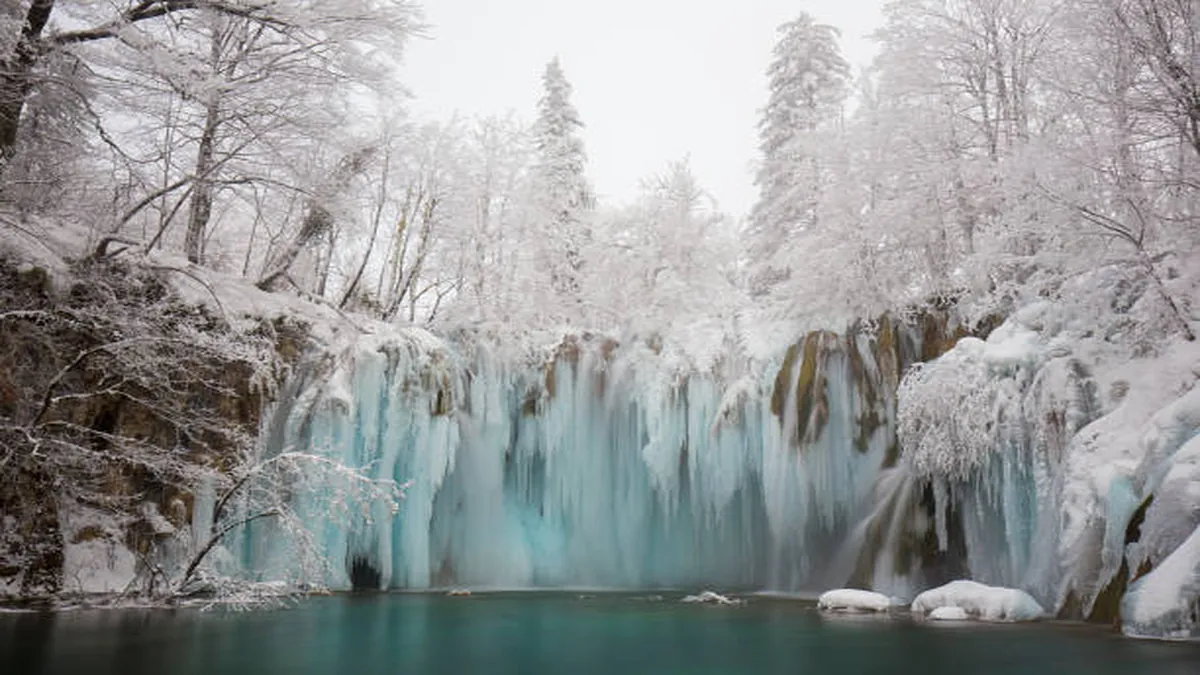
The photos everyone shares of Plitvice Lakes National Park show turquoise water threading through green forest. Almost nobody shows you what happens in January, when that same water freezes mid-fall and the boardwalks empty out completely. That’s the version of Plitvice most travelers never see — and it might be the better one.
Plitvice Lakes National Park stays open all winter, but only the Lower Lakes section is accessible, since the Upper Lakes boardwalks close for safety. Expect daytime temperatures near freezing, entry fees around €10, and a landscape of ice-framed waterfalls with a fraction of summer’s crowds. Winter runs from late October to late March.
Is Plitvice Lakes National Park Worth Visiting in Winter?
Short answer: yes, if you know what you’re trading. You lose access to about half the park and you won’t get the lush green-and-turquoise postcard look. What you gain is a national park that, on a quiet weekday, can feel almost empty — a sharp contrast to summer, when the main boardwalks near Veliki Slap get so crowded that photographing the falls without a stranger in frame is close to impossible.
Ticket prices drop for the season too, and several travelers who’ve done both trips describe winter as the more atmospheric visit, even with fewer lakes on the itinerary. If you want the full 16-lake, 90-waterfall experience, this isn’t that trip. If you want silence, snow, and a slower pace, it usually delivers.
Quick takeaway: Winter Plitvice trades scale for atmosphere. Go for the quiet and the ice, not for completeness.
What’s Open and What’s Closed in Winter
The park splits into the Lower Lakes and the Upper Lakes. In winter, the Upper Lakes boardwalks close because snow and ice make the wooden walkways dangerous, and maintenance crews use the off-season to do repairs. That leaves the Lower Lakes — centered on Lake Kozjak and the canyon trail down to Veliki Slap — as the part you’ll actually walk.
In practice, that means the two official winter routes are what the park calls Program A and Program B, both shorter loops through the Lower Lakes. The electric boat across Lake Kozjak still runs, connecting Entrance 2 (near Hotel Jezero) to the walking trail, and the panoramic train sometimes runs on a reduced schedule — worth checking on arrival rather than assuming it’s active.
Most in-park restaurants and cafés cut back their hours or close entirely for winter; a couple near Entrance 1 typically stay open for coffee and a quick snack, but don’t plan a park visit around a sit-down lunch.
Winter Opening Hours and Season Dates
The park defines winter as running from the last Sunday in October through the last Saturday in March. During this stretch, opening hours shrink to roughly 8:00 AM–4:00 PM, with ticket offices closing earlier, often around 1:00 PM. Hours can shift slightly year to year, so check the official schedule close to your travel date rather than relying on last year’s numbers.
| Season | Typical Hours |
|---|---|
| Winter (late Oct–late Mar) | 8:00 AM – 4:00 PM |
| Spring (late Mar–May) | 8:00 AM – 7:00 PM |
| Summer (Jun–Aug) | 7:00 AM – 8:00 PM |
| Autumn (Sep–Oct) | 8:00 AM – 6:00 PM |
Ticket Prices and How to Buy Them
Winter tickets run noticeably cheaper than the summer rate. As of the current winter season, adult entry is roughly €10, with children around €4, and a two-day pass costing about €15 for adults. Unlike peak summer, when pre-booking online days in advance is close to essential, winter demand is low enough that you can often buy tickets directly at the booth at Entrance 1 or the auxiliary Entrance 2 without a queue. Booking online the day before still isn’t a bad idea if you’re visiting on a weekend or around Christmas and New Year, when day-tripper numbers pick back up.
| Entrance | Best For |
|---|---|
| Entrance 1 | Main entrance, closer to the canyon trail and Veliki Slap viewpoint |
| Entrance 2 | Near Hotel Jezero, boat access across Lake Kozjak |
Weather in Winter and What to Pack
Plitvice sits at around 700 meters elevation, tucked against the Velebit mountains, which keeps it noticeably colder than Croatia’s coast — while Split or Dubrovnik rarely see snow, Plitvice gets it regularly. Daytime temperatures typically hover between 0°C and 12°C depending on the month, and nights can drop to −2°C to −4°C or lower.
Month-by-month weather
| Month | Typical Daytime Temp | Snow Likelihood |
|---|---|---|
| November | 5–10°C | Low–moderate |
| December | 0–5°C | Moderate |
| January | −2–3°C | High |
| February | −2–5°C | High |
| March | 3–8°C | Moderate, melting |
Snow isn’t guaranteed on any single day — some winter visitors arrive to bare, brown trees rather than snow cover — but the coldest stretch, mid-December through February, offers the best odds of a genuinely white landscape.
Packing checklist
- Waterproof, insulated jacket
- Thermal base layers
- Hiking boots or trail shoes with real grip (the boardwalks ice over)
- Hat, gloves, scarf
- A spare phone/camera battery — cold drains them fast
- Microspikes or grippers if you’re visiting after fresh snow or a freeze
Quick takeaway: You don’t need mountaineering gear, but you do need proper grip on your boots and a backup battery. Regular sneakers on icy boardwalks are how people end up on the ground.
How to Get to Plitvice Lakes National Park in Winter
There’s no airport near the park — Zagreb is the closest major city, about a 2-hour drive. Zadar is also around 2 hours, and Split is closer to 2.5–3 hours.
- By car: The most flexible option, and the way most winter visitors get around, since bus frequency drops sharply off-season. Winter tyres are effectively mandatory — shaded stretches of road near the park ice over even when the main roads look clear.
- By bus: FlixBus runs a limited winter schedule between Zagreb and Plitvice, usually once a day. Reliable, but plan your return carefully since options thin out.
- By guided tour: Day tours from Zagreb, Split, or Zadar bundle transport, entry tickets, and often a stop in Rastoke. This is the simplest option if you don’t want to deal with icy roads yourself.
Where to Stay Near the Park
If you want more than a few rushed hours, staying overnight lets you catch the park at opening, before day-trippers arrive.
- Hotel Jezero — closest to Entrance 2, straightforward and comfortable.
- Lakeside Hotel Plitvice — a well-reviewed option right by the park.
- Fenomen Plitvice — walking distance from the entrance, good winter value.
- B&B Millenium House — a budget-friendly alternative nearby.
The Best Winter Walking Route
With the Upper Lakes closed, most winter visitors follow a version of Program A or B:
- Start at Entrance 2, near Hotel Jezero, and take the electric boat across Lake Kozjak.
- Walk the lakeside trail toward the canyon, passing several smaller cascades along the way.
- Continue to Veliki Slap, the park’s largest waterfall, which is often partially frozen and framed in ice by January.
- Loop back via the wooden bridges toward Entrance 1, or retrace your steps to the boat dock.
Budget around 3–4 hours for this loop at a relaxed winter pace, including photo stops. It’s shorter than a full summer circuit, but it covers the park’s single most photogenic stretch.
Frozen Waterfalls and Photography Tips
Veliki Slap rarely freezes solid, but by deep winter its edges and the rock face around it are usually coated in ice, and mist off the falls often freezes on nearby branches. Overcast days actually work well for photos here — they even out the light on the ice and snow, which can otherwise blow out in bright sun. Arrive close to opening time for the best chance at empty boardwalks in your shots, and keep a lens cloth handy; spray from the falls freezes fast in cold air.
Staying Safe on Icy Boardwalks
The wooden boardwalks that make Plitvice so photogenic in summer become the main hazard in winter. A few practical rules:
- Stick to open, marked sections — closures exist because a specific stretch has been judged unsafe, not as a formality.
- Walk slower than feels necessary on any boardwalk with visible frost or sheen.
- If park staff mention the canyon trail is closed for ice, don’t push past a barrier to see it anyway; this happens more often than travelers expect.
- Bring microspikes if snow has fallen in the last day or two — regular tread isn’t enough on packed ice.
Nearby Add-Ons for a Winter Trip
- Rastoke village — a cluster of old watermills and waterfalls about 30–45 minutes away, often paired with a Plitvice day tour.
- Mukinje ski slope — a small, beginner-friendly hill near the park with a lift and toboggan rentals, good for families with a few spare hours.
- Zagreb Christmas markets — if you’re visiting in December, combining a Plitvice day trip with Zagreb’s Advent markets makes for an easy two-destination itinerary.
Plitvice Lakes Winter vs. Other Seasons
| Winter | Summer | |
|---|---|---|
| Access | Lower Lakes only | Full park |
| Crowds | Minimal | Very heavy |
| Entry fee | ~€10 | ~€25 |
| Temperature | 0°C to −4°C | Up to 30°C+ |
| Scenery | Snow, ice, bare trees | Lush green, turquoise water |
| Facilities | Reduced | Full |
Winter Trip, Real Expectations
Plitvice in winter isn’t the postcard version of the park — it’s a quieter, starker one. You’ll see less of it, but what you do see, you’ll often see alone. For travelers who’ve been put off by stories of summer crowds, that trade-off is usually worth making.
If you’re planning the trip, book your accommodation near Entrance 1 or 2 first, check the current season’s opening hours a day or two before you go, and pack for real cold rather than a mild European winter. Do that, and a few hours at Plitvice in January can end up being one of the more memorable stops on a Croatia trip.
Want more travel inspiration? Browse our collection of destination guides.
FAQ Section
Is Plitvice Lakes National Park open in winter?
Yes, the park is open year-round, including winter, though hours shrink to roughly 8:00 AM–4:00 PM and only the Lower Lakes section is accessible.
Are the Upper Lakes closed in winter?
Yes. The Upper Lakes boardwalks close for the season because snow and ice make them unsafe to walk, and the park uses the closure period for maintenance.
How cold does it get at Plitvice Lakes in winter?
Daytime temperatures typically sit between 0°C and 12°C depending on the month, with January and February the coldest, and nights regularly dropping to −2°C to −4°C.
Will I definitely see snow at Plitvice in winter?
Not guaranteed on any given day, but the park sits at elevation near the Velebit mountains and gets regular snowfall, especially from mid-December through February.
Do I need a car to visit Plitvice in winter?
Not strictly — buses and guided tours run, though less frequently than in summer. A car with winter tyres gives you the most flexibility for icy roads.
How much are winter tickets to Plitvice Lakes?
Adult entry is roughly €10 for the current winter season, with reduced rates for children, and a two-day pass around €15.
Is Plitvice Lakes worth visiting in winter?
For travelers who want fewer crowds, lower prices, and a striking ice-and-snow landscape, yes. If seeing the full 16-lake system matters more to you, visit in late spring or early autumn instead.
How long do I need at Plitvice Lakes in winter?
Most visitors comfortably see the Lower Lakes loop in 3–4 hours, making it a manageable half-day trip from Zagreb, Zadar, or Split.