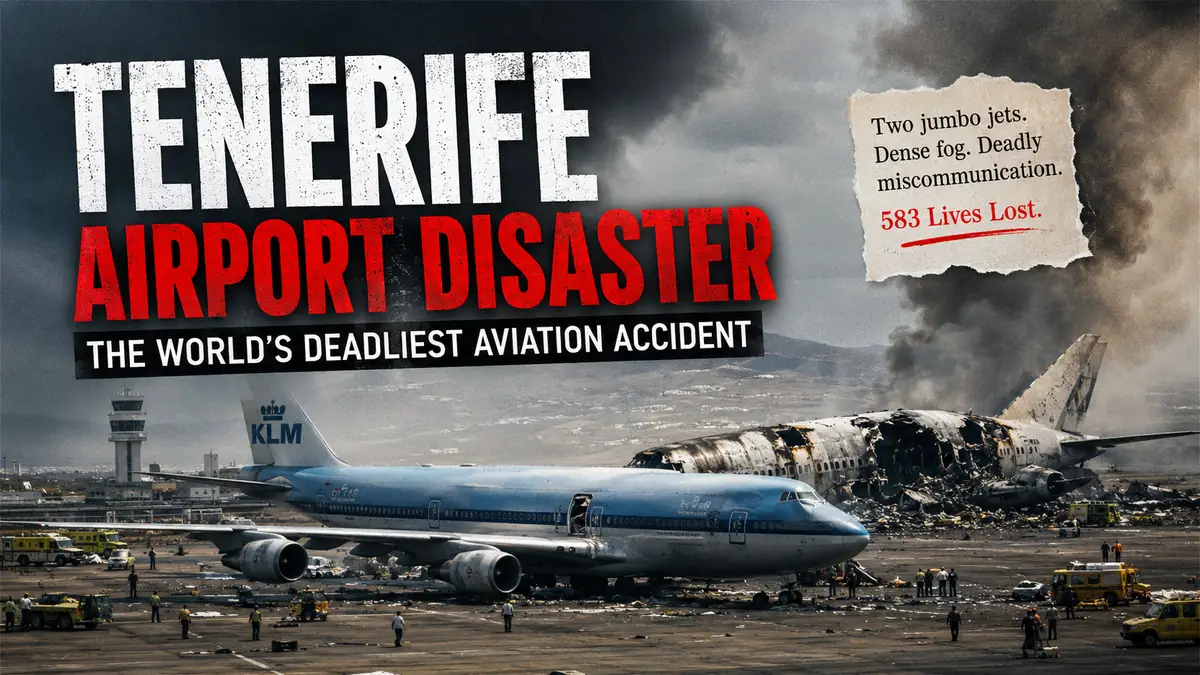
On March 27, 1977, two Boeing 747s collided on a fog-covered runway on Tenerife in Spain’s Canary Islands. Neither aircraft was originally supposed to be there. A bombing at Gran Canaria Airport had diverted both flights to the smaller Los Rodeos Airport, setting off a chain of congestion, communication problems, poor visibility, and human decisions that ended in catastrophe.
The tenerife airport disaster killed 583 people, making it the deadliest accident in commercial aviation history. KLM Flight 4805 began its takeoff roll while Pan Am Flight 1736 was still taxiing on the same runway. Dense fog, ambiguous radio communication, airport congestion, lack of ground radar, cockpit hierarchy, and a takeoff initiated without clearance combined to make the collision possible.
The disaster was not simply the result of one mistake. Its lasting importance lies in how several individually manageable problems lined up at exactly the wrong moment.
What Was the tenerife airport disaster?
The tenerife airport disaster was a runway collision between KLM Flight 4805 and Pan American World Airways Flight 1736 at Los Rodeos Airport on Tenerife on March 27, 1977.
Both aircraft were Boeing 747 passenger jets:
| Aircraft | Flight | Route | People aboard | Outcome |
|---|---|---|---|---|
| Boeing 747-206B | KLM Flight 4805 | Amsterdam to Gran Canaria | 248 | No survivors |
| Boeing 747-121 | Pan Am Flight 1736 | Los Angeles/New York to Gran Canaria | 396 | 61 survivors |
| Total | — | — | 644 | 583 fatalities |
All 248 occupants of the KLM aircraft died. Of the 396 people aboard the Pan Am aircraft, 335 died and 61 survived.
The accident happened at approximately 17:06 local/GMT time during severely restricted visibility.
Los Rodeos is now known as Tenerife North-Ciudad de La Laguna Airport. The collision remains a defining case study in aviation safety because the aircraft themselves were modern and serviceable and the crews were experienced.
Is Tenerife still the deadliest plane crash?
Yes, when accidents are considered rather than deliberate attacks, Tenerife remains the deadliest accident in aviation history, with 583 fatalities.
That distinction matters. Aviation statistics generally separate accidents from intentional acts such as terrorism. The Tenerife collision was an unintended aviation accident involving two passenger aircraft during ground and takeoff operations.
Why Were KLM and Pan Am at Tenerife?
One of the most striking facts about the disaster is that neither 747 was supposed to be at Los Rodeos.
Their intended destination was Gran Canaria Airport, then commonly called Las Palmas Airport, on another island in the Canary Islands.
Earlier on March 27, a bomb exploded at Gran Canaria Airport. Authorities temporarily closed the airport because of the security situation, forcing approaching aircraft to divert.
KLM Flight 4805 and Pan Am Flight 1736 were among those sent to Tenerife.
The diversion created unexpected congestion
Los Rodeos was much smaller than the airport at Gran Canaria and was not designed to comfortably accommodate the sudden influx of large diverted aircraft.
Aircraft filled available parking areas.
More importantly, parked airplanes obstructed the normal parallel taxiway. That meant departing aircraft would eventually have to use the active runway itself for taxiing.
This unusual arrangement became a critical part of what followed.
The two 747s would not simply taxi along a separate taxiway before departure. They would have to travel along the runway and maneuver while other aircraft were preparing to use it.
Why didn’t the Pan Am aircraft simply leave?
The Pan Am crew wanted to continue to Gran Canaria once conditions allowed, but the KLM 747 was positioned in a way that prevented Pan Am from easily getting past.
The KLM crew also decided to refuel at Tenerife.
That added to the delay. Refueling increased the KLM aircraft’s weight as well, a detail that later became part of discussions about whether the aircraft might otherwise have cleared the Pan Am jet during its attempted rotation. The core cause of the accident, however, was not the fuel load.
Eventually, Gran Canaria reopened.
Both 747s prepared to depart Tenerife.
By then, the weather was changing.
How the Tenerife Airport Disaster Happened
Understanding the accident requires following the sequence rather than looking for a single dramatic error.
1. Both aircraft prepared to leave Los Rodeos
After Gran Canaria reopened, the KLM 747 was instructed to taxi down the runway.
Because the regular taxiway was obstructed, the KLM aircraft traveled along the active runway, turned around at the far end, and positioned itself for departure.
Pan Am was then instructed to follow the KLM aircraft along the same runway.
The plan was for Pan Am to leave the runway using a taxiway before reaching the KLM aircraft.
2. Dense fog moved across the airport
Los Rodeos sits at an elevation where rapidly changing clouds and fog can severely reduce visibility.
Patches of fog moved across the airport that afternoon. Visibility deteriorated to the point that the pilots could not reliably see the other 747.
The air traffic controllers could not see the aircraft either.
Today, controllers at major airports may use sophisticated surface surveillance systems to track aircraft and vehicles in low visibility. Los Rodeos did not have ground radar at the time.
Controllers therefore depended heavily on radio reports from the crews to understand where each aircraft was.
3. Pan Am remained on the runway
The Pan Am crew was supposed to turn off the runway onto a taxiway.
The instructions and taxiway geometry caused confusion, and the aircraft did not leave at the expected exit.
Instead, Pan Am continued taxiing along the runway toward another exit that was easier for a Boeing 747 to negotiate.
This placed the aircraft in an extremely dangerous position: the KLM 747 was at one end of the same runway preparing for departure, while Pan Am remained farther down it.
Fog prevented the crews from seeing each other.
4. KLM received its route clearance
At the departure end, the KLM crew received an ATC route clearance describing what it should do after departure.
This was not the same thing as clearance to actually take off.
That distinction became crucial.
The KLM first officer read the clearance back and used wording referring to “takeoff.” The controller responded with language that could contribute to misunderstanding before indicating that the aircraft should wait for takeoff clearance.
At nearly the same moment, Pan Am transmitted that it was still taxiing on the runway.
5. Radio transmissions interfered with each other
The tower and Pan Am transmissions overlapped.
This simultaneous transmission produced radio interference, sometimes described as a heterodyne, in the KLM cockpit.
As a result, crucial information was not clearly received.
The KLM crew did not clearly hear the warning that would have confirmed the Pan Am 747 remained on the runway. Investigations and subsequent analyses have repeatedly identified the radio sequence as a major part of the accident chain.
6. KLM began its takeoff roll
The KLM aircraft accelerated down the runway.
The central fact established by the Spanish investigation was that the KLM captain commenced takeoff without having received takeoff clearance.
Captain Jacob Veldhuyzen van Zanten was one of KLM’s most senior pilots and its chief Boeing 747 training captain.
His experience makes the accident particularly significant in discussions of human factors. Expertise does not eliminate vulnerability to expectation, time pressure, communication ambiguity, or incorrect situational awareness.
7. The KLM flight engineer raised a concern
As the KLM aircraft accelerated, another warning appeared inside its cockpit.
After hearing radio traffic involving Pan Am, the KLM flight engineer questioned whether the American aircraft had actually cleared the runway.
The captain responded confidently that it had.
The takeoff continued.
This brief exchange later became important in the development of thinking about cockpit authority gradients—situations where junior crew members may struggle to challenge the decision of a highly authoritative captain.
8. The crews finally saw each other
For most of the sequence, fog concealed the aircraft.
The Pan Am crew eventually saw the KLM 747 approaching at high speed and attempted to turn off the runway while applying engine power.
The KLM crew also saw the obstruction and attempted to rotate.
But there was almost no time left.
PBS’s reconstruction of the cockpit recordings notes that the Pan Am crew detected the approaching KLM aircraft only seconds before impact.
9. The two Boeing 747s collided
The KLM aircraft began lifting from the runway but could not completely clear the Pan Am 747.
Its lower fuselage and landing gear struck the Pan Am aircraft.
According to the investigation summarized by SKYbrary, the KLM aircraft was almost airborne at impact. It continued briefly through the air after the collision before crashing back onto the runway and erupting in fire.
Both Boeing 747s were destroyed.
What Caused the Tenerife Airport Disaster?
The most accurate answer separates the primary cause from the many contributing conditions.
The Spanish investigation identified the KLM captain’s decision to take off without clearance as the fundamental cause. But the disaster developed within a much larger system of poor visibility, ambiguous communication, runway congestion, radio interference, taxiing difficulties and human factors.
Primary cause: takeoff without clearance
The KLM 747 started its takeoff before air traffic control had authorized it to do so.
Had the aircraft remained stationary until an unmistakable takeoff clearance was received, the collision would not have occurred in the way it did.
That is the central causal finding.
It should not, however, obscure why an extremely experienced crew could reach that point.
Contributing factor: ambiguous radio phraseology
Modern aviation relies heavily on standardized language because everyday conversational English can be interpreted differently by different people.
In Tenerife, words relating to “takeoff” appeared in communications that were not actual takeoff clearance.
The controller’s use of “OK” also contributed to ambiguity.
Neither issue alone inevitably causes an accident. Combined with the KLM captain’s apparent expectation that departure was imminent, however, they helped create a dangerous misunderstanding.
Contributing factor: simultaneous transmissions
Two radio transmissions occurred at almost the same time.
Instead of receiving two clear messages, the KLM crew heard interference.
That mattered because the blocked information concerned exactly what the crew needed to know: Pan Am had not yet cleared the runway.
Contributing factor: dense fog
The fog removed the most basic safety check available to the people involved—sight.
The KLM pilots could not see Pan Am.
Pan Am could not see the KLM aircraft until very late.
The tower could not visually confirm the location of either aircraft.
A misunderstanding that might have been immediately obvious on a clear day therefore remained hidden.
Contributing factor: no ground radar
Los Rodeos lacked airport surface radar.
Controllers were consequently dependent on position reports and radio communications during very poor visibility.
Modern surface surveillance technology is designed partly to prevent exactly this type of uncertainty by showing controllers where aircraft and vehicles are located.
Contributing factor: airport congestion
The bomb incident at Gran Canaria brought far more aircraft to Tenerife than Los Rodeos normally handled.
Parked aircraft blocked the normal taxiway, which forced airplanes to use the runway for taxiing.
The result was an abnormal operating environment in which multiple aircraft needed the same strip of pavement for different purposes.
Contributing factor: Pan Am’s missed runway exit
Pan Am remained on the runway longer than originally expected.
The crew did not take the intended exit, with taxiway layout and communications contributing to the situation.
This fact sometimes leads to oversimplified claims that Pan Am “caused” the accident by missing its exit.
That is not what the primary investigative finding concluded.
Pan Am’s continued presence was part of the accident chain, but an occupied runway should never be entered for takeoff without the required clearance and assurance that it is safe.
Contributing factor: cockpit hierarchy
The KLM captain was exceptionally senior.
When the flight engineer questioned whether Pan Am had cleared the runway, his concern did not result in an aborted takeoff.
That exchange became an enduring example of why aviation crews need more than technical flying ability.
They need a cockpit culture in which uncertainty can be challenged immediately, regardless of rank.
Quick Takeaway
No single factor—fog, radio interference, congestion, a missed taxiway or hierarchy—fully explains Tenerife. The catastrophe occurred because multiple defenses failed together, ending with the KLM aircraft beginning takeoff without clearance while Pan Am was still occupying the runway.
Who Was Flying the Two Aircraft?
The crews were not inexperienced pilots struggling with unfamiliar airplanes.
That is one reason the Tenerife disaster became so influential.
KLM Flight 4805
The KLM Boeing 747 was commanded by Captain Jacob Veldhuyzen van Zanten, a highly experienced pilot and prominent figure within KLM’s training organization.
He served as the airline’s chief 747 instructor.
The cockpit also included First Officer Klaas Meurs and Flight Engineer Willem Schreuder.
The captain’s status later became central to analysis of the cockpit’s authority gradient.
Pan Am Flight 1736
The Pan Am Boeing 747 was commanded by Captain Victor Grubbs, with First Officer Robert Bragg and Flight Engineer George Warns among the flight crew.
The Pan Am crew became increasingly concerned while taxiing in the fog because they knew another 747 was somewhere on the same runway.
Their final attempt to escape came only after the KLM aircraft emerged through the fog at takeoff speed.
How Many People Died in the Tenerife Airport Disaster?
The final death toll was 583.
That figure consisted of:
- 248 deaths aboard KLM Flight 4805
- 335 deaths aboard Pan Am Flight 1736
- 61 survivors from the Pan Am aircraft
There were no survivors from the KLM aircraft.
The numbers are especially staggering because the accident involved two Boeing 747s, then among the largest passenger aircraft in service.
How did 61 people survive?
The survivors were aboard the Pan Am aircraft, primarily in its forward section.
The collision tore through the aircraft and was followed by intense fire, but parts of the forward fuselage provided a short opportunity for escape.
Some occupants evacuated through openings in the damaged aircraft rather than through a normal, orderly evacuation.
The investigation found that those who escaped did so from the forward fuselage in roughly a minute, with crew members helping the evacuation.
Survival depended heavily on where a passenger happened to be, the structural damage around that location, and whether an escape route remained accessible.
Why Didn’t Air Traffic Control Stop the Collision?
The controller did not knowingly clear KLM to take off toward an occupied runway.
The problem was that the controller’s mental picture of the runway and the KLM captain’s understanding of the situation were different.
Fog prevented visual confirmation.
There was no ground radar.
Radio terminology was imperfect.
And simultaneous transmissions blocked critical information.
The tower expected KLM to wait.
KLM began moving.
Pan Am was still taxiing.
By the time the conflict became visually apparent to the pilots, there was almost no physical space or time available to correct it.
This distinction matters because descriptions that reduce Tenerife to an “ATC mistake” miss the deeper lesson. Safe aviation systems are designed around multiple independent defenses precisely because humans will occasionally misunderstand one another.
At Tenerife, too many of those defenses failed at once.
Did the Fog Cause the Tenerife Crash?
Fog was a major contributing factor, but saying that fog “caused” the crash is misleading.
Aircraft routinely operate safely in poor visibility because procedures, instrumentation, ATC separation and communication standards are designed to compensate for limited sight.
At Tenerife, fog became dangerous because other protections were already compromised.
Consider what would have changed with clear visibility.
The KLM crew might have seen the Pan Am aircraft before beginning the takeoff.
Pan Am might have seen KLM earlier.
Controllers could potentially have visually monitored the runway.
The fog therefore removed opportunities to detect the developing error.
It did not authorize the takeoff.
Was the Tenerife Airport Disaster Pilot Error?
It is often described as a pilot-error accident, and the official Spanish investigation placed primary responsibility on the KLM captain for commencing takeoff without clearance.
But modern accident analysis usually looks beyond the label “pilot error.”
Calling something human error explains who performed the final unsafe action, but it does not necessarily explain why the system allowed that action to become catastrophic.
Tenerife involved:
| Human/Operational Factor | Effect |
|---|---|
| Premature KLM takeoff | Put KLM on a collision course |
| Ambiguous phraseology | Increased misunderstanding |
| Radio interference | Blocked critical information |
| Pan Am remaining on runway | Created the physical conflict |
| Dense fog | Removed visual awareness |
| No ground radar | Limited controller awareness |
| Airport congestion | Forced unusual runway taxi operations |
| Cockpit hierarchy | Reduced effective challenge of captain |
| Expectation/time pressure | Encouraged premature assumptions |
This systems-based view is one reason Tenerife remains relevant to pilots, controllers, safety engineers, psychologists and other industries studying human error.
How the tenerife airport disaster Changed Aviation
Tenerife’s greatest legacy is not simply its death toll.
The accident forced aviation to reconsider how trained professionals communicate and make decisions when information is incomplete.
Standard radio phraseology became even more important
One major lesson concerned the word “takeoff.”
Aviation authorities strengthened the principle that terminology connected with takeoff must be tightly controlled.
Clearance language needs to distinguish between an aircraft receiving its departure routing and an aircraft actually being authorized to begin its takeoff roll.
Standard phraseology reduces the possibility that conversational wording such as “OK,” “at takeoff,” or similar expressions will be interpreted differently by pilots and controllers.
Safety recommendations following the investigation specifically emphasized standard phraseology and avoiding use of “take-off” in ATC departure clearances where it could create confusion.
Readbacks and confirmation became critical defenses
Modern air traffic communication depends heavily on readback-hearback procedures.
A controller issues an instruction.
The pilot reads critical information back.
The controller listens for an incorrect readback and corrects it.
The purpose is simple: do not assume that the message received was the message intended.
Tenerife demonstrated how disastrous an uncorrected difference in understanding can become.
Crew Resource Management changed cockpit culture
Perhaps the most famous long-term lesson associated with Tenerife is Crew Resource Management, usually abbreviated CRM.
Traditional cockpit culture gave captains enormous authority. Technical competence and command were emphasized, sometimes at the expense of collaborative decision-making.
CRM promotes a different model.
Flight crews are trained to use all available resources—people, information and equipment—to maintain safety.
That includes:
- assertive communication;
- cross-checking decisions;
- challenging unsafe actions;
- maintaining situational awareness;
- recognizing stress and workload;
- managing authority gradients;
- making decisions as a crew;
- communicating uncertainty clearly.
Tenerife contributed to the broader human-factors movement that made these principles fundamental to modern airline training.
A first officer must be able to challenge a captain
One of CRM’s most important cultural changes is straightforward:
Rank does not override safety.
A junior pilot who sees a serious risk is expected to speak clearly and escalate the warning when necessary.
The same principle applies to flight engineers, cabin crews and other operational personnel.
Tenerife showed what can happen when a concern is raised but fails to change the action being taken.
Situational awareness became a central human-factors concept
The KLM captain apparently believed Pan Am was clear.
Pan Am knew it was not.
The controller expected KLM to remain stationary.
Three parties were operating in the same physical environment with incompatible understandings of reality.
Modern training treats that divergence as a major warning sign.
Crews are taught to continuously ask, in effect:
Where are we? What is happening? What should happen next? Does everyone have the same picture?
What Happened to Los Rodeos Airport After the Disaster?
Los Rodeos continued operating after the accident and is today Tenerife North Airport, officially Tenerife North-Ciudad de La Laguna Airport.
Tenerife also gained another major airport.
Tenerife South Airport opened in 1978 and handles a large share of the island’s international tourist traffic.
The disaster was not the sole reason aviation infrastructure evolved on the island, but Tenerife’s difficult weather and the limitations exposed at Los Rodeos became inseparable from discussions of airport safety.
Surface surveillance, runway lighting, operational procedures and airport infrastructure across global aviation have advanced considerably since 1977.
Common Misconceptions About the Tenerife Disaster
Because the accident has been retold for decades, simplified versions sometimes obscure important details.
“The planes crashed because they couldn’t see each other”
Not by itself.
Poor visibility prevented early detection, but proper runway separation and takeoff clearance procedures are specifically intended to keep aircraft safe even when pilots cannot see one another.
“Air traffic control told KLM to take off”
The evidence does not support that interpretation.
KLM received a departure-related ATC clearance, but not the required clearance to commence takeoff. The Spanish investigation identified the initiation of takeoff without clearance as the fundamental cause.
“Pan Am caused the crash by missing its exit”
Pan Am remaining on the runway contributed to the physical circumstances of the collision, but this does not make it the primary cause.
The safety system required KLM to remain stopped until properly cleared for takeoff.
“The KLM captain was inexperienced”
The opposite is true.
Veldhuyzen van Zanten was a senior KLM pilot and chief 747 instructor. His experience is precisely why the accident became such a powerful lesson about authority, expectation and human factors.
“A mechanical failure caused the accident”
There was no major aircraft mechanical failure that explains the collision.
Both aircraft were modern Boeing 747s operated by major international airlines. The central problems were operational and human rather than a catastrophic failure of the airplanes themselves.
Why Tenerife Is Still Studied Today
Nearly half a century later, Tenerife remains relevant because it demonstrates a fundamental principle of safety engineering:
Catastrophes rarely need one enormous mistake when several smaller failures can align.
Consider the chain.
A bomb closes another airport.
Aircraft divert.
The smaller airport becomes congested.
The taxiway is obstructed.
Aircraft must taxi on the runway.
Fog arrives.
Pan Am remains on the runway longer than expected.
Controllers cannot see the airplanes.
There is no ground radar.
Radio language becomes ambiguous.
Two transmissions overlap.
A senior captain believes the runway is clear.
A crew member questions that assumption.
The challenge does not stop the takeoff.
Seconds later, 583 people are dead.
Remove almost any major link from that chain and the outcome might have been different.
That concept is central to modern accident prevention. Safety cannot depend on one perfect person making perfect decisions. It must contain overlapping defenses so that when one protection fails, another catches the error.
Research continues to use Tenerife as an example of how ambiguity, hierarchy, communication and degraded situational awareness can interact within complex systems.
The Lasting Lessons of the tenerife airport disaster
The tenerife airport disaster remains the deadliest accidental event in commercial aviation history, but its importance extends far beyond the number 583.
KLM Flight 4805 and Pan Am Flight 1736 arrived at Los Rodeos because of circumstances outside either crew’s original plan. What followed was an extraordinary accumulation of risk: airport congestion, runway taxiing, dense fog, confusing communications, radio interference, lack of ground surveillance and incompatible assumptions about whether the runway was clear.
The decisive event was the KLM Boeing 747 beginning its takeoff without clearance while Pan Am was still on the runway.
Aviation responded by strengthening the defenses surrounding human decision-making rather than assuming experienced professionals would never make mistakes. Standardized ATC phraseology, stronger cockpit communication, Crew Resource Management, assertive cross-checking and greater attention to situational awareness became essential parts of the industry’s safety culture.
That is why Tenerife is still taught.
Its most enduring lesson is not simply that communication must be clear. It is that uncertainty must be treated as a warning, assumptions must be challenged, and no single person’s confidence should substitute for confirmation when lives depend on the answer.