Most people picture gold when they think of Thai temples. Chiang Rai breaks that picture on purpose. Here, you’ll find a temple that’s blinding white, one that’s deep cobalt blue, and one that isn’t a temple at all but looks like something out of a fever dream. If you’re planning a trip north of Chiang Mai, this is the guide that tells you which Chiang Rai temples actually deserve your time, what they cost in 2026, and how to see them without losing half your day to tour buses.
Quick answer: Chiang Rai’s essential temples are Wat Rong Khun (White Temple, 200 THB, 8am–5:30pm), Wat Rong Suea Ten (Blue Temple, free, 7am–8pm), Baan Dam Museum (Black House, an art museum rather than a working temple), and Wat Huay Pla Kang, home to a 69-meter Guan Yin statue. Most visitors cover all four in one long day.
The Must-See Chiang Rai Temples at a Glance
Before you build an itinerary, it helps to see the whole picture side by side.
| Temple | Nickname | Entry Fee | Hours | Distance from City |
|---|---|---|---|---|
| Wat Rong Khun | White Temple | 200 THB (foreigners) | 8:00am–5:30pm | 13 km south |
| Wat Rong Suea Ten | Blue Temple | Free (donation) | 7:00am–8:00pm | 6 km north |
| Baan Dam Museum | Black House | Small fee | Varies, generally 9am–5pm | ~4 km north |
| Wat Huay Pla Kang | Big Buddha / Guan Yin Temple | Free (40 THB for elevator) | 7:00am–9:30pm | ~9 km north |
| Wat Phra Kaew | Emerald Buddha Temple | Free | 6:00am–6:00pm | City center |
Notice that three of the five sit north of the city and one sits south — that split is exactly why your route matters, and we’ll get to that.
White Temple (Wat Rong Khun) — The One Everyone Comes For
Wat Rong Khun is the reason most travelers add Chiang Rai to their itinerary at all. It isn’t an ancient site — it’s a working art project. Local artist Chalermchai Kositpipat started rebuilding a derelict temple on this spot in 1997, using his own money, and the complex is still expanding today. He’s said he expects the full nine-building vision to take until around 2070 to finish.
The white plaster and embedded mirror chips aren’t decoration for its own sake — the white represents the purity of the Buddha’s teachings, and the mirrors represent his wisdom catching the light. You cross the Bridge of the Cycle of Rebirth to reach the main hall, passing hundreds of carved hands reaching up from the ground — a depiction of unchecked desire. Inside the ubosot, murals mix traditional Buddhist imagery with unexpected pop-culture references; photography isn’t allowed inside, so you’ll have to see it in person.
What changed for 2026: entry jumped from 100 THB to 200 THB per foreign visitor as of January 1, 2026, and that ticket now folds in the Cave of Art, which used to be a separate 50 THB add-on. Thai nationals, children under 120cm, and visitors 70 and older still get in free. Budget 90 minutes to two hours, and go right at 8am opening — tour buses from Chiang Mai typically roll in around 10 or 11am, and by midday the marble walkways get genuinely hot underfoot.
Quick Takeaway: 200 THB, 8am–5:30pm, arrive at opening, no photos inside the ubosot.
Blue Temple (Wat Rong Suea Ten) — The Quieter, Cheaper Sibling
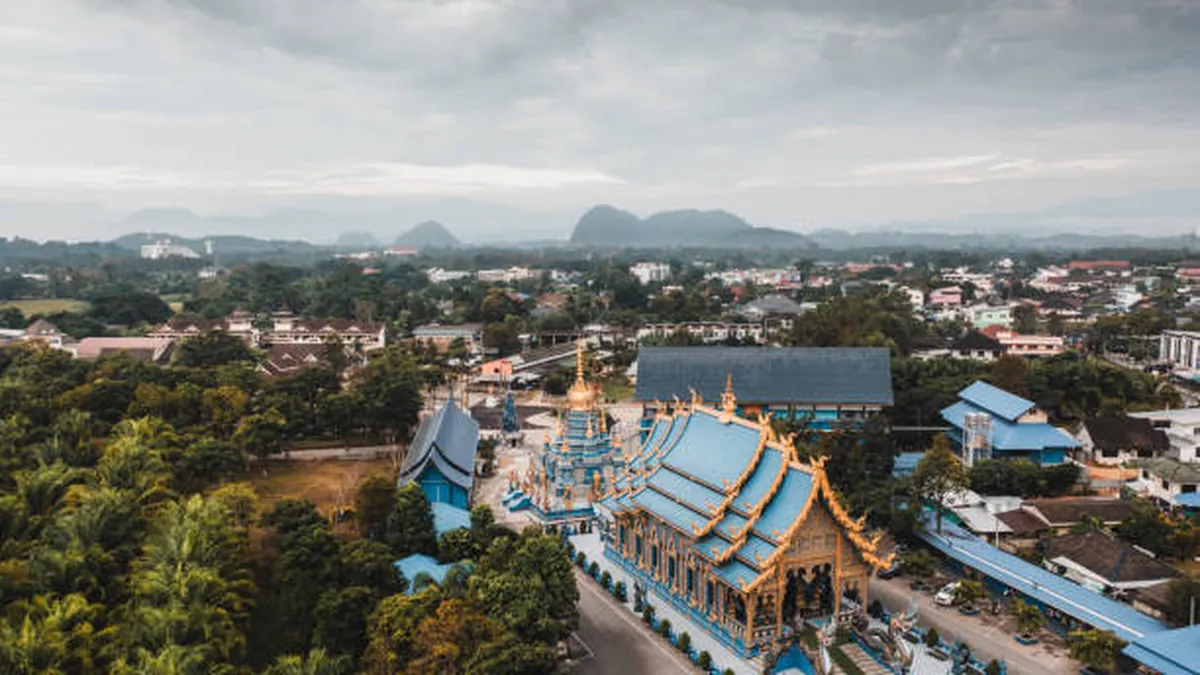
If the White Temple is the famous older sibling, Wat Rong Suea Ten is the one that grew up in its shadow and then found its own voice. It was designed by Putha Kabkaew, a student of Chalermchai’s, and every surface — walls, pillars, roofline — is painted in a saturated sapphire blue with gold trim. Where white stands for purity, the blue here is meant to evoke wisdom and the Buddhist idea of releasing material attachment.
The name translates to “Temple of the Dancing Tiger,” a nod to local legend that tigers once leapt across a canal on this site. Inside sits a striking white porcelain Buddha statue that contrasts hard against the blue walls, along with murals tracing the Buddha’s life story.
The best part: it’s free. No ticket booth, no queue — just a donation box if you’d like to contribute. It’s also open longer than the White Temple, from 7am to 8pm, and sits just north of the city rather than 13km south, so it’s easy to pair with a city-center morning.
Quick Takeaway: Free entry, 7am–8pm, best photographed at golden hour or on an overcast day when the blue reads richer.
Black House (Baan Dam Museum) — Not a Temple, But You’ll Want to Go Anyway
Here’s a distinction most first-time visitors miss: Baan Dam, or the Black House, isn’t a functioning Buddhist temple. It’s an art museum built around the work of the late artist Thawan Duchanee, who also designed the carved teak doors at several actual Chiang Rai temples. The complex of dark wooden buildings, topped with steep pointed roofs, houses unsettling large-scale artworks — animal skulls, hides, bone furniture — that intentionally sit as a dark counterpoint to the White Temple’s purity theme.
It’s worth including precisely because it disrupts the “prettier and prettier” temple-hopping rhythm with something stranger. Most guided day tours bundle it in alongside the White and Blue Temples as the “Colors of Chiang Rai” — white, blue, and black.
Wat Huay Pla Kang and Wat Phra Kaew — History Over Hype
Once you’ve done the Instagram circuit, these two round out the picture with substance.
Wat Huay Pla Kang sits on a hilltop and mixes Thai Lanna style with Chinese architectural elements — think dragons instead of the naga serpents you’ll see elsewhere. Its centerpiece is a roughly 69-meter white statue of Guan Yin, the Bodhisattva of Mercy, which is frequently misidentified by visitors as a “Big Buddha.” A separate nine-tiered pagoda sits beside it, ringed by smaller pagodas representing the twelve zodiac signs. You can ride an elevator inside the Guan Yin statue for a panoramic view over the surrounding valley for a small extra fee.
Wat Phra Kaew, inside the Old Town, has the deepest history of the group. This is where the Emerald Buddha — now Thailand’s most revered Buddha image, housed in Bangkok’s Grand Palace — was reportedly discovered in 1436 after a chance crack in an old stucco chedi revealed the jade statue underneath. The temple complex dates to 1782, the same year Bangkok became Siam’s capital, and today it’s a genuinely peaceful spot with a small museum of Buddhist scripture and a replica Angkor Wat model.
Lesser-Known Temples Worth a Detour
If you have more than a day, or you’ve already done the big four, a couple of quieter sites reward the extra effort. Wat Phra That Doi Chom Thong sits on the banks of the Kok River and ranks among the oldest temples in the region. Wat Ming Muang, tucked into the Old Town, is a local favorite for traditional Lanna architecture without a single tour bus in the parking lot. Neither will dominate your itinerary, but both are worth 20 minutes if you’re already nearby.
How to Plan Your Chiang Rai Temple Day
If you’re day-tripping from Chiang Mai: it’s roughly a three-hour drive each way, so realistically you’re looking at the White Temple and Blue Temple, maybe Baan Dam if your group moves fast. Organized tours leave Chiang Mai between 7 and 7:30am and return between 7 and 8pm — a long day, and one that’s genuinely tiring with kids or anyone prone to carsickness.
If you can spend one or two nights in Chiang Rai itself, the logistics get much easier, since three of the four major temples sit within about 10km of the city center. A workable two-day split looks like this:
- Day 1 morning: White Temple at 8am opening, before the tour buses arrive.
- Day 1 afternoon: Blue Temple, then Baan Dam Museum nearby.
- Day 2 morning: Wat Huay Pla Kang, best visited early for the light on the statue.
- Day 2 afternoon: Wat Phra Kaew in the Old Town, followed by the Night Bazaar.
Getting between them: a rented scooter (roughly 150–250 THB/day) gives you the most flexibility. Grab or Bolt rides typically run 80–150 THB between city-center sites. Public songthaews and the local bus (about 20–30 THB) reach the White Temple from Bus Terminal 1, though catching a ride back is less reliable since Grab drivers rarely wait near the temple unprompted.
Temple Etiquette and What to Wear
These are active places of worship, even the touristy ones, so the basics matter everywhere on this list:
- Cover your shoulders and knees — loose, breathable fabric handles the heat better than tight clothing.
- Remove your shoes before entering any main shrine or ubosot; sarongs are usually available to borrow at busier sites, though they can run out on peak days.
- Never point your feet toward a Buddha image, and step over (not on) raised thresholds.
- Keep your voice down near anyone praying, and skip the exaggerated photo poses.
- Follow posted photography rules — the White Temple’s ubosot is the clearest no-photo zone in the group.
Final Thoughts
Chiang Rai’s temples work as a set because each one is doing something different — one is an ongoing art project, one is a quiet counterpoint in blue, one isn’t a temple at all, and two carry centuries of actual history. Give yourself at least one full day, ideally two, and go early. The temples don’t change much year to year, but the crowds, and now the fees, do — so check current numbers before you lock in a schedule, and build your route around geography rather than fame alone.
Looking for more itinerary ideas? Check out our complete collection of travel guides.
FAQ Section
Is the White Temple in Chiang Rai free to enter?
No. As of January 1, 2026, entry is 200 THB per foreign adult, which now includes the Cave of Art. Thai citizens, children under 120cm, and visitors 70+ enter free.
Is the Blue Temple free?
Yes, Wat Rong Suea Ten has no fixed entrance fee; a donation box is available for those who’d like to contribute.
Is Baan Dam (Black House) a temple?
No. It’s an art museum built around the works of artist Thawan Duchanee, styled to look like a temple complex but not used for regular Buddhist worship.
How many days do you need for Chiang Rai temples?
One full day covers the White Temple, Blue Temple, and Baan Dam. Two days lets you add Wat Huay Pla Kang, Wat Phra Kaew, and a lesser-known site without rushing.
Can I visit Chiang Rai temples as a day trip from Chiang Mai?
Yes, though it’s a long day — roughly three hours’ drive each way, with most tours covering only the White and Blue Temples plus a stop at Baan Dam.
What should I wear to visit the temples?
Cover your shoulders and knees, wear shoes you can slip off easily, and bring a light scarf as backup in case borrowed sarongs run out.
What’s the difference between the White Temple and Blue Temple?
The White Temple, designed by Chalermchai Kositpipat, represents purity and Buddhist teaching through white plaster and mirror mosaics. The Blue Temple, by his student Putha Kabkaew, uses blue to represent wisdom and letting go of material attachment.
Where was the Emerald Buddha discovered?
At Wat Phra Kaew in Chiang Rai, reportedly in 1436, after lightning cracked open a stucco chedi and revealed the jade Buddha image now housed in Bangkok’s Grand Palace.