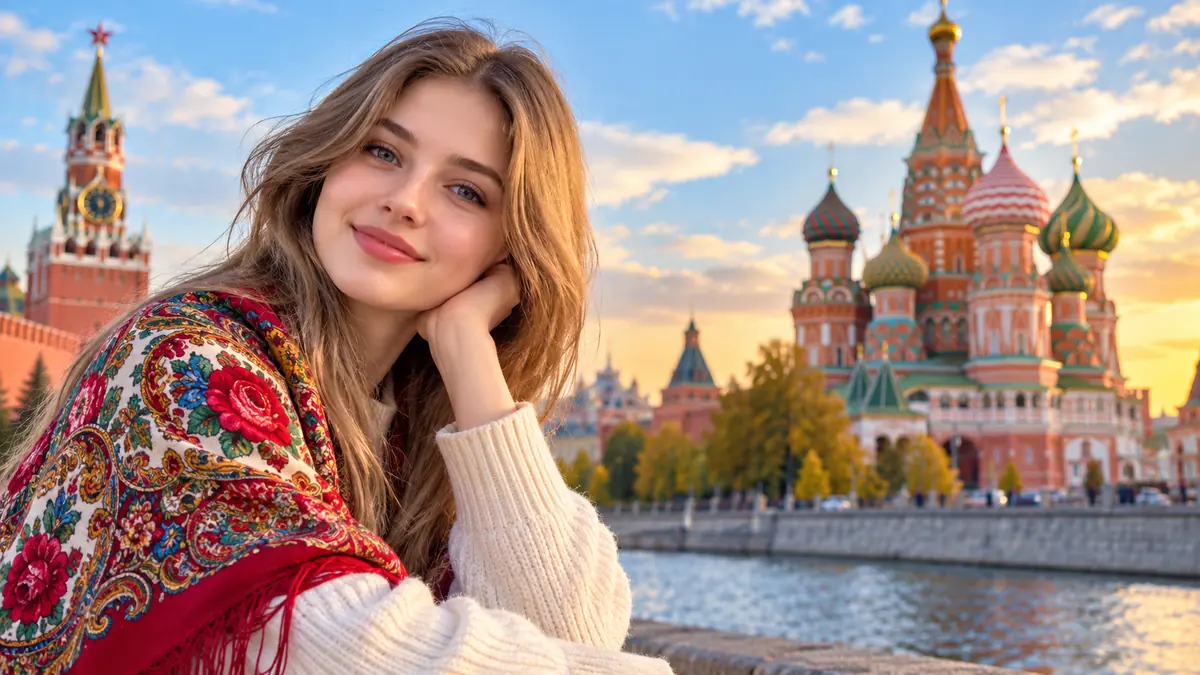
Search for russian girl online and you will encounter everything from cultural articles and fashion photography to social-media clips and sweeping stereotypes. The problem is that these portrayals can make a remarkably diverse population appear as though everyone shares the same appearance, personality, or lifestyle.
A russian girl simply means a girl or, informally, a young woman from Russia or someone with Russian cultural heritage. It does not define how someone looks, dresses, communicates, studies, works, or approaches relationships. Russia’s regional, ethnic, linguistic, religious, and social diversity makes individual experience far more meaningful than nationality-based stereotypes.
What Does russian girl Mean?
In ordinary English, “russian girl” generally refers to a female person from Russia. The word “girl” technically describes a child or younger person, although informal English sometimes uses it for a young adult woman.
When referring to an adult in formal writing, Russian woman is usually the more precise and respectful expression.
The distinction matters because the search term itself has acquired meanings beyond nationality. Online, it can appear in discussions about beauty, fashion, dating, language, travel, social media, history, and Russian culture.
None of those associations creates a single definition of what Russian women are actually like.
Russia had a population exceeding 143 million in 2024 and stretches across both Europe and Asia. The World Bank describes it as spanning a vast territory and sharing borders with 14 countries. Such geographic scale alone should make the idea of one universal “Russian type” seem unrealistic.
There Is No Single Russian Girl Appearance
One of the most persistent misconceptions is that Russian women have a specific physical appearance.
International media sometimes presents a narrow image: fair skin, blond hair, blue eyes, tall stature, and distinctly Slavic facial features. Those characteristics certainly occur, but they cannot represent an entire country.
Russia contains numerous ethnic and cultural communities, and physical characteristics naturally vary. People may have blond, brown, black, or red hair; light or dark eyes; and a wide range of skin tones, facial features, heights, and body types.
Why is the blonde stereotype so common?
Visibility is not the same as demographic reality.
Film casting, fashion photography, advertising, tourism imagery, and social-media algorithms can repeatedly expose international audiences to particular appearances. Once that image becomes recognizable as “Russian,” entertainment and advertising can reinforce it.
This creates selection bias: the people who receive the most international attention do not necessarily resemble the population as a whole.
The practical takeaway is simple: you cannot reliably identify someone’s nationality merely from appearance.
Russian Girl Culture and Regional Diversity
Understanding Russian women requires understanding the scale of Russia itself.
Moscow and Saint Petersburg are internationally recognizable metropolitan centers, but life outside those cities can be very different. Russia also includes smaller industrial cities, rural communities, Arctic settlements, Siberian regions, and culturally distinct republics.
Russia’s geography crosses Eastern Europe and northern Asia. That creates substantial differences in climate, local traditions, food, architecture, employment, transportation, and everyday routines.
A university student in central Moscow may have little in common with someone of the same age living thousands of kilometers away.
Ethnicity and language add another layer
“Russian” can describe citizenship, nationality, language, cultural background, or ethnic identity depending on context.
The Russian language plays a central role nationally, but Russia is not culturally homogeneous. Regional and minority languages and traditions also contribute to people’s identities.
This is why phrases such as “Russian girls always…” should immediately be treated with caution. A country this geographically and culturally broad cannot realistically produce one personality type.
Education and Student Life in Russia
Education is a major part of everyday life for Russian girls and young women.
World Bank gender data, drawing on UNESCO information, reports very high educational indicators in Russia. Lower-secondary completion was about 97% for girls in the available 2019 data, while female adult literacy was reported at 99.9% for 2021.
These figures challenge another common online tendency: discussing Russian women primarily through beauty or relationships while overlooking education, professional ambitions, and ordinary working life.
Young women study across disciplines ranging from humanities and languages to medicine, economics, engineering, science, information technology, and the arts.
Student experience varies by institution and location. Someone attending university in a major city may use public transportation, spend time in cafés and libraries, participate in student organizations, work part-time, and communicate with friends through the same digital platforms familiar to young adults elsewhere.
Education also affects mobility. Some students remain in their home regions, while others move to larger cities for university and employment opportunities.
Russian Women in Work and Professional Life
The glamorous social-media stereotype also obscures a more ordinary reality: millions of Russian women participate in the workforce.
World Bank data places female labor-force participation in Russia at approximately 54.5% in 2025. Women also represented 41.7% of people employed in senior and middle management according to the gender indicators reported for 2025.
Women work throughout education, healthcare, business, science, retail, technology, administration, finance, media, culture, and numerous other sectors.
That does not mean gender expectations have disappeared. Work, household responsibilities, motherhood, economic conditions, and social expectations can interact in complicated ways.
The key point is that describing Russian women mainly through dating or appearance leaves out a substantial part of everyday reality.
russian girl Fashion and Beauty: Stereotype vs Reality
Fashion is probably responsible for some of the strongest international images associated with Russian women.
A familiar stereotype portrays a Russian woman as always carefully styled, wearing elaborate makeup, fashionable clothes, and heels even during routine activities.
Reality is much broader.
Some people genuinely enjoy glamorous clothing and detailed beauty routines. Others prefer jeans, sneakers, sportswear, minimalist wardrobes, alternative fashion, or practical clothing.
Climate matters too.
Russian winters can make coats, insulated boots, hats, scarves, gloves, and layered clothing necessities rather than fashion statements.
Personal style also changes according to age, occupation, location, income, social circle, and occasion.
| Common stereotype | More realistic perspective |
|---|---|
| All Russian girls are blonde | Hair and physical characteristics vary widely |
| Everyone dresses glamorously | Style ranges from formal to casual and practical |
| Beauty is every woman’s priority | Interests and priorities differ by individual |
| Russian women always wear heels | Sneakers, boots, flats, and other everyday footwear are normal |
| Appearance reveals nationality | Nationality cannot reliably be determined from looks |
The strongest mistake is confusing a visible fashion trend with a universal cultural rule.
Family Life and Russian Traditions
Family is an important institution in Russian society, but that does not mean every Russian household operates in the same way.
Families may include married couples, single parents, multigenerational households, unmarried partners, or adults living independently. Attitudes toward marriage, children, household responsibilities, careers, and independence vary by generation, region, personal beliefs, and economic circumstances.
Grandparents can play an important role in some families, particularly in childcare and maintaining family traditions.
Celebrations and family gatherings may center on birthdays, weddings, anniversaries, New Year festivities, and religious or cultural holidays depending on the household.
Are Russian girls traditional?
Some are. Others are not.
This question becomes misleading when “traditional” is treated as a national personality trait.
A young woman may value marriage and motherhood while pursuing an ambitious professional career. Another may prioritize education, travel, independence, or creative work. Someone else may combine these priorities differently.
Modern and traditional values are not mutually exclusive.
Communication Style and the “Cold Russian” Stereotype
Another widespread stereotype says Russians are naturally cold, serious, or unfriendly.
Part of this impression can come from differences in social conventions.
A culture in which strangers do not constantly smile at one another can appear unfriendly to visitors accustomed to frequent public smiling. Yet public reserve says little about how someone behaves among friends and family.
Communication also depends heavily on personality and context.
Someone may be quiet around strangers and animated with close friends. Another person may be naturally outgoing. Social confidence, humor, warmth, directness, and emotional expression cannot be predicted simply from nationality.
This is an important distinction when encountering cross-cultural differences: different social signals do not automatically carry the same meaning across cultures.
Social Media and Modern Russian Youth Culture
The internet has changed how Russian youth culture is both experienced and viewed internationally.
Young Russians participate in digital culture through messaging, entertainment, music, gaming, fashion, memes, photography, short-form video, online communities, and content creation.
Yet social media creates a distorted sample of everyday life.
Highly polished photographs, luxury lifestyles, dramatic fashion, and unusual personalities attract attention. Ordinary routines—studying for an exam, commuting, grocery shopping, working, or spending a quiet evening at home—rarely spread internationally.
That creates a simple but powerful distortion:
What becomes viral is not necessarily what is typical.
The same principle applies when judging any country from Instagram photographs, short videos, influencers, or entertainment content.
Common russian girl Stereotypes and What They Get Wrong
Stereotypes are appealing because they turn complicated societies into simple stories. They can also sound positive while still being misleading.
“Russian girls are exceptionally beautiful”
Beauty is subjective.
Russia certainly has women whom people consider beautiful, just as every large population does. But there is no objective scientific standard establishing one nationality as naturally more attractive than another.
Fashion, cosmetics, photography, media selection, and cultural preferences strongly influence perceptions of beauty.
“All Russian women are feminine”
Femininity itself means different things to different people.
Some women enjoy traditionally feminine clothing, beauty routines, or social roles. Others do not. Treating femininity as a national characteristic replaces millions of individual identities with a stereotype.
“Russian girls want foreign husbands”
International marriages occur, but they cannot establish the intentions of an entire population.
This stereotype has been reinforced for years by international dating advertising and selective media portrayals. Someone’s nationality tells you very little about whom they want to date or marry.
“Russian women only want wealthy men”
Financial stability can matter in relationships anywhere, but individual priorities differ.
People may value affection, compatibility, humor, loyalty, shared goals, financial responsibility, independence, education, or countless combinations of characteristics.
Nationality is not a relationship preference algorithm.
“Russian women are naturally tough”
This stereotype often has a more complimentary tone, but it is still a generalization.
Historical hardship and cultural narratives may influence popular images of resilience. Yet people respond to difficulty differently. Some individuals are exceptionally resilient; others need support, just as they do everywhere else.
Population Facts Put the Stereotypes in Perspective
Demographics provide useful context because they reveal how unreasonable it is to describe Russian women as one uniform group.
According to World Bank data based on UN population estimates, females represented approximately 53.6% of Russia’s population in 2025.
Russia’s population exceeds 143 million people, while around 75.25% of the country’s population was urban in 2025.
That means discussions about a “typical Russian girl” are attempting to summarize the experiences of an enormous population spread across one of the world’s largest countries.
There will naturally be differences between generations, cities, ethnic communities, economic backgrounds, educational levels, professions, and families.
Russian Girls in Literature and Popular Culture
International ideas about Russian women did not begin with social media.
Russian literature, Soviet imagery, Cold War entertainment, fashion, cinema, and advertising have all contributed to recognizable female archetypes.
Classic Russian literature includes memorable female characters associated with writers such as Leo Tolstoy, Fyodor Dostoevsky, and Ivan Turgenev. These literary figures helped international readers encounter different ideas about Russian family life, morality, social class, love, and personal responsibility.
The Soviet period introduced another powerful visual identity: women as workers, professionals, farmers, mothers, athletes, and contributors to the state.
Western Cold War entertainment developed its own Russian archetypes, including spies, mysterious strangers, athletes, and femme-fatale characters.
Later media added glamorous models, oligarch lifestyles, dating stereotypes, and internet personalities.
These images sometimes contradict each other. The same culture can portray a Russian woman as austere and tough in one story, glamorous and extravagant in another.
That contradiction is evidence that these are media archetypes rather than demographic descriptions.
Everyday Life Matters More Than the Internet Image
An ordinary day for a Russian girl or young woman is unlikely to resemble a movie stereotype.
Depending on her circumstances, she might attend school or university, travel to work, meet friends, exercise, shop, cook, use public transportation, care for relatives, watch entertainment, play games, study languages, or spend time online.
Location makes a considerable difference.
The experience of living in Moscow may differ significantly from living in a smaller city or rural community. Urban Russia itself is substantial: World Bank data indicates roughly three-quarters of the population lives in urban areas.
Income, education, family circumstances, age, and profession can matter more to daily routines than nationality-based assumptions.
How to Understand Russian Culture Without Stereotyping
Curiosity about another culture is useful. Problems begin when curiosity turns into assumptions about individuals.
A better approach is to separate cultural patterns from personality.
For example, learning about Russian holidays, food, literature, history, family customs, education, climate, or communication conventions can provide valuable cultural context. Assuming a particular woman must behave a certain way because she is Russian does not.
When meeting someone from Russia:
- Treat nationality as background, not personality.
- Ask respectful questions instead of making assumptions.
- Remember regional and ethnic diversity.
- Do not treat social-media imagery as representative evidence.
- Avoid assuming someone’s relationship preferences from nationality.
- Use “Russian woman” rather than “girl” when referring formally to an adult.
- Recognize individual preferences before cultural stereotypes.
This approach works beyond Russia. Cultural knowledge becomes most useful when it helps you understand context without pretending that every individual follows the same rules.
russian girl: The Most Accurate Perspective
The phrase russian girl sounds simple, but internet culture has loaded it with assumptions about beauty, personality, fashion, relationships, and traditional values. The reality is far less predictable.
Russia is a vast country spanning Europe and Asia with more than 143 million residents. Women participate extensively in education and employment; World Bank gender data reports female literacy at 99.9% in the available 2021 data and female labor-force participation at 54.5% in 2025.
Those facts provide a much more useful starting point than viral photographs or dating clichés.
A russian girl is ultimately an individual whose identity may be influenced by nationality, region, family, language, education, generation, and culture—but cannot be completely explained by any of them.
If you want to understand Russian girls and women accurately, learn about the country’s cultural diversity while leaving room for individual differences. That is both more respectful and far closer to real life than any stereotype.