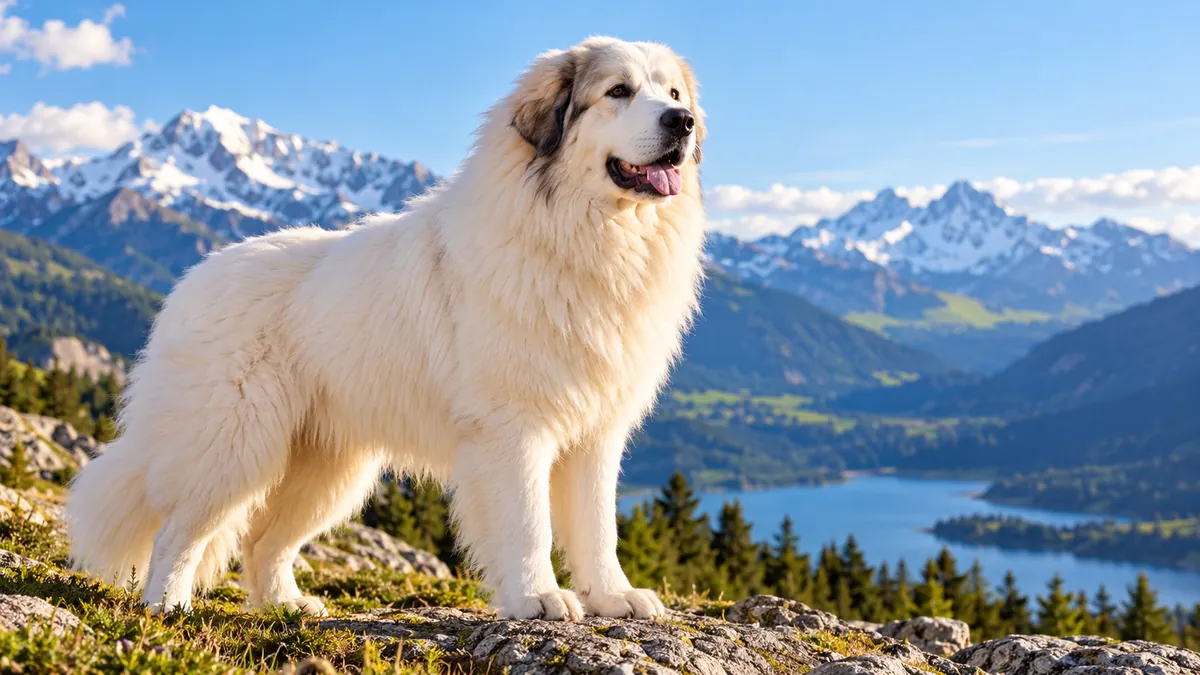
Calm, imposing, and covered in a striking white coat, the great pyrenees was developed for a serious job: protecting livestock against predators in rugged mountain country. That heritage still shapes nearly everything about the breed, from its independent decision-making to its habit of watching the surroundings while appearing completely relaxed.
The great pyrenees is a giant livestock guardian dog known for being patient, loyal, protective, and independent. Adults typically stand 25–32 inches tall; females generally weigh 85 pounds or more, while males commonly reach 100 pounds or more. The breed has a thick double coat and an expected lifespan of about 10–12 years. American Kennel Club
This is not simply an oversized fluffy companion. A Pyr thinks for itself, sheds heavily, may bark frequently, and can be surprisingly determined when it decides something deserves investigation. Understanding those traits is essential before bringing one home.
Great Pyrenees Breed Overview
| Trait | Typical Great Pyrenees |
|---|---|
| Breed group | Working |
| Original purpose | Livestock guardian |
| Male height | 27–32 inches |
| Female height | 25–29 inches |
| Male weight | 100+ pounds |
| Female weight | 85+ pounds |
| Life expectancy | 10–12 years |
| Coat | Long, weather-resistant double coat |
| Common color | White; sometimes with gray, tan, reddish-brown or badger markings |
| Temperament | Calm, patient, protective, independent |
| Exercise needs | Moderate |
| Shedding | High |
| Trainability | Intelligent but independent |
The American Kennel Club describes the breed as smart, patient, and calm and places it in the Working Group. Its physical size varies considerably, particularly because the breed standard specifies minimum rather than maximum adult weights. American Kennel Club
History and Origin of the Great Pyrenees
The breed takes its name from the Pyrenees Mountains, which form a natural boundary between France and Spain.
For centuries, dogs of this type accompanied livestock and protected sheep, cattle, and homesteads. Their enemies weren’t minor nuisances. They needed the courage and physical ability to respond to wolves, bears, and human threats.
That explains several characteristics modern owners sometimes find puzzling.
A livestock guardian could not wait for a shepherd to issue a command whenever something suspicious appeared. It needed to observe a situation, assess the danger, and respond independently.
That independence remains deeply embedded in the modern dog’s behavior.
From Mountain Guardian to Companion
The breed’s story eventually extended beyond pastoral life. Great Pyrenees became associated with French aristocracy and royalty, while still retaining its traditional working role.
The breed later became established in the United States, where Mary Crane played an important role in its development and preservation. Great Pyrenees continue working as livestock guardians today, although many now live primarily as family companions. American Kennel Club
This transition hasn’t erased their original instincts. A family may effectively become the dog’s modern “flock.”
Great Pyrenees vs. Pyrenean Mountain Dog
These names can cause confusion.
Great Pyrenees is the name commonly used in the United States. Pyrenean Mountain Dog is the name commonly encountered in the United Kingdom and some other countries.
Don’t confuse the breed with the Pyrenean Shepherd, a much smaller and more energetic herding breed, or the Pyrenean Mastiff, another distinct giant dog. American Kennel Club
Great Pyrenees Size and Appearance
Few people mistake an adult Pyr for a small dog.
Males generally stand 27–32 inches at the shoulder and weigh at least 100 pounds. Females typically stand 25–29 inches and weigh at least 85 pounds. American Kennel Club
Their size is impressive, but a healthy Pyr shouldn’t simply look bulky. The breed combines strength with balance and surprisingly graceful movement.
Coat and Colors
One of the breed’s defining characteristics is its weather-resistant double coat.
It consists of:
- A long, coarse outer coat
- A dense, fine, woolly undercoat
- Heavier hair around the neck and shoulders, especially in males
- Feathering on the legs
- A plumed tail
White is the characteristic color. Gray, badger, reddish-brown, and various tan markings may also occur, particularly around the head, ears, tail, and portions of the body. AKC Images
That beautiful coat wasn’t developed merely for appearance. It helped working dogs tolerate harsh mountain weather.
Double Dewclaws
Another characteristic worth noticing is the presence of double dewclaws on the rear legs, an established feature of the breed standard.
For prospective owners, this also means extra nails to remember during routine nail care.
Great Pyrenees Temperament
Understanding the great pyrenees temperament requires remembering what the dog was bred to do.
The ideal Pyr is confident, composed, patient, affectionate with its family, and capable of becoming protective when circumstances demand it. The official breed standard also emphasizes independence, loyalty, attentiveness, and a somewhat reserved nature. AKC Images
Calm Doesn’t Mean Passive
Great Pyrenees can spend considerable time resting and observing their environment.
Then something changes—a strange animal enters the property, someone approaches the house, or an unusual sound appears at night—and that relaxed dog can become intensely alert.
This contrast is normal for a guardian breed.
Are Great Pyrenees Aggressive?
A properly bred, socialized Great Pyrenees should not display indiscriminate aggression toward people.
Protectiveness and aggression aren’t the same thing.
The breed standard specifically considers excessive shyness, nervousness, or aggression toward humans serious faults. A stable Pyr should be confident enough to evaluate situations without treating every unfamiliar person as an immediate enemy. AKC Images
Early socialization matters because a giant protective dog is much easier to live with when it has learned how to respond appropriately to visitors, animals, noises, and unfamiliar environments.
Why Are Great Pyrenees So Independent?
Imagine guarding sheep on a mountain at night while the shepherd is elsewhere.
Waiting for instructions isn’t useful.
Generations of selection for autonomous livestock protection produced dogs comfortable making decisions without constant human direction. That independence remains even when the “livestock guardian” is sleeping beside a sofa.
This is why a Pyr may clearly understand a command yet appear to consider whether complying is worthwhile.
Are Great Pyrenees Good Family Dogs?
For the right household, yes.
Great Pyrenees are typically devoted and affectionate toward their families. Their patient temperament can make them appealing family companions, and guarding the household often comes naturally.
However, “gentle giant” shouldn’t be interpreted as “effortless family pet.”
An adult can weigh more than many people. Even friendly movement from a dog that size can accidentally knock over a small child.
Interactions between dogs and young children should therefore always be supervised. American Kennel Club
Children should also learn not to:
- Climb on the dog
- Pull its coat or tail
- Disturb it while eating or sleeping
- Take toys or food from its mouth
- Treat the dog like a piece of furniture
Respect works both ways.
Do Great Pyrenees Get Along With Other Dogs?
Many can live successfully with other dogs, especially when properly introduced and socialized.
Individual temperament still matters.
Guardian instincts can influence relationships with unfamiliar animals, so introductions should be controlled rather than assuming every Pyr will automatically accept every dog it meets.
Great Pyrenees With Cats and Livestock
Their livestock-guardian heritage can make Great Pyrenees capable of living peacefully with animals they recognize as part of their household or flock.
That doesn’t eliminate the need for careful introductions.
A puppy raised appropriately around cats, poultry, sheep, goats, or other animals has the opportunity to learn which animals belong within its social group. Supervision is particularly important while a young dog is still developing.
Training a Great Pyrenees
Here’s where many first-time owners encounter their biggest surprise.
The Great Pyrenees is intelligent.
But intelligence does not automatically equal obedience.
Traditional livestock guardians were rewarded by evolution and selective breeding for making independent decisions. Repeating the same obedience exercise twenty times may make perfect sense to a highly handler-focused working breed; a Pyr may decide after repetition number three that the matter has been settled.
What Training Actually Works?
Start early and keep sessions:
- Short
- Consistent
- Positive
- Reward-based
- Varied enough to maintain interest
Positive reinforcement is particularly useful. Harsh punishment can damage trust without changing the underlying independent temperament.
AKC guidance emphasizes early socialization, puppy training, patience, consistency, and positive reinforcement. American Kennel Club
Socialization Is Essential
Introduce puppies gradually to the experiences they’ll encounter as adults:
- Different people
- Friendly dogs
- Household visitors
- Vehicles
- Grooming and veterinary handling
- Different surfaces
- Everyday sounds
- New environments
The objective isn’t to make a guardian dog love every stranger.
It’s to teach the dog how to distinguish ordinary life from something genuinely concerning.
Recall Can Be Challenging
A Great Pyrenees shouldn’t be assumed to have reliable off-leash recall simply because it behaves well indoors.
A scent, animal, sound, or perceived boundary issue can activate its instinct to patrol.
A secure physical fence is therefore extremely valuable. These dogs historically covered territory while guarding livestock, so wandering beyond the owner’s preferred boundary isn’t necessarily unusual behavior.
Why Great Pyrenees Bark So Much
Barking is one of the most underestimated aspects of living with this breed.
Livestock guardians use barking as a tool.
A dog protecting sheep doesn’t necessarily want to physically confront every predator. Loud vocal warnings can tell potential threats that a guardian is present.
That same instinct may appear at home when your Pyr hears:
- Someone walking outside
- Wildlife
- Another dog
- A vehicle
- A gate moving
- An unfamiliar nighttime sound
Great Pyrenees can be particularly alert after dark because guarding livestock historically required nighttime vigilance. American Kennel Club
Training and environmental management can reduce unnecessary barking, but expecting complete silence from the breed is unrealistic.
People living close to neighbors should take this characteristic seriously.
Great Pyrenees Exercise Requirements
Their enormous size creates an understandable assumption that Great Pyrenees require enormous amounts of exercise.
Usually, they don’t.
The breed was designed to conserve energy while watching livestock and then respond quickly when necessary. Moderate daily exercise is generally more appropriate than relentless high-intensity activity. American Kennel Club
Daily activity might include walks, controlled outdoor exploration, play, training, and mentally stimulating activities.
Exercise for Puppies
Growing giant-breed puppies require special consideration.
Their developing joints shouldn’t be subjected unnecessarily to repetitive high-impact activity. Exercise should allow natural movement and exploration without turning every outing into endurance training.
Your veterinarian can help determine appropriate activity as the puppy grows.
Mental Exercise Matters Too
Patrolling and guarding provided working Pyrs with mental stimulation.
Companion dogs still benefit from having something meaningful to do.
Food puzzles, scent-based games, short training exercises, property walks, and appropriate canine activities can provide stimulation without requiring hours of running.
Great Pyrenees Grooming and Shedding
Yes, Great Pyrenees shed.
A lot.
Their dense undercoat is particularly noticeable during seasonal coat changes. Weekly brushing helps remove loose hair before much of it reaches furniture, clothing, and floors. More frequent brushing can be useful during heavy shedding periods. American Kennel Club
Fortunately, their outer coat is relatively resistant to dirt and tangling compared with what its volume might suggest.
Basic Grooming Routine
A sensible routine includes:
- Thorough brushing at least weekly
- More frequent brushing during heavy shedding
- Regular nail trimming
- Checking ears for debris or irritation
- Dental care
- Bathing when genuinely necessary
- Checking rear dewclaws carefully
Pay attention to areas where friction encourages tangles, including behind the ears and around feathered portions of the coat.
Should You Shave a Great Pyrenees?
Generally, no.
The double coat serves a functional purpose. The outer guard hairs protect the dog while the undercoat changes with the seasons. AKC breed guidance specifically advises against shaving the coat simply because the weather becomes warm. American Kennel Club
Instead, keep the coat brushed, provide shade and fresh water, avoid strenuous activity during extreme heat, and give the dog access to a comfortably cool environment.
Great Pyrenees Health and Lifespan
The typical great pyrenees lifespan is approximately 10–12 years. American Kennel Club
As with other large and giant dogs, prospective owners should understand the health problems that may affect the breed.
Hip and Elbow Dysplasia
Hip dysplasia involves abnormal development of the hip joint and can contribute to pain and arthritis.
Elbow problems can also occur.
Responsible breeding, appropriate nutrition, maintaining a healthy body condition, and sensible exercise during development can all contribute to better orthopedic health.
Patellar Problems and Eye Conditions
The national breed guidance referenced by the AKC recommends health screening and identifies orthopedic and eye concerns among conditions relevant to responsible breeding programs. American Kennel Club
When buying a puppy, don’t accept “the parents look healthy” as a substitute for documented health testing.
Bloat and GDV
Gastric dilatation-volvulus (GDV) is one of the health emergencies giant-dog owners should know.
The stomach expands with gas and may rotate, potentially interfering with blood circulation. The condition can become fatal rapidly and requires immediate veterinary treatment.
Possible warning signs include unsuccessful attempts to vomit, abdominal enlargement, excessive salivation, restlessness, weakness, or collapse.
Never wait to see whether suspected GDV resolves on its own.
Owners of deep-chested or otherwise at-risk dogs should discuss individual risk, feeding management, emergency planning, and preventive gastropexy with their veterinarian.
Cancer and Other Conditions
Certain cancers and neurological or immune-mediated disorders have also been reported in the breed. American Kennel Club
No dog is guaranteed to avoid inherited disease, but choosing breeders who conduct appropriate health testing reduces avoidable risk.
Feeding a Great Pyrenees
Giant dogs need appropriate nutrition rather than simply enormous quantities of food.
Puppies are particularly important because excessively rapid growth can place unnecessary stress on developing bones and joints.
A diet appropriate for the dog’s:
- Age
- Size
- Activity level
- Body condition
- Medical needs
is preferable to choosing food solely on marketing claims.
Portion size should be adjusted according to the individual dog’s condition rather than automatically following the maximum amount printed on a package.
You should be able to feel the ribs without the dog becoming excessively thin.
Because Great Pyrenees can be susceptible to GDV, discuss meal frequency and other risk-management practices with your veterinarian.
Living With a Great Pyrenees
The everyday realities of Pyr ownership matter more than their impressive photographs.
You’re potentially sharing your home with a 100-pound-plus guardian that sheds, patrols, watches windows, notices unfamiliar noises, and occasionally decides your command is merely a suggestion.
For some people, that’s exactly the appeal.
For others, it becomes exhausting.
Can Great Pyrenees Live in Apartments?
Physical exercise alone isn’t the biggest issue.
Barking, giant body size, access to appropriate outdoor space, and managing guardian behavior can make apartments challenging.
The breed is generally better suited to a home where owners can safely accommodate its size and behavior. AKC breed commentary similarly notes that apartment living isn’t an ideal match for many Pyrs. American Kennel Club
A large yard isn’t a substitute for interaction, though. A bored dog placed outside indefinitely doesn’t become fulfilled simply because the property is large.
Secure Fencing Matters
A reliable fence is one of the most practical investments a Pyr owner can make.
Guardian dogs naturally inspect territory. If they discover that the boundary continues beyond your property, they may decide further investigation is necessary.
Don’t depend exclusively on obedience to override centuries of independent patrolling instinct.
Are Great Pyrenees Good for First-Time Owners?
They can be, but they aren’t one of the easiest choices.
A committed first-time owner who researches guardian breeds, attends training classes, socializes the puppy thoroughly, installs secure fencing, and understands barking and shedding can succeed.
But the margin for mistakes becomes smaller with a giant dog.
Experienced owners are often better prepared for the breed’s combination of physical power, independent thinking, and protective instincts. AKC guidance similarly suggests that Great Pyrenees are generally better suited to people with previous dog experience. American Kennel Club
Male vs. Female Great Pyrenees
The clearest predictable difference is physical size.
Males are generally taller and heavier, with a more pronounced mane around the neck and shoulders. Females are typically somewhat smaller, although an adult female Pyr remains a very large dog. American Kennel Club
Personality differences are much less dependable.
Genetics, early environment, socialization, training, health, and individual temperament can matter more than sex when determining whether a particular dog suits your household.
Choose based on the individual dog rather than assuming every male or female will behave a certain way.
Great Pyrenees Pros and Challenges
| Potential strengths | Potential challenges |
|---|---|
| Loyal to family | Independent thinker |
| Naturally protective | Can be difficult to train |
| Generally calm indoors | Frequent barking |
| Moderate exercise needs | Heavy shedding |
| Impressive guardian ability | Requires secure containment |
| Often patient and affectionate | Giant size increases handling costs |
| Can coexist with other animals | May be reserved with strangers |
| Beautiful weather-resistant coat | Grooming requires consistency |
This balance matters.
The characteristics people love most about the breed often have another side. Independence makes the Pyr an effective guardian but complicates obedience. Alertness protects property but produces barking. The spectacular double coat provides weather protection but also fills a house with hair.
Is a Great Pyrenees Right for You?
A great pyrenees is most likely to thrive with someone who appreciates the breed it actually is rather than trying to turn it into an oversized version of a highly obedient companion breed.
The best owner is prepared for a large, powerful dog; consistent positive training; early socialization; secure fencing; substantial shedding; and guardian behaviors such as barking and watching unfamiliar people.
In return, the Great Pyrenees offers something distinctive: a calm and deeply devoted companion whose protective instincts were shaped through centuries of working beside livestock in the mountains.
Before choosing a puppy or adult dog, spend time with mature Great Pyrenees if possible. Speak with responsible breeders, rescue organizations, veterinarians, and experienced owners. Seeing how these dogs behave beyond puppyhood gives you a far more realistic picture than appearance alone.
For the right household, their combination of independence, patience, courage, and loyalty is precisely what makes the Great Pyrenees remarkable.