Most people give Jordan a week, then spend half of it stuck in traffic between sites that were never worth the detour. That’s the real planning problem — not “what to see” but “what order to see it in without wasting a day.”
One week is the sweet spot for a Jordan itinerary: enough time to cover Petra, Wadi Rum, and the Dead Sea properly, plus Amman, without rushing. Rent a car or hire a driver, buy the Jordan Pass in advance, and plan on 5–7 driving days minimum for the classic loop.
I’ve pieced this route together from the way the country actually flows geographically — Amman in the north, Petra and Wadi Rum in the south, the Dead Sea in between — rather than the scattershot order a lot of tour packages default to.
How Many Days Do You Need in Jordan?
If you’re only chasing the big three — Petra, Wadi Rum, the Dead Sea — four days is technically doable, but it’s a sprint. Seven days is where the trip stops feeling rushed. Ten to fourteen days lets you add the King’s Highway castles, Dana Biosphere Reserve, and a proper stretch of Red Sea downtime in Aqaba.
A quick gut-check:
- 3–4 days: Petra and Wadi Rum only, skip Amman almost entirely
- 5–6 days: Add the Dead Sea, cut one Wadi Rum night
- 7 days: The full classic loop (this guide’s default)
- 10–14 days: Add Dana Biosphere Reserve, Aqaba diving, Kerak Castle, and slower mornings in Petra
Quick Takeaway: Don’t stretch Amman beyond one night unless you’re recovering from jet lag or you genuinely like capital cities — most of what makes Jordan special is outside it.
When to Go: Best Time to Visit Jordan
Spring (March–May) and autumn (September–November) bring the mildest temperatures for hiking around Petra and driving the desert roads, which is also why they’re the busiest months. Summer (June–August) gets brutally hot in Wadi Rum and the Dead Sea basin, though evenings are pleasant. Winter, especially November through January, brings the heaviest rain — and Petra has flooded during storms in past seasons, which occasionally closes the Siq for safety.
If you can tolerate cooler nights, December offers noticeably thinner crowds at the Treasury and the Monastery.
The Jordan Pass — Is It Worth Buying?
For nearly every international visitor staying three or more nights, yes. Buying separately, a standard Petra one-day ticket runs 50 JD and the visa-on-arrival fee is another 40 JD — 90 JD before you’ve entered a single other site. The Jordan Pass folds both into one purchase and throws in access to over 40 attractions.
| Jordan Pass Tier | Petra Access | Price | Best For |
|---|---|---|---|
| Jordan Wanderer | 1 day | 70 JD | Short trips, tight schedules |
| Jordan Explorer | 2 consecutive days | 75 JD | Most travelers — time to see the Monastery without rushing |
| Jordan Expert | 3 consecutive days | 80 JD | Photographers, hikers, repeat visitors |
A few rules trip people up:
- You must buy it online, before arrival — it’s not sold at the airport or land borders.
- The visa waiver only applies if you stay at least two nights (three days).
- Petra days must be used on consecutive days, and the pass activates the moment it’s first scanned at any site, expiring one month later.
- Arab nationals and travelers from visa-exempt countries don’t need it for the visa portion, though it still bundles attraction access.
The Complete 7-Day Jordan Itinerary
Here’s the route, day by day, running Amman → Petra → Wadi Rum → Dead Sea, which minimizes backtracking on the King’s Highway.
| Day | Base | Highlights |
|---|---|---|
| 1 | Amman | Citadel, Roman Theater, Rainbow Street |
| 2 | Amman → Petra | Jerash (optional detour), Madaba, Mount Nebo |
| 3–4 | Petra (Wadi Musa) | Treasury, Siq, Monastery, Petra by Night |
| 5 | Wadi Rum | Jeep tour, Bedouin camp, stargazing |
| 6 | Dead Sea | Floating, Ma’in Hot Springs, resort spa |
| 7 | Amman or Aqaba | Departure, or extend to the Red Sea |
Day 1–2: Amman and Jerash
Land at Queen Alia International Airport and spend your first day easing into the city rather than fighting jet lag on a packed schedule. The Amman Citadel gives you hilltop views over the capital and Roman-era ruins in about 90 minutes; the Roman Theater downhill from it is one of the easiest historical sites to check off if you’re tired. In the evening, Rainbow Street has the best casual food in the city — get there before 1 PM if you want falafel without a lunch-rush queue.
On day two, decide whether Jerash earns a detour. Its Roman ruins genuinely rival anything outside Italy, but it adds several hours to a day that also needs to cover Madaba (famous for its 6th-century Byzantine mosaic map of the Holy Land inside St. George’s Church) and Mount Nebo, where tradition places Moses’s burial and where, on a clear day, you can see across the Jordan Valley toward Jerusalem. If you’ve already seen major Roman sites elsewhere, skip Jerash and give Madaba and Mount Nebo more breathing room instead.
Quick Takeaway: Amman and Jerash are the two stops most seasoned Jordan travelers say they’d trim first if time got tight. Petra and Wadi Rum are not negotiable; these two are.
Day 3–4: Petra
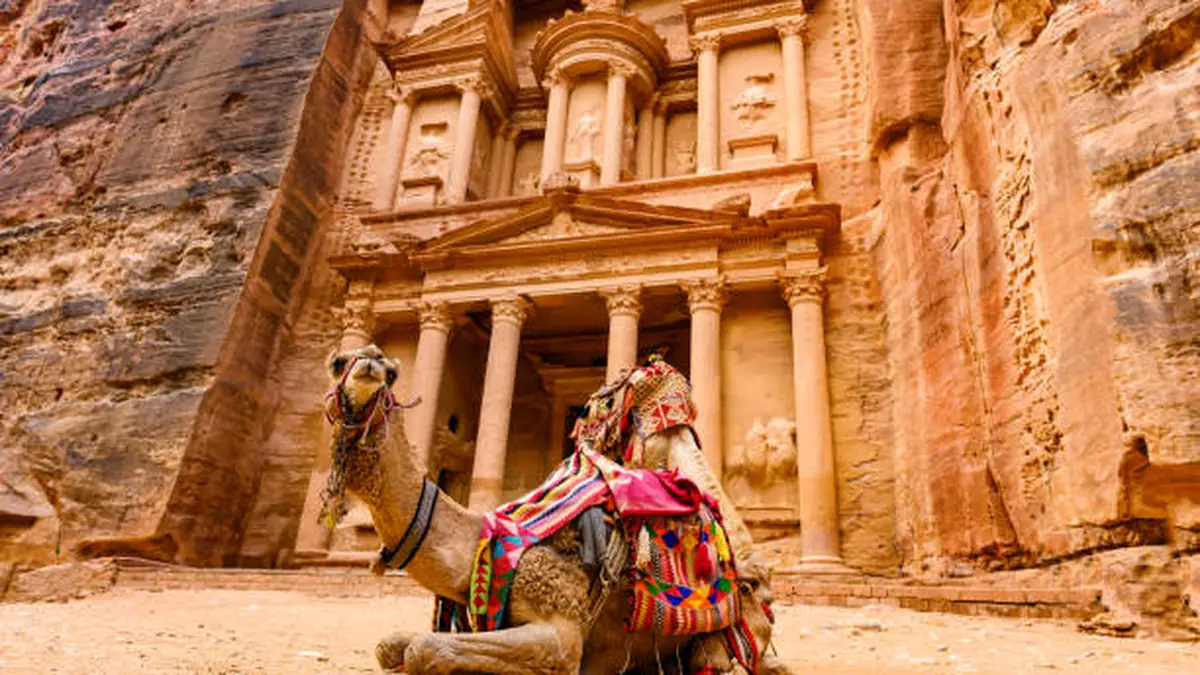
This is what the whole trip is built around, and it deserves two full days if your schedule allows it. Enter through the Siq, a narrow sandstone canyon that opens suddenly onto the Treasury (Al-Khazneh) — carved by the Nabataeans roughly two thousand years ago and still the single most photographed structure in the country.
Arrive at opening (6–7 AM) on your first morning if you want the Treasury without a wall of tour groups in the frame. Spend day one on the front section — the Street of Facades, the Roman Theater inside the park, and the Royal Tombs. Save the Monastery (Ad Deir) climb for day two: it’s roughly 800 steps and takes 45 minutes uphill, but the payoff view is worth doing before the midday heat sets in.
If your visit falls on a Monday, Wednesday, or Thursday, Petra by Night is worth the separate ticket (it isn’t included in the Jordan Pass) — candlelit paths through the Siq leading to a Bedouin music performance in front of the illuminated Treasury.
Day 5: Wadi Rum
Roughly a two-hour drive from Petra, Wadi Rum trades ancient ruins for raw desert scenery — the same red-rock valleys used as a stand-in for Mars in several films. Book a half- or full-day 4×4 jeep tour with a Bedouin guide, who’ll take you through spots like Khazali Canyon’s ancient rock carvings, Lawrence’s Spring, and the wind-carved rock bridges scattered across the valley.
Stay the night in a Bedouin camp rather than day-tripping through. Dinner is typically a zarb — meat and vegetables slow-cooked underground — and the stargazing here, with almost zero light pollution, is one of the most-repeated highlights across every trip report I’ve read.
Day 6: Dead Sea and Madaba
Roughly an hour from Amman and about three hours from Petra, the Dead Sea sits 423 meters below sea level, the lowest point on dry land, with salinity around 34% — high enough that floating takes no effort at all. A few practical notes competitors gloss over: skip shaving for a day beforehand (the salt stings broken skin badly), bring water shoes for the crystallized shore, and book a resort with freshwater showers rather than a public beach if you want to rinse off comfortably afterward.
If you have a spare few hours, Ma’in Hot Springs, about 30 minutes away, adds naturally heated mineral pools (roughly 45–60°C) fed straight from volcanic rock underground — a nice contrast to the Dead Sea’s still, salty water.
Day 7: Aqaba or Amman Departure
Most itineraries loop back to Amman for the flight home, but if diving or beach time appeals, it’s just as easy to add a night in Aqaba on the Red Sea and fly out from there instead. Note that public beaches in Jordan have modesty expectations for swimwear; organized beach clubs like Berenice Beach Club are the more comfortable option for visitors unfamiliar with local norms.
Getting Around Jordan: Self-Drive, Driver, or Bus?
Self-driving is the most flexible option and genuinely good value — roads between major sites are well-signed and generally in good condition, aside from some winding sections on the King’s Highway. Hiring a private driver costs more but removes the stress of desert driving and border-area checkpoints, and it’s the better call if this is your first Middle East road trip. The JETT bus connects Amman, Petra, and Aqaba on a fixed schedule and is by far the cheapest option, but it strips out flexibility for stops like Kerak Castle or Wadi Mujib along the way.
What a Week in Jordan Really Costs
Budgets vary wildly by hotel category, but a realistic mid-range breakdown for one traveler over 7 days looks roughly like this:
| Category | Estimated Cost (USD) |
|---|---|
| Jordan Pass (Explorer, 2-day Petra) | ~$106 |
| Mid-range accommodation (6 nights) | $350–600 |
| Wadi Rum jeep tour + overnight camp | $60–100 |
| Car rental (7 days) or driver | $150–400 |
| Food | $150–250 |
| Petra by Night ticket (optional) | ~$17 |
| Miscellaneous (Ma’in Hot Springs, tips, snacks) | $50–100 |
Most travelers land somewhere between $900 and $1,600 for a week, excluding international flights.
Adjusting the Itinerary: 5, 10, or 14 Days
5 days: Cut Amman down to a single afternoon, combine Madaba and Mount Nebo into one quick stop, and drop the second Wadi Rum night.
10 days: Add Dana Biosphere Reserve for a genuinely different, quieter side of Jordan, extend Petra to three days with the Jordan Expert pass, and give Aqaba two full nights for diving.
14 days: Everything above, plus Kerak Castle and Shobak Castle along the King’s Highway, and a slower, more scenic drive rather than the highway route between stops.
Quick Takeaway: Every extra day should go to Petra, Dana, or Aqaba before it goes to Amman. That’s where the actual return on your time is.
What to Pack and What to Know Before You Go
- Footwear: comfortable walking shoes handle 90% of the trip; you don’t need serious hiking boots unless you’re doing longer Dana or Wadi Rum treks.
- Modesty: Jordan is conservative but tourist-friendly; cover shoulders and knees at religious sites and in smaller towns, and use organized beach clubs rather than public beaches for swimwear.
- Money: carry Jordanian Dinar (JD) in cash for smaller vendors and rural stops; card payments at bigger hotels and the Petra Visitor Center often carry a small surcharge.
- Connectivity: a local SIM (Zain, Orange, or Umniah) is cheap and easy to pick up at the airport, and coverage is solid even in Wadi Rum near the main camps.
- Solo travelers, particularly women: Jordan is widely regarded as one of the safer countries in the region for solo travel, and Bedouin-run tours are generally respectful and used to independent travelers — but stick to organized beach areas and avoid unlit desert walks alone at night.
Jordan rewards a loop, not a checklist. Book the Jordan Pass before you fly, give Petra the two days it deserves, and don’t let Amman eat time that Wadi Rum or Dana would use better.
For more destination guides and trip-planning tips, explore our full travel guide collection.
FAQ Section
How many days do you need in Jordan?
Seven days covers Amman, Petra, Wadi Rum, and the Dead Sea comfortably without rushing. Four days works if you’re only after Petra and Wadi Rum, while 10–14 days lets you add Dana Biosphere Reserve, Aqaba, and the King’s Highway castles.
Is the Jordan Pass worth it?
Yes, for almost anyone staying three or more nights. It bundles the Petra ticket with the visa fee and 40+ other attractions, typically saving over $100 compared to paying separately — but it must be bought online before you arrive.
What is the best time to visit Jordan?
March–May and September–November offer the mildest weather for hiking Petra and touring Wadi Rum. Summer is very hot; November through January brings the heaviest rain, which has occasionally flooded parts of Petra.
Can you visit Jordan without renting a car?
Yes. The JETT bus connects Amman, Petra, and Aqaba affordably, and private drivers or organized tours cover the rest. You’ll lose some flexibility for smaller stops like Kerak Castle or Wadi Mujib along the way.
Is Jordan safe to travel to?
Jordan is widely considered one of the safer, more stable countries in the Middle East for tourism, with a well-developed tourism infrastructure around Petra, Wadi Rum, and the Dead Sea. Standard travel precautions apply, as anywhere.
How much does a week in Jordan cost?
A realistic mid-range budget for one traveler runs roughly $900–1,600 for seven days, covering the Jordan Pass, accommodation, a Wadi Rum tour, transport, and food — not including international flights.
Do you need a visa for Jordan?
Most nationalities can get a visa on arrival for 40 JD, which is waived automatically if you buy the Jordan Pass in advance and stay at least two nights (three days).
What shouldn’t you miss in Jordan?
Petra’s Treasury and Monastery, an overnight stay (not just a day trip) in a Wadi Rum Bedouin camp, and floating in the Dead Sea are the three experiences nearly every returning traveler names as non-negotiable.