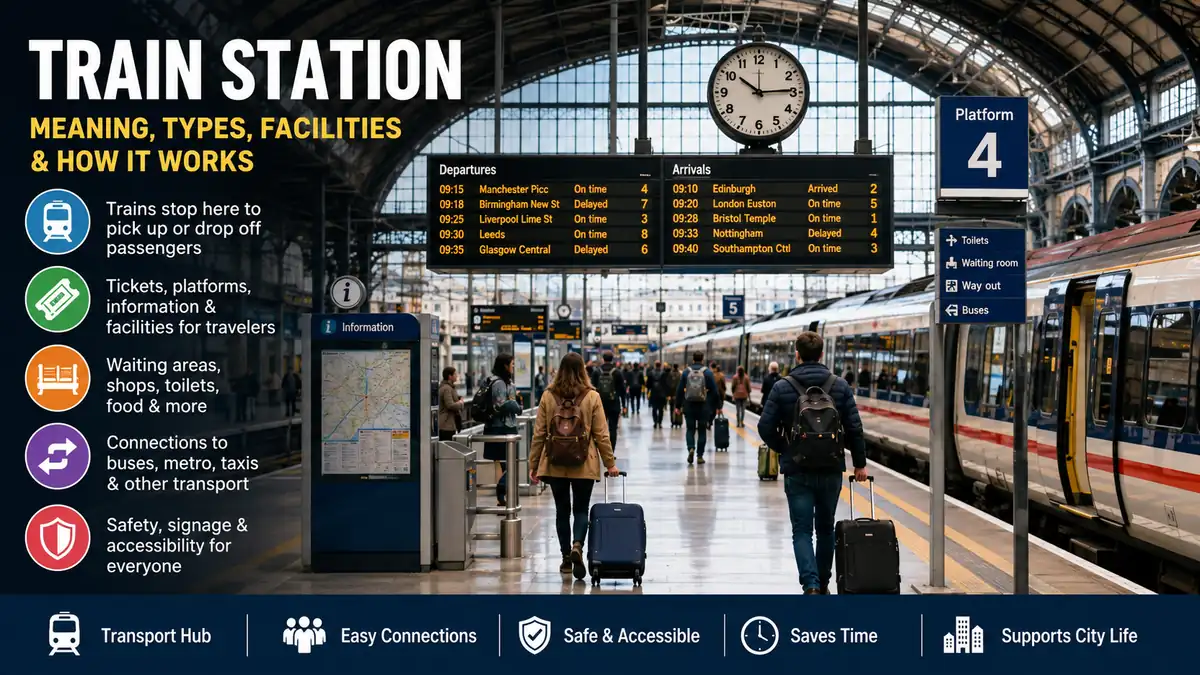
A train station can feel simple at first glance: trains arrive, passengers get on or off, and trains leave again. Behind that everyday experience, however, is a carefully organized transport facility that coordinates tracks, platforms, tickets, passenger information, safety, transfers, accessibility, and sometimes freight.
A train station is a railway facility where trains stop to pick up or drop off passengers, goods, or both. Most passenger stations include tracks and platforms, while larger stations may also provide ticket offices, waiting rooms, information displays, toilets, shops, baggage services, parking, and connections to buses, trams, metros, or taxis.
Understanding how stations work makes rail travel easier, especially when you are using an unfamiliar network, changing trains, or navigating a large city terminal.
What Is a Train Station?
A train station is a designated point on a railway network where trains can stop for passengers or freight. Cambridge defines a railway station simply as a place where trains stop so people can get on or off, while broader railway definitions include stations that handle goods as well as passengers.
A typical station has several basic components:
- Railway tracks used by arriving, departing, or passing trains
- Platforms where passengers wait and board
- Signs showing platform numbers, exits, and connections
- Timetables or electronic departure and arrival boards
- Ticketing facilities at many locations
- Waiting or sheltered areas
- Access routes such as stairs, ramps, lifts, bridges, or subways
Larger stations function as transport hubs rather than simple boarding points. They may connect national rail services with commuter trains, metro systems, buses, trams, taxis, bicycles, and pedestrian networks.
The terminology varies by country. Train station is widely used in American English, while railway station is traditional in British and Commonwealth English. Railroad station and train depot are also used in North America.
Train station vs railway station
For ordinary passenger travel, there is usually no practical difference between a train station and a railway station.
The distinction is mainly linguistic:
| Term | Common Usage | Basic Meaning |
|---|---|---|
| Train station | Especially common in the United States | Place where trains stop |
| Railway station | Common in Britain and many Commonwealth countries | Same basic facility |
| Railroad station | Mainly North American | Alternative term for a train station |
| Train depot | Used in parts of North America | Station or railway facility |
| Halt | Usually a small stopping point | Limited facilities compared with a full station |
| Terminal/terminus | End point or major passenger facility | Often where services begin or end |
Cambridge specifically identifies railway station as the British term and railroad station as a U.S. equivalent.
How Does a Train Station Work?
A train station brings passengers and trains together while keeping train movements separated and controlled.
Before a train reaches the station, railway signaling and operating systems determine whether the correct track is available. The train approaches the designated platform, stops at an appropriate position, passengers leave, new passengers board, and the train departs when operational conditions allow.
For travelers, the process generally looks like this:
- Check the train and departure time. Use a ticket, timetable, mobile app, information board, or station display.
- Find the correct platform. Platform assignments may be printed in advance or announced shortly before departure.
- Follow station signs. Large stations may require walking through halls, tunnels, footbridges, or different levels.
- Wait behind the platform safety boundary. Give arriving trains and exiting passengers space.
- Check the train before boarding. Confirm the destination, service number, route, or carriage information.
- Board when permitted. Let passengers leave first where possible.
- Keep the ticket available. Tickets may be checked at a barrier, on the platform, or on the train.
At a small rural stop, this entire process may involve little more than a sign, a basic platform, and a shelter. At a major city station, hundreds of train and passenger movements can take place across numerous platforms.
Why trains use different platforms
Platforms help separate train services and passenger flows. A station serving several routes may assign platforms according to direction, destination, train type, or operational requirements.
Platform assignments are not always permanent. Railway operators may change them because of delays, maintenance, track congestion, disruptions, or another train occupying the planned track.
That is why checking the departure board again shortly before boarding is a useful habit.
Main Parts of a Train Station
Although station designs vary enormously, several elements appear repeatedly across railway systems.
Railway tracks
Tracks guide trains through or into the station. A small station may have only one track, while a major terminal can contain many.
Stations located on single-track railway lines may include additional track arrangements that allow trains traveling in opposite directions to pass one another.
Platforms
A platform is the raised or designated area beside a railway track where passengers board and leave trains.
Common arrangements include side platforms, positioned along the outer sides of tracks, and island platforms, positioned between tracks so passengers can use either side.
Passengers should always verify the platform number rather than assuming a train will depart from the same location every day.
Concourse
The concourse is the main passenger circulation area found in many medium and large stations. It may contain ticket machines, information boards, shops, seating, entrances, exits, and access routes to platforms.
Major termini sometimes have enormous concourses serving as the central organizing space for the entire station.
Ticket gates and barriers
Some rail networks use automated gates that open after a passenger inserts, scans, or taps a valid ticket, smart card, or digital travel credential.
Other systems operate without physical barriers and rely on ticket inspections.
Footbridges, tunnels, stairs, ramps, and lifts
Passengers often need to cross railway tracks safely to reach another platform.
Modern stations commonly use pedestrian bridges, underpasses, lifts, ramps, escalators, or controlled crossings rather than allowing travelers to walk directly across active tracks.
Train Station Facilities You May Find
Facilities depend heavily on station size, passenger volume, location, and the railway operator.
A small station may provide little more than a platform, sign, shelter, timetable, and ticket machine. Larger stations can resemble airports or shopping centers.
Common facilities include ticket counters, automated ticket machines, toilets, waiting rooms, baggage facilities, departure and arrival displays, shops, restaurants, taxi ranks, bus bays, and car parks.
Ticket office and ticket machines
A staffed ticket office allows passengers to purchase tickets and request journey information.
Self-service machines may offer:
- Single and return tickets
- Seat reservations
- Ticket collection
- Fare information
- Travel-card services
Increasingly, passengers also use mobile tickets or contactless payment, although the systems available depend on the country and operator.
Departure and arrival boards
Electronic displays are among the most useful parts of a modern station.
They commonly show the destination, departure or arrival time, platform, service status, calling points, delays, cancellations, and other operating information.
When information on an old printed schedule conflicts with a live station display, passengers should normally follow current operator information and announcements.
Waiting rooms and shelters
Waiting facilities range from simple covered shelters to heated or air-conditioned lounges.
Busy stations may have separate waiting areas for long-distance services or ticket classes.
Toilets, shops, and food
Major stations frequently provide toilets, cafés, restaurants, convenience stores, pharmacies, cash machines, and retail outlets. Smaller stations may have none of these.
Passengers taking a long journey should check available facilities before relying on the station for food, luggage storage, or other services.
Baggage services
Depending on the railway system and station, passengers may find luggage lockers, staffed baggage storage, baggage carts, lost-property offices, or checked-baggage services.
These facilities are far from universal.
Parking and onward transport
Stations frequently connect rail travel with other forms of transportation.
A station may include or sit beside:
- Bus stops
- Metro or subway entrances
- Tram stops
- Taxi ranks
- Ride-hailing pickup zones
- Bicycle parking
- Car parks
- Passenger drop-off areas
This role is especially important at major railway hubs where travelers transfer between local and long-distance transport.
Quick takeaway: Never assume every station has toilets, ticket staff, luggage storage, food, parking, or step-free access. Check the specific station before traveling when one of those facilities is essential.
Different Types of Train Station
Not every train station serves the same purpose. Railway networks use several station layouts depending on geography, passenger demand, route structure, and operational needs.
Through station
At a through station, railway tracks continue beyond the station in both directions.
A train arrives, stops, and normally continues along the same route. This is one of the most common station designs.
Terminal or terminus station
A terminus sits at the end of a railway route or contains tracks that end inside the station.
Trains arrive and later leave in the opposite direction, although the locomotive or operating procedure used to achieve this varies with the train type.
Large city termini often handle substantial numbers of regional and long-distance passengers.
Junction station
A junction station sits where railway routes meet, separate, or cross.
Passengers often use these locations to transfer from one line or service to another.
Interchange station
An interchange focuses on connections between services.
It may connect two railway lines or combine heavy rail with metro, tram, bus, or other public transportation.
An interchange can also be a junction or terminal; these descriptions refer to different aspects of how the station functions.
Underground station
Underground stations have platforms below ground level and are common on metro systems and railway routes passing beneath dense urban areas.
Entrances, ticket halls, escalators, lifts, ventilation systems, and emergency exits become particularly important in underground designs.
Elevated station
Elevated stations place tracks and platforms above street level.
They can reduce conflicts between trains and road traffic while allowing streets and pedestrian routes to continue underneath the railway.
Halt or stop
A halt generally refers to a simpler stopping point with fewer facilities than a conventional station.
Some may be unstaffed and consist mainly of a platform and basic passenger information. The distinction between a station and halt varies between railway networks.
Request or flag stop
At certain lightly used stops, trains may stop only when a passenger requests it or when somebody is waiting to board.
Such systems are more common on rural or low-frequency routes than on busy urban railways.
Passenger Station vs Freight Station
Passenger stations are designed primarily for people. Freight or goods stations are designed for cargo.
A passenger train station therefore emphasizes platforms, waiting areas, ticketing, accessibility, passenger information, and connections to other transportation.
A freight terminal may instead contain loading areas, warehouses, cranes, container equipment, sidings, classification or marshalling facilities, and road connections for trucks.
Historically, passenger and freight operations were often located together. As railway systems developed, major freight handling increasingly moved toward specialized terminals.
Freight stations may also be described as goods stations, freight terminals, container terminals, or transshipment facilities depending on their role.
Train Station Signs and Information Explained
A large station becomes much easier to navigate once you know what information matters.
Departures
The departures board shows trains expected to leave the station.
Look for your departure time and destination first. Then confirm the service and platform.
Arrivals
The arrivals board shows trains coming into the station.
This is particularly useful when meeting someone or checking whether an incoming service is delayed.
Platform number
The platform number tells you where the train should arrive or depart.
Some stations have sections such as 4A and 4B, allowing two shorter trains to use different portions of a long platform. Pay attention to the complete designation.
Calling points
Calling points are stations where the train is scheduled to stop before reaching its final destination.
Checking these is useful because the destination displayed on the front of a train may not be the station where you plan to leave.
Delayed
A delayed service is expected to operate later than scheduled.
The estimated departure time may change as railway staff receive new information.
Cancelled
A cancelled train will not operate as planned.
Passengers should check official information for alternative services, ticket validity, or replacement transport.
Final destination
Departure boards often identify trains by their final destination rather than by every intermediate stop.
This is one of the most common sources of confusion for first-time rail passengers. If your city is not displayed prominently, check the list of calling points.
How Early Should You Arrive at a Train Station?
There is no universal arrival time because railway systems differ.
For an ordinary domestic journey from a familiar station, passengers often need far less preparation time than they would at an airport. However, extra time is sensible when using a large station, collecting a ticket, checking luggage, traveling internationally, requiring accessibility assistance, or visiting the station for the first time.
The key question is not simply how early you arrive. It is how many steps must be completed before boarding.
Allow more time when you need to:
- Find an unfamiliar platform
- Purchase or collect tickets
- Pass through security or border controls
- Navigate a large terminal
- Transfer with heavy luggage
- Arrange mobility assistance
- Travel with children
- Locate a particular carriage or reserved seat
For services with compulsory check-in or boarding deadlines, follow the railway operator’s stated time rather than a general rule.
How to Find the Right Train and Platform
Mistaking a platform or boarding the wrong service is easier than many first-time passengers expect, especially at a large station where several trains may leave within minutes.
Use three pieces of information together: departure time, destination, and train or service number where one is provided.
Then check the calling points.
Suppose your train goes from City A to City D but you are traveling only to City C. The departure board may display City D, not City C, because City D is the final destination.
If uncertain, compare your ticket with the live departure board or ask railway staff before boarding.
The practical rule is simple: never identify a train from the platform number alone. Platforms can change.
Train Station Accessibility
Accessible railway travel depends on much more than simply having a ramp.
Useful accessibility features can include step-free routes, lifts, ramps, accessible toilets, tactile paving, audible announcements, visual information screens, induction loops, wheelchair boarding equipment, accessible ticket counters, marked assistance points, and staff support.
Availability varies sharply between stations.
Older stations present particular challenges because they may have narrow platforms, historic structures, stairs, or layouts that were designed long before modern accessibility standards.
Travelers who require step-free access or boarding assistance should verify the specific origin, interchange, and destination stations rather than assuming the whole route is accessible.
Train Station Safety
Train stations are generally designed to separate passengers from moving trains, but railway environments still require attention.
Platform edges deserve particular care. Trains can approach quickly, and some services pass through stations without stopping.
Stay behind the marked safety line until the train has stopped and boarding is allowed. Do not retrieve objects that fall onto the railway track yourself.
Other sensible precautions include keeping children close, using designated bridges or underpasses when changing platforms, paying attention to announcements, avoiding blocked emergency routes, and keeping luggage out of busy walking areas.
Escalators and stairs also cause problems when passengers rush with heavy bags. Lifts are often the safer option when luggage is difficult to handle.
At busy stations, keep valuables secure and remain aware of your belongings.
What Is the Difference Between a Train Station and a Train Stop?
The terms overlap, but a train station usually suggests a more established railway facility.
A train stop, halt, or flag stop may have fewer facilities. Some consist only of a platform or waiting area, and very basic stops may have little more than signage.
A full station is more likely to provide ticketing, passenger information, shelters, waiting areas, staff, or interchange facilities.
There is no single worldwide technical definition that separates every station from every halt, so terminology should be understood within the railway system being used.
Why Train Stations Matter to Cities
A train station does more than provide access to trains. Major stations can become central nodes in a city’s transportation and development.
Placing rail passengers within walking distance of offices, homes, shops, hotels, buses, metros, and public spaces can make journeys possible without requiring a private car.
Stations can also influence the neighborhoods around them. Commercial activity often develops near busy transport hubs because thousands of people move through the area every day.
Historically, railway stations were sometimes monumental public buildings intended to represent the importance of both the railway company and the city. Nineteenth-century stations used architectural styles ranging from highly decorative structures to enormous iron-and-glass train sheds. Modern high-speed stations often use much more functional designs resembling airport terminals.
Railway architecture therefore tells part of the story of how transportation itself has changed.
A Brief History of the Train Station
Stations developed alongside passenger railways in the nineteenth century.
One early milestone was The Mount in Swansea, Wales, associated with passenger service on the Swansea and Mumbles Railway beginning in 1807 when trains were horse-drawn. Heighington station on the Stockton and Darlington Railway later served early locomotive-powered railway operations. In the United States, Baltimore’s Mount Clare station was associated with early Baltimore and Ohio Railroad passenger service in 1830.
As railway networks expanded, stations became gateways to towns and cities.
Large stations acquired booking halls, waiting rooms, restaurants, luggage facilities, train sheds, hotels, and substantial architectural façades.
The railway station continued evolving through the twentieth century as electric trains, suburban rail, metros, high-speed services, electronic signaling, automated ticketing, and digital passenger-information systems changed the way people traveled.
Today, newer stations may integrate conventional rail with high-speed trains, metros, trams, buses, cycling infrastructure, and pedestrian districts.
Some Remarkable Train Station Records
The scale of major stations shows how dramatically railway facilities can differ from a simple rural stop.
Shinjuku Station in Tokyo is renowned for enormous passenger traffic, while Grand Central Terminal in New York City is notable for its large number of platforms. Hubballi Junction in Karnataka, India, has also been recognized for an exceptionally long railway platform.
These records measure different things, so claims about the “largest train station in the world” can be misleading.
A station might be considered largest by land area, floor area, number of platforms, number of tracks, passenger volume, or another measurement. When comparing major stations, the metric matters.
Practical Tips for Using Any Train Station
The most effective approach is to rely on current station information rather than assumptions.
Check the live departure board when you arrive, confirm the platform again before boarding, and look at the train’s destination and calling points. Keep your ticket or travel pass accessible until the journey is complete.
When changing trains, find the next platform before stopping for food or shopping. At complex terminals, what looks like a short connection on a timetable can involve several minutes of walking.
If you have heavy luggage, limited mobility, or young children, identify lifts and accessible routes early instead of following the fastest-looking staircase.
Most importantly, do not panic when a platform changes. Platform changes are a routine part of railway operations. Read the updated information carefully and follow official signs or staff instructions.
The Train Station in Modern Rail Travel
The modern train station is simultaneously a boarding point, transport interchange, passenger-information center, and piece of railway infrastructure.
Some stations are little more than platforms serving local communities. Others are vast terminals connecting intercity trains, commuter rail, high-speed services, metros, trams, buses, taxis, bicycles, and pedestrians.
Despite those differences, every station serves the same fundamental purpose: bringing trains, passengers, and railway routes together in an organized place.
For travelers, understanding platforms, departure boards, calling points, station facilities, accessibility, and basic safety removes much of the uncertainty from rail travel. Before your next journey, check the specific station layout and live service information, then confirm your train and platform once you arrive.