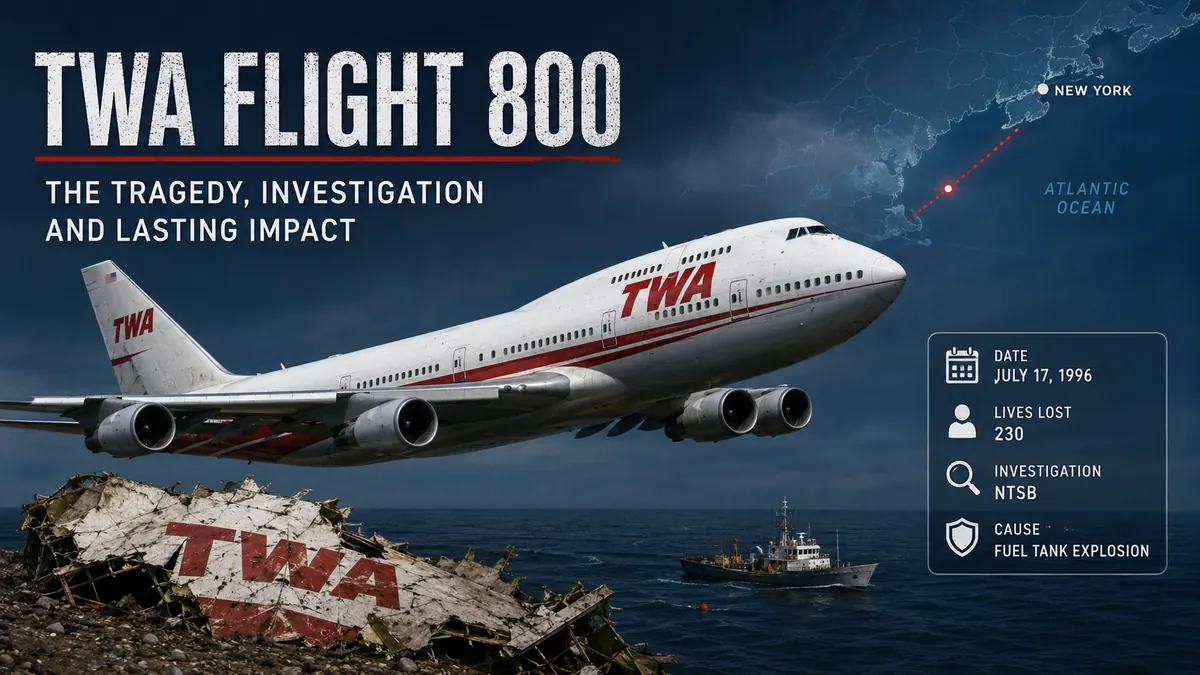
Twelve minutes after leaving New York for Paris, a Boeing 747 carrying 230 people broke apart over the Atlantic Ocean. The disaster triggered an enormous recovery operation, an FBI criminal inquiry, years of engineering tests, intense debate over eyewitness accounts, and changes that reshaped fuel-tank safety on commercial aircraft.
twa flight 800 was a Trans World Airlines Boeing 747-131 that crashed near East Moriches, New York, on July 17, 1996, killing all 230 people aboard. The National Transportation Safety Board concluded that an explosion in the center wing fuel tank caused the aircraft to break apart after flammable fuel-air vapor was ignited, most likely by an electrical fault.
The tragedy remains significant not simply because of the death toll. It changed how investigators handle major aviation disasters, how airlines and manufacturers think about fuel-tank hazards, and how federal agencies coordinate when an aircraft accident might also be a crime.
What Was twa flight 800?
TWA Flight 800 was a regularly scheduled international passenger service operated by Trans World Airlines, commonly known as TWA.
On the evening of July 17, 1996, the aircraft was scheduled to fly from John F. Kennedy International Airport in New York to Charles de Gaulle Airport in Paris.
The airplane was a Boeing 747-131 with registration N93119. According to the NTSB, the flight was operating under Part 121 rules and departed JFK at approximately 8:19 p.m. Eastern Daylight Time.
The basic facts were:
| Detail | Information |
|---|---|
| Airline | Trans World Airlines (TWA) |
| Flight | TWA Flight 800 |
| Date | July 17, 1996 |
| Aircraft | Boeing 747-131 |
| Registration | N93119 |
| Departure | John F. Kennedy International Airport |
| Destination | Charles de Gaulle Airport, Paris |
| Crash area | Atlantic Ocean near East Moriches, New York |
| Passengers | 212 |
| Crew | 18 |
| Total aboard | 230 |
| Survivors | 0 |
The crew consisted of two pilots, two flight engineers and 14 flight attendants. All 212 passengers and 18 crew members died.
How long was TWA Flight 800 in the air?
Only about 12 minutes passed between departure and the catastrophic breakup.
The Boeing 747 departed JFK at approximately 8:19 p.m. At about 8:31 p.m., while climbing away from the New York area, it suffered the explosion and subsequent structural breakup.
There was no long sequence of obvious mechanical trouble beforehand. The NTSB later reported that flight data recorder and cockpit voice recorder information did not reveal a pre-event problem that explained what was about to happen.
That suddenness became one of the central challenges of the investigation.
What Happened to twa flight 800?
After leaving JFK, Flight 800 climbed eastward toward the Atlantic.
The weather was not considered a major factor. The NTSB reported visual meteorological conditions, with the aircraft operating on an instrument flight rules flight plan.
Then catastrophe struck.
An explosion occurred in the aircraft’s center wing fuel tank, or CWT. The resulting damage led to a rapid structural breakup of the Boeing 747.
Burning wreckage fell into the Atlantic south of Long Island.
Because the accident happened after dark and produced a large fireball, people on land, boats and aircraft reported seeing unusual lights, streaks or flames in the sky. Those eyewitness accounts quickly became important to investigators—and later became a major source of controversy.
Where did TWA Flight 800 crash?
The aircraft crashed in the Atlantic Ocean near East Moriches on Long Island, New York.
The wreckage field was underwater, dramatically complicating the investigation. Search teams had to locate, recover, identify and catalogue thousands of pieces from the ocean floor.
The FBI has said its New York scuba team participated in searching roughly 40 square miles of ocean floor. Ultimately, more than 95 percent of the aircraft was recovered.
That unusually extensive recovery gave investigators a remarkable amount of physical evidence.
How Many People Died on TWA Flight 800?
All 230 people aboard died.
There were:
- 212 passengers
- 18 crew members
- 230 fatalities
- No survivors
The loss was felt internationally because the passenger list included people from different countries and communities.
One community was hit especially hard.
The Montoursville students and chaperones
Among those aboard were 16 students and five adult chaperones associated with the Montoursville Area High School French Club in Pennsylvania.
They were traveling to France.
The loss of those 21 people had an extraordinary impact on the relatively small Montoursville community. Thirty years later, memorial events continued to honor them and the other people killed in the disaster.
The identification process following the crash was itself a huge undertaking. More than a year after the disaster, authorities completed identification of all 230 victims, using techniques that included DNA comparison.
Why Did Investigators Initially Consider Terrorism?
The circumstances immediately raised fears of an attack.
A large passenger jet had apparently exploded in flight. Witnesses described unusual streaks of light. The United States was also confronting serious concerns about international terrorism during the 1990s.
Investigators therefore could not simply assume they were dealing with a conventional mechanical accident.
The case effectively developed along two tracks.
The Federal Bureau of Investigation (FBI) examined whether a criminal or terrorist act had occurred, while the National Transportation Safety Board (NTSB) investigated the aviation accident and its technical causes.
The FAA describes the investigation as unprecedented because the possibility of a criminal act meant investigators had to preserve chain-of-custody procedures while also performing normal aircraft-accident wreckage recovery and analysis.
Bomb and missile possibilities
Investigators examined possibilities including:
- An onboard bomb
- A missile strike
- A mechanical or electrical failure
- A fuel-tank explosion originating within the aircraft
Recovered components were examined for signs that could support a hostile act.
According to the FAA’s account of the investigation, investigators did not find bomb or missile fragments, explosive residue, or other physical evidence establishing that an attack caused the crash.
The FBI’s criminal investigation ultimately found no evidence supporting a terrorist attack.
The Massive Investigation Into twa flight 800
Few aviation investigations have involved this combination of criminal inquiry, underwater recovery, wreckage reconstruction, eyewitness analysis and experimental engineering.
The NTSB investigation continued for approximately four years.
Its docket remains enormous. The NTSB’s public docket lists hundreds of items connected with investigation number DCA96MA070.
Recovering the Boeing 747
Divers and recovery crews retrieved wreckage from the Atlantic.
Every useful component could potentially answer a question:
Was there evidence of an explosive device?
Did something penetrate the aircraft from outside?
Where did the structural breakup begin?
Which pieces showed fire damage?
What electrical systems could have supplied sufficient energy to ignite fuel vapor?
The extraordinary recovery rate allowed investigators to reconstruct a substantial portion of the Boeing 747.
Reconstructing the aircraft
The recovered structure was carefully arranged and reconstructed.
This was much more than a dramatic visual display. The location, damage pattern and relationship between recovered pieces helped investigators establish how the aircraft came apart.
The reconstruction later became a training resource for accident investigators.
It was never intended as a public museum exhibit. The NTSB eventually announced that it would decommission the reconstruction after using it for nearly two decades as an investigative training aid.
What Did the NTSB Determine Caused twa flight 800?
The NTSB issued its final accident report in 2000.
Its probable-cause finding centered on the center wing fuel tank.
The Board concluded that Flight 800 was destroyed by an explosion of the flammable fuel-air mixture inside that tank.
The crucial distinction is that investigators were confident about where the initiating explosion occurred, but they could not establish the precise ignition source with absolute certainty.
According to the NTSB, the most likely explanation was a short circuit outside the center wing tank that allowed excessive voltage to enter through wiring associated with the fuel quantity indication system.
The center wing fuel tank explained
Large commercial aircraft contain multiple fuel tanks.
The center wing tank on this Boeing 747 was located in an area affected by heat sources beneath it.
A fuel tank is not necessarily filled completely with liquid fuel. The space above the liquid can contain a mixture of fuel vapor and air.
Under the right temperature and concentration conditions, that vapor can become flammable.
This matters because the hazard requires more than fuel alone. A combustible mixture also needs sufficient ignition energy.
Investigators therefore had to answer two separate questions:
Why was the tank’s vapor flammable?
And:
What ignited it?
Why temperature mattered
Heat can increase fuel vapor generation.
The NTSB identified the placement of heat sources beneath the center wing tank—and the lack of a system to adequately reduce tank heating or make the vapor nonflammable—as a contributing factor.
This finding would eventually have consequences far beyond a single Boeing 747.
What Ignited the Fuel Tank?
This remains one of the most misunderstood aspects of the official finding.
The NTSB did not claim that investigators identified one damaged wire and proved beyond doubt that it produced the initiating spark.
Instead, investigators evaluated possible ignition mechanisms.
The probable-cause report states that the ignition energy source could not be determined with certainty. Among the possibilities evaluated, the most likely involved excessive voltage entering the center wing tank through wiring connected with the fuel quantity indication system.
The FAA describes a related scenario involving a latent fault in a fuel quantity indicating system component combined with a short circuit or other fault outside the tank, potentially producing enough electrical energy to ignite the vapor.
That distinction is essential:
Established official conclusion: the center wing tank’s flammable fuel-air mixture exploded.
Most likely ignition mechanism: an electrical fault involving the fuel quantity indication system wiring.
Not established with certainty: the exact physical ignition source.
Was TWA Flight 800 Shot Down by a Missile?
The missile theory is the most persistent alternative explanation for the disaster.
It arose partly because numerous eyewitnesses described seeing a streak or ascending light in the sky.
That testimony deserved investigation, and investigators did examine it.
But eyewitness evidence had to be compared with radar information, wreckage patterns, aircraft performance, physical evidence and the timing of the breakup.
Why eyewitness reports became controversial
A person watching an unexpected event at night has no flight-data display showing exactly what happened first.
A witness may see:
- a moving light,
- an initial flash,
- burning aircraft,
- falling wreckage,
- a larger secondary fireball,
- or some combination of those events.
Determining the sequence afterward is difficult.
Investigators examined whether witnesses could have been observing the crippled aircraft or burning wreckage rather than an object approaching the airplane.
The CIA participated in analyzing witness observations and developed a visual explanation of how the accident sequence could account for reports interpreted as a missile. In testimony later published by the U.S. government, the analysis stated that it found no physical or other evidence establishing that a missile brought down Flight 800.
What did investigators find in the wreckage?
The physical evidence became critical.
Investigators searched recovered components for indications expected from a bomb or missile attack, including explosive residue and characteristic fragmentation.
The FAA’s official accident summary states that no bomb or missile debris fragments, explosive residue, or other evidence of a hostile act were found.
That is why the official conclusion remains a fuel-tank explosion rather than a missile strike.
Why Do Alternative Theories Still Exist?
Large disasters often generate competing explanations, particularly when some element of the official causal chain cannot be established with complete certainty.
For Flight 800, three factors have kept debate alive.
First, eyewitness descriptions of streaks of light were dramatic.
Second, the exact ignition source inside the official accident sequence was never conclusively identified.
Third, the simultaneous involvement of agencies including the FBI, NTSB and CIA produced continuing suspicion among critics who disagreed with the government’s interpretation of evidence.
None of those points, however, is equivalent to physical proof that a missile destroyed the aircraft.
The 2013 request to reopen the case
Debate became prominent again in 2013 when a group that included former participants in the investigation petitioned the NTSB to reconsider its findings.
The petitioners argued that evidence supported an external explosion and challenged aspects of the original analysis.
The NTSB reviewed their submission and held a listening session in January 2014.
On July 2, 2014, the Board denied the petition for reconsideration.
As a result, the NTSB’s official probable-cause determination remained unchanged.
Why the story continues to attract attention
Public interest did not disappear with the final report.
Questions about eyewitness testimony, government records and agency involvement continue to appear in documentaries, litigation and Freedom of Information Act requests.
For example, in 2026 Judicial Watch announced litigation seeking CIA records connected with the agency’s participation in the investigation and its witness-perception analysis. That litigation represents an effort by a private organization to obtain additional records; it does not by itself alter the NTSB’s established probable-cause finding.
This distinction matters whenever reading newer claims about the disaster: a request for documents, alternative analysis or allegation is not the same thing as a new official accident finding.
What Did Investigators Learn From the Fuel-Tank Explosion?
The deepest safety lesson went beyond determining what happened to one aircraft.
Historically, aircraft fuel-tank safety relied heavily on eliminating possible ignition sources.
Flight 800 exposed a weakness in that philosophy.
Aircraft contain complex electrical and mechanical systems. Over a long service life, completely guaranteeing that no ignition source can ever develop is extremely difficult.
That led regulators toward a more layered approach:
Prevent ignition sources, but also reduce the ability of fuel-tank vapor to burn.
This shift became one of Flight 800’s most important aviation-safety legacies.
Fuel-tank inerting
One solution is known as inerting.
Instead of relying entirely on eliminating every possible spark, an inerting system reduces oxygen concentration in the tank’s vapor space.
With insufficient oxygen, the environment becomes much less capable of supporting combustion even if an ignition source appears.
The FAA conducted research involving onboard fuel-tank inerting systems, including testing on Boeing aircraft.
That represented a fundamental change in safety philosophy: control both sides of the fire equation rather than relying exclusively on preventing sparks.
How twa flight 800 Changed Aviation Safety
The consequences of the investigation eventually appeared in regulations, aircraft design practices, maintenance requirements and emergency-response procedures.
1. Fuel-tank flammability rules
In July 2008, the FAA issued its final rule on Reduction of Fuel Tank Flammability in Transport Category Airplanes.
The rule established requirements intended to substantially reduce the probability of catastrophic fuel-tank explosions.
Affected aircraft could require a Flammability Reduction Means (FRM) or an Ignition Mitigation Means (IMM), depending on the applicable requirements.
The rules affected existing and newly produced transport aircraft and strengthened the regulatory framework around fuel-tank flammability.
2. Broader examination of ignition hazards
The FAA also issued numerous airworthiness directives addressing potential fuel-system ignition hazards across aircraft types.
Its retrospective discussion of Flight 800 notes that more than 150 airworthiness directives were issued across multiple models in connection with the broader fuel-tank safety effort, reinforcing the conclusion that eliminating ignition sources alone was not an adequate safety strategy.
3. Better coordination between the FBI and NTSB
The accident demonstrated the complexity of an event that could simultaneously be an aviation accident and a potential criminal act.
Who controls the wreckage?
Who interviews witnesses?
How is evidence preserved?
When does the NTSB’s safety investigation give way to a criminal investigation?
The experience helped produce clearer cooperation between the FBI and NTSB for future cases involving possible intentional acts. The NTSB has specifically identified the resulting memorandum of understanding between the agencies as part of Flight 800’s institutional legacy.
4. Family assistance after major transportation disasters
Flight 800 also influenced how authorities and carriers support victims’ families.
The NTSB says the experience contributed to the development of its Transportation Disaster Assistance function and legislation governing airline responsibilities toward families after transportation disasters.
This is an often-overlooked part of the disaster’s legacy.
Aviation safety is not limited to preventing the next crash. It also includes how institutions respond when the worst has already happened.
What Happened to the Reconstructed TWA Flight 800 Wreckage?
For years, the reconstructed portion of the aircraft remained at the NTSB Training Center in Ashburn, Virginia.
Thousands of investigators and other transportation professionals were able to learn from it.
But there was an important restriction: the reconstruction was to be used for training, not turned into a public attraction.
In 2021, approaching the 25th anniversary of the crash, the NTSB announced that it would decommission the reconstruction. Advances such as three-dimensional scanning and drone imagery had reduced the need to maintain such a massive physical training resource.
The agency planned extensive 3-D documentation before dismantling it.
That preserved a digital historical and educational record while respecting the agreement that the wreckage would not become a public exhibit.
The TWA Flight 800 Memorial
The story is ultimately about 230 people, not simply an aircraft or engineering investigation.
The TWA Flight 800 International Memorial provides a permanent place of remembrance near the Long Island coast.
The memorial was dedicated in 2002 at Smith Point County Park.
Montoursville, Pennsylvania, has also continued to remember the 16 students and five adult chaperones lost on the flight.
Those memorials provide an important counterbalance to the technical discussion.
Fuel-air mixtures, electrical wiring, radar returns and structural reconstruction explain how investigators approached the disaster. They do not capture the human cost.
A Clear Timeline of twa flight 800
| Date | Event |
|---|---|
| July 17, 1996 | TWA Flight 800 departs JFK for Paris |
| About 8:31 p.m. | Aircraft suffers an explosion and breaks apart near Long Island |
| July 1996 onward | Massive ocean recovery and joint investigative effort begins |
| 1996–1997 | FBI and NTSB investigate mechanical failure and possible criminal causes |
| 1997 | FBI concludes its criminal investigation without evidence establishing a terrorist attack |
| August 23, 2000 | NTSB adopts final accident report |
| 2002 | TWA Flight 800 International Memorial dedicated |
| July 2008 | FAA issues major fuel-tank flammability reduction rule |
| June 2013 | Petition asks NTSB to reconsider the accident findings |
| July 2014 | NTSB denies reconsideration petition |
| 2021 | NTSB decommissions the reconstructed wreckage as a training aid |
| July 2026 | Communities mark 30 years since the disaster |
The timeline shows why Flight 800 cannot be understood as a single night in 1996. Its investigation and safety consequences extended for decades.
What Is Known—and What Remains Uncertain?
Separating established evidence from unresolved details makes the history much easier to understand.
| Question | Best-supported answer |
|---|---|
| What aircraft was involved? | Boeing 747-131, registration N93119 |
| How many people died? | 230 |
| Were there survivors? | No |
| Where did it crash? | Atlantic Ocean near East Moriches, New York |
| What caused the breakup according to the NTSB? | Explosion of the center wing fuel tank |
| What was inside the tank? | A flammable fuel-air mixture |
| What ignited it? | Exact source uncertain; an electrical fault was considered most likely |
| Did investigators examine terrorism? | Yes, extensively |
| Was physical evidence found proving a missile or bomb caused the crash? | Investigators reported no such evidence |
| Was the official finding later overturned? | No |
| Did the crash change aviation safety? | Yes, particularly fuel-tank safety and flammability reduction |
The unresolved ignition source should not be confused with an unresolved overall accident cause.
Investigators determined that the center wing fuel tank exploded. What they could not establish with certainty was the exact source of electrical or other energy that ignited the flammable mixture.
That is a narrower uncertainty than is sometimes suggested in discussions of the disaster.
Why twa flight 800 Still Matters
Three decades after the crash, twa flight 800 remains one of the defining aviation investigations of the modern era.
The tragedy killed every one of the 230 people aboard, devastated families and communities, and confronted investigators with an unusually difficult combination of underwater wreckage recovery, potential terrorism, hundreds of witness accounts and a catastrophic failure with no obvious warning.
The official investigation concluded that a flammable fuel-air mixture in the Boeing 747’s center wing fuel tank exploded, most likely after electrical energy reached the tank through fuel-system wiring. Investigators could not identify the precise ignition source with certainty, but the physical evidence did not establish a bomb or missile as the cause.
Its most lasting lesson was practical rather than theoretical: preventing every possible ignition source is not enough when an aircraft can contain a dangerously flammable environment.
That realization helped drive fuel-tank flammability reduction requirements, inerting technology, maintenance improvements and a more layered approach to aircraft safety. The investigation also changed cooperation between accident investigators and law enforcement and improved institutional support for families after transportation disasters.
For anyone researching twa flight 800 today, the most useful next step is to distinguish documented findings from later theories: start with the NTSB accident record and FAA safety lessons, then evaluate alternative claims against the physical evidence and subsequent regulatory changes.