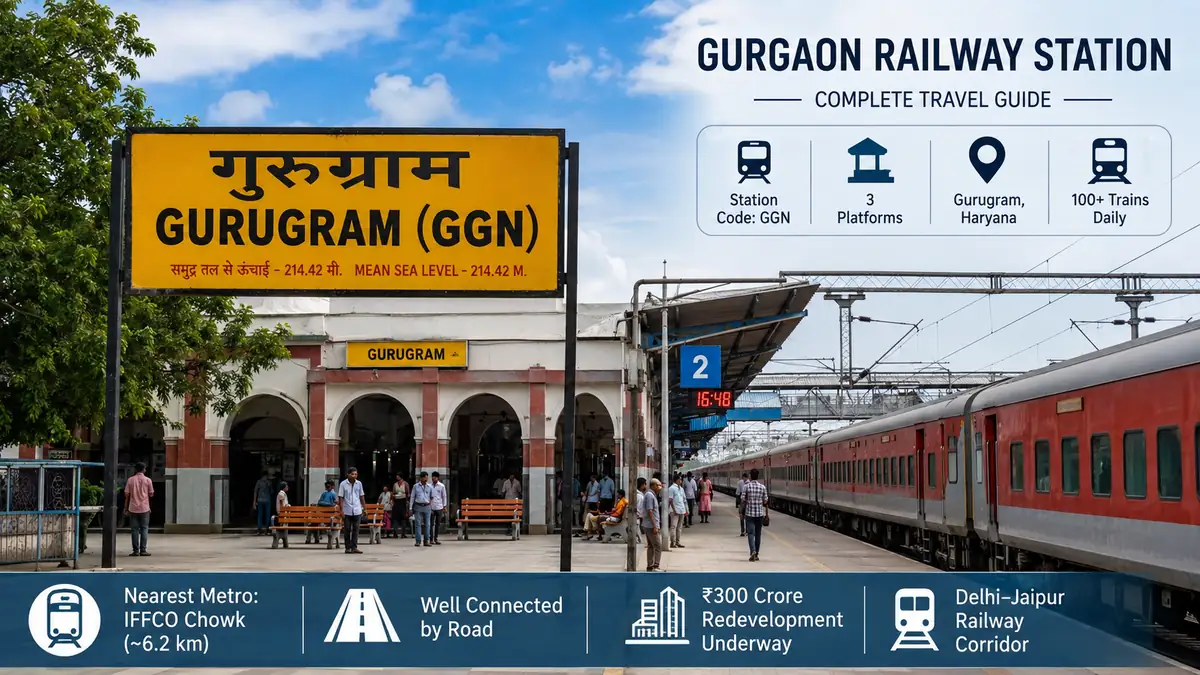
For many travelers, Gurgaon is associated with Cyber City, corporate offices and the Delhi Metro. Yet gurgaon railway station remains an important rail gateway for commuters and long-distance passengers traveling between Delhi, Gurugram, Rewari, Jaipur and destinations farther into Rajasthan and western India.
The station is officially associated with Gurugram, although Indian Railways continues to use the station code GGN, and the name Gurgaon remains common in railway searches and passenger information systems. It belongs to the Northern Railway network and the Delhi railway division.
Quick answer: gurgaon railway station is an operational Indian Railways station in Gurugram, Haryana, with station code GGN. It has three platforms and lies on the electrified Delhi–Jaipur railway corridor. More than 100 scheduled trains may call at the station, although the exact number changes with railway timetables and special services.
gurgaon railway station Overview and Station Code
The railway station serving Gurugram is known as Gurgaon railway station in many railway databases, while Gurugram is increasingly used as its local or official geographic name.
The most important detail passengers need when booking or checking a train is the station code:
| Station information | Details |
|---|---|
| Station name | Gurgaon / Gurugram |
| Station code | GGN |
| City | Gurugram, Haryana |
| Railway zone | Northern Railway |
| Railway division | Delhi |
| Station type | Regular railway station |
| Platforms | 3 |
| Railway line | Delhi–Jaipur corridor |
| Electrification | Electrified |
| Approximate elevation | 214 metres above sea level |
| Postal area | Gurugram 122001 |
Railway information sources identify GGN as Gurgaon, while station databases describe it as a three-platform station on a double electrified railway line.
This distinction matters when searching online. Entering “Gurugram railway station” may produce the same station, but GGN is the safest identifier when checking reservations, train schedules or running information.
Is Gurgaon Railway Station the Same as Gurugram Railway Station?
Yes. In normal passenger use, Gurgaon railway station and Gurugram railway station refer to the same railway station.
Gurgaon’s official city name was changed to Gurugram, but the older name remains deeply embedded in travel terminology and railway-related searches. Railway databases still commonly display the station as Gurgaon with code GGN.
Passengers therefore should not assume that Gurgaon and Gurugram are two separate stations.
Where Is gurgaon railway station Located?
gurgaon railway station is located on the older western side of Gurugram rather than in the modern business districts around Golf Course Road, MG Road or Cyber City.
Railway information sources place it on Old Railway Road, Laxman Vihar Phase II, Gurugram, Haryana 122001.
This location is useful to understand before planning a journey because many first-time visitors underestimate the distance between Gurugram’s metro-oriented commercial districts and the mainline railway station.
The station is relatively close to areas such as Laxman Vihar and the older Gurgaon city, while destinations such as IFFCO Chowk, Sector 29, MG Road, Cyber City and Millennium City Centre require onward road transport.
Nearby Railway Stations
The railway corridor around Gurgaon includes several other stations.
Basai Dhankot is roughly 4 km away, while Bijwasan is approximately 6 km away. Garhi Harsaru Junction is about 10 km from Gurgaon railway station. Delhi Cantt is farther toward Delhi.
On the Delhi–Jaipur railway route, Gurgaon effectively sits between the Delhi-side rail network and stations leading toward Rewari and Rajasthan. Wikidata identifies Bijwasan and Basai Dhankot as adjacent stations on the Delhi–Jaipur line.
gurgaon railway station Trains and Major Routes
One of the most common questions is: How many trains stop at Gurgaon railway station?
There is no permanently fixed answer because railway schedules change and special trains can be introduced or withdrawn. Current railway-information databases list well over 100 trains calling at GGN, although individual services and the total count can vary. For example, ixigo recently listed 152 trains passing through the station, while RailRoute listed 113 calling services.
That difference is a good reminder not to rely on a static train count when planning an actual journey.
Important Train Connections
GGN is particularly useful for journeys along the Delhi–Rewari–Jaipur/Rajasthan axis.
Current timetable databases show services such as the Delhi Sarai Rohilla–Bikaner Superfast Express, Sainik Express, Chetak Express, Yoga Express, Garib Nawaz Express and other Mail/Express or Superfast services calling at Gurgaon.
Connections available through trains stopping at or passing the station may link Gurugram with destinations including Delhi, Jaipur, Rewari, Bikaner, Jodhpur, Ajmer, Udaipur and other cities depending on the individual service.
Not every train traveling through the corridor stops at GGN, however.
This is particularly important for passengers searching for trains to eastern, southern or other parts of India. Gurgaon does not provide the same breadth of long-distance services as major Delhi terminals such as New Delhi, Delhi Junction, Hazrat Nizamuddin or Anand Vihar.
A recent August 2026 report noted demands for additional train stoppages at Gurgaon because passengers still need to use major Delhi stations for many destinations outside the station’s strongest existing corridors.
Does Gurgaon Railway Station Have Local Trains?
Yes. The corridor also supports regional and commuter-oriented services connecting areas around Delhi, Gurgaon and Rewari.
These can be useful for daily passengers who do not need a premium or long-distance train.
Timetables can change, so passengers should search by GGN and their destination on the day they plan to travel rather than depending on an old timetable saved from another website.
Do All Trains Stop for Several Minutes?
No. Many trains have relatively short scheduled halts.
Current timetable listings show several services with stops of around one or two minutes at Gurgaon.
For practical travel, reach the correct platform early and have luggage organized before the train arrives. A two-minute halt leaves little time to walk along the platform searching for a coach.
Platforms, Railway Line and Station Layout
Gurgaon railway station currently has three platforms according to multiple railway information sources. It is an at-grade station on an electrified broad-gauge corridor.
The station forms part of the important rail connection running southwest from Delhi toward Rewari, Jaipur and Rajasthan.
Passenger movement can become busy around popular express and commuter services, especially when trains have short halts. Platform information may also change according to railway operations.
For that reason, treat a platform number shown on an unofficial website as provisional. Check the station’s display boards and announcements after arriving.
Quick Takeaway: Know your train number rather than relying only on its name, arrive before the scheduled departure, and confirm the platform on the station display. This is especially useful at GGN because several trains stop only briefly.
Nearest Metro to gurgaon railway station
There is no Delhi Metro station directly connected to Gurgaon railway station at present.
This is one of the most important facts for visitors because Gurugram has an extensive metro presence in its eastern commercial areas, but the main railway station sits several kilometres west of the existing Yellow Line.
Current mapping services generally identify IFFCO Chowk Metro Station on the Delhi Metro Yellow Line as one of the closest practical metro options, at roughly 6.2–6.3 km by mapped distance.
MG Road and Millennium City Centre are other possible Yellow Line options depending on your starting point and road traffic.
| Metro option | Line | Approximate relationship to GGN |
|---|---|---|
| IFFCO Chowk | Yellow Line | About 6.2–6.3 km |
| MG Road | Yellow Line | Roughly 6–7 km |
| Millennium City Centre Gurugram | Yellow Line | Roughly 7 km |
| Rapid Metro network | Rapid Metro | Farther east; road transfer required |
The actual fastest choice can change with traffic. An auto-rickshaw, e-rickshaw or cab is normally required between the metro network and the railway station.
Is a Metro Link to Gurgaon Railway Station Planned?
A direct rail-metro connection has been discussed, but passengers should not mistake a proposed project for an operational service.
Plans have included a roughly 1.8 km spur connecting the railway station area with Gurugram’s forthcoming Millennium City Centre–Cyber City metro corridor. The proposal has undergone technical and financial review, and in 2026 authorities were still examining how the railway-station connection should integrate with the main project.
Therefore, travelers should continue planning a road transfer between the existing metro system and GGN until an official operational metro connection is announced.
How to Reach Gurgaon Railway Station
For most passengers within Gurugram, road transport remains the simplest way to reach the station.
Autos, e-rickshaws, taxis and app-based cabs operate across the city. If traveling from the Delhi Metro, get off at a convenient Yellow Line station such as IFFCO Chowk and continue by road.
Traffic conditions deserve extra attention. Gurugram’s journey times can change substantially during weekday office hours, rain or congestion around major roads.
A trip that looks short on a map can take much longer during peak periods. Build a reasonable buffer into your journey rather than timing your arrival exactly against the train’s departure.
Gurgaon Railway Station to Delhi
Gurgaon has direct rail connectivity toward Delhi, making GGN useful for passengers traveling into the capital.
Depending on the service, trains may run toward stations such as Delhi Cantt, Delhi Sarai Rohilla or other parts of the Delhi rail network.
If your onward train departs specifically from New Delhi Railway Station, Hazrat Nizamuddin or Anand Vihar Terminal, do not assume your Gurgaon train arrives at the same terminal. Delhi has multiple major railway stations.
Always check the actual destination station code.
Gurgaon Railway Station to Delhi Airport
Indira Gandhi International Airport is geographically much closer to Gurugram than many central Delhi locations.
Railway information sources place IGI Airport at approximately 12 km from Gurgaon railway station in straight/local reference terms, although the actual road journey to a particular airport terminal can be longer.
Passengers changing between a train and a flight should allow substantial extra time. Airport terminal access, Gurugram traffic, security queues and road conditions can all affect the transfer.
There is no direct airport-rail interchange at GGN.
Facilities at Gurgaon Railway Station
Passenger facilities at Gurgaon railway station are changing because the station is undergoing a major redevelopment.
Historically, the station has offered the usual basic railway infrastructure such as platforms, passenger waiting areas, ticketing access, drinking-water provisions, road access and parking, although the quality and availability of individual facilities have varied over time.
Older descriptions of the station should therefore be treated carefully. A facility mentioned several years ago may have been shifted, rebuilt or temporarily affected by construction.
For passengers traveling during redevelopment, the practical rule is simple: expect temporary route changes around entrances, circulating areas or platform access and allow extra time.
₹300 Crore Gurgaon Railway Station Redevelopment
One of the biggest current changes at the station is its large-scale modernization.
On June 5, 2026, India’s Ministry of Railways reported that Railway Minister Ashwini Vaishnaw inspected the ongoing redevelopment of Gurugram Railway Station. The Press Information Bureau stated that the station is being redeveloped at a cost of ₹300 crore.
Northern Railway’s earlier project documentation also recorded the redevelopment of Gurugram Railway Station through the Rail Land Development Authority (RLDA), showing a sanctioned project figure of approximately ₹295.28 crore in its works programme.
By August 2026, redevelopment work was still reported as underway.
The project is intended to significantly improve capacity, passenger movement and station amenities as Gurugram’s population and travel demand continue to grow.
Why Is the Station Being Redeveloped?
Modern Gurugram is one of the National Capital Region’s largest employment and business centers, while its railway station historically developed on a much smaller scale.
Indian Railways had already acknowledged this mismatch years earlier. A Ministry of Railways release described Gurgaon as having evolved from a small town into a major IT, financial and industrial hub and documented previous improvements to the station entrance, circulating area, parking arrangements and passenger facilities.
The current redevelopment is a much larger intervention aimed at adapting the station to contemporary passenger demand.
Passengers visiting during construction should remember that redevelopment details, access routes and available amenities can change as individual phases are completed.
Booking Tickets and Checking Live Train Status
When searching for a journey from Gurgaon, use GGN as the departure or arrival code.
This prevents confusion with similarly named locations and gives more reliable railway search results.
Before leaving for the station, verify the train number, scheduled arrival and departure, running status, coach position, platform information and ticket status. Timetables published on third-party websites are useful for planning, but same-day operational information should always take priority.
This matters because train schedules can be modified due to maintenance blocks, seasonal changes, special trains, route diversions or operational conditions.
Passengers with waitlisted reservations should also check their latest PNR status rather than relying on the status shown when the ticket was originally booked.
Practical Tips for Traveling Through Gurgaon Railway Station
The most useful preparation is simple: search by GGN, not merely by city name; reach the station early; verify your platform on arrival; and keep your coach number ready.
If coming from Gurugram’s metro corridor, leave additional time for the road journey to Old Railway Road. The station is not within walking distance of the main Yellow Line stations for most travelers.
During the ongoing redevelopment, extra time is even more valuable because entrances, parking patterns and passenger circulation can be affected by construction.
For long-distance journeys, also compare your options carefully. GGN is very convenient when your chosen train actually stops in Gurgaon, particularly for routes toward Rewari, Jaipur and Rajasthan. For destinations not well served from GGN, a major Delhi terminal may offer substantially more trains.
Understanding Gurgaon Railway Station Before You Travel
gurgaon railway station is more important than its relatively compact historical layout might suggest. With code GGN, three platforms, Northern Railway operations and a strategic position on the Delhi–Jaipur corridor, it provides Gurugram with direct regional and long-distance rail access.
Its biggest limitation today is last-mile connectivity: the existing Delhi Metro does not directly serve the station. IFFCO Chowk and other Yellow Line stations require an additional road journey. At the same time, the ongoing ₹300 crore redevelopment shows that GGN is being prepared for a much larger role in Gurugram’s transport network.
For an actual journey, use GGN when searching, verify your train and platform shortly before departure, and allow extra travel time while redevelopment work continues.