Borivali railway station is one of Mumbai’s busiest transport hubs, serving Western Line local trains and numerous long-distance services. For a first-time visitor, its multiple platforms, crowded bridges, east–west exits, and separate station codes can make navigation confusing.
Borivali railway station is located on the Western Line of the Mumbai Suburban Railway. Its suburban code is BO, while its mainline code is BVI. The station has 10 platforms and serves local, fast, semi-fast, mail, and express trains connecting Mumbai with northern and western India.
Borivali Railway Station at a Glance
| Station detail | Information |
|---|---|
| Station name | Borivali |
| Suburban station code | BO |
| Mainline station code | BVI |
| Railway zone | Western Railway |
| Railway division | Mumbai Division |
| Suburban line | Western Line |
| Number of platforms | 10 |
| Number of tracks | 9 |
| Station structure | Ground-level |
| Main services | Slow, semi-fast, fast, mail, and express trains |
| City | Mumbai |
| State | Maharashtra |
| Ownership | Indian Railways |
| Operational status | Active |
The two station codes serve different railway systems. BO is commonly associated with Mumbai suburban operations, while BVI appears on Indian Railways tickets, reservation charts, train schedules, and enquiry platforms for mainline journeys.
When checking a long-distance ticket, searching the National Train Enquiry System, or booking through IRCTC, passengers should use BVI.
Where Is Borivali Railway Station Located?
Borivali railway station serves the Borivali suburb in the northern part of Mumbai. It sits between Kandivali and Dahisar on the Western Line.
The station separates Borivali into two major areas:
- Borivali West, reached from the western exits
- Borivali East, reached from the eastern exits
The correct exit matters because crossing from one side to the other can take extra time, particularly during rush hour. Borivali West provides access toward areas such as IC Colony, Eksar, Gorai and parts of the Link Road corridor. Borivali East connects toward National Park, Carter Road, Magathane and the Western Express Highway.
The landmark officially known as Sanjay Gandhi National Park is on the eastern side of Borivali. Passengers visiting the park should normally leave through Borivali East and continue by bus, auto-rickshaw, taxi, or another local connection.
Why Borivali Is an Important Western Line Station
Borivali is more than an ordinary suburban stop. It functions as a major originating, terminating and interchange point on the Western Railway network.
Many Mumbai local trains begin or end here. The station also serves as an important halt for mail and express trains travelling out of Mumbai toward Gujarat, Rajasthan, Delhi and other destinations in northern or western India.
Its importance comes from four overlapping roles:
- It serves commuters living in Mumbai’s northern suburbs.
- It acts as a terminal for numerous suburban services.
- It allows passengers to board selected long-distance trains without travelling to Mumbai Central or Bandra Terminus.
- It connects rail passengers with BEST buses, Metro services, taxis and auto-rickshaws.
Western Railway data released with the 2026 redevelopment plan described Borivali as handling approximately 3.65 lakh passengers, nearly 1,200 suburban services, and about 191 long-distance services daily. These figures illustrate why platforms, bridges and entrance areas become extremely busy.
Service totals can change with timetable revisions, maintenance blocks and infrastructure work.
Borivali Railway Station Platforms
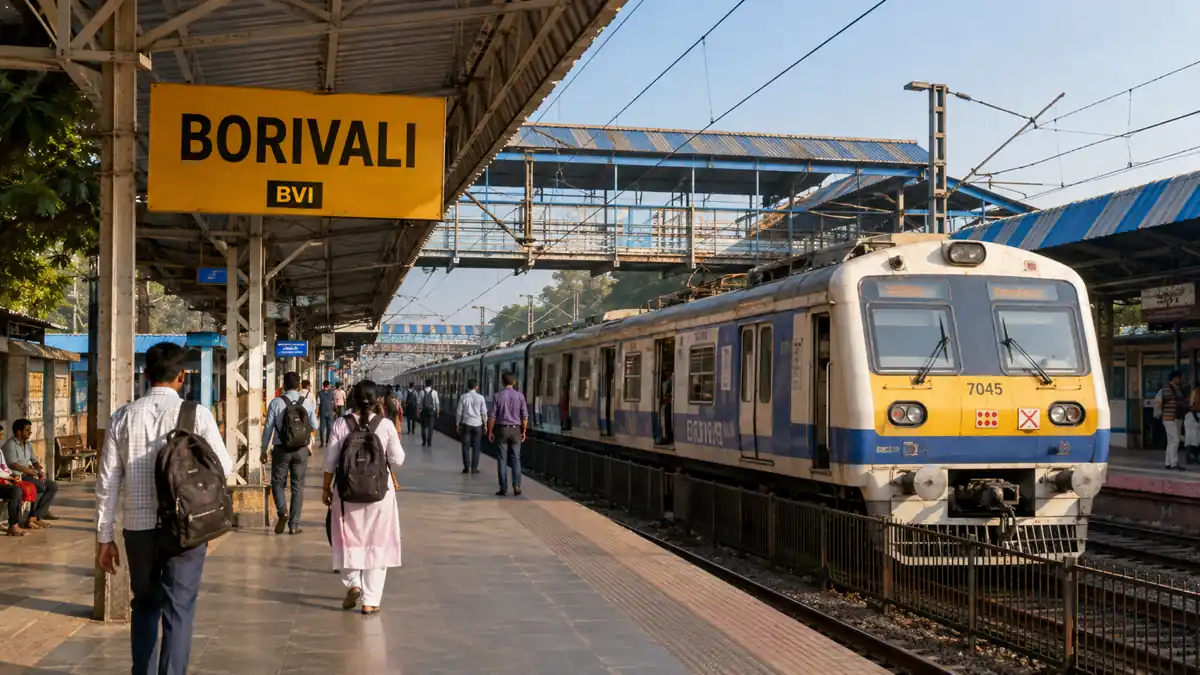
Borivali railway station currently has 10 platforms, numbered from west to east. The platform layout supports a mixture of terminating local trains, through suburban services and long-distance trains.
A fixed platform-to-route list can become unreliable because operational assignments may change. Trains may be moved to another platform during maintenance, late running, congestion or special traffic arrangements.
Passengers should therefore confirm the platform using:
- Station indicator boards
- Public-address announcements
- Railway enquiry displays
- The National Train Enquiry System
- The Where Is My Train or UTS applications, where applicable
- Information shown on an authorised railway enquiry platform
Which platform is used for a particular train?
There is no single platform that can be guaranteed for every service. Suburban trains and long-distance trains generally follow planned platform assignments, but Indian Railways may alter them for operational reasons.
Check the live display after arriving, even when an application has already shown a platform number.
Navigating between platforms
Foot overbridges connect the station’s different sections. Borivali is a high-footfall station, so passengers should avoid waiting near staircases, escalator landings or bridge entrances.
Changing platforms may require more time than the distance suggests. Crowd movement is often slow during weekday mornings, evening peaks and immediately before a long-distance departure.
Quick takeaway: Arrive early, check the electronic display, and move toward the correct coach position before the train enters the platform.
Mumbai Local Trains from Borivali Railway Station
Borivali is a key stop on the Western Line of the Mumbai Suburban Railway, which links Mumbai’s business districts and residential suburbs along the western corridor.
Southbound trains travel toward destinations such as:
- Kandivali
- Malad
- Goregaon
- Andheri
- Bandra
- Dadar
- Mumbai Central
- Churchgate
Northbound trains continue toward destinations including:
- Dahisar
- Mira Road
- Bhayandar
- Naigaon
- Vasai Road
- Nalasopara
- Virar
Some services terminate at Borivali, while others run through the station. A traveller going north must check whether the train ends at Borivali or continues toward Bhayandar, Vasai Road or Virar.
Slow and fast local trains
A slow local generally stops at every station on its scheduled route. A fast local skips selected stations, although the exact stopping pattern depends on the service and time of day.
Borivali is served by slow, semi-fast and fast trains. It is also a common interchange point for passengers switching between different stopping patterns.
Never board based only on the word “fast.” Confirm the destination and scheduled stops on the indicator board. Two trains described as fast may not follow identical stopping patterns.
Is there a direct local train from Borivali to Churchgate?
Yes. Direct southbound local services operate between Borivali and Churchgate. Depending on the service, the train may be slow, semi-fast or fast.
Journey time varies according to the stopping pattern, congestion and operational conditions. Travellers should check the current timetable instead of relying on a fixed duration.
Can passengers travel directly to the Central Line?
Borivali is not a direct interchange with Mumbai’s Central Line. Passengers commonly travel south on the Western Line and change through an appropriate interchange route, depending on their destination.
For example, Dadar provides access between the Western and Central suburban networks, but changing there can involve heavy crowds and a walk between the relevant sections. Route-planning applications can identify a more suitable connection based on the final station.
Long-Distance Trains at Borivali
Borivali is a scheduled halt for many long-distance trains operated through Western Railway. This allows passengers from northern Mumbai to board selected services without first travelling south to a major terminal.
Depending on the timetable, services stopping at BVI may connect Mumbai with cities and regions such as:
- Ahmedabad
- Vadodara
- Surat
- Rajkot
- Jaipur
- Jodhpur
- Udaipur
- New Delhi
- Chandigarh
- Indore
- parts of Madhya Pradesh and northern India
Not every train travelling through the corridor stops at Borivali. A train may originate at Mumbai Central, Bandra Terminus, Dadar or another station and pass through Borivali without a scheduled halt.
How to check whether a train stops at Borivali
Use the following process:
- Open the official IRCTC booking service or National Train Enquiry System.
- Search using the mainline station code BVI.
- Open the train’s complete schedule.
- Confirm that BVI appears as a scheduled boarding station.
- Recheck the departure time and platform on the travel date.
- Review railway messages for diversions, cancellations or changed boarding points.
A ticket booked from another Mumbai station does not automatically permit boarding at Borivali. The boarding point printed or officially updated on the reservation should be followed.
Tickets, Passes and Train Information
Suburban passengers can obtain tickets through station counters, authorised ticket vending facilities, or the UTS mobile application, subject to Indian Railways’ rules and location restrictions.
Common suburban travel products include:
- Second-class single or return tickets
- First-class tickets
- Air-conditioned local tickets
- Monthly or quarterly season tickets
- Other passes offered under current railway rules
Long-distance reserved tickets are generally booked through IRCTC, railway reservation counters or authorised agents. Passengers should verify the train number, boarding station, travel date, coach and berth before completing a reservation.
Using mobile tickets correctly
A mobile ticket must be booked under the conditions specified by the UTS system. Rules may restrict paperless booking when a passenger is already inside a station or too close to railway tracks.
Keep the phone charged and make sure the valid ticket can be displayed during inspection. A screenshot should not be treated as a substitute unless railway rules explicitly allow it.
Facilities at Borivali Railway Station
As a major SG-1 category station in Western Railway’s Mumbai Division, Borivali provides essential facilities for both suburban and long-distance travellers.
Facilities reported at or around the station include:
- Suburban ticket counters
- Reservation-related services
- Automated ticketing facilities
- Electronic train indicators
- Public-address announcements
- Foot overbridges
- Escalators and accessibility support at selected points
- Waiting areas
- Drinking-water points
- Toilets
- Food and refreshment stalls
- ATMs and nearby banking services
- Parking in designated surrounding areas
- Auto-rickshaw, taxi and bus connections
The availability or operating condition of individual amenities can change during repairs, construction or redevelopment. Passengers needing step-free access should identify the most suitable entrance before travelling.
Food and refreshments
Food stalls and small refreshment outlets operate in and around the station. Borivali East and West also have restaurants, snack shops and convenience stores within walking distance.
For a long-distance journey, purchase food only from a reliable vendor, check sealed packaging, and keep enough drinking water. Avoid delaying near the station entrance for shopping when the departure time is close.
Waiting at the station
Borivali can become crowded even outside the traditional peak period. Long-distance passengers should wait in the designated area or near the correct coach position without blocking commuter movement.
Keep luggage close and avoid leaving bags unattended. Families, older travellers and passengers with children should select a clear meeting point in case the group becomes separated.
Borivali East and West Transport Connections
Both sides of the station connect with Mumbai’s road-based public transport network, but they serve different neighbourhoods.
Connections from Borivali West
Borivali West offers access toward:
- Chandavarkar Road
- SV Road
- Link Road
- IC Colony
- Eksar
- Gorai
- Borivali West Metro station area
- Local residential and commercial districts
BEST buses, taxis and auto-rickshaws are available in the surrounding area. Traffic can be heavy, so road travel time should not be estimated from distance alone.
Connections from Borivali East
Borivali East provides access toward:
- Sanjay Gandhi National Park
- Western Express Highway
- Magathane
- Carter Road
- Dahisar East
- Kandivali East
- Metro Line 7 corridor
Passengers may use BEST buses, auto-rickshaws or taxis for onward journeys. The Rashtriya Udyan station on Mumbai Metro Line 7 serves the National Park area, but the railway-to-Metro connection is not a direct same-building interchange.
Metro connections near Borivali
Mumbai Metro Line 2A serves Borivali West, while Line 7 operates along the eastern corridor. These services improve access across western and eastern suburbs, but passengers should allow time to travel between the railway station and the relevant Metro entrance.
Use the latest Mumbai Metro map and official service information when planning an interchange. Walking distance, traffic and the amount of luggage can materially affect transfer time.
How Early Should You Arrive?
For an ordinary local journey, arriving 10–15 minutes early is generally sensible if the route is familiar. A first-time passenger may need more time to locate the correct entrance, ticket counter and platform.
For a long-distance departure, arriving 30–45 minutes early is safer. Consider allowing even more time when:
- Travelling during peak hours
- Carrying heavy luggage
- Accompanying children or older passengers
- Using an unfamiliar entrance
- Travelling during monsoon weather
- Construction or a maintenance block is reported
- The train has a short scheduled halt
Long-distance trains may stop for only a few minutes. Find the coach-position display in advance rather than walking along the platform after the train arrives.
Practical Tips for a Smoother Journey
1. Use the correct station code
Search BVI for mainline trains and reservations. BO is associated with the suburban station.
2. Confirm the direction before entering
Borivali East and West lead to different roads and transport options. Ask for the correct exit before crossing a bridge with luggage.
3. Check the train destination
A platform may serve more than one terminating or through service. Read the train destination and stopping pattern rather than following the crowd.
4. Stand behind the safety line
Platforms can become densely crowded. Remain behind the marked line and do not approach a moving train.
5. Avoid boarding or leaving a moving train
Wait until the train stops. Door areas become dangerous when passengers attempt to enter and exit simultaneously.
6. Keep valuables secure
Use zipped bags, keep phones away from platform edges, and avoid displaying wallets in crowded passageways.
7. Do not cross the tracks
Use an authorised foot overbridge, subway or designated connection. Track crossing is illegal and can be fatal.
8. Plan for Mumbai’s monsoon
Rain can slow traffic, make walking areas slippery and disrupt railway operations. Protect electronic tickets and allow additional travel time.
9. Follow live announcements
A saved timetable cannot reflect every last-minute platform change, cancellation or delay. Station announcements and live railway displays take priority.
Quick takeaway: The most common mistakes are using the wrong station code, choosing the wrong east–west exit, and assuming a familiar train will always depart from the same platform.
Accessibility and Travel with Luggage
Passengers with reduced mobility should look for entrances connected to lifts, escalators or less demanding routes. Facilities may not provide uninterrupted step-free access to every platform, especially when equipment is unavailable or construction changes passenger circulation.
For a more manageable trip:
- Travel outside peak periods where possible.
- Keep luggage compact enough to handle on bridges.
- Use bags with secure wheels and handles.
- Ask railway staff about the easiest platform route.
- Allow extra time for lift or escalator queues.
- Avoid standing with luggage near coach doors.
- Arrange assistance in advance when required under current Indian Railways procedures.
Porter services may be available, but passengers should confirm authorised rates and identification before handing over baggage.
History of Borivali Railway Station
Borivali’s railway history reaches back to the early development of suburban travel on the former Bombay, Baroda and Central India Railway, commonly abbreviated as BB&CI Railway.
Historical accounts identify the station as one of the stops on an early regular suburban service inaugurated between Bombay Backbay and Virar on 12 April 1867. The area and station name appeared in older records with spellings such as “Berewla.”
As Mumbai expanded northward, Borivali developed from a suburban stop into an important terminus and long-distance halt. The station was remodelled in the early 20th century as local population and rail traffic increased.
Today, it forms part of Western Railway under the Ministry of Railways and remains central to daily mobility across northern Mumbai.
Borivali Railway Station Redevelopment
A major redevelopment and capacity-enhancement plan for Borivali was reviewed by the Ministry of Railways in June 2026. The proposal responds to existing congestion and projected passenger growth.
Key elements announced for the master plan include:
- An additional railway platform
- Expanded concourse areas
- Improved passenger circulation
- Better connections between platforms
- Upgraded foot overbridges and skywalk integration
- More entry and exit capacity
- Improved accessibility through lifts and escalators
- Better integration with surrounding transport systems
Kandivali is also planned for parallel development to distribute passenger demand and increase outstation train-handling capacity along the corridor.
The redevelopment should be understood as a planned, phased infrastructure programme. Proposed features may change during design and execution, and construction can temporarily alter entrances, pathways or platform access.
The sixth railway line
Western Railway commissioned the sixth line between Kandivali and Borivali in January 2026, completing the concluding section of the first phase between Bandra Terminus and Borivali.
The additional line is intended to improve operational separation and capacity for suburban and long-distance traffic. Infrastructure benefits may be introduced progressively as signalling, timetables and related projects are coordinated.
Places Near Borivali Railway Station
Passengers with time between journeys can find several notable destinations in the wider Borivali area:
- Sanjay Gandhi National Park: A major protected green area on the eastern side of Borivali.
- Kanheri Caves: Ancient Buddhist rock-cut monuments inside the National Park.
- Mandapeshwar Caves: Historic rock-cut caves in Borivali West.
- Gorai Beach: A coastal destination reached through road and ferry connections.
- Global Vipassana Pagoda: A prominent meditation monument near Gorai.
- EsselWorld area: The Gorai region historically associated with Mumbai’s large amusement destination.
- Veer Savarkar Udyan: A local recreational space in Borivali West.
Travel times depend heavily on traffic, weather and the chosen transport mode. A short geographic distance does not always mean a quick journey in Mumbai.
Final Travel Checklist
Before leaving for Borivali railway station:
- Confirm the train number and date.
- Use BVI for long-distance train searches.
- Check whether the train actually stops at Borivali.
- Verify the current departure time and platform.
- Identify whether you need Borivali East or West.
- Keep a valid ticket or pass accessible.
- Allow extra time for bridges and crowds.
- Find the coach position before departure.
- Follow live railway announcements.
- Use authorised pedestrian routes and transport services.
Borivali railway station is a vital gateway for Mumbai commuters and long-distance passengers. Its scale can initially feel overwhelming, but the journey becomes much easier when you know the correct code, entrance, direction and platform. Check live railway information before departure because timetables, platform assignments and access routes can change.