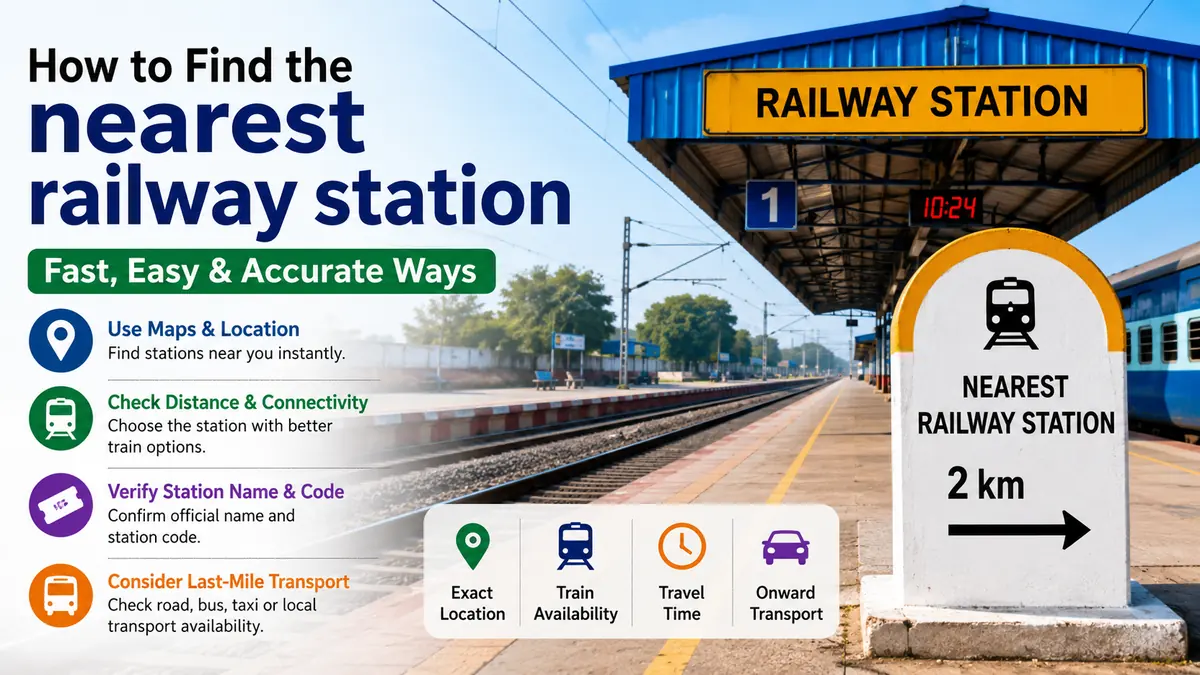
Finding the nearest railway station sounds simple until you discover that the station physically closest to your location may not actually be the best one for your journey. A small halt might be 3 km away, while a major junction 10 km away offers direct trains, better connections, ticketing facilities, and easier onward transport.
For most travelers, the quickest way to find the nearest railway station is to search for “railway station” in a maps app using your current location or destination. Then compare the closest stations by road distance, train availability, station code, connectivity, and transport options rather than choosing purely by straight-line distance.
This distinction matters whether you are traveling to a tourist attraction, hotel, university, examination center, airport, village, business district, or unfamiliar city.
How to Find the nearest railway station
There are several reliable ways to identify a nearby station. The right method depends on whether you are looking from your current position or planning a future trip.
1. Search on Google Maps or another maps app
A digital map is usually the fastest starting point.
Search for:
- railway station
- train station
- railway station near me
- nearest train station
- railway station near your destination name
With location services enabled, the map can show stations around your current position. For a future trip, enter the exact destination first and then search nearby for railway stations.
Do not rely only on the distance displayed on the map. Open each promising station and check the driving or walking route.
A station may appear extremely close geographically but sit on the opposite side of a river, highway, railway yard, or other obstacle.
2. Search using the exact destination
For travel planning, searching from the destination is usually more useful than searching from your present location.
Suppose you are visiting a monument. Search the monument first, then identify nearby stations. The same approach works for:
- hotels
- colleges and universities
- hospitals
- temples and religious sites
- tourist attractions
- examination centers
- offices
- airports
- towns and villages
Official tourism and district websites frequently provide this information. Government destination pages, for example, commonly list the closest railhead alongside road and airport access.
3. Verify the station name and station code
Once you find a station, confirm its official name and railway station code.
Station codes are especially useful in countries with large railway networks because cities can have several similarly named stations.
For example, India’s railway network uses codes such as:
| Railway Station | Station Code |
|---|---|
| New Delhi | NDLS |
| Mumbai Central | MMCT |
| Chandigarh | CDG |
| Amritsar Junction | ASR |
| Pathankot Junction | PTK |
| Fazilka | FKA |
Codes reduce the chance of searching for or booking a train from the wrong station. India’s official tourism portal, for example, identifies Fazilka Railway Station with the code FKA.
Quick Takeaway: Find the station on a map first, but verify its official station name and code before planning the journey.
Why the Closest Station Is Not Always the Best Station
One of the most common travel-planning mistakes is assuming that “nearest” automatically means “most convenient.”
It does not.
There are really two questions:
- Which railway station is physically closest?
- Which railway station is best for reaching my destination?
The answers can be different.
Distance versus railway connectivity
Imagine these three options:
| Station | Distance | Train Service | Practical Choice |
| Station A | 4 km | Very limited | Sometimes |
| Station B | 9 km | Frequent regional trains | Good |
| Station C | 18 km | Major express trains | Often best |
Station A wins on distance, but Station B or C could save hours.
This happens frequently around small towns, rural destinations, mountain regions, and tourist attractions.
Jibhi in Himachal Pradesh provides a useful example. A nearby rail option may look attractive by distance, but limited railway service can make a more distant, better-connected railhead more practical for many travelers.
Check these factors before choosing
A useful railway station should be evaluated for:
- road distance from your destination
- actual road travel time
- direct train availability
- number and frequency of trains
- express train stops
- local transportation
- station facilities
- accessibility
- arrival and departure times
- onward bus or taxi availability
For a late-night arrival, transport availability becomes particularly important. Saving a few kilometers is rarely worthwhile if you arrive at a tiny station with no practical way to complete the last part of your journey.
nearest railway station by Current Location
When someone searches for the nearest railway station without adding a place name, they often want a location-based result.
Your device can provide that information quickly if location permission is enabled.
Use your phone’s location
Open a maps application and search “railway station.” Nearby results should appear based on GPS or your device’s estimated location.
Switch to directions mode and compare:
Current location → Railway Station
Look at both distance and estimated travel time.
Road travel time is usually more meaningful than straight-line distance.
A station 6 km away might require a 25-minute drive because of traffic or road layout, while another station 8 km away could take only 15 minutes.
When location results are inaccurate
Location-based searches sometimes produce misleading results. This can happen when:
- GPS accuracy is poor
- location permission is disabled
- you are using a VPN
- the station is newly opened or renamed
- a small railway halt is categorized inconsistently
- the map places the station entrance incorrectly
If something looks wrong, search using your neighborhood, landmark, postal code, or exact destination instead.
nearest railway station for a Tourist Destination
Tourist destinations create a slightly different problem because many attractions do not have railway stations of their own.
You may need to find a nearby railhead and continue by road.
Government tourism resources often publish “How to Reach” information identifying the appropriate railway station. For example, destination information for Raigad discusses several railway options depending on which tourist place a traveler intends to visit.
This highlights an important principle: there may be several reasonable railway stations for the same broad destination.
Check official destination information
Search:
destination name + nearest railway station
Then prioritize sources such as:
- official tourism departments
- district administration websites
- railway authorities
- official attraction websites
- recognized transport information services
Cross-check the result against a current map before traveling.
Measure distance to the actual attraction
Do not measure from the station to the city center unless the city center is your destination.
For example, if you are visiting a fort 20 km outside a city, the closest station to downtown may not be the closest station to the fort.
Use the attraction’s exact map pin whenever possible.
Understanding Railway Station Types
Knowing basic railway terminology can help you make a better choice.
Junction
A railway junction is generally a station where railway routes meet or diverge.
Junctions can be useful because they often provide broader connectivity, although the word “Junction” alone does not guarantee frequent service or extensive passenger facilities.
Terminus
A terminus is a station where railway services or lines terminate.
Major termini can handle large numbers of long-distance services. Chhatrapati Shivaji Maharaj Terminus in Mumbai, for example, is one of India’s best-known major railway terminals and a UNESCO World Heritage Site.
Halt station
A halt is typically a smaller stopping point.
It may be geographically closest to your destination but can have:
- fewer trains
- limited facilities
- fewer transport connections
- fewer long-distance services
Always check whether your intended train actually stops there.
Major railhead
“Railhead” is frequently used in travel information to describe the railway station travelers commonly use to access a destination.
The major railhead and geographically closest station are not necessarily the same.
Quick Takeaway: Station type gives you clues about connectivity, but the train timetable ultimately determines whether a station works for your journey.
How to Choose Between Two Nearby Railway Stations
Large cities and tourist regions frequently have multiple stations within a relatively small area.
Instead of automatically picking the first result, compare them systematically.
Compare train availability first
Check whether your required train:
- originates at the station
- terminates there
- stops there
- runs on your travel date
A station being close to you has little value if your train never stops there.
Compare road travel time
Next, calculate travel time between each station and your final destination.
Consider traffic patterns too.
A central station may be closer by distance but harder to reach during rush hour.
Check arrival time
Daytime and nighttime journeys should be treated differently.
If your train arrives after midnight, consider:
- taxi availability
- rideshare availability
- public transport hours
- station waiting areas
- lighting and accessibility
- distance to your accommodation
A larger station can sometimes be more practical even when it requires a slightly longer transfer.
Compare facilities
Depending on your needs, check for:
- waiting rooms
- toilets
- food stalls
- parking
- ticket counters
- reservation facilities
- accessibility features
- foot overbridges
- elevators or escalators
- luggage assistance
Major stations tend to offer more services, although facilities vary widely.
How to Find a Railway Station Without GPS
You do not necessarily need live location services.
If you know your destination’s name or address, you can find nearby railway stations before leaving home.
Search by town or locality
Use queries such as:
- railway station near [town]
- closest train station to [hotel]
- railway station near [tourist attraction]
- nearest railhead to [destination]
- how to reach [destination] by train
Then compare results with official information.
Check government travel pages
Government district websites can be particularly useful for destinations that receive fewer tourists.
For example, the Hazaribag district’s official travel information identifies Hazaribag as the nearby railway station and also explains onward transport by bus, taxi, or auto.
The Uttar Dinajpur district travel page similarly lists Raiganj as a nearby station while also mentioning alternatives such as Malda, Dalkhola, Kishanganj, Barsoi Junction, and Aluabari Road Junction for different parts of the district.
That is why checking several stations can produce a better route than simply accepting one search result.
Calculate the Real Distance From Station to Destination
There are three different measurements you may encounter:
Straight-line distance: The geographical distance between two points.
Road distance: How far a vehicle actually travels.
Travel time: How long the journey is expected to take.
For most travelers, travel time is the most useful measurement.
Consider:
Station A: 7 km away, 35 minutes by road
Station B: 10 km away, 18 minutes by road
Although Station A is technically the nearest railway station, Station B could be the more convenient arrival point.
Bridges, one-way roads, mountains, rivers, traffic congestion, and station entrance locations can all change the calculation.
Check Train Availability Before Finalizing the Station
After identifying one or two stations, check actual railway services.
For Indian rail travel, railway information resources can help verify stations, train schedules, routes, and service information. Station guides also commonly recommend confirming station details and train running information rather than relying solely on geographic proximity.
Search using both the station name and its code.
Confirm:
- Your origin station.
- Your possible destination station.
- Travel date.
- Direct trains.
- Connecting trains if necessary.
- Scheduled arrival time.
- Whether the train actually stops at that station.
Timetables can change, so information should be checked again close to the journey date.
How Far Can the nearest railway station Be?
There is no standard maximum distance.
In a dense urban area, several railway stations may exist within a few kilometers.
In rural, mountainous, desert, or remote regions, the closest useful railhead can be much farther away.
This is especially common when visiting:
- hill stations
- national parks
- remote monuments
- villages
- trekking destinations
- wildlife reserves
- coastal areas away from rail corridors
In these cases, rail travel becomes a two-stage journey:
Train → nearest practical railhead → road transport → destination
Plan both stages together.
What If There Is No Railway Station at the Destination?
This is common and usually not a problem.
Find the closest practical railhead with useful train connections, then arrange the final transfer.
Bus
Public buses are generally economical and can connect major railway stations with nearby towns.
Check the bus departure point carefully because the bus terminal may not be next to the railway station.
Taxi
A taxi provides direct station-to-destination transport and can be particularly useful for families, groups, luggage-heavy travelers, and remote locations.
Auto-rickshaw or local transport
For shorter distances in many South Asian cities, auto-rickshaws and other local transport can bridge the gap between a station and the final destination.
Hotel transfer
Some accommodations provide pickup services from major railway stations.
If you are heading somewhere remote, asking the property which station its guests normally use can reveal a more practical route than choosing purely by distance.
Common Mistakes When Searching for a Railway Station
A few simple mistakes create a surprising number of travel problems.
Choosing purely by distance
The geographically closest station may have very limited services.
Check trains before deciding.
Confusing similar station names
Large metropolitan areas can have several stations with similar names.
Always verify the station code and map location.
Assuming every train stops there
A railway line passing through a station does not mean every express or long-distance train stops at it.
Check your specific service.
Ignoring the last-mile journey
Your trip does not finish when the train arrives.
Work out how you will travel from the station to your hotel, attraction, home, examination center, or other destination.
Using outdated travel information
Railway services, station names, train routes, and road conditions can change.
Older blogs can still be useful for general planning, but schedules and operational information should be confirmed using current railway or official sources.
Measuring from the wrong location
If you are visiting a specific attraction, use its exact location rather than the general city name.
This is particularly important in large districts.
A Better Way to Select Your Station
For most trips, use this simple process:
- Pin your exact destination. Use the hotel, attraction, neighborhood, examination center, or address rather than only the city name.
- Find three nearby stations. Do not stop at the first result.
- Record their station codes. This helps prevent confusion when checking trains.
- Compare road travel time. Use actual routes rather than straight-line distance.
- Check train connectivity. Determine which station has useful services from your origin.
- Check arrival time and local transport. Make sure you can complete the last-mile journey.
- Compare facilities if needed. This matters particularly for families, older passengers, travelers with disabilities, and people carrying significant luggage.
- Verify current schedules. Recheck your train before departure.
This approach takes a few extra minutes but can prevent hours of unnecessary travel.
Finding the nearest railway station for Forms and Applications
The phrase can also appear on government, recruitment, examination, travel-pass, or institutional forms.
In this context, “nearest railway station” normally asks for the railway station closest or most practically associated with your address or stated location.
Indian Railway recruitment documentation, for example, can ask eligible candidates to enter a nearest station in connection with rail travel authority arrangements.
If a form does not provide special instructions, enter the official station name rather than a nickname.
Where requested, include the station code.
If two stations are almost equally close, check the application’s instructions before assuming that the larger station is preferred. The definition used by an administrative form may differ from the “most convenient station” logic used for ordinary travel planning.
Can You Walk From the Railway Station?
Sometimes, but check the actual walking route first.
A destination appearing 1 km from a station on the map does not necessarily mean there is a safe 1 km pedestrian route.
Railway yards, fenced tracks, highways, bridges, restricted entrances, and large station complexes can increase walking distance substantially.
Use pedestrian directions rather than estimating from the map.
For luggage-heavy journeys, even a short walk may be inconvenient. Local transport can be the better option.
Practical Checklist Before Traveling
Before leaving for the station, confirm:
- official station name
- station code
- train number
- departure date
- scheduled departure time
- correct station entrance or terminal
- platform information when available
- route from your location
- estimated traffic
- appropriate arrival buffer
- onward transport at your destination
Keep your ticket and identification accessible, and check current train information shortly before departure.
For unfamiliar destinations, save the destination and station locations on your phone in advance. Offline maps can also be useful where mobile coverage is unreliable.
Final Thoughts on Finding the nearest railway station
The nearest railway station is not always simply the station with the smallest distance number. For practical travel, the best choice balances proximity with train connectivity, road travel time, station facilities, arrival time, and last-mile transportation.
Start with a maps search, identify several nearby stations, confirm their official names and station codes, and then check which one your train actually serves. For tourist destinations and unfamiliar regions, cross-check official tourism, district, or railway information as well.
A few minutes spent comparing the closest station with the most convenient railhead can make the entire journey simpler—and prevent you from arriving at a nearby station that does not actually get you where you need to go.