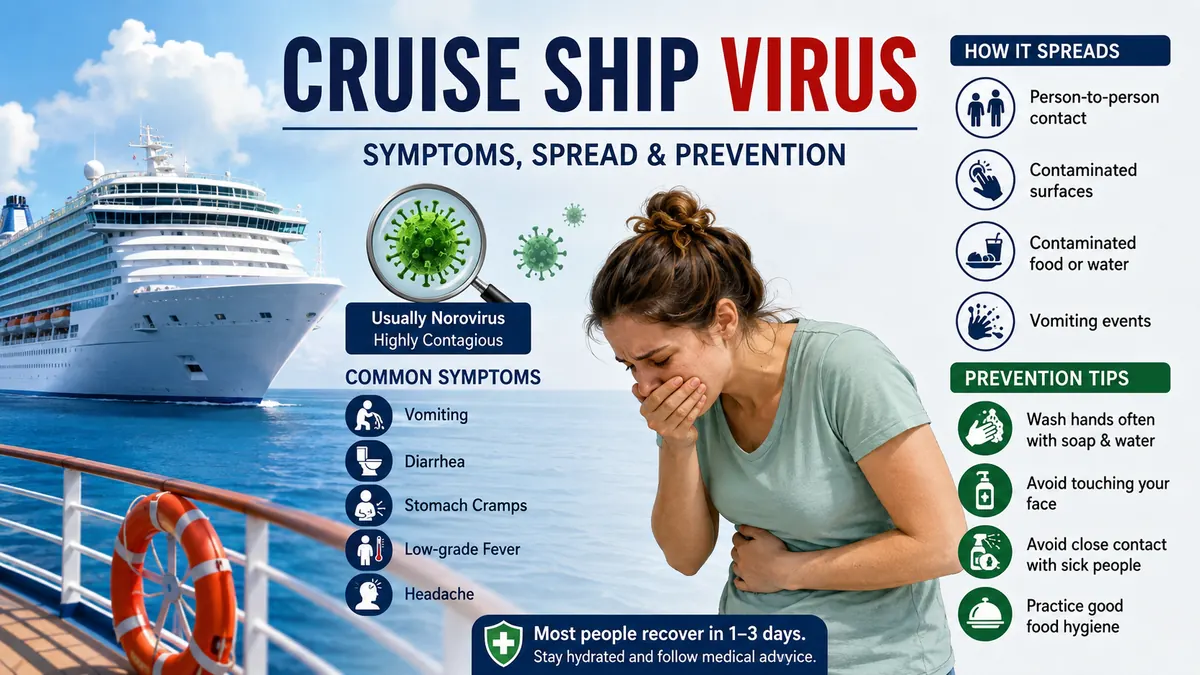
Few things can derail a vacation faster than sudden vomiting, diarrhea, and stomach cramps at sea. When several passengers become sick during the same voyage, you may hear reports describing the problem as a cruise ship virus.
Most of the time, that phrase refers to norovirus, a highly contagious virus and a leading cause of acute gastroenteritis. Norovirus is particularly noticeable on cruise ships because thousands of people share dining areas, cabins, restrooms, entertainment spaces, and frequently touched surfaces. But it isn’t limited to ships—it spreads in many crowded settings on land too.
Quick answer: Cruise ship virus usually means norovirus, a contagious virus that causes sudden vomiting, watery diarrhea, nausea, and stomach cramps. It spreads through infected people, contaminated food or water, and contaminated surfaces. Symptoms typically begin 12–48 hours after exposure and usually improve within one to three days.
What Is the cruise ship virus?
“cruise ship virus” isn’t the medical name of a specific disease. It is an informal label commonly associated with norovirus, which causes inflammation of the stomach and intestines known as acute gastroenteritis.
Norovirus is sometimes incorrectly called “stomach flu.” It isn’t influenza and has no biological relationship to influenza viruses.
The association with cruises is understandable. Norovirus spreads remarkably well anywhere large numbers of people live, eat, socialize, and use shared facilities in relatively close quarters.
Cruise ships also have organized illness surveillance systems, so outbreaks can be identified and publicly reported more systematically than illnesses occurring across a dispersed population on land.
The CDC says norovirus accounts for more than 90% of diarrheal-disease outbreaks on cruise ships. Yet cruise-ship outbreaks represent only about 1% of all reported norovirus outbreaks. Schools, healthcare facilities, childcare centers, universities and other group settings experience outbreaks as well.
Norovirus vs. other gastrointestinal illnesses
Not every outbreak of vomiting or diarrhea aboard a ship is norovirus.
Other organisms and sources can cause gastrointestinal illness, including:
- Escherichia coli (E. coli)
- Campylobacter
- Clostridium perfringens
- Contaminated food
- Contaminated drinking water
The CDC has documented cruise outbreaks caused by these organisms as well as outbreaks where investigators could not determine the causative agent.
That distinction matters. Hearing that a ship has a “stomach bug” does not automatically establish that norovirus is responsible.
Why Does Norovirus Spread on Cruise Ships?
Cruise ships combine several conditions that make person-to-person transmission easier.
Passengers eat in shared restaurants and buffets, touch elevator buttons and railings, attend crowded entertainment venues, use public restrooms, and spend days in relatively contained environments.
Norovirus itself also has characteristics that make outbreaks difficult to stop. According to CDC travel guidance, these include a low infectious dose, efficient person-to-person transmission, prolonged viral shedding, limited long-term immunity, environmental persistence and the absence of a vaccine.
How does the cruise ship virus spread?
Norovirus can reach another person’s mouth through microscopic particles of infected stool or vomit.
Transmission commonly occurs through:
| Route | Example aboard a cruise |
|---|---|
| Person-to-person | Close contact with someone who is infected |
| Contaminated surfaces | Touching a railing or door handle and then touching your mouth |
| Contaminated food | Food handled by an infected person |
| Contaminated water | Drinking or consuming something made with contaminated water |
| Vomiting events | Tiny droplets contaminate nearby surfaces, food or people |
A person with norovirus can shed enormous numbers of viral particles, while only a small number are required to cause infection.
This combination explains why transmission can accelerate once the virus enters a crowded environment.
Where does the virus come from?
A common misconception is that norovirus somehow originates on cruise ships.
It doesn’t.
An infected passenger or crew member can bring it aboard. Someone may also become infected during a port visit and develop symptoms later in the voyage.
Contaminated food or water can introduce the virus too.
Environmental contamination is another concern. Norovirus can persist on objects and surfaces, which is one reason intensive disinfection becomes important during an outbreak.
cruise ship virus Symptoms and Incubation Period
Norovirus illness tends to appear abruptly.
The most characteristic symptoms are:
- Watery or non-bloody diarrhea
- Vomiting
- Nausea
- Stomach pain or abdominal cramps
Some people also experience:
- Low-grade fever
- Headache
- Muscle aches
- General weakness or fatigue
Symptoms usually begin 12 to 48 hours after exposure. Most otherwise healthy people recover within approximately one to three days.
What symptoms do cruise ships monitor?
The CDC’s Vessel Sanitation Program uses specific criteria when monitoring acute gastroenteritis.
A case can involve three or more loose stools during a 24-hour period—or more than normal for that individual—or vomiting accompanied by another symptom such as diarrhea, abdominal cramps, headache, muscle aches or fever.
Reporting symptoms matters because ship medical teams need accurate information to recognize unusual patterns and respond before more passengers become ill.
Is norovirus dangerous?
For most healthy adults, the infection is miserable but short-lived.
The main complication is dehydration.
Repeated vomiting and diarrhea cause the body to lose water and electrolytes. Dehydration can become more serious in young children, older adults and people with certain underlying health problems.
Warning signs can include very little urination, dry mouth, severe weakness, dizziness or difficulty keeping fluids down.
Passengers experiencing significant symptoms should contact the ship’s medical center rather than trying to hide the illness to avoid missing vacation activities.
How Long Is cruise ship virus Contagious?
This is where norovirus becomes particularly troublesome.
People are most contagious while they have symptoms—especially vomiting—and during the first few days after they start feeling better.
However, viral shedding can continue longer. The CDC notes that people can continue spreading norovirus for two weeks or more after recovery.
That doesn’t mean someone remains equally infectious throughout that entire period. The highest transmission risk is generally associated with active illness and the period immediately after symptoms disappear.
Still, recovering passengers should continue being meticulous about handwashing.
Can you catch norovirus twice?
Yes.
Previous infection doesn’t provide reliable long-term protection against every future norovirus infection. Multiple genetic types circulate, and immunity following infection isn’t necessarily durable.
This helps explain why norovirus remains common despite so many people having encountered it before.
Are Cruise Ship Norovirus Outbreaks Common?
They happen, but the public perception can be misleading.
Cruise outbreaks receive considerable attention because a ship represents a clearly defined population. When dozens or hundreds of passengers report similar symptoms during one voyage, investigators can identify the cluster.
Individual norovirus cases occurring across a city are much less visible.
CDC data also show that gastrointestinal outbreaks aboard ships aren’t automatically caused by norovirus.
For example, among outbreaks listed by the CDC for 2026 through its June 1 update, Caribbean Princess and Star Princess had confirmed norovirus outbreaks, while outbreaks aboard Oceania Insignia and Seven Seas Mariner were attributed to E. coli. The cause of a May outbreak aboard National Geographic Sea Bird remained unknown at that update.
That is why laboratory investigation matters.
What counts as an official cruise ship outbreak?
For voyages within the CDC Vessel Sanitation Program’s jurisdiction, the agency generally posts an outbreak when:
- The voyage includes both U.S. and foreign ports and falls under VSP jurisdiction.
- At least 3% of passengers or crew report gastrointestinal illness symptoms to onboard medical staff.
The CDC can also report other incidents considered significant to public health.
The 3% threshold shouldn’t be interpreted as meaning nothing happens below it. It is a surveillance and reporting threshold.
A real 2026 example
The Star Princess experienced a confirmed norovirus outbreak during its March 7–14, 2026 voyage.
According to the CDC, 141 of 4,307 passengers reported illness, representing 3.3% of passengers. Fifty-two of 1,561 crew members also reported illness, likewise 3.3%. Diarrhea and vomiting were the predominant symptoms.
The response included increased cleaning and disinfection, isolation of sick passengers and crew, collection of stool specimens and consultation with the Vessel Sanitation Program.
One useful detail about these statistics is often missed: reported case totals cover the entire voyage. They don’t mean every recorded passenger was sick simultaneously.
Quick Takeaway: Norovirus outbreaks are highly visible on cruise ships, but cruise ships account for only a small fraction of reported norovirus outbreaks overall.
How Cruise Lines Respond to an Outbreak
When gastrointestinal illness begins spreading, early reporting can make a significant difference.
Cruise operators may activate outbreak prevention and response procedures that go beyond routine sanitation.
Typical measures include:
- Identifying cases through passenger and crew reports.
- Isolating symptomatic people to reduce close contact.
- Increasing cleaning and disinfection in cabins and public areas.
- Collecting stool samples when appropriate to identify the causative agent.
- Monitoring new cases to determine whether transmission is increasing.
- Consulting public-health authorities when required.
- Conducting environmental assessments when investigators need to identify possible transmission sources.
These aren’t merely theoretical measures. The CDC documented increased cleaning, specimen collection, isolation and an environmental investigation during the 2026 Star Princess outbreak.
What is the Vessel Sanitation Program?
The Centers for Disease Control and Prevention (CDC) operates the Vessel Sanitation Program (VSP) to help prevent and control gastrointestinal illness on cruise ships within its jurisdiction.
The program conducts inspections, monitors reported illness and participates in outbreak investigations.
Cruise ships covered by VSP are required to report gastrointestinal illness cases to the CDC.
This surveillance is one reason travelers hear detailed statistics about cruise outbreaks.
How to Avoid cruise ship virus
You cannot eliminate every possibility of infection while traveling, but simple habits can substantially reduce exposure.
1. Wash your hands with soap and water
Proper handwashing is one of the most useful precautions against norovirus.
Wash thoroughly:
- After using the restroom
- Before eating
- Before handling food
- After touching frequently handled public surfaces
- After caring for someone who is sick
CDC cruise guidance specifically recommends frequent handwashing with soap and water, particularly before eating and after using the restroom.
2. Don’t rely entirely on hand sanitizer
Hand sanitizer is convenient while traveling, but it shouldn’t replace thorough handwashing when you’re trying to prevent norovirus.
If a sink is available, wash your hands properly with soap and water.
Think of sanitizer as an additional hygiene measure rather than permission to skip the sink.
3. Keep your hands away from your face
Passengers constantly touch high-contact objects:
- Elevator buttons
- Stair railings
- Door handles
- Touchscreens
- Casino equipment
- Restaurant chairs
- Public restroom fixtures
Touching a contaminated surface doesn’t automatically infect you. The problem occurs when viral particles are transferred toward your mouth.
The CDC therefore recommends avoiding unnecessary face touching as part of gastrointestinal illness prevention during cruise travel.
4. Be careful around someone who is vomiting
Vomiting can spread microscopic droplets containing norovirus.
Those particles can contaminate nearby surfaces or food, and some may enter another person’s mouth.
Don’t gather around someone who has suddenly become ill. Move away and alert crew members so the area can be handled appropriately.
5. Pay attention to food hygiene
Norovirus can spread when an infected person handles food or when food comes into contact with contaminated water or surfaces.
Ready-to-eat foods can be particularly vulnerable because they may receive no additional cooking before consumption.
Raw shellfish—especially oysters—are another recognized source because shellfish can concentrate viruses from contaminated water.
Normal food-safety judgment still applies on vacation.
6. Don’t board knowingly sick if you can avoid it
Someone experiencing active vomiting or diarrhea shortly before departure can potentially introduce infection into a densely populated environment.
Follow the cruise line’s health guidance and be truthful about significant gastrointestinal symptoms.
Trying to protect a vacation by concealing illness can ultimately expose other passengers, crew members and traveling companions.
What Should You Do If You Get Sick During a Cruise?
Contact the onboard medical center promptly.
Don’t simply stay in your cabin without informing anyone. Cruise medical teams use passenger reports to identify clusters of gastrointestinal illness.
CDC guidance specifically advises cruise travelers to contact the ship’s medical center promptly even when gastrointestinal symptoms seem mild.
You may be instructed to remain isolated temporarily.
That can be frustrating when you’ve paid for a vacation, but continuing to visit restaurants, pools, shows and other public areas while actively vomiting or experiencing diarrhea creates opportunities for further transmission.
Focus on preventing dehydration
For uncomplicated norovirus, treatment is primarily supportive because antibiotics do not treat viral infections.
Fluid replacement is the priority.
Take frequent small amounts of fluids if larger amounts trigger nausea or vomiting. Oral rehydration solutions can help replace both fluids and electrolytes lost through diarrhea and vomiting.
Avoid assuming that feeling slightly better means you’re immediately non-contagious.
When should you seek medical attention?
Medical evaluation becomes particularly important when someone:
- Cannot keep liquids down
- Develops signs of significant dehydration
- Has severe or worsening symptoms
- Becomes unusually weak, confused or dizzy
- Has symptoms that don’t improve as expected
- Belongs to a group at greater risk from dehydration
Young children, older adults and people with certain medical conditions can be more vulnerable to complications from fluid loss.
The ship’s medical staff can evaluate the situation and determine the appropriate care.
How Is Norovirus Different From Food Poisoning and Seasickness?
Vomiting on a cruise doesn’t necessarily mean norovirus.
Several conditions can produce overlapping symptoms.
| Feature | Norovirus | Foodborne illness | Seasickness |
| Vomiting | Common | Often | Common |
| Diarrhea | Common | Often | Uncommon |
| Stomach cramps | Common | Common | Sometimes |
| Spreads person-to-person | Yes | Depends on cause | No |
| Related to ship movement | No | No | Yes |
| Typical norovirus onset | 12–48 hours after exposure | Depends on organism/toxin | Often linked to motion |
| Outbreak potential | High | Possible | No |
Food poisoning isn’t one single disease. Bacteria, viruses, parasites or toxins can all cause foodborne illness, and their incubation periods differ.
Seasickness is completely different. Motion can cause nausea, dizziness and vomiting, but it doesn’t cause a contagious gastrointestinal outbreak.
If several unrelated passengers develop vomiting and diarrhea, particularly over multiple days, infectious gastroenteritis becomes more plausible than ordinary motion sickness.
Common Myths About cruise ship virus
“Norovirus only happens on dirty ships”
False.
Sanitation matters, but norovirus can be introduced into an otherwise well-maintained environment by an infected person or contaminated food.
Because very few viral particles can cause infection and the virus spreads efficiently, an introduction can sometimes trigger transmission despite routine cleaning.
“Everyone gets sick during an outbreak”
Usually not.
An outbreak can involve a relatively small percentage of passengers.
For example, the confirmed March 2026 Star Princess outbreak involved 3.3% of passengers reporting illness during the voyage—not the entire ship.
“If there’s vomiting onboard, it must be norovirus”
No.
Motion sickness, foodborne illness and other infections can cause vomiting.
Even gastrointestinal outbreaks can have other causes. CDC records include outbreaks attributed to E. coli and incidents where the causative agent remained unknown.
“Cruise ships are where most norovirus outbreaks happen”
This is another misleading assumption.
Cruise outbreaks attract media coverage because they occur within a defined population and are actively monitored. The CDC estimates that cruise-ship outbreaks represent only around 1% of reported norovirus outbreaks.
What Travelers Should Remember Before Their Next Cruise
The cruise ship virus is usually norovirus, but the nickname makes the problem sound more cruise-specific than it really is.
Norovirus circulates worldwide and can spread in schools, healthcare facilities, hotels, restaurants, universities, childcare centers and other environments where people congregate. Cruise ships simply provide conditions where an introduced virus can spread efficiently—and where illness is closely tracked.
The most useful protection isn’t complicated: wash your hands thoroughly with soap and water, practice sensible food hygiene, avoid unnecessary contact with people who are actively ill, and report vomiting or diarrhea to the ship’s medical center quickly.
If symptoms do develop, concentrate on hydration and follow onboard medical and isolation guidance. Most healthy people recover from norovirus within one to three days, but preventing transmission during those uncomfortable days helps keep one passenger’s illness from becoming an outbreak.