thane railway station is far more than a stop on Mumbai’s suburban rail network. It is one of the busiest transport hubs in the Mumbai Metropolitan Region, serving daily commuters, intercity passengers, students, office workers, and travelers heading between Mumbai, Thane, Navi Mumbai, Kalyan and destinations farther across Maharashtra.
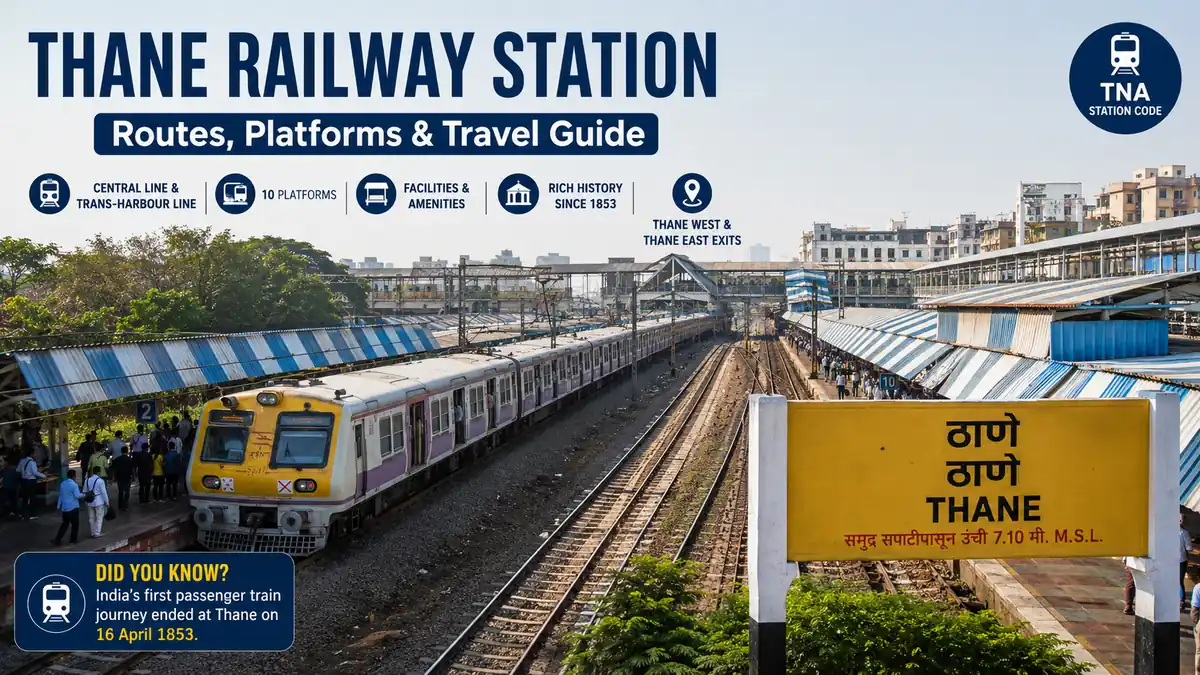
thane railway station, station code TNA, is a major Central Railway station in Thane, Maharashtra. It has 10 platforms and serves Mumbai Suburban Railway’s Central Line and Trans-Harbour Line as well as selected long-distance trains. The station also has exceptional historical importance because India’s first passenger railway journey ended at Thane in 1853.
The station can feel overwhelming during rush hour. Knowing which side to exit from, how local services work, where Trans-Harbour trains operate, and how to check your platform can make the journey considerably easier.
thane railway station at a Glance
Here are the key details passengers usually need first.
| Detail | Information |
|---|---|
| Station name | Thane |
| Station code | TNA |
| City | Thane, Maharashtra |
| Railway zone | Central Railway |
| Division | Mumbai Division |
| Station category | NSG-1 |
| Platforms | 10 |
| Main suburban network | Central Line |
| Navi Mumbai connection | Trans-Harbour Line |
| Operator | Central Railway |
| Structure | At grade |
| Electrification | 25 kV AC |
| Main access | Thane West and Thane East |
| Historic significance | Terminus of India’s first passenger train journey |
Railway reference data identifies Thane as an NSG-1 station with ten platforms, while the station addresses correspond broadly to Dada Patil Marg on the western side and the Kopri/Rambhau Mhalgi Road side in the east.
Recent reports place daily passenger movement at more than eight lakh people, illustrating how substantially the station’s role has grown since earlier traffic estimates.
Why thane railway station Is So Important
Thane sits at a strategic point between Mumbai’s core suburban corridor and the expanding residential and commercial zones of Thane, Kalyan-Dombivli and Navi Mumbai.
For Central Line passengers, the station provides frequent suburban connections toward Mumbai and toward the northeastern and southeastern branches beyond Kalyan. For Navi Mumbai passengers, Thane is particularly valuable because Trans-Harbour trains connect it directly with stations toward Vashi and Panvel.
That combination makes Thane an interchange point rather than simply another suburban halt.
The station also handles selected Mail and Express trains. As a result, the same station infrastructure has to accommodate short-distance commuters, travelers carrying luggage, intercity passengers and people changing between railway corridors.
Central Line connectivity
On the Mumbai Suburban Railway’s Central Line, Thane sits between Mulund on the Mumbai side and Kalva on the Kalyan side. Services connect passengers toward major stations such as:
- Chhatrapati Shivaji Maharaj Terminus
- Dadar
- Kurla
- Ghatkopar
- Mulund
- Kalva
- Dombivli
- Kalyan
- Kasara
- Karjat and Khopoli routes via the wider Central Line network
The exact stopping pattern varies between slow, semi-fast and fast services, so passengers should always check the train indicator rather than assuming every train stops at the same intermediate stations.
Trans-Harbour Line connectivity
Thane is the northern terminus for the Trans-Harbour suburban corridor. From here, trains run toward Navi Mumbai, including the Vashi and Panvel direction. Railway references identify Digha Gaon as the next station from Thane on this corridor.
This link is especially useful for passengers traveling between Thane and employment or residential centers around Airoli, Rabale, Ghansoli, Kopar Khairane, Turbhe, Vashi and farther toward Panvel.
A common source of confusion is the terminology. The Trans-Harbour Line is the direct suburban corridor serving Thane. Although it connects into Navi Mumbai’s wider suburban network, travelers should not treat “Harbour Line” and “Trans-Harbour Line” as interchangeable when checking a specific train.
Quick Takeaway: For Mumbai travel, look for Central Line services. For Navi Mumbai destinations such as Airoli, Vashi or Panvel, look for Trans-Harbour services.
thane railway station Platforms and Train Movement
Thane has 10 platforms. Because it handles slow suburban trains, fast suburban trains, Trans-Harbour services and long-distance trains, understanding the platform system is useful—but platform assignments should never be treated as permanently fixed.
Historically, the platforms have broadly been used as follows:
| Platforms | Typical use |
| 1–4 | Mainly Central Line suburban services |
| 5–6 | Fast suburban services and some long-distance traffic |
| 7–8 | Through or long-distance train movements |
| 9–10 | Trans-Harbour suburban services |
Older operational references describe Platforms 9 and 10 as serving trains toward Vashi and Panvel, while Platforms 5 and 6 have handled a mixture of fast suburban and longer-distance services.
These patterns are useful for orientation, not as a substitute for live railway information.
How do you find the correct platform at Thane?
The safest method is simple:
- Check the station’s electronic train indicator.
- Listen to the public-address announcement.
- Confirm the destination and scheduled departure time.
- Follow the signs for the correct foot overbridge and platform.
- Recheck the indicator if the train is delayed or your platform appears to have changed.
This matters because platform assignments can change due to congestion, maintenance blocks or operational requirements.
The Ministry of Railways has stated that train indicator boards and round-the-clock public-address systems are used at Mumbai suburban stations to support passenger movement.
Thane West vs Thane East: Which Exit Should You Use?
thane railway station serves two very different sides of the city.
Thane West exit
The western side is generally the busier side of the station. It provides access toward major commercial areas, markets and neighborhoods including Naupada and the wider Thane West area.
A Mumbai Railway Vikas Corporation study noted that both station exits open into commercial areas but described the Thane West side as having the larger market and heavier crowding.
Use the western side if your destination is toward areas such as central Thane West, Naupada, Talao Pali or major west-side bus routes.
Thane East exit
The eastern side serves Kopri and adjoining neighborhoods and may be more convenient if your destination lies toward eastern Thane.
The practical rule is to decide your exit before you leave the platform. Crossing to the wrong side and then trying to travel around the station by road can waste considerable time during peak traffic.
Station Area Traffic Improvement Scheme
Thane is also notable for its station-area transport integration. In a February 2026 parliamentary response, the government said Station Area Traffic Improvement Scheme, or SATIS, work had been undertaken at Thane to improve integration between railway and road transport and help disperse passenger crowds.
This reflects a wider challenge at Thane: the railway itself is only one part of the journey. Thousands of passengers transfer immediately to buses, auto-rickshaws, taxis or other road transport.
Facilities Available at thane railway station
A station handling several lakh passengers needs substantial passenger infrastructure.
Facilities reported across railway and station sources include ticketing areas, waiting spaces, food and refreshment stalls, drinking water, toilets, foot overbridges, escalators, lifts, public announcements and electronic information displays.
Ticket counters and booking areas
Booking facilities exist on both sides of the station. A passenger study of Thane specifically noted booking offices on the east and west sides, with the west-side booking area adjoining Platform 1 and typically experiencing heavier crowds.
For commuters, digital ticketing can often save time.
UTS mobile ticketing
The official Indian Railways UTS application supports unreserved ticketing. Depending on the applicable ticket type and railway rules, the system can be used for journey tickets, season tickets and platform tickets. The application is developed by the Centre for Railway Information Systems, or CRIS.
For paperless tickets, location restrictions apply. Indian Railways explains that GPS is used to determine whether a passenger is in the permitted booking area, so travelers should not wait until they are already inside a train to attempt a paperless booking.
Foot overbridges, escalators and lifts
Moving between ten platforms requires substantial vertical circulation infrastructure. Foot overbridges connect different sections of the station, while escalators and lifts improve access for passengers carrying luggage, senior citizens and people with reduced mobility.
At peak times, the fastest route is not always the nearest staircase. If one bridge is heavily congested, following signs toward another connection may provide a smoother transfer.
Waiting areas
Waiting and seating facilities are available in the station. A 2026 railway-focused report also documented a waiting hall on Platform 1.
Long-distance passengers should allow extra time before departure because navigating from the entrance to a particular platform can take longer during commuter rush periods.
Food and refreshments
Food stalls and refreshment counters operate around the station. The surrounding Thane West commercial area also provides extensive food and shopping options, although passengers leaving the station should account for road traffic and queues when returning.
Security and passenger information
CCTV coverage, railway security personnel, electronic displays and station announcements contribute to passenger management.
In a station this crowded, personal precautions still matter. Keep wallets and phones secure, keep luggage within sight, and avoid standing close to platform edges while checking your phone.
How to Buy Tickets at Thane
The right ticketing method depends on the type of journey.
For Mumbai suburban local trains
You can generally use:
- UTS booking counters
- Automatic ticket vending facilities where available
- The official UTS mobile application
- Valid season passes for regular travel
Central Railway’s UTS system supports journey tickets, return tickets on suburban sections and various season-ticket products.
For reserved long-distance trains
Reserved railway tickets are handled separately from ordinary suburban local tickets. Passengers traveling on reserved Mail or Express services should check their train number, coach and reservation status before arriving.
Do not assume a local suburban ticket is valid for a reserved intercity journey.
Best Time to Use thane railway station
There is no genuinely “quiet” period at a station of this scale, but crowd levels vary dramatically.
The heaviest passenger movement generally occurs during weekday office commuting periods—toward Mumbai in the morning and back toward Thane/Kalyan-side suburbs in the evening.
If your schedule is flexible, traveling outside the principal morning and evening rush periods usually makes navigating platforms, bridges and station exits easier.
How early should you arrive?
For an ordinary local train, frequent services mean passengers generally do not need the kind of arrival buffer required at an airport.
For a long-distance train, however, arriving at least 20–30 minutes before departure is a sensible practical buffer, particularly if:
- you have luggage;
- you are unfamiliar with the station;
- you need to cross several platforms;
- you are traveling with children or older passengers;
- you need to collect or purchase a ticket.
During major infrastructure blocks or unusually crowded periods, allow more time.
The Historic Importance of thane railway station
The history of Thane station is inseparable from the beginning of passenger railways in India.
On 16 April 1853, India’s first passenger train service ran from Bori Bunder in Bombay to Thane. The journey covered roughly 34 km. The train consisted of 14 carriages, carried about 400 passengers and was hauled by three steam locomotives named Sahib, Sindh and Sultan.
That makes Thane one of the foundational locations in Indian railway history.
What happened before the famous 1853 journey?
The development of the railway did not begin with the ceremonial passenger run.
A trial journey was conducted in November 1852 toward the Thane area before the formal passenger inauguration. Historical accounts describe the Great Indian Peninsula Railway, or GIPR, as the company responsible for developing the early Bombay-Thane railway.
After the passenger service opened, the railway expanded beyond Thane. The line was extended toward Kalyan in 1854, and the development of rail infrastructure around Thane Creek became part of the rapidly growing network.
Is Thane India’s first railway station?
The most accurate way to describe it is that Thane was one of the two endpoints of India’s first passenger railway service, with Bori Bunder at the Bombay end.
Calling it simply “India’s first railway station” can obscure that distinction. Its historical status remains extraordinary because the first formal passenger train in India completed its journey here.
Crowd Management and Platform Improvements
Thane’s biggest operational challenge is scale.
Railway planning documents and engineering studies have repeatedly addressed congestion, particularly around heavily used platforms and passenger circulation routes.
An engineering paper concerning Platform 5 described widening work undertaken because Platforms 5 and 6 handled intense suburban and long-distance traffic. The project widened Platform 5 using precast RCC hollow-box construction while railway operations had to be carefully managed around the work.
15-coach platform expansion in 2026
Capacity improvement continued in 2026.
In March 2026, Central Railway carried out infrastructure work at Thane connected with extending platforms to support 15-coach suburban trains. Work included track and crossover modifications designed to create space for further extension of Platforms 3 and 4.
Longer suburban trains can carry more passengers per service, making platform length an important part of increasing capacity on one of India’s most intensively used commuter networks.
Proposed larger redevelopment
Thane’s long-term modernization remains an active public issue.
In June 2026, Mumbai Mirror reported that elected representatives had pressed Central Railway to begin a broader redevelopment plan for Thane station, citing daily passenger traffic above eight lakh and pressure on platforms and foot overbridges. The report said the proposal, valued at more than ₹800 crore under the Amrit Bharat Station framework, had been accepted by the Railway Board, although representatives were seeking faster commencement of physical work.
Passengers should therefore distinguish between completed improvement works, ongoing platform-capacity projects, and the larger proposed redevelopment. They are not the same project.
Nearby Transport and Onward Connections
For most passengers, the railway journey ends with another transport connection.
Outside the station, travelers can connect to:
- city buses;
- auto-rickshaws;
- taxis;
- app-based cabs;
- walking routes into nearby commercial and residential areas.
The west side generally experiences more intense commercial activity and passenger movement, while the east side may be preferable for Kopri and nearby eastern neighborhoods.
If you are being picked up by car or cab, agree on the station side in advance. Simply telling a driver “Thane station” is often not enough.
Nearby Places From Thane Station
Several well-known parts of Thane are accessible from the station by road or a combination of walking and local transport.
Common destinations include:
Talao Pali
Masunda Lake, popularly known as Talao Pali, is one of central Thane’s best-known landmarks and lies relatively close to the station.
Naupada
Naupada is a busy residential and commercial locality immediately associated with the station’s western side and is convenient for passengers traveling into central Thane.
Wagle Estate
Wagle Estate is a major business and employment district in Thane. Passengers commonly continue there by road after arriving by suburban train.
Upvan Lake
Upvan Lake lies farther west and normally requires an auto-rickshaw, taxi, bus or other road connection from the station.
Travel time to any of these places depends heavily on traffic, particularly during office hours.
Practical Tips for First-Time Passengers
A few habits make using Thane much easier.
Check the destination, not just the platform number. Platform assignments can change, but your train’s route and destination remain the key identifiers.
Decide between Thane East and Thane West before exiting. Choosing the wrong side can add an unnecessary road journey.
Use live station displays. Old platform lists found online can be helpful for understanding the general layout but should not be trusted for a specific departure.
Allow extra time during rush hour. Walking through a crowded foot overbridge can take far longer than expected.
Keep luggage compact. Large suitcases are particularly awkward on busy suburban platforms and stairways.
Stand in a safe position before the train arrives. Avoid rushing toward a moving train or blocking passengers who are trying to get off.
Use official ticketing channels. For suburban and other unreserved travel, Indian Railways’ UTS system is the appropriate digital platform.
Quick Takeaway: At Thane, the biggest time-savers are knowing your railway line, checking the live platform indicator, and choosing the correct east or west exit before leaving the station.
Final Thoughts on thane railway station
thane railway station combines two very different identities. It is a landmark in the history of Indian Railways, connected to the first passenger train journey of 1853, but it is also a modern commuter hub coping with enormous daily passenger demand.
Its ten platforms connect Central Line commuters, Trans-Harbour passengers and selected long-distance services, while ongoing capacity improvements reflect the continuing pressure on the station.
For travelers, the most useful approach is straightforward: check your train and platform using live railway information, understand whether you need the Central Line or Trans-Harbour Line, and choose the correct Thane East or Thane West exit before leaving the station. Those three steps remove much of the confusion from traveling through one of Mumbai’s most important railway gateways.