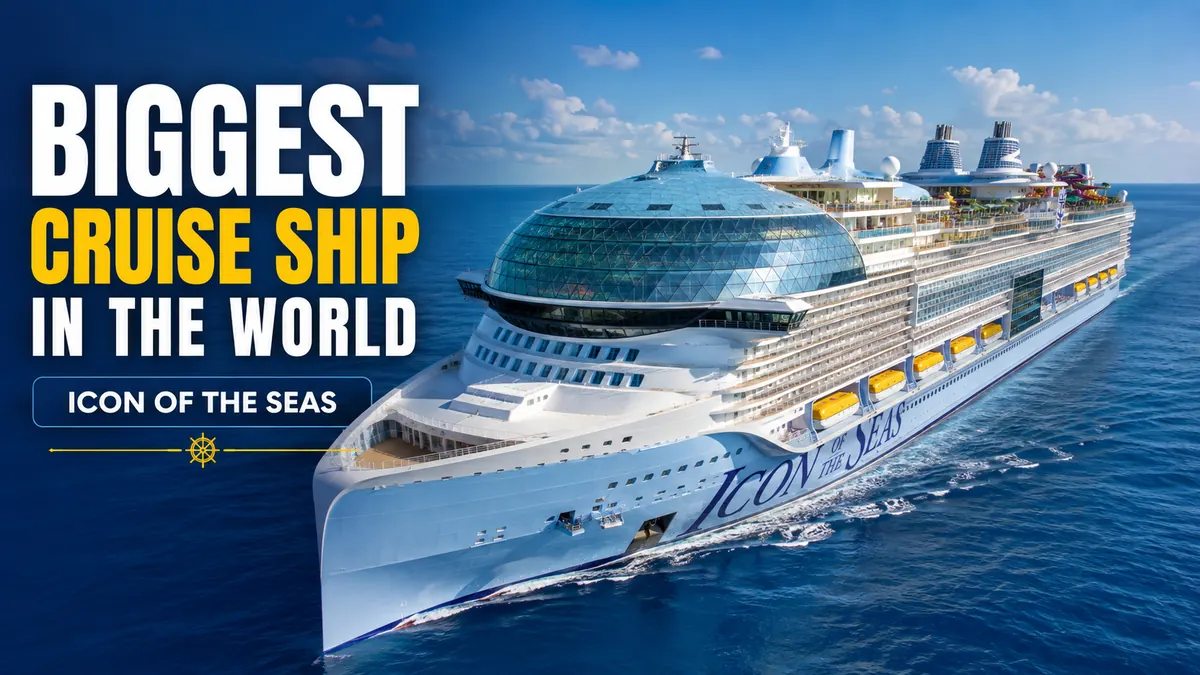
Cruise ships have grown from large ocean-going hotels into floating resorts with waterparks, parks, theaters, dozens of restaurants, and room for thousands of travelers. In 2026, the race for the title of biggest cruise ship in the world has become especially close because Royal Caribbean now operates three enormous Icon Class sister ships.
The biggest cruise ship in the world in 2026 is Royal Caribbean’s Legend of the Seas when overall length is used: it is about 1,197 feet (365 meters) long and roughly a foot longer than its Icon Class sisters. By gross tonnage, Legend of the Seas, Icon of the Seas, and Star of the Seas are essentially in the same record-breaking size category, commonly listed around 248,663–250,800 GT.
That distinction matters. A cruise ship can be the longest without having significantly more internal volume, while another can carry more passengers without being longer. Understanding how ships are measured makes the current record much easier to interpret.
What Is the biggest cruise ship in the world in 2026?
As of August 2026, Legend of the Seas is the newest member of Royal Caribbean’s Icon Class and can reasonably be described as the world’s biggest cruise ship based on its slight length advantage over its sister ships.
Royal Caribbean officially took delivery of Legend of the Seas from the Meyer Turku shipyard in Turku, Finland, on June 10, 2026. It became the third Icon Class vessel after Icon of the Seas and Star of the Seas.
Cruise industry specifications commonly put the ship at approximately:
| Specification | Legend of the Seas |
|---|---|
| Length | About 1,197 ft / 365 m |
| Gross tonnage | About 248,663–250,800 GT |
| Double-occupancy guests | 5,610 |
| Maximum guests | Around 7,000–7,600 |
| Crew | About 2,350 |
| Decks | Around 20 |
| Class | Icon Class |
| Builder | Meyer Turku |
| Delivered | June 10, 2026 |
| Propulsion | LNG-capable dual-fuel system |
Published specifications can vary slightly because cruise lines, ship registries, and travel databases sometimes use different certified or rounded figures. For example, industry sources list Legend around 248,663 GT, while other cruise databases use the rounded 250,800-GT figure.
Is Legend of the Seas bigger than Icon of the Seas?
Only slightly in physical length.
Cruise Critic reported at Legend’s June 2026 delivery that the new ship became Royal Caribbean’s biggest vessel by about one foot. Icon of the Seas and Star of the Seas remain essentially the same scale in gross tonnage and passenger capacity.
So the simplest answer is:
- Longest current Icon Class ship: Legend of the Seas
- Largest class of cruise ships: Royal Caribbean Icon Class
- Gross-tonnage leaders: Legend, Icon, and Star are effectively in the same approximately quarter-million-GT category
- Previous outright record holder: Icon of the Seas
Quick Takeaway: The title is no longer as simple as it was when Icon of the Seas debuted. Legend of the Seas has a tiny length advantage, while all three Icon Class ships occupy essentially the same unprecedented size tier.
How Is the World’s Biggest Cruise Ship Measured?
Calling a ship “biggest” sounds straightforward, but ships can be compared using several measurements.
The cruise industry generally gives the greatest importance to gross tonnage, or GT.
Despite its name, gross tonnage does not measure how much a ship weighs. It is a standardized measure related to the volume of enclosed spaces inside a vessel.
A ship with a larger GT generally has more enclosed space available for cabins, restaurants, theaters, lounges, corridors, entertainment venues, and other facilities.
Gross tonnage vs. length vs. passenger capacity
| Measurement | What It Tells You |
|---|---|
| Gross tonnage | Overall enclosed internal volume |
| Length | Distance from bow to stern |
| Beam | Maximum width of the vessel |
| Passenger capacity | Number of guests the ship can accommodate |
| Deck count | Number of vertical levels |
| Crew capacity | Approximate onboard workforce |
This explains why different lists of the largest cruise ships can occasionally appear to contradict one another.
One source might call Legend of the Seas the world’s biggest because it is slightly longer. Another may group Legend, Icon, and Star together because their gross tonnage is virtually identical.
Gross tonnage remains the most useful measurement when comparing the overall scale of modern passenger ships.
How Big Is Legend of the Seas?
Numbers such as 365 meters and approximately 250,000 GT can be difficult to visualize.
Legend of the Seas is roughly 1,197 feet long, putting its bow-to-stern distance at approximately the length of three and a half American football fields placed end to end.
Its scale becomes even clearer when passengers are included.
The ship is designed for approximately 5,610 guests when cabins are occupied by two people, with substantially more possible when additional berths in family cabins are used. Around 2,350 crew members support the operation.
At high occupancy, that means the ship can function as a temporary home and workplace for close to 10,000 people.
Yet size is not simply about packing more people aboard.
Icon Class ships were designed around large neighborhoods and dedicated entertainment areas, allowing passengers to spread across different parts of the vessel rather than concentrating everyone around a traditional pool deck.
A floating resort rather than a conventional ship
Modern mega-ships operate more like integrated resorts.
A vessel of this scale needs far more than passenger cabins. Behind the public areas are enormous food-storage facilities, kitchens, laundry operations, water-production systems, waste-management equipment, crew accommodations, technical spaces, engines, electrical systems, medical facilities, and extensive logistics infrastructure.
That hidden infrastructure is one reason gross tonnage provides a more meaningful size comparison than passenger capacity alone.
What Is Icon Class?
Icon Class is Royal Caribbean International’s newest generation of mega cruise ships.
The ships were constructed by Meyer Turku in Finland and represent a major step beyond Royal Caribbean’s already enormous Oasis Class.
The three Icon Class ships operating by 2026 are:
- Icon of the Seas — entered passenger service in 2024.
- Star of the Seas — entered service in 2025.
- Legend of the Seas — joined the fleet in 2026.
Icon of the Seas was the ship that originally shattered the modern cruise-size record. Guinness World Records recorded the vessel at 250,800 gross tons when it was delivered by Meyer Turku on November 27, 2023. It measures roughly 365 meters long and can accommodate 5,610 passengers at double occupancy or as many as 7,600 at maximum capacity.
Star of the Seas subsequently joined the same class at virtually identical dimensions, followed by Legend.
What comes after Legend of the Seas?
The Icon Class expansion is not finished.
Royal Caribbean Group has continued ordering additional ships from Meyer Turku, meaning the record for the biggest cruise ship in the world could change again as newer Icon Class vessels enter service. The company’s long-term shipbuilding program extends the class beyond its first three vessels.
That is worth remembering whenever looking at “largest cruise ship” rankings: they can become outdated quickly.
What Is Inside the biggest cruise ship in the world?
The most striking part of an Icon Class ship is not simply its dimensions. It is what designers have managed to fit inside those dimensions.
Legend of the Seas follows the neighborhood-based concept used throughout Icon Class.
Instead of treating the vessel as one continuous hotel, Royal Caribbean divides large sections into distinctive destinations with different atmospheres and purposes.
Among the recognizable Icon Class concepts are AquaDome, Central Park, Surfside, The Pearl, Royal Promenade, Thrill Island, Chill Island, and suite-focused areas.
AquaDome
The AquaDome occupies a prominent area near the front of the ship.
It combines panoramic ocean views with entertainment and dining spaces, creating a climate-controlled destination that can be used regardless of outside weather.
The venue is also associated with Royal Caribbean’s elaborate AquaTheater-style performances.
Central Park
One of the most unusual concepts aboard Royal Caribbean’s largest ships is Central Park.
Rather than creating a conventional indoor shopping corridor, designers developed an open-air neighborhood featuring thousands of real plants surrounded by restaurants, bars, cabins, and walkways.
It gives passengers a quieter alternative to the ship’s busier entertainment areas.
The Pearl
The Pearl is a large kinetic and architectural centerpiece located around the Royal Promenade area.
Beyond its visual role, it forms part of the structural and experiential design of Icon Class, immediately signaling that passengers have entered a ship very different from earlier generations of cruise vessels.
Pools and water attractions
Water attractions are another defining feature.
Icon of the Seas established the basic Icon Class formula with seven pools and six waterslides, including a full onboard waterpark. Guinness World Records highlighted the scale of its water attractions when documenting the ship’s record-breaking debut.
The result is closer to a resort waterpark at sea than the simple swimming-pool decks associated with older cruise ships.
Dining and entertainment
A ship carrying thousands of guests needs dining capacity on an extraordinary scale.
Icon Class ships incorporate numerous restaurants, bars, cafés, quick-service locations, entertainment venues, theaters, and lounges across their neighborhoods.
Legend also introduced or adapted venues including Royal Railway and Hollywoodland Supper Club, while maintaining recognizable Icon Class destinations such as AquaDome Market.
The variety is partly practical. Spreading dining and entertainment throughout the vessel helps distribute thousands of passengers across different areas.
Legend of the Seas vs. Icon of the Seas vs. Star of the Seas
The three ships are sisters, so their fundamental dimensions are extremely close.
| Ship | Debut | Approx. Gross Tonnage | Approx. Length | Double Occupancy |
|---|---|---|---|---|
| Legend of the Seas | 2026 | ~248,663–250,800 GT | ~1,197 ft | 5,610 |
| Star of the Seas | 2025 | ~248,663–250,800 GT | ~1,196 ft | 5,610 |
| Icon of the Seas | 2024 | ~248,663–250,800 GT | ~1,196 ft | 5,610 |
The biggest practical difference is therefore not a dramatic increase in scale.
Legend represents an evolution of the same Icon Class platform, with different entertainment, dining, and itinerary choices. Its roughly one-foot length advantage is enough for some current sources to describe it as Royal Caribbean’s largest ship, but passengers should expect all three vessels to feel remarkably similar in overall scale.
Largest Cruise Ships in the World Compared
Royal Caribbean has dominated the mega-ship rankings for years.
Before Icon Class arrived, its Oasis Class repeatedly broke records. Ships such as Oasis of the Seas, Allure of the Seas, Harmony of the Seas, Symphony of the Seas, Wonder of the Seas, and Utopia of the Seas progressively expanded the large-resort-at-sea concept.
A useful approximate comparison is:
| Cruise Ship | Cruise Line | Approx. Gross Tonnage |
|---|---|---|
| Legend of the Seas | Royal Caribbean | ~248,663–250,800 GT |
| Star of the Seas | Royal Caribbean | ~248,663–250,800 GT |
| Icon of the Seas | Royal Caribbean | ~248,663–250,800 GT |
| Utopia of the Seas | Royal Caribbean | ~236,000+ GT |
| Wonder of the Seas | Royal Caribbean | ~235,000+ GT |
| Symphony of the Seas | Royal Caribbean | 228,081 GT |
| Harmony of the Seas | Royal Caribbean | 226,963 GT |
| Oasis of the Seas | Royal Caribbean | 226,838 GT |
| Allure of the Seas | Royal Caribbean | 225,282 GT |
| MSC World America | MSC Cruises | 216,638 GT |
Exact published tonnage can vary depending on the source and whether a rounded marketing figure or registered figure is used. What does not change is the broader picture: Royal Caribbean’s Icon Class occupies the top size tier, followed closely by the largest Oasis Class vessels.
What is the largest non-Royal Caribbean cruise ship?
Among the major current mega-ships, MSC World America from MSC Cruises is one of the most significant non-Royal Caribbean vessels.
At roughly 216,638 GT, it is enormous by normal cruise-ship standards, yet still considerably below the approximately quarter-million-GT scale reached by Icon Class.
That comparison illustrates just how far Royal Caribbean has pushed the upper boundary of cruise-ship size.
How Much Bigger Is Icon Class Than Oasis Class?
The difference sounds relatively modest when expressed as a percentage, but becomes substantial in physical terms.
Utopia of the Seas, one of Royal Caribbean’s largest Oasis Class ships, is around 236,000 GT. Icon Class vessels approach 250,000 GT.
Icon is therefore roughly five to six percent larger by gross tonnage than the biggest Oasis Class ships.
The difference becomes much more dramatic when compared with older generations.
Oasis of the Seas shocked the cruise industry when it entered service in 2009 at more than 226,000 GT. Less than two decades later, even that enormous ship has been overtaken by several newer vessels.
What was the biggest cruise ship before Icon of the Seas?
Before Icon, Wonder of the Seas held the record.
Guinness World Records lists Wonder at 235,600 GT and approximately 362 meters long, with capacity for nearly 7,000 passengers. Icon then jumped to approximately 250,800 GT, establishing a new size category when delivered in 2023 and entering passenger service in January 2024.
The progression shows how quickly the record has changed:
Oasis Class → Wonder of the Seas → Icon of the Seas → Star of the Seas → Legend of the Seas and the expanding Icon Class.
Is the biggest cruise ship in the world Bigger Than the Titanic?
Yes — dramatically.
RMS Titanic was approximately 882 feet (269 meters) long and had a gross registered tonnage of about 46,000 tons.
Legend of the Seas is approximately 1,197 feet long and close to 250,000 GT.
That means a modern Icon Class ship is more than 300 feet longer than Titanic and has more than five times its gross tonnage.
The comparison needs one caveat: modern gross tonnage and Titanic-era gross registered tonnage are not perfectly interchangeable measurements. Still, the difference in physical scale is unmistakable.
Modern ships also dedicate enormous amounts of space to features that simply did not exist on early-20th-century ocean liners: waterparks, multiple theaters, huge pool decks, entertainment neighborhoods, extensive children’s facilities, sports attractions, and dozens of food and beverage venues.
How Many People Can the World’s Largest Cruise Ship Carry?
Legend of the Seas is designed for 5,610 passengers at double occupancy, meaning two guests are assigned to each standard berth configuration.
Maximum occupancy can be considerably higher because many cabins can accommodate third or fourth passengers, especially family-focused accommodations.
Around 2,350 crew members are needed to operate a ship of this scale.
This creates an important distinction between three figures readers often encounter:
Double occupancy
This is the cruise industry’s standard baseline and assumes two guests per cabin.
Maximum passenger capacity
This includes additional berths such as sofa beds, Pullman beds, and family accommodations.
Total people onboard
Add crew members to maximum passenger capacity and an Icon Class ship can approach 10,000 people onboard simultaneously.
That is effectively the population of a small town moving between ports.
Where Does Legend of the Seas Sail?
Legend of the Seas is notable not only for its size but also for where it began operating.
After construction at Meyer Turku in Finland, the vessel was delivered to Royal Caribbean on June 10, 2026. It then headed toward the Mediterranean for its inaugural season.
Legend became the first Icon Class ship to introduce the concept to European itineraries, operating Western Mediterranean cruises involving destinations in Italy, Spain, and France.
Its early routes include ports associated with Civitavecchia/Rome, Barcelona, Naples, Palma de Mallorca, Marseille, and other Mediterranean destinations.
Later in 2026, Legend is scheduled to reposition across the Atlantic to Fort Lauderdale, Florida, for Caribbean service.
From there, its itineraries expand into Western and Southern Caribbean destinations, including calls associated with Aruba, Curaçao, Falmouth, Cabo Rojo, and Royal Caribbean’s Perfect Day at CocoCay in the Bahamas.
How Does a Ship This Large Move?
One of the most surprising facts about mega cruise ships is that their size does not prevent them from maneuvering with considerable precision.
Icon Class ships use a diesel-electric propulsion architecture with ABB Azipod propulsion units. Azipods can rotate, directing thrust in different directions rather than relying solely on a traditional fixed propeller-and-rudder arrangement.
Bow thrusters provide additional lateral control during port maneuvers.
Icon Class ships also use Wärtsilä dual-fuel engines capable of operating with liquefied natural gas (LNG) as part of their fuel system. Icon of the Seas was Royal Caribbean’s first LNG-powered vessel.
Despite their enormous dimensions, these vessels can travel at roughly 22 knots under normal design specifications.
Are Giant Cruise Ships Environmentally Friendly?
The environmental question is more complicated than simply labeling a ship “green” or “not green.”
Modern Icon Class ships incorporate technologies intended to improve efficiency compared with older vessels, including dual-fuel engines, shore-power capability, energy-management technologies, and other systems designed to reduce resource consumption per passenger.
LNG can reduce some conventional air pollutants compared with traditional marine fuels.
However, LNG has also attracted criticism because unburned methane can escape during production, transport, or combustion. Methane is a powerful greenhouse gas, and environmental groups have raised concerns about methane slip from LNG-powered cruise vessels.
There is also the basic scale issue.
A ship carrying thousands of passengers requires large quantities of energy, food, water, supplies, and waste-management capacity. Improvements in efficiency therefore do not make the environmental footprint disappear.
The most accurate takeaway is that new mega-ships can incorporate more efficient technology than previous generations while still creating substantial environmental challenges because of their enormous scale.
Why Are Cruise Ships Getting So Big?
Cruise lines are not building quarter-million-GT vessels simply to break records.
Large ships support a different type of vacation.
Instead of using the vessel primarily as transportation between destinations, modern cruise companies increasingly design the ship itself as a destination.
More internal space makes room for:
- Multiple pools and water attractions
- Large entertainment venues
- Family neighborhoods
- Adults-only areas
- Parks and promenades
- Specialty restaurants
- Sports facilities
- Children’s clubs
- Suite neighborhoods
- Live shows and theaters
- Large retail and social spaces
Scale also allows a cruise line to offer several experiences simultaneously.
One passenger might be watching an aquatic performance while another is eating in Central Park, children are using a waterpark, and other guests are relaxing beside a pool.
That variety is the central idea behind the modern mega-ship.
Bigger does not automatically mean better
There are trade-offs.
Some travelers enjoy the enormous range of entertainment and dining choices. Others prefer smaller ships because they can feel quieter, require less walking, carry fewer passengers, and visit ports that cannot accommodate the world’s largest vessels.
Large ships may also produce crowds at elevators, embarkation points, popular attractions, or ports during peak periods.
Ship size is therefore a feature rather than a universal measure of cruise quality.
What Comes Next for the World’s Largest Cruise Ships?
The cruise industry’s size race is not over.
Royal Caribbean has continued expanding the Icon Class program, with additional ships planned beyond Legend of the Seas. That means today’s record holder may eventually be overtaken by another vessel from the same family.
There is also a practical limit to unlimited growth.
Cruise ships must fit into ports, navigate shipping channels, pass under bridges where applicable, meet safety requirements, and operate economically. Bigger vessels also require terminals capable of processing thousands of arriving and departing passengers within a short period.
Future competition may therefore focus as much on how efficiently space is used as on adding another few thousand gross tons.
Final Takeaway
The answer to biggest cruise ship in the world depends slightly on how “biggest” is measured.
As of August 2026, Royal Caribbean’s Legend of the Seas has a slight claim based on physical length, measuring roughly 1,197 feet and edging its Icon Class sisters by about a foot. Icon of the Seas, Star of the Seas, and Legend of the Seas remain essentially tied at the top when viewed by their approximately quarter-million-GT scale.
Legend carries about 5,610 guests at double occupancy, is supported by roughly 2,350 crew members, and combines the scale of a small town with neighborhoods, pools, water attractions, restaurants, theaters, parks, and sophisticated propulsion and hotel systems.
More importantly, the record shows how dramatically cruising has changed. Wonder of the Seas seemed enormous only a few years ago. Icon Class pushed the industry into another size category, and additional ships are already planned.
For now, Legend of the Seas sits at the leading edge of that evolution — but in the modern cruise industry, the title of world’s biggest ship rarely stays settled for long.