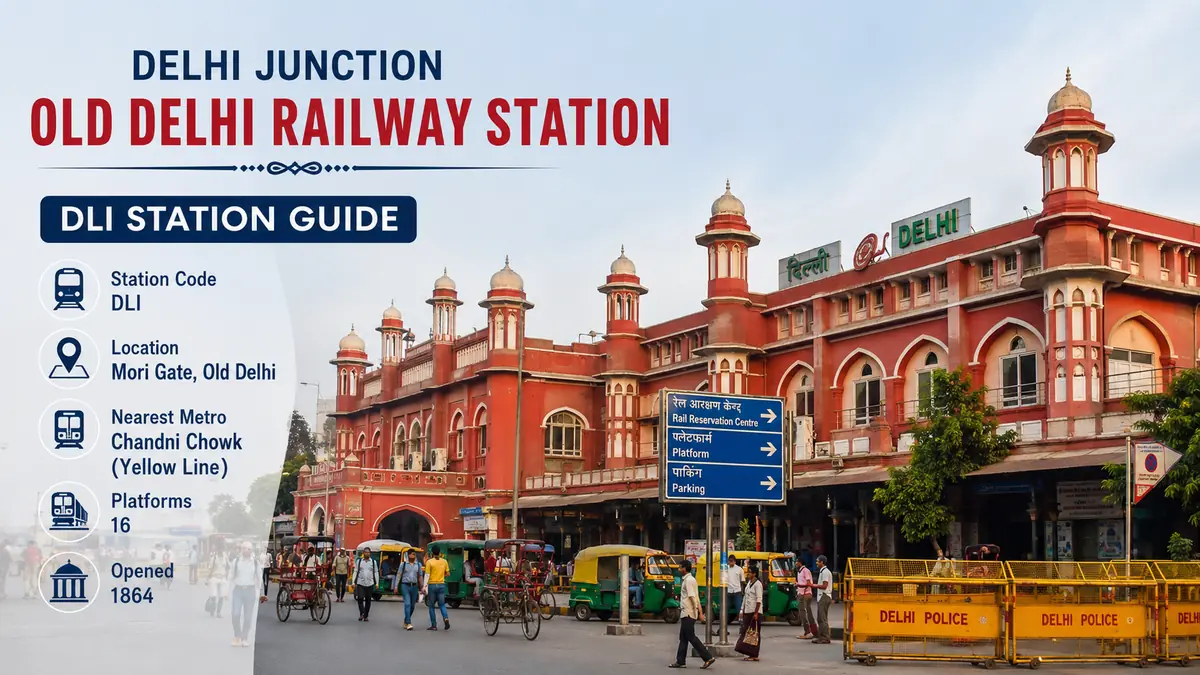
Delhi has several major railway terminals, and their similar names can easily confuse first-time passengers. If your ticket shows DLI, your train uses Delhi Junction—commonly called Old Delhi Railway Station or Purani Dilli Railway Station—not New Delhi Railway Station (NDLS).
delhi railway station old (dli) refers to Delhi Junction, the historic Indian Railways station in Old Delhi near Chandni Chowk and Mori Gate. Its station code is DLI. The station dates to the 19th century, serves long-distance and suburban trains, and is conveniently connected to Chandni Chowk Metro Station on the Delhi Metro Yellow Line.
delhi railway station old (dli) Station Code, Location and Key Details
Delhi Junction is among the oldest major railway stations serving India’s capital. Indian Railways passengers commonly recognize it by the three-letter code DLI.
Here is a quick reference before travelling:
| Station detail | Information |
|---|---|
| Official/common name | Delhi Junction |
| Common alternative name | Old Delhi Railway Station / Purani Dilli |
| Station code | DLI |
| Location | Mori Gate, Old Delhi |
| Nearby landmark | Chandni Chowk |
| Railway zone | Northern Railway |
| Railway division | Delhi |
| Opened | 1864 |
| Present main building | Opened in 1903 |
| Platforms | 16 commonly numbered passenger platforms |
| Tracks | 18 |
| Nearest metro | Chandni Chowk |
| Metro line | Yellow Line |
| Station status | Active |
| Operator | Indian Railways |
Historical and railway references identify DLI as Delhi Junction and place it in Old Delhi close to Chandni Chowk.
One practical rule eliminates most confusion: check the station code on your ticket rather than relying only on the word “Delhi.”
What does DLI mean on a train ticket?
DLI is the Indian Railways station code for Delhi Junction Railway Station, commonly known as Old Delhi Railway Station.
It should not be confused with:
- NDLS — New Delhi Railway Station
- DEE — Delhi Sarai Rohilla
- NZM — Hazrat Nizamuddin
- ANVT — Anand Vihar Terminal
These are separate railway stations in different parts of Delhi.
Is Delhi Junction the Same as Old Delhi Railway Station?
Yes. Delhi Junction and Old Delhi Railway Station generally refer to the same railway station.
The terminology can look inconsistent because passengers, booking platforms and local residents may use different names. You might encounter Delhi Junction, Old Delhi, Purani Delhi, or Purani Dilli while referring to DLI.
The most reliable identifier remains the station code.
DLI = Delhi Junction / Old Delhi Railway Station.
This distinction matters because New Delhi Railway Station is another major terminal. Arriving at NDLS when your train departs from DLI can create a stressful last-minute transfer.
Is Old Delhi Railway Station the same as New Delhi Railway Station?
No.
Old Delhi Railway Station and New Delhi Railway Station are two separate railway terminals.
| Feature | Old Delhi Railway Station | New Delhi Railway Station |
|---|---|---|
| Station code | DLI | NDLS |
| Common name | Delhi Junction | New Delhi |
| General area | Old Delhi / Mori Gate | Central New Delhi |
| Nearby metro | Chandni Chowk | New Delhi |
| Historical role | Delhi’s older major railway station | Later major central terminal |
Delhi Junction predates New Delhi Railway Station by decades and historically served as Delhi’s principal railway gateway before the development of New Delhi.
Quick Takeaway: Never assume “Delhi station” means NDLS. If your reservation says DLI, go to Old Delhi Railway Station.
Where Is delhi railway station old (dli)?
Old Delhi Railway Station is situated around Mori Gate and Chandni Chowk in Old Delhi, close to the historic commercial core of the capital.
The area around the station contains some of Delhi’s best-known historical districts and landmarks, including Chandni Chowk, Red Fort, Kashmere Gate and Jama Masjid.
The station’s position also makes it useful for passengers visiting the walled-city area of Shahjahanabad.
Old Delhi Railway Station address
A practical address for navigation is:
Delhi Junction Railway Station
Old Delhi / Mori Gate
Delhi – 110006
India
Older railway guides describe it as lying between the Chandni Chowk and Kashmere Gate areas.
When using a navigation app or arranging a taxi, searching for “Old Delhi Railway Station (DLI)” or “Delhi Junction Railway Station” helps distinguish it from NDLS.
Nearest Metro Station to Old Delhi Railway Station
For most passengers using public transport, Chandni Chowk Metro Station is the most convenient metro connection for DLI.
Chandni Chowk is on the Yellow Line of the Delhi Metro. Current transit information places it only a few hundred metres from Delhi Junction, while railway references note that underground pedestrian connectivity links the railway station and metro area.
How to reach DLI from Chandni Chowk Metro
A straightforward journey is:
- Travel on the Delhi Metro to Chandni Chowk Metro Station.
- Follow signs toward the Old Delhi Railway Station side.
- Use the pedestrian/subway connection where appropriate.
- Enter the railway station and check the electronic departure board.
- Confirm your platform before proceeding through the foot overbridge or other passenger circulation routes.
Allow additional walking time if you have heavy luggage, elderly passengers, children or several bags.
Is Kashmere Gate Metro close to Old Delhi Railway Station?
Kashmere Gate is also relatively close, but Chandni Chowk is normally the more convenient metro station for direct railway access.
Current public-transit mapping places Chandni Chowk Metro roughly a four-minute walk from the Delhi Junction area, whereas Kashmere Gate is considerably farther on foot.
Kashmere Gate remains useful because it is a major Delhi Metro interchange and is close to the Maharana Pratap ISBT.
How to Reach Old Delhi Railway Station
DLI is surrounded by dense roads, markets and historic neighbourhoods, so your best transport option depends heavily on your starting point and travel time.
By Delhi Metro
The metro is usually one of the most predictable choices because road congestion around Old Delhi can be substantial.
Use the Delhi Metro network to reach Chandni Chowk on the Yellow Line, then continue toward Delhi Junction on foot through the station connection.
Passengers travelling during peak hours should allow extra time for crowds inside both the metro and railway station.
By bus
Delhi city buses serve the Old Delhi and Chandni Chowk areas. Kashmere Gate’s major interstate bus terminal is also nearby.
If you are arriving in Delhi on an interstate bus, check whether your service terminates at Maharana Pratap ISBT, Kashmere Gate. From there, you can continue toward DLI by local transport.
By auto-rickshaw or e-rickshaw
Autos and e-rickshaws are widely used for short journeys around Old Delhi.
They can be useful when travelling from nearby markets, hotels or neighbourhoods, although road congestion and pedestrian activity can make travel times unpredictable.
By taxi or app-based cab
A taxi or app-based cab can be convenient if you have substantial luggage.
Ask the driver specifically for Old Delhi Railway Station / Delhi Junction DLI. Saying only “Delhi Railway Station” creates unnecessary scope for confusion.
During busy periods, it can be faster to leave a little earlier rather than depend on an optimistic navigation-app arrival estimate.
Old Delhi Railway Station Platforms and Layout
Delhi Junction is a large station rather than a small local stop.
Current reference material commonly lists 16 passenger platforms and 18 tracks.
Platforms are linked through passenger circulation routes such as foot overbridges. Depending on your entrance and assigned platform, reaching your train can involve a reasonable amount of walking.
This is particularly relevant when your coach is toward the far end of a long train.
How early should you reach DLI?
For a long-distance departure, arriving roughly 30–45 minutes early is a sensible minimum under ordinary conditions.
Consider allowing closer to an hour when:
- you have never used DLI before;
- you are travelling with children or elderly family members;
- you have several pieces of luggage;
- your assigned platform is far from your entrance;
- you need to use a cloakroom or waiting facility;
- you are travelling during a festival or holiday rush;
- heavy Old Delhi traffic is expected.
Your platform can change, so always verify it on official station displays or railway information systems after arriving.
Trains and Railway Routes Through DLI
Delhi Junction developed as an important junction because railway routes approaching Delhi from several directions converge around the station.
Historically, connections developed toward places including Ghaziabad, Ambala, Rohtak and other northern railway corridors. Reference material describes five railway routes converging at Delhi Junction.
Today DLI handles a combination of long-distance express services and local/suburban trains.
Train schedules change over time, and temporary special trains are frequently introduced during periods of heavy demand. For example, Northern Railway has continued operating special services through Delhi during high-demand periods in 2026.
For that reason, a static list of “all trains from Old Delhi” becomes outdated quickly.
Before travelling, verify:
- train number;
- departure date;
- departure time;
- boarding station code;
- platform;
- running status;
- coach position.
The critical field is boarding station: DLI.
Facilities at Old Delhi Railway Station
As a major railway junction, DLI provides passenger facilities expected at a busy Indian Railways station, though availability and operating arrangements can change.
Travellers may encounter facilities such as waiting areas, food outlets, toilets, drinking-water points, passenger information displays and luggage-related services.
Independent station guides have also documented waiting rooms, AC waiting areas, retiring-room facilities and cloakroom services at DLI.
Waiting areas
Passengers can find seating and waiting areas within the station.
At busy times—particularly around major festivals and overnight departures—these spaces may become crowded.
Keep your ticket and identification accessible if using a passenger facility with eligibility restrictions.
Retiring rooms
Indian Railways retiring rooms are intended primarily for railway passengers needing short-term accommodation around their journey.
Availability, room categories, eligibility and charges can change, so check current railway information before depending on a retiring room for an overnight stay.
Cloakroom and luggage storage
Cloakroom facilities can be particularly useful if you have several hours between trains and want to visit nearby Old Delhi.
Rules regarding accepted luggage, ticket requirements, identification, locking of baggage and storage charges can change. Confirm current requirements at the station rather than relying on older online price lists.
Food and refreshments
Food and refreshment options are available around the station, while the surrounding Old Delhi district provides a much broader range of dining choices.
If your train leaves soon, eating within the station or immediately outside is safer than entering the crowded lanes of Chandni Chowk and assuming you can return quickly.
Accessibility
Delhi Junction is listed as an accessible station in current reference information.
Passengers requiring assistance should still allow extra time because the station is large and movement between distant platforms may take longer than expected.
History of Old Delhi Railway Station
The historical importance of DLI is one of the biggest differences between Delhi Junction and Delhi’s newer terminals.
The station traces its origins to 1864, when railway services connecting Delhi with eastern India were developing. Historical accounts describe trains from Howrah/Calcutta reaching Delhi during this early period.
The station subsequently became a crucial transport gateway to Delhi.
The present building and Red Fort influence
The recognizable historic station building came later.
The present structure was built during British rule and opened in 1903. Its red-toned, fort-like architectural character was deliberately influenced by the nearby Red Fort.
That visual relationship is especially appropriate in Old Delhi, where Mughal-era architecture and later colonial infrastructure exist within the same urban landscape.
Delhi’s railway network expands
Railway development around Delhi accelerated during the early 20th century.
The opening of the Agra–Delhi railway connection further strengthened Delhi’s position as a major rail junction, while lines approaching from different directions connected the capital with northern, western and eastern regions.
Before New Delhi Railway Station
For decades, Delhi Junction functioned as Delhi’s principal railway station.
Development of New Delhi as the imperial capital eventually required changes to railway alignments and infrastructure. New Delhi Railway Station later emerged as another major terminal, but DLI retained its importance within the network.
Later modernization
Delhi Junction did not remain frozen in its early-20th-century form.
Historical records describe remodelling in the 1930s, platform extensions, signalling improvements and later expansion. A new Kashmere Gate-side entrance and additional platforms were developed during subsequent modernization phases.
Platform numbering was reorganized in 2011, and further renovation followed.
Heritage Conservation and Future Improvements
Old Delhi Railway Station has renewed heritage significance in 2026.
Northern Railway has been coordinating plans to preserve the station’s historic architectural identity while upgrading its functionality. The conservation focus includes its red-stone appearance, arches and fort-like towers, architectural characteristics closely associated with its historic setting near the Red Fort.
This approach differs from simply replacing an old station building with a modern terminal.
The challenge is balancing two needs: protecting a historically significant railway structure while allowing it to function efficiently as a heavily used transport hub.
The surrounding public realm has also received attention. The Delhi Development Authority’s UTTIPEC approved a Walkability Plan for Old Delhi Railway Station in 2022, reflecting the importance of pedestrian movement around this congested part of the city.
These improvements matter because the railway station sits inside a much larger heritage landscape rather than an isolated transport precinct.
Old Delhi Railway Station and Chandni Chowk
One advantage of DLI is its exceptional location.
Chandni Chowk is immediately associated with the station area, putting travellers close to the historic centre of Shahjahanabad.
Nearby attractions and districts include:
- Chandni Chowk
- Red Fort
- Jama Masjid
- Kashmere Gate
- Dariba Kalan
- Old Delhi markets and historic streets
The station can therefore function as both a transport gateway and an entry point into historic Delhi.
However, do not treat a short geographic distance as a guaranteed short journey. Pedestrian congestion, traffic and busy market streets can slow movement considerably.
Old Delhi Railway Station vs New Delhi Railway Station
Confusing DLI and NDLS is one of the easiest travel mistakes to make in Delhi.
Remember this comparison:
| If your ticket says | Go to |
|---|---|
| DLI | Delhi Junction / Old Delhi Railway Station |
| NDLS | New Delhi Railway Station |
| DEE | Delhi Sarai Rohilla |
| NZM | Hazrat Nizamuddin |
| ANVT | Anand Vihar Terminal |
Delhi Sarai Rohilla, for example, has the station code DEE and is another distinct Northern Railway station.
What if you accidentally reach NDLS instead of DLI?
Do not wait until your scheduled departure time to correct the mistake.
Check your train’s current boarding details immediately and calculate the journey to DLI using live traffic or metro information. Delhi traffic can vary dramatically by time of day.
If sufficient time remains, the metro can provide a relatively predictable connection because both railway stations have access to Delhi’s metro network.
The better strategy is prevention: check the three-letter station code before leaving your hotel or home.
Practical Tips for Using delhi railway station old (dli)
A little preparation makes DLI much easier to navigate.
1. Use DLI in your navigation search
Searching the exact station code helps reduce confusion with New Delhi Railway Station.
2. Recheck the platform after entering
Do not depend entirely on an old screenshot, message or third-party app. Look at the current departure board and railway announcements.
3. Allow time to reach your platform
DLI has numerous platforms. Crossing from one side of a large station to another while carrying luggage takes time.
4. Keep your ticket and identification handy
You may need them during your railway journey or when accessing certain passenger facilities.
5. Protect valuables in crowded areas
Old Delhi, Chandni Chowk, metro stations and major railway terminals can become extremely crowded. Keep phones, wallets and travel documents secure.
6. Plan for road congestion
Traffic conditions around Old Delhi are not always predictable. Metro travel can remove much of that uncertainty.
7. Confirm live train information
Train schedules, platforms and running status can change. Use current Indian Railways information rather than relying on an old timetable published online.
Quick Takeaway
For most first-time passengers, the easiest plan is simple: verify DLI on the ticket, reach Chandni Chowk Metro Station if travelling by metro, arrive well before departure, and confirm the platform once inside Delhi Junction.
Why DLI Still Matters to Delhi
Delhi now has multiple important railway terminals, but Old Delhi Railway Station retains a distinctive role.
It is simultaneously a working Indian Railways junction, a gateway to historic Old Delhi and a surviving piece of the city’s railway heritage.
Its location near Chandni Chowk connects today’s passengers with the commercial heart of Shahjahanabad, while its early railway history reflects the transformation of Delhi into a major transport centre.
The planned heritage-focused improvements make that identity particularly relevant today: modernization does not necessarily have to erase the station’s historical character.
For anyone searching delhi railway station old (dli) before a journey, the essential facts are straightforward: DLI is Delhi Junction, commonly called Old Delhi Railway Station; it is located near Mori Gate and Chandni Chowk; Chandni Chowk on the Yellow Line is the nearest convenient metro station; and it is completely separate from New Delhi Railway Station (NDLS).
Check the DLI station code, your current train status and your assigned platform before departure, then allow enough time to navigate one of Delhi’s oldest and most historically significant railway gateways.