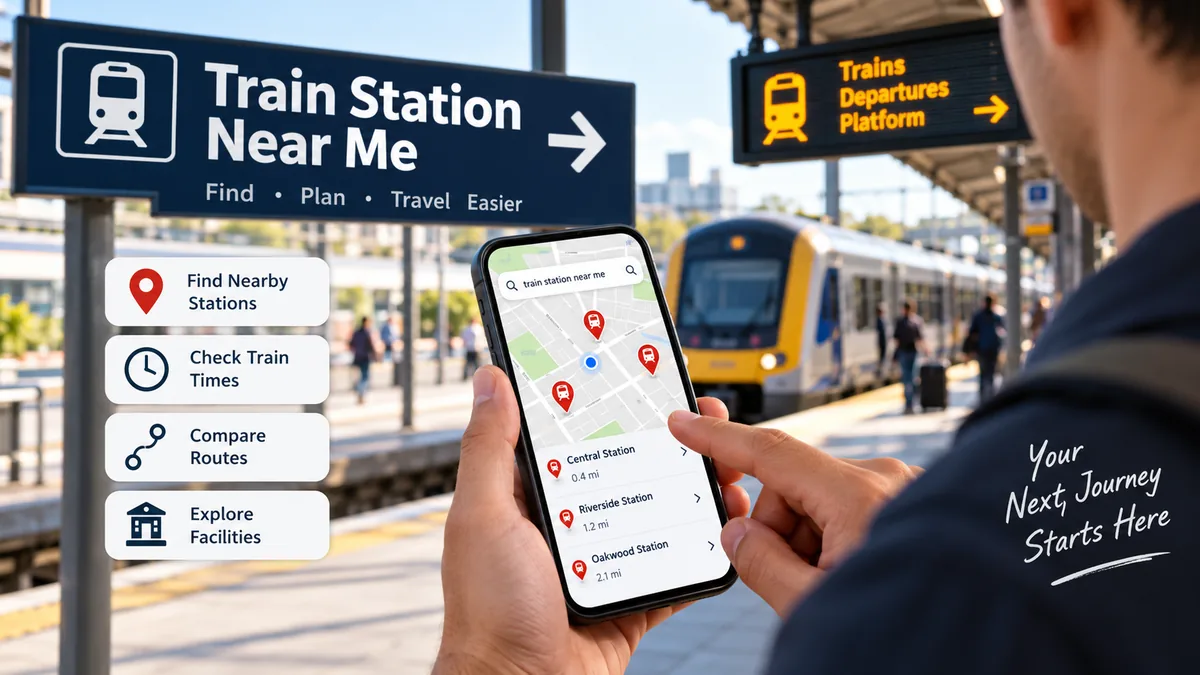
Searching for a train station near me usually means you need more than a station name. You may need to know which station is genuinely closest, how long it takes to reach, whether your train stops there, and when the next service leaves.
The quickest way to find a train station near you is to use your phone’s location in a mapping or railway service, search for nearby railway stations, compare actual walking or driving routes, and then verify departures with the relevant rail operator. The geographically closest station is not always the most useful one for your journey.
This guide explains how to find the right station, check its distance, understand the difference between railway and metro stations, and verify schedules before leaving.
How to Find a train station near me
For most travelers, a map application is the easiest starting point. Modern mapping services use your device’s GPS or approximate location to display nearby transport facilities.
A simple process works almost anywhere:
- Turn on location services on your phone.
- Open a map or trusted public-transport application.
- Search train station near me.
- Look at the nearest two or three railway stations.
- Compare walking, driving, taxi, bus, or public-transit travel times.
- Check which trains actually serve each station.
- Verify the latest departure information before traveling.
This final step matters. A station can be physically close but have limited services, while a slightly farther junction or main station may provide a direct train to your destination.
Quick Takeaway
Nearest does not necessarily mean best. Compare the station’s route, service frequency, connections, accessibility, and actual travel time before deciding where to board.
Use Your Current Location to Find the Nearest Railway Station
Location-based searches work best when your device has permission to determine where you are.
When GPS is available, a mapping service can place your current position on the map and identify railway stations around it. Google Maps, Apple Maps, local transit applications, and national railway journey planners can all be useful depending on the country.
Google Maps, for example, can display railway stations and provide directions from your current location.
Search Using GPS
On a smartphone:
- Enable Location or Location Services.
- Open your preferred map application.
- Search for “train station” or the exact keyword train station near me.
- Select a station marker.
- Choose Directions.
- Compare walking, driving, cycling, and public-transit options where available.
Your phone’s location does not need to be perfect to start the search. Once nearby stations appear, compare the actual routes rather than relying only on the order in which the results are displayed.
Search Without Sharing Your Location
You can still find nearby stations without enabling GPS.
Search using:
- your city or town
- neighborhood
- street
- postcode or ZIP code
- hotel name
- airport
- landmark
- university
- shopping center
- destination address
For example, instead of searching “nearest railway station,” you could search for “railway station near [postcode]” or “train station near [landmark].”
Some dedicated station finders support postcode, town, station-name, and station-code searches. In the UK, for instance, TrainMap allows searches using a postcode, place, station name, or three-letter station code and returns nearby stations.
How Far Is the Nearest Train Station?
There are several ways to measure the distance to a railway station, and they can produce very different answers.
| Distance type | What it means | Best used for |
|---|---|---|
| Straight-line distance | Direct distance between two geographic points | Identifying potentially nearby stations |
| Walking distance | Distance along walkable streets and paths | Travelers going on foot |
| Driving distance | Road distance to the station | Cars, taxis and drop-offs |
| Public-transit time | Time using buses, metro or other transit | Urban journeys |
| Estimated travel time | Expected time based on the selected route | Deciding which station is practical |
A station locator might say a station is 1 mile away because it measures a straight line. The actual walking journey could be significantly longer because of rivers, railway tracks, motorways, restricted crossings, or street layouts.
This distinction appears in dedicated station-finding tools as well. TrainMap, for example, explains that its nearest-station distances are straight-line measurements and that walking or driving routes can be longer.
Distance vs. Travel Time
Travel time is usually more useful than raw distance.
Imagine:
Station A: 1.2 miles away, 28-minute walk
Station B: 1.7 miles away, 8-minute bus ride
Station C: 2 miles away, 7-minute drive
Station A is technically nearest, but it may not be the practical choice.
If you are catching a specific train, work backward from its departure time and include enough time to reach the correct entrance and platform.
Is the Closest Station the Right Station?
This is one of the most common mistakes when searching for a nearby railway station.
Suppose you find a small station five minutes away. Your destination may require two changes from that station. A larger railway station 15 minutes away could offer a direct service.
Before choosing, check four things:
1. Does Your Train Stop There?
Not every train serves every station along a railway line.
Express and intercity trains commonly skip smaller stations. Confirm that your intended service actually stops at the station you found.
2. Can You Reach Your Destination Directly?
A direct train can be easier than starting at the absolute nearest station and changing trains multiple times.
Compare:
- number of changes
- total journey duration
- connection times
- service frequency
This becomes particularly important when traveling with children, heavy luggage, mobility equipment, or during busy periods.
3. How Frequent Are the Trains?
A larger station may have departures every few minutes or multiple services per hour, while a small station may have a much less frequent timetable.
Missing one departure at a low-frequency station can significantly delay your trip.
4. What Facilities Are Available?
Depending on your needs, check for:
- ticket machines or ticket counters
- waiting rooms
- toilets
- elevators or lifts
- step-free access
- parking
- bicycle storage
- taxi pickup areas
- bus connections
- food and drink
- luggage facilities
- customer assistance
Station facilities vary considerably, so verify anything essential before traveling.
train station near me for Walking
If you plan to walk, don’t select a station based solely on its apparent proximity on the map.
Choose the station and request walking directions.
Pay attention to:
- pedestrian crossings
- bridges and underpasses
- station entrances
- steep streets
- stairs
- pedestrian-only paths
- construction
- accessibility requirements
Large stations can have several entrances. Your map may direct you to one side of the building even though your platform is easier to reach from another entrance.
A Practical Walking Rule
Give yourself more time than the map’s minimum estimate.
An estimated 12-minute walk doesn’t mean arriving 12 minutes before departure is safe. You may still need to find the entrance, identify the platform, pass through ticket barriers, buy or validate a ticket, and walk along the platform.
train station near me by Car or Taxi
Driving introduces a different set of considerations.
The nearest railway station by straight-line distance may require a longer road journey than another station because roads do not follow railway lines directly.
When comparing stations, look at:
Driving time: Use the road route rather than geographic distance.
Parking: Determine whether the station has parking and whether restrictions, charges, or capacity limitations apply.
Drop-off area: Major stations may have designated taxi and passenger drop-off zones.
Traffic: City-center railway stations can be surrounded by congestion, particularly during commuting periods.
Station entrance: A large station’s official address may not correspond to the most convenient vehicle entrance.
If someone is dropping you off, share the specific entrance or drop-off point rather than simply sending the station name.
Railway Station vs. Metro, Subway and Tram Stop
A search for a nearby train station can produce several types of transit stops.
They aren’t necessarily interchangeable.
Mainline Railway Station
A conventional railway station generally serves regional, commuter, intercity, or long-distance trains.
Depending on the country, examples include services operated through national railway networks, commuter rail agencies, or intercity operators.
Metro or Subway Station
Metro systems primarily handle urban transportation.
Depending on the city, these may be called:
- Metro
- Subway
- Underground
- MRT
- U-Bahn
- Rapid transit
A metro station may connect you to a mainline railway terminal, but it isn’t automatically a long-distance railway station.
Light Rail or Tram Stop
Light rail and trams generally serve local urban or suburban routes.
Map searches sometimes show these alongside conventional railway stations, which can cause confusion when you’re trying to catch an intercity train.
Some specialized railway maps deliberately separate mainline railways, trams, light rail, and underground systems into different map layers for this reason.
Train Station vs. Railway Station
In everyday English, “train station” and “railway station” usually refer to the same basic place: a facility where passengers board or leave trains.
The preferred wording varies by country. “Railway station” is common in countries including the UK, India, and Pakistan, while “train station” is widely used in the United States and everyday international searches.
Check Live Train Times Before Going to the Station
Finding the station solves only the first part of the problem.
Next, check the departure board.
Look for:
- scheduled departure time
- estimated departure time
- platform number
- delays
- cancellations
- service alterations
- destination
- intermediate stops
A timetable tells you when a train is supposed to operate. Live running information tells you what is happening now.
Where real-time information is available, check it shortly before leaving and again when you arrive.
Why Platform Information Can Change
Operational requirements can cause platforms to change.
Treat the platform shown in an app before your journey as useful guidance rather than a guarantee. Once at the station, check official departure screens and announcements.
Finding Nearby Stations in Different Countries
The basic method is universal, but railway systems and terminology vary by country.
United States
For intercity journeys, travelers commonly need to determine whether the nearest passenger station is served by Amtrak or by a regional or commuter railway.
A station physically close to you might serve only commuter trains.
If you’re planning an intercity journey, check the operator and route rather than assuming every nearby railway station provides the same type of service.
United Kingdom
The UK has an extensive National Rail network alongside systems such as the London Underground, light rail, and local metro services.
Station searches can use place names, postcodes, or three-letter station codes. Dedicated UK mapping tools can rank nearby stations by approximate geographic distance.
If you’re in London, pay particular attention to the distinction between National Rail stations and Underground stations.
Pakistan
Pakistan Railways connects major cities and many smaller communities across the country.
Major railway stations include those serving Karachi, Lahore, Rawalpindi, Multan, Faisalabad, Peshawar, Hyderabad and other cities. Railway information services can also provide station directories, schedules, train status, and journey-planning information.
For long-distance travel, check whether your chosen train stops at the smaller station nearest to you. In some cases, traveling to a major junction or larger station can provide a wider choice of services.
Other Countries
The same principle applies internationally.
Start with a map to identify possible stations, then switch to the official railway or local transit information source to confirm:
- station name
- train operator
- route
- timetable
- ticket requirements
- live status
This combination is more reliable than treating a general map search as a complete journey planner.
How to Find the Nearest Station by Postcode or ZIP Code
A postcode or ZIP code is useful when GPS isn’t available or when you’re planning a journey from somewhere other than your current location.
The process is straightforward:
- Enter the postcode or ZIP code into a map or station finder.
- Search for railway stations around that location.
- Identify several nearby stations.
- Compare their actual routes from the address.
- Check train services from each station.
- Choose the station that best fits your journey.
In Britain, some station tools specifically rank railway stations based on the location represented by a postcode.
Remember that a postcode usually represents an area rather than your exact physical position. For precise walking directions, use the complete address when possible.
How to Find a Train Station Near a Hotel, Airport or Landmark
You don’t have to be physically present at a location to find its nearest railway station.
This is especially helpful when planning travel in advance.
Search combinations such as:
- nearest railway station to my hotel
- train station near the airport
- closest train station to a tourist attraction
- railway station near university
- station near city center
- train station near destination address
Then compare routes.
Airports
Be careful with airports because several different rail arrangements exist.
An airport may have:
- a railway station inside the terminal
- a station connected by shuttle
- a metro station
- an airport express service
- no direct railway connection
Check the actual terminal you’re using rather than assuming the airport has one universal rail stop.
Hotels
Hotels in large cities may sit between several stations.
Ask a more useful question than “Which station is closest?”
Ask:
Which station gives me the easiest journey to where I’m going?
A station an extra five minutes away may eliminate a transfer later.
How Early Should You Arrive at the Train Station?
There is no universal arrival time because railway systems operate differently.
For a simple commuter service from a familiar station, passengers may need relatively little extra time. A large unfamiliar terminal, long-distance train, border-control procedure, ticket collection requirement, or luggage process can require substantially more.
Build extra time into your plan when:
- visiting the station for the first time
- traveling from a large terminal
- buying or collecting tickets
- carrying substantial luggage
- traveling with children
- needing accessibility assistance
- making a connection
- traveling during peak periods
- station security or identity checks may apply
Check the railway operator’s instructions for your specific service rather than relying on a universal rule.
What to Check Before Leaving Home
Once you’ve identified the nearest suitable station, perform a quick journey check.
| Check | Why it matters |
|---|---|
| Correct station | Cities can have several stations with similar names |
| Train stops there | Express services may skip smaller stations |
| Departure time | Timetables can vary by day |
| Live status | Delays and cancellations can occur |
| Route to station | Walking and road distance may differ |
| Platform | Helps you navigate, though it may change |
| Ticket requirements | Rules vary between operators and networks |
| Accessibility | Step-free routes aren’t available everywhere |
| Parking/drop-off | Useful when arriving by vehicle |
| Connections | Important if your journey requires transfers |
A two-minute check can prevent a much larger problem at the station.
Common Mistakes When Searching for the Nearest Railway Station
Finding a station sounds simple, but a few mistakes repeatedly cause problems.
Choosing the First Map Result
Search-result order isn’t a substitute for journey planning.
Open several nearby stations and compare them.
Confusing Straight-Line and Walking Distance
A railway line, river, motorway, fenced property, or lack of pedestrian crossings can turn a geographically short distance into a surprisingly long walk.
Use directions to calculate a realistic route.
Finding the Wrong Type of Station
Metro, subway, tram, light rail, commuter rail, and intercity rail can all appear in transport searches.
Check which network serves the station.
Ignoring the Train’s Stopping Pattern
Being close to the railway does not mean your train stops there.
Verify the stops for your specific service.
Relying on an Old Screenshot
Train schedules, platforms, service patterns, and disruptions can change.
Use current information whenever possible.
Arriving With No Time Buffer
Navigation doesn’t end when you reach the station building. Large terminals can require several more minutes to reach the correct platform.
What If There Is No Train Station Nearby?
In rural areas and cities without passenger rail, the nearest railway station may be many miles or kilometers away.
Consider a multimodal journey:
Home → bus/taxi/car → railway station → train → destination
A coach or bus terminal may sometimes offer a more practical starting point than traveling a long distance to a railway station.
You can also check nearby towns. A larger town slightly farther away may have better rail connections, more frequent services, parking, or direct trains.
How to Choose Between Two Nearby Stations
When two stations appear equally convenient, compare the whole journey rather than only the first leg.
Use this order:
- Direct service to your destination
- Total journey time
- Train frequency
- Reliability of connections
- Time needed to reach the station
- Accessibility and facilities
- Parking or local transit connections
For example, imagine one station is a 7-minute walk away but requires two train changes. Another is a 15-minute walk away and offers a direct service.
For many passengers, the second station will be the easier option despite being farther away.
Quick Takeaway
The best station minimizes the difficulty of the entire journey, not merely the distance between your front door and the platform.
Can I Find a train station near me Without GPS?
Yes.
GPS makes a nearby search easier, but it isn’t essential.
Enter a location manually using a:
- postcode
- ZIP code
- address
- town
- city
- landmark
- station name
You can then examine nearby stations and request directions from your chosen starting point.
This approach is also useful for planning tomorrow’s journey from a hotel, workplace, airport, or another location where you aren’t currently standing.
How Accurate Are Nearest-Station Finders?
They are useful for identifying candidates, but their results need context.
A station finder can accurately calculate which station is geographically closest while still failing to tell you which station is easiest to reach.
For example, a tool based on coordinates may calculate straight-line distance. A routing service instead considers the roads or pedestrian paths connecting the two points.
That distinction explains why two services can legitimately give apparently different answers.
Think of a station locator as the discovery step and route planning as the verification step.
A Better Way to Search for a train station near me
When you need a train quickly, use this simple sequence:
Locate → Compare → Verify → Navigate
Locate: Find two or three nearby railway stations using GPS, an address, postcode, or map.
Compare: Check actual walking, driving, or transit time rather than straight-line distance.
Verify: Confirm your train serves the station and check the latest timetable or live departure information.
Navigate: Follow directions to the appropriate station entrance and allow enough time to reach your platform.
This method solves the biggest weakness of a basic train station near me search: the closest dot on a map isn’t necessarily the station you should use.
Final Thoughts on Finding a train station near me
A train station near me search is the fastest way to identify nearby railway options, but don’t stop at the first result. Check actual travel time, station type, train routes, stopping patterns, live departures, accessibility, and available facilities.
For the most reliable journey, use your map or station locator to identify nearby stations, then verify the service with the relevant railway or transit operator before leaving. That extra check helps ensure you’re heading not just to the closest station, but to the right one.