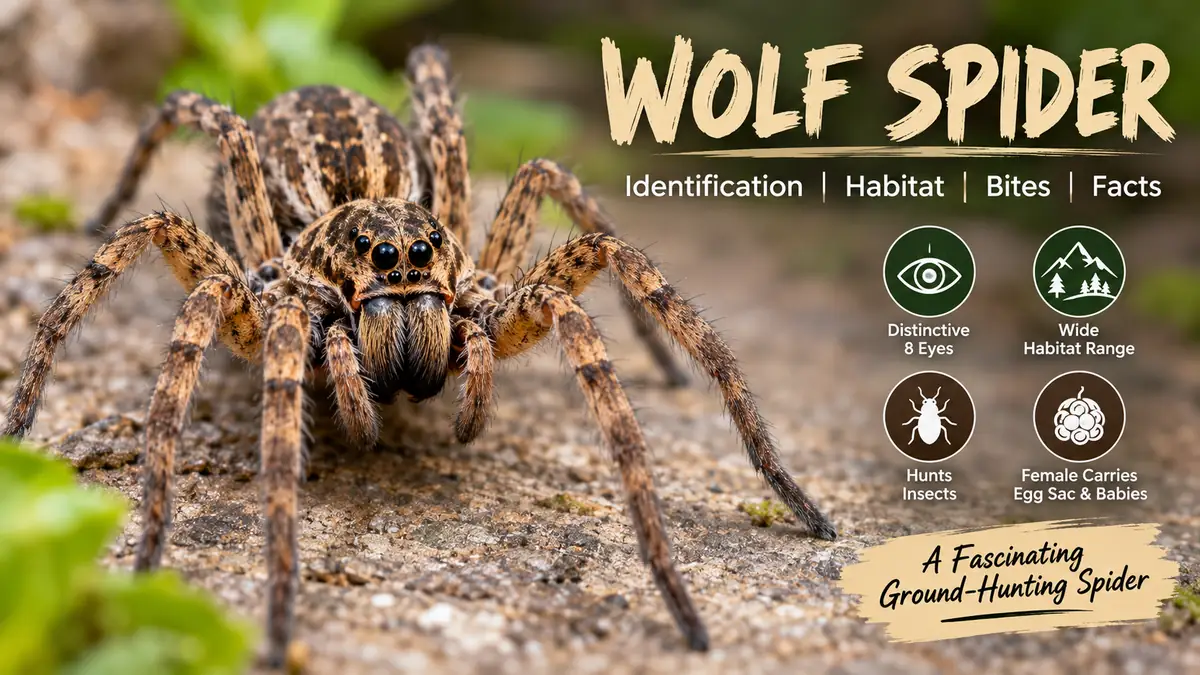
A large, fast spider racing across the floor can be alarming, especially when it is brown, hairy, and seemingly headed straight toward you. In many cases, that intimidating visitor is a wolf spider—an active hunter that is far more interested in insects than people.
A wolf spider is a ground-hunting spider in the family Lycosidae. Unlike many spiders, wolf spiders usually chase or ambush prey rather than relying on a capture web. They are recognizable by their distinctive eight-eye arrangement, strong legs, excellent vision, and the female’s unusual habit of carrying her egg sac and newly hatched spiderlings.
Wolf spiders occur in a remarkable range of environments and include thousands of species worldwide. Their size and speed often make them look threatening, but they generally avoid humans and provide useful natural pest control.
What Is a Wolf Spider?
Wolf spiders belong to the spider family Lycosidae, within the order Araneae. The family contains numerous genera, including Hogna, Tigrosa, Pardosa, Arctosa, Allocosa, and others. Taxonomy within Lycosidae continues to be studied and revised as researchers examine species and relationships among different groups.
The name “wolf spider” comes from their active predatory lifestyle. Instead of sitting in a sticky web waiting for an insect to become trapped, most species hunt on or near the ground.
Some roam through vegetation, leaf litter, fields, and shorelines. Others use burrows as shelters and ambush points.
This hunting behavior is one of the easiest ways to understand why a wolf spider sometimes appears unexpectedly inside a house: it may simply be wandering while searching for prey or shelter.
Do Wolf Spiders Make Webs?
Wolf spiders produce silk, but they generally do not build the familiar prey-catching webs associated with orb-weavers and many house spiders.
Silk still serves several purposes.
A wolf spider may use it for:
- Lining or protecting a retreat
- Constructing an egg sac
- Reproductive behavior
- Providing safety lines during movement
- Protecting a burrow or resting area
Their primary hunting strategy, however, relies on movement, camouflage, eyesight, and speed rather than trapping prey in a large web.
Quick takeaway: Seeing a large spider running across open ground rather than sitting in a web is one clue that you may be looking at a wolf spider.
What Does a Wolf Spider Look Like?
Wolf spiders vary substantially because Lycosidae is a large family rather than a single species.
Most have earthy coloration—brown, gray, tan, or combinations of these colors—with darker stripes, bands, or mottled patterns. This camouflage helps them disappear against soil, bark, rocks, dead leaves, and other ground surfaces.
Common characteristics include:
| Feature | Typical Wolf Spider Characteristic |
|---|---|
| Body | Robust and often hairy |
| Color | Brown, gray, tan, or dark brown |
| Legs | Eight strong walking legs |
| Eyes | Eight arranged in three rows |
| Movement | Fast-running ground hunter |
| Web | Usually no prey-catching web |
| Female | Carries egg sac on spinnerets |
| Spiderlings | Ride on mother’s abdomen after hatching |
Size varies greatly between species. University of Minnesota Extension describes wolf spiders ranging from roughly 1/4 inch to an inch or more, while some particularly large species can be considerably more imposing when their legs are included.
Wolf Spider Eyes Are One of the Best Identification Clues
Color alone is unreliable for identifying spiders. Many unrelated species are brown, gray, striped, or hairy.
The eye arrangement provides a much better clue.
Wolf spiders have eight eyes arranged in three rows. Four relatively small eyes form the lower row, with two much larger eyes above them and another pair farther back.
Those prominent eyes are associated with the strong vision wolf spiders use while hunting. Their eyes can also reflect light, which is why wolf spiders may produce noticeable eye shine when illuminated at night.
Naturalists sometimes locate wolf spiders after dark by shining a flashlight across grass or soil and looking for tiny reflected points of light.
Wolf Spider vs Brown Recluse: How to Tell the Difference
One common concern is whether a large brown spider might actually be a brown recluse.
The two should not be identified based on brown coloration alone.
A wolf spider usually has a sturdier, hairier appearance and eight eyes. Brown recluse spiders have six eyes rather than eight and are known for a characteristic violin-like marking, although relying on a single marking is not always sufficient for accurate identification.
| Characteristic | Wolf Spider | Brown Recluse |
|---|---|---|
| Family | Lycosidae | Sicariidae |
| Eyes | 8 | 6 |
| Body appearance | Often robust and hairy | Generally smoother and more slender |
| Pattern | Often stripes or mottling | May show violin-shaped marking |
| Hunting | Active hunter | Wandering hunter |
| Medical significance | Usually mild bite | Bite can be medically significant |
If a medically significant spider is suspected, avoid handling it simply to obtain a closer look.
Photographing the spider from a safe distance can be more useful than trying to catch it with bare hands.
Where Do Wolf Spiders Live?
Wolf spiders have an enormous geographic distribution. They occur across much of the world and have adapted to habitats ranging from forests and grasslands to shorelines and dry environments.
Cleveland Clinic notes that members of the family occur on every continent except Antarctica.
Typical wolf spider habitat includes:
- Grasslands
- Forest floors
- Fields
- Gardens
- Leaf litter
- Beneath stones and logs
- Shorelines
- Burrows
- Agricultural areas
- Areas around buildings
Some groups are remarkably specialized. For example, research on Allocosa includes species associated with sandy estuarine and oceanic coastal habitats, while Australian Tetralycosa includes spiders adapted to saline environments.
That diversity explains why there is no single universal “wolf spider habitat.”
Why Do Wolf Spiders Come Inside Houses?
A wolf spider indoors does not necessarily indicate an infestation.
Because these spiders actively move while hunting, individuals can wander through cracks, door gaps, garages, basements, sheds, or other openings.
Common indoor locations include:
- Basements
- Garages
- Sheds
- Storage rooms
- Closets
- Around doors
- Near ground-level windows
Homes with plenty of insect prey may naturally attract more predatory spiders.
Wolf spiders generally aren’t trying to establish themselves around people. A building can simply provide shelter, favorable temperatures, and access to insects.
What Do Wolf Spiders Eat?
Wolf spiders are predators.
Their diet consists primarily of insects and other small arthropods that they can overpower. Depending on species and size, potential prey can include crickets, flies, beetles, cockroaches, grasshoppers, and other spiders.
Instead of constructing an elaborate trapping web, a wolf spider may stalk prey, chase it, wait in camouflage, or attack from near a burrow.
After catching an animal, the spider uses its chelicerae and fangs to subdue it.
This predatory lifestyle makes wolf spiders beneficial members of many ecosystems. University of Minnesota Extension specifically describes them as beneficial predators of insects.
They help form part of a much larger food web: wolf spiders consume smaller organisms while themselves becoming prey for birds, reptiles, amphibians, larger arthropods, and other predators.
How Wolf Spiders Hunt
The hunting behavior of Lycosidae separates them from the stereotypical image of a spider waiting motionlessly in a web.
Strong legs allow them to move quickly across the ground, while their vision helps them detect prey and navigate their surroundings.
Different species use different strategies.
Active Pursuit
Some species wander through suitable habitat searching for prey. Once potential food is detected, the spider can quickly close the distance and attack.
Ambush Hunting
Other wolf spiders remain relatively still and attack prey when it moves within striking distance.
Burrow Hunting
Some species occupy burrows that provide shelter from predators and environmental extremes. The spider can remain near the entrance and rush toward suitable prey that approaches.
These strategies explain the “wolf” comparison better than appearance does. Wolf spiders are built for active predation rather than passive web trapping.
Are Wolf Spiders Dangerous?
For most people, wolf spiders are not considered dangerous.
They possess venom because venom helps them subdue prey, but that does not mean their venom presents a serious threat to humans.
Wolf spiders also aren’t generally aggressive toward people. Bites are most likely when a spider becomes trapped against the skin, is handled, or otherwise feels threatened.
The spider’s intimidating size therefore gives a misleading impression of its medical significance.
Do Wolf Spiders Bite Humans?
Yes. A wolf spider is physically capable of biting a person.
That is different from actively seeking humans to bite.
A defensive bite may occur if someone:
- Picks up the spider
- Traps it against their body
- Reaches into its hiding place
- Puts on clothing or footwear containing a spider
- Handles materials where a spider is sheltering
Avoiding direct handling greatly reduces the chance of being bitten.
What Does a Wolf Spider Bite Look Like?
A confirmed wolf spider bite can cause localized symptoms such as:
- Redness
- Pain
- Swelling
- Itching
- A small raised bump
- Possible fang marks
Symptoms are generally mild and should gradually improve. Cleveland Clinic states that wolf spider venom isn’t considered dangerous to humans and that most bites do not require medical treatment.
There is an important limitation, though: you usually cannot identify the spider responsible for a mysterious skin lesion simply by looking at the bite.
Many insect bites, infections, allergic reactions, and skin conditions can resemble what people call a “spider bite.”
If the spider wasn’t actually observed biting, identification based solely on the skin reaction is unreliable.
What Should You Do After a Wolf Spider Bite?
For a mild, confirmed bite, basic first aid is usually appropriate:
- Wash the area gently with soap and warm water.
- Apply a cold pack or cool damp cloth.
- Avoid scratching the affected skin.
- Monitor redness, pain, and swelling.
- Seek medical advice if symptoms become severe, spread, or fail to improve.
Cleveland Clinic also notes that antihistamines may help itching and over-the-counter pain relievers can help manage discomfort in appropriate individuals.
When Does a Spider Bite Need Medical Attention?
Do not assume that a serious reaction is “just a wolf spider bite.”
Seek prompt medical care for symptoms such as difficulty breathing, facial or mouth swelling, severe or worsening pain, spreading rash, significant dizziness, vomiting, fever, discharge from the wound, muscle cramps, or other severe systemic symptoms. Difficulty breathing or signs of anaphylaxis require emergency attention.
This matters because the spider may have been misidentified, the wound could be infected, or the person may be experiencing an allergic reaction.
Quick takeaway: Wolf spider bites are usually mild, but severe symptoms after any suspected spider bite deserve medical evaluation rather than home identification.
Wolf Spider Life Cycle and Reproduction
One of the most fascinating things about wolf spiders isn’t their hunting behavior at all. It is their parental care.
After mating, a female produces eggs and encloses them in a silk egg sac.
Unlike spiders that simply leave an egg sac attached somewhere, a female wolf spider carries the egg sac attached to her spinnerets at the rear of her abdomen.
She continues walking and hunting while carrying it.
Why Does a Wolf Spider Carry Babies on Its Back?
After the eggs hatch, the spiderlings climb onto their mother’s abdomen.
A female covered with dozens of tiny spiderlings can look startling at first glance, but this behavior is normal for wolf spiders and is one of the family’s most recognizable characteristics. University of Minnesota Extension highlights both the attached egg sac and spiderlings riding on the female’s abdomen as identifying traits.
The young eventually disperse and begin independent lives.
This level of maternal care distinguishes wolf spiders from many other familiar spider groups.
If you find a female carrying spiderlings, crushing or disturbing her can scatter numerous tiny spiders in every direction. Moving her outside intact is usually a cleaner solution.
Common Types of Wolf Spiders
“Wolf spider” describes an entire family rather than one species, so appearance and behavior vary considerably.
In the United States alone, Penn State Extension reports approximately 240 species in 21 genera. It highlights Hogna and Tigrosa as notable groups containing some of the larger wolf spiders encountered in its region.
Hogna
The genus Hogna includes some large and visually impressive wolf spiders. Hogna carolinensis, for example, is among the larger species encountered in parts of the United States.
Tigrosa
Tigrosa species are another group of robust wolf spiders. Penn State Extension discusses Tigrosa aspersa among notable wolf spiders that may occasionally enter homes.
Pardosa
Members of Pardosa are generally active hunters commonly associated with ground-level habitats. The genus represents another example of the considerable diversity within Lycosidae.
Arctosa
Arctosa occurs across multiple regions. Taxonomic work on Indian wolf spiders, for example, has examined species of this genus using museum collections and type specimens, illustrating how identification can require detailed anatomical study rather than appearance alone.
Artoria
The diversity of wolf spiders continues to become clearer through taxonomic research. A 2024 revision of Artoria in Western Australia recognized 20 species in the region, including 13 described as new to science in that work.
These examples show why online photographs labeled simply “wolf spider” can look surprisingly different from one another.
Are Wolf Spiders Good to Have Around?
Outdoors, wolf spiders are generally beneficial.
They naturally hunt insects and other arthropods without damaging plants, wood, clothing, or buildings.
A wolf spider in a garden may therefore be doing exactly what you would want a natural predator to do: reducing populations of small insects while participating in the local ecosystem.
They are not parasites and do not feed on humans or pets.
They also don’t consume household materials or bore into structural wood.
For most outdoor encounters, there is little reason to interfere with them.
How to Remove a Wolf Spider From Your House Safely
Finding one indoors does not mean you need to touch or kill it.
For a single spider, a simple capture-and-release approach often works:
- Place a wide container over the spider.
- Carefully slide a stiff piece of paper or thin cardboard underneath.
- Keep the container and card together.
- Carry the spider outside.
- Release it away from frequently used entrances.
Wear gloves if appropriate and avoid handling the spider directly.
Because wolf spiders can move quickly, use a container considerably wider than the spider rather than trying to trap it with your hands.
How to Reduce Wolf Spiders Indoors
If wolf spiders repeatedly appear inside, focus on the conditions allowing them to enter rather than treating every spider as the underlying problem.
Useful measures include:
- Seal cracks around doors and windows.
- Repair damaged screens.
- Add weather stripping to exterior doors.
- Reduce clutter in basements and garages.
- Keep firewood outside and away from living spaces.
- Shake out stored shoes, gloves, and outdoor clothing.
- Reduce insect prey inside the home.
- Remove unnecessary hiding places around foundations.
Cleveland Clinic also recommends checking firewood before bringing it indoors and shaking out footwear and clothing that may have been stored where spiders can hide.
A recurring spider problem can sometimes indicate abundant prey insects or easy entry points rather than an unusually large spider population.
Wolf Spider Facts Worth Remembering
Several characteristics make Lycosidae especially distinctive.
Wolf spiders are arachnids, not insects. Like other spiders, adults have eight legs and a body divided primarily into the cephalothorax and abdomen.
They have eight eyes, including a conspicuous pair of large forward-facing eyes that contribute to their recognizable appearance.
They are primarily hunters rather than web trappers, although they still produce and use silk.
Females display unusually visible maternal care, carrying an egg sac from their spinnerets and later transporting spiderlings on their abdomen.
They occupy an enormous range of habitats and occur around the world except Antarctica.
Most importantly for people who unexpectedly encounter one, wolf spiders are not generally aggressive toward humans. Their speed is part of their hunting and escape behavior, not evidence that they are chasing people.
Living Alongside the Wolf Spider
The wolf spider looks much more dangerous than it usually is. Its large body, hairy legs, reflective eyes, and sudden bursts of speed can make an encounter memorable, but those same features belong to a highly effective predator adapted to hunting insects and other small arthropods.
Identification is easiest when several characteristics are considered together: the distinctive eight-eye pattern, active ground-hunting behavior, earthy coloration, strong legs, lack of a typical prey-catching web, and—in females—the remarkable habit of carrying egg sacs and spiderlings.
Wolf spider bites can occur defensively, but they are usually associated with localized pain, redness, itching, or swelling rather than serious poisoning. Severe or unusual symptoms after any suspected spider bite should still be medically evaluated because identifying the responsible species from a skin lesion alone is unreliable.
If you encounter a wolf spider outdoors, the simplest response is usually to leave it alone. If one wanders indoors, safely relocating it and addressing entry points provides a practical solution while allowing this useful predator to continue doing what it does best: hunting.