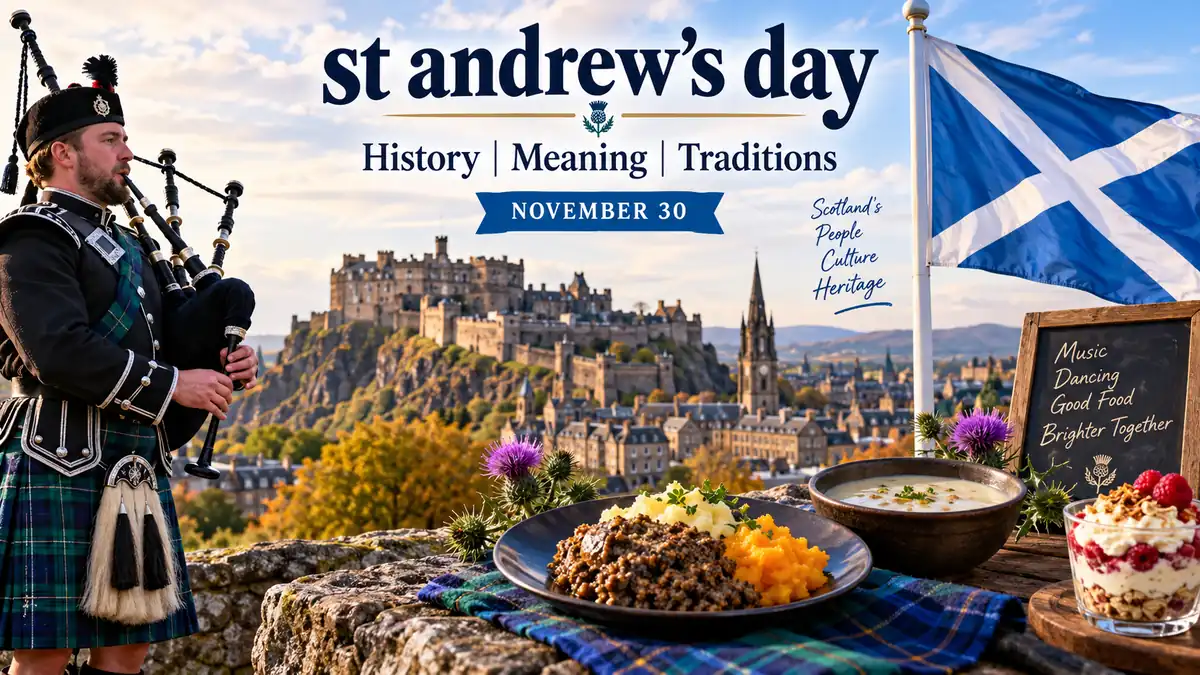
Every November 30, Scotland celebrates a fisherman from the ancient shores of the Sea of Galilee who became one of Christianity’s best-known apostles. His story eventually became intertwined with Scotland’s national identity, its flag, its medieval history and traditions that are still enjoyed today.
st andrew’s day is observed on November 30 each year in honor of Saint Andrew, one of the twelve apostles of Jesus Christ and the patron saint of Scotland. In Scotland, the day combines a Christian feast with a national celebration featuring the Saltire, ceilidh dancing, traditional music, Scottish food and community events.
For Scots at home and communities with Scottish connections around the world, November 30 is an opportunity to celebrate Scotland’s history, culture and people.
When Is st andrew’s day?
st andrew’s day falls on November 30 every year.
In 2026, November 30 falls on a Monday, and it is listed as the St Andrew’s Day bank holiday in Scotland.
The date is traditionally associated with Saint Andrew’s martyrdom and is observed as his feast day in several Christian traditions. It also falls around the beginning of Advent, giving the occasion religious significance beyond its role in Scottish national culture.
| Year | Date | Day |
|---|---|---|
| 2026 | November 30 | Monday |
| 2027 | November 30 | Tuesday |
| 2028 | November 30 | Thursday |
| 2029 | November 30 | Friday |
| 2030 | November 30 | Saturday |
When November 30 falls on a weekend, Scotland normally observes a substitute bank holiday on the following Monday. For example, November 30 fell on a Sunday in 2025, so the Scottish bank holiday was observed on Monday, December 1.
Is st andrew’s day a bank holiday?
Yes. St Andrew’s Day became an official Scottish bank holiday under the St Andrew’s Day Bank Holiday (Scotland) Act 2007.
That does not automatically mean every employee receives a paid day off. Scottish government guidance explains that employers can decide how bank holidays are handled and may include them within a worker’s statutory annual leave entitlement.
It is specifically a Scottish bank holiday rather than a UK-wide one. England, Wales and Northern Ireland do not observe November 30 as the St Andrew’s Day bank holiday.
Who Was Saint Andrew?
Saint Andrew, also known as Andrew the Apostle, was a first-century Galilean fisherman and an important figure in Christianity.
According to the New Testament tradition, Andrew was the brother of Saint Peter. Both men were fishermen before becoming disciples of Jesus Christ. Andrew is counted among the twelve apostles and is remembered as one of the earliest followers of Jesus.
His name comes from the Greek Andreas, commonly associated with strength or courage.
Christian tradition connects Andrew with missionary activity in different parts of the ancient world. Over centuries, his veneration spread far beyond the eastern Mediterranean, and he became associated with countries and communities across Europe.
Today, Saint Andrew is particularly famous as the patron saint of Scotland, but his patronage and religious importance extend to other places as well.
How did Saint Andrew die?
Christian tradition holds that Andrew was martyred at Patras in Greece.
He later became strongly associated with an X-shaped cross rather than the traditional upright form of the Christian cross. This diagonal cross became known as St Andrew’s Cross or the Saltire.
The Saltire eventually became one of the most recognizable symbols of Scotland.
The details surrounding Andrew’s martyrdom developed through later Christian traditions, so historical accounts should distinguish between documented early history and stories that emerged centuries afterward.
Why Is Saint Andrew the Patron Saint of Scotland?
This is one of the most interesting parts of the story because Saint Andrew was not Scottish and, according to traditional accounts, never personally visited Scotland.
His connection with Scotland developed through medieval Christianity, legends concerning his relics and the growing importance of the religious center that became the town of St Andrews in Fife.
One famous tradition involves Saint Regulus, also called St Rule. According to the legend, Regulus carried relics of Saint Andrew from Patras and eventually arrived on Scotland’s east coast at a settlement traditionally called Kilrymont.
The settlement became an important religious destination and eventually became known as St Andrews.
The University of St Andrews notes that the town became consistently associated with the name St Andrews by around 1200 as devotion surrounding Andrew’s supposed relics grew. Construction of St Andrews Cathedral began in the 12th century, and the cathedral was consecrated in 1318 in the presence of Robert the Bruce.
The relic story is part history and part medieval tradition; it should not be treated as a straightforward eyewitness account.
The Declaration of Arbroath and Saint Andrew
Saint Andrew’s importance became deeply connected with Scottish national identity during the Middle Ages.
The Declaration of Arbroath, written in 1320 during Scotland’s struggle to maintain its independence, invoked Scotland’s special relationship with Saint Andrew. His standing as the brother of Saint Peter gave the association considerable religious and political significance in medieval Europe.
By this period, Andrew was firmly established as Scotland’s national patron saint.
The Battle of Athelstaneford legend
Another famous Scottish legend connects Saint Andrew with the Battle of Athelstaneford, traditionally dated to the ninth century.
According to the story, a Pictish king saw a sign connected with Saint Andrew before battle. A white diagonal cross then appeared against the blue sky, inspiring the Picts before their victory.
The story became closely associated with the origin of Scotland’s Saltire. Historical evidence for the miraculous event itself is lacking, so it is better understood as an important national legend rather than a verified account of the battle. The Saltire nevertheless became established as a Scottish national symbol over the centuries.
Why Is the Saltire Associated With st andrew’s day?
The Saltire, Scotland’s national flag, has a white diagonal cross against a blue background.
Its cross represents St Andrew’s Cross and therefore creates a direct visual link between the apostle and Scotland.
The flag is widely displayed during st andrew’s day celebrations and at other events representing Scottish identity.
The symbol has a remarkably long history. Medieval Scottish seals and documents used imagery associated with Saint Andrew, while the diagonal cross gradually became an established national emblem. A Scottish Parliament historical discussion notes that the Saltire was formally connected with Scottish forces by parliamentary action in 1385.
Today, the flag is one of the simplest ways to recognize a Scottish national celebration: a blue field crossed from corner to corner by a white X.
How Is st andrew’s day Celebrated in Scotland?
Modern st andrew’s day celebrations combine national pride, community gatherings and older cultural traditions.
There is no single required way to celebrate. A family dinner can be just as much a part of the occasion as a large public event.
Common celebrations include:
- Ceilidh dancing
- Traditional Scottish and contemporary music
- Pipe bands and performances
- Scottish storytelling
- Community gatherings
- Cultural exhibitions
- Festivals and concerts
- Scottish food and shared meals
- Displays of the Saltire
- Events celebrating Scottish heritage
Scotland’s official national information site describes the day as an occasion for dancing, music, food, drink and gatherings across the country.
What is a ceilidh?
A ceilidh is a social gathering associated particularly with Scottish and Irish traditions. In modern Scotland, it commonly involves traditional music and group dancing.
You do not need extensive dancing experience to attend one. At many ceilidhs, a caller or experienced dancer explains the steps before each dance.
That accessibility is one reason ceilidhs work so well for st andrew’s day: they turn Scottish culture into something people participate in rather than simply watch.
Traditional instruments such as fiddles, accordions and bagpipes may feature, although modern ceilidh bands often combine traditional sounds with contemporary arrangements.
Traditional st andrew’s day Food
Food plays an important role because the celebration is built around gathering together.
There is no official St Andrew’s Day menu, but several distinctly Scottish dishes are commonly associated with national celebrations.
Haggis, neeps and tatties
Perhaps the most recognizable combination is haggis, neeps and tatties.
- Haggis is a traditional savory Scottish dish.
- Neeps generally refers to mashed swede or turnip in Scottish usage.
- Tatties means potatoes.
Although haggis is also strongly associated with Burns Night, it works naturally as part of a St Andrew’s Day meal celebrating Scottish cuisine.
Cullen skink
Cullen skink is a thick Scottish soup traditionally made with smoked haddock, potatoes and onions.
Its name comes from Cullen, a coastal town in Moray, and it is a good example of how regional Scottish dishes can become part of wider national food culture.
Cranachan
For dessert, cranachan is a classic choice.
It traditionally combines ingredients such as cream, oats, raspberries and whisky, producing a dessert strongly associated with Scotland’s agricultural and culinary heritage.
Modern celebrations are not limited to historical recipes. Scotland.org highlights everything from haggis, neeps and tatties and Cullen skink to cranachan, Scottish salmon, Angus beef and newer fusion foods such as haggis pakora.
The practical lesson is simple: a St Andrew’s Day meal does not have to follow a rigid menu. The tradition is as much about sharing Scottish food with other people as it is about serving any one particular dish.
The History of st andrew’s day in Scotland
Devotion to Saint Andrew in Scotland is much older than the modern bank holiday.
Evidence and traditions surrounding Andrew developed over many centuries, particularly around Scotland’s east coast. The cult of St Andrew had become established there during the early medieval period, and the shrine associated with him eventually developed into one of Scotland’s major religious centers.
By the reign of Malcolm III in the 11th century, celebrations connected with St Andrew were becoming increasingly important. Malcolm’s wife, Margaret of Wessex, later Saint Margaret of Scotland, supported pilgrims travelling to St Andrew’s shrine. She is associated with measures that helped pilgrims cross the Firth of Forth, contributing to the development of the places now known as North and South Queensferry.
St Andrews grew into a major ecclesiastical center. Its cathedral became the largest medieval church in Scotland, while the town later became home to the University of St Andrews, founded in the early 15th century.
What happened to Saint Andrew’s relics?
The medieval shrine did not survive intact.
During the Scottish Reformation in the 16th century, St Andrews Cathedral was attacked and its religious furnishings were destroyed. The relics historically associated with Saint Andrew disappeared, and their ultimate fate remains unknown.
Later, other relics connected with Saint Andrew were given to Scotland. In 1879, a relic from Amalfi was presented to St Mary’s Cathedral in Edinburgh. Further relics were presented in the 20th century by Pope Paul VI to Scottish Cardinal Gordon Joseph Gray.
These later relics helped renew the religious connection between Saint Andrew and Scotland.
How st andrew’s day Became a Modern National Celebration
One surprising feature of the holiday’s history is the role played by Scottish communities outside Scotland.
Scottish emigrants maintained strong cultural connections with their homeland, forming organizations that provided social support while preserving Scottish traditions.
The St Andrew’s Society of Charleston in South Carolina was founded in 1729. A similar organization, the St Andrew’s Society of the State of New York, followed in 1756. These organizations helped strengthen St Andrew’s Day celebrations among Scottish communities abroad.
St Andrew’s societies later appeared in many countries.
This diaspora tradition explains why November 30 can be highly visible in places thousands of miles from Scotland. For expatriate communities, the celebration became a way of preserving connections with Scottish ancestry, music, food and social traditions.
st andrew’s day Around the World
Saint Andrew is not significant only in Scotland.
His Christian feast and related folk traditions are found in several European countries, although the customs can differ dramatically.
Romania
Saint Andrew has major religious and cultural significance in Romania.
Romanian traditions associated with the feast include older folk beliefs alongside Christian observance. Some customs involve garlic, which was traditionally associated with protection from evil spirits, while other traditions concern luck, marriage and predictions for the coming year.
Ukraine
Saint Andrew also has an established place in Ukrainian tradition.
Historically, celebrations included social gatherings, games, courtship customs, fortune-telling and playful pranks. Scotland.org notes that traditional Ukrainian celebrations connected with Saint Andrew included pancakes and pastries in games associated with predictions about marriage.
Calendar traditions can differ between Christian communities, so the date on which a particular religious community observes Saint Andrew should not automatically be assumed to match Scotland’s November 30 national celebration.
Other countries and communities
Andrew the Apostle has historical religious connections with a much wider geographical area, including Greece and parts of Eastern Europe.
Scottish diaspora communities in countries such as the United States, Canada, Australia and New Zealand have also maintained St Andrew’s Day events through Scottish clubs, cultural associations and St Andrew’s societies.
This gives the day two overlapping identities: it is a Christian feast associated with an apostle and a cultural celebration strongly associated with Scotland.
Is st andrew’s day Scotland’s National Day?
St Andrew’s Day is widely regarded as Scotland’s national day, with Saint Andrew serving as the country’s patron saint.
Unlike an independence day commemorating the establishment of a modern state, November 30 developed through religious, cultural and historical traditions.
It now forms part of Scotland’s wider winter festival season.
St Andrew’s Day comes first, followed by Hogmanay, Scotland’s famous New Year celebration, and then Burns Night on January 25, which commemorates poet Robert Burns. The Scottish Government has described these occasions collectively as Scotland’s Winter Festivals.
Each celebrates something different:
| Celebration | Date | Main focus |
|---|---|---|
| St Andrew’s Day | November 30 | Scotland’s patron saint and Scottish culture |
| Hogmanay | December 31 | Scottish New Year traditions |
| Burns Night | January 25 | Life and poetry of Robert Burns |
Together, they make late autumn and winter an especially important period in Scotland’s cultural calendar.
What Does st andrew’s day Mean Today?
The meaning of the day has expanded far beyond its medieval religious origins.
For Christians, November 30 remains the feast of Andrew the Apostle. For many Scots, it is also a celebration of national identity, heritage and culture. For people of Scottish descent overseas, it can provide a connection to family history and ancestral roots.
And participation does not depend on being Scottish.
Community celebrations often emphasize hospitality: eating together, listening to music, dancing, telling stories and introducing other people to Scottish culture.
That social element reflects how the modern celebration has evolved. The central question is no longer simply who Saint Andrew was, but how his feast became a shared symbol connecting religion, history, folklore and Scottish identity.
Simple Ways to Celebrate st andrew’s day
You do not need to attend a major festival to mark November 30.
A meaningful celebration can be as simple as learning the history behind the Saltire, preparing a Scottish dish or listening to Scottish music.
For a more traditional celebration:
- Learn about Saint Andrew. Understanding the apostle and the legends surrounding his connection to Scotland gives the day historical context.
- Display the Saltire. Scotland’s flag is directly connected with St Andrew’s Cross.
- Prepare Scottish food. Haggis, neeps and tatties, Cullen skink or cranachan can form the basis of a themed meal.
- Listen to Scottish music. Explore traditional fiddle, pipes, folk songs or modern Scottish artists.
- Join a ceilidh. Community dances are one of the most participatory ways to experience Scottish culture.
- Explore Scottish history. Read about St Andrews Cathedral, the Declaration of Arbroath or Scotland’s medieval kingdoms.
- Share the occasion. Invite friends or family rather than treating the celebration as something that requires Scottish ancestry.
The most authentic approach is not to force every Scottish stereotype into one evening. Pick a few traditions, understand where they come from and enjoy them in their cultural context.
Why st andrew’s day Still Matters
st andrew’s day has survived because it represents several layers of Scotland’s story at once.
It begins with Andrew the Apostle, a Galilean fisherman who became an early Christian disciple. Medieval traditions then carried his name and supposed relics to Fife, where St Andrews developed into one of Scotland’s most important religious centers.
His X-shaped cross became the Saltire, while his status as patron saint became linked with Scotland’s medieval identity and the Declaration of Arbroath. Centuries later, Scottish emigrants helped turn November 30 into an international expression of Scottish heritage.
Today, st andrew’s day remains fixed on November 30, combining history, faith and culture through ceilidhs, music, food, flags and community gatherings.
Knowing that history makes the celebration more meaningful. When the Saltire appears on November 30, it represents far more than a national flag: it connects an ancient Christian tradition, medieval Scotland and a modern global Scottish community.