Walk through almost any garden and you may see dozens of flowers that look completely different from one another. Some bloom for a few weeks in spring, others flower all summer, while certain plants return reliably for years.
Types of flowers can be classified by life cycle, plant structure, growing habit, bloom season, flower form, and botanical family. Common examples include roses, tulips, lilies, orchids, sunflowers, daisies, peonies, hydrangeas, carnations, chrysanthemums, dahlias, marigolds, and lavender. Each type has its own appearance, growing conditions, and seasonal pattern.
Understanding these differences makes flower identification easier and helps gardeners choose plants suited to their climate, sunlight, soil, and available space.
How Are Different Types of Flowers Classified?
A flower is the reproductive structure of an angiosperm, or flowering plant. Botanists identify flowering plants using characteristics such as petals, sepals, stamens, pistils, leaves, fruit, seeds, and overall plant structure.
For everyday gardening, however, flowers are usually grouped in more practical ways.
Annual Flowers
Annuals complete their life cycle within one growing season. They germinate, grow, flower, produce seed, and eventually die.
Common annual flowers include:
- Zinnias
- Cosmos
- Marigolds
- Petunias
- Many sunflowers
- Sweet peas
Annuals are useful when you want fast-growing seasonal color. Many bloom generously because producing flowers and seeds is central to their short life cycle.
Some plants grown as annuals in cold regions are actually tender perennials in warmer climates, so the label can depend partly on local conditions.
Biennial Flowers
Biennials normally complete their life cycle across two growing seasons. During the first year, they mainly develop roots and leaves. Flowering and seed production usually occur during the second year.
Examples include foxgloves, honesty and some forms of sweet William.
Weather can complicate this classification. A plant’s behavior in a warm climate may differ from its behavior in a region with cold winters.
Perennial Flowers
Perennials live for multiple years. Many herbaceous perennials die back during winter and emerge again from their roots when conditions improve.
Popular flowering perennials include:
- Peonies
- Coneflowers
- Hostas
- Delphiniums
- Asters
- Daylilies
Perennials are often chosen for established gardens because they do not normally require complete replanting every year.
Woody shrubs, trees, and some vines are technically perennials too, although gardeners usually use “perennial” to describe herbaceous plants. The Royal Horticultural Society distinguishes these life cycles in much the same way: annuals complete their cycle in one growing season, biennials generally take two, and perennials survive for multiple years.
Bulbs, Corms, Rhizomes, and Tubers
Not every underground storage structure is technically a bulb.
True bulbs, such as tulips and daffodils, store energy underground in layered structures. Corms, including crocus and gladiolus, are swollen stem bases. Tubers, such as those produced by dahlias, are enlarged storage structures. Rhizomes, found in plants such as many irises, are horizontal underground or ground-level stems.
These differences matter because planting depth, propagation, storage, and winter care can vary.
Quick Takeaway: “Flower type” can describe several different things. A rose and tulip are different botanical plants, while terms such as annual, perennial, bulb, shrub, vine, and wildflower describe life cycle or growth habit.
Popular Types of Flowers and Their Characteristics
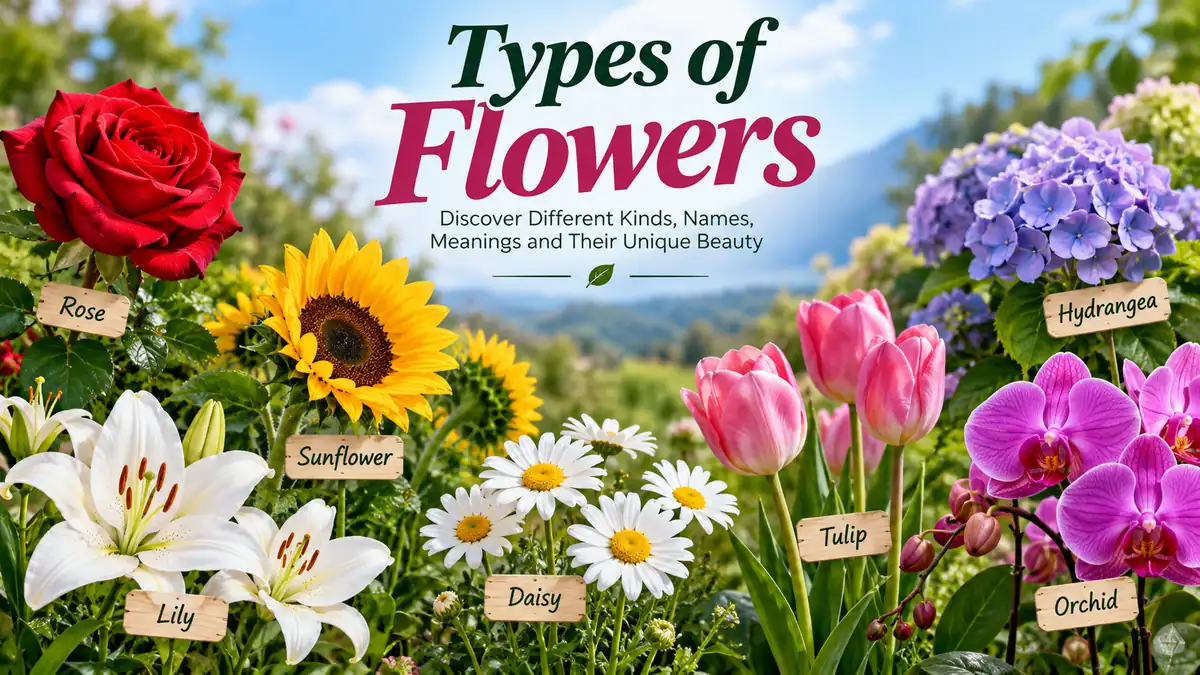
Thousands of flowering plant species are cultivated or grow naturally around the world, so no short list can represent all of them. The following 40 examples cover many familiar garden, landscape, wildflower, and cut-flower groups.
1. Rose
Roses (Rosa species and hybrids) are woody flowering plants recognized for layered petals, distinctive hips, and—in many cultivars—strong fragrance.
Flowers may be red, pink, white, yellow, peach, orange, purple, or multicolored. Growth habits range from compact miniature roses to shrubs and vigorous climbers.
Most garden roses perform best with plenty of sunlight, fertile soil, good drainage, and sufficient air circulation. Their flowering pattern varies considerably among species and cultivars.
2. Tulip
Tulips belong to the genus Tulipa and are among the most recognizable spring bulbs.
Their upright, often cup-shaped flowers appear in an enormous range of colors. Tulip bulbs are typically planted before winter so they can experience the cool period needed for normal spring development.
Although botanically perennial, some modern tulips perform less reliably in subsequent years and are therefore replanted by gardeners seeking consistent displays.
3. Lily
True lilies belong to the genus Lilium. They grow from bulbs and produce prominent flowers, often on tall stems.
Popular groups include Asiatic and Oriental lilies. Colors include white, yellow, orange, pink, red, and combinations of these shades.
Not every plant called a “lily” is a true lily. Daylilies, calla lilies, and lilies of the valley belong to other botanical groups.
4. Orchid
The orchid family, Orchidaceae, contains an extraordinary diversity of flowering plants.
Orchids range from tiny species to large tropical plants. Their flowers have highly specialized structures and frequently exhibit bilateral symmetry.
Many familiar houseplant orchids, including Phalaenopsis, are epiphytes in nature, meaning they grow on other plants without parasitizing them. This explains why ordinary dense garden soil is often inappropriate for their roots.
5. Sunflower
The familiar sunflower, Helianthus annuus, is an annual native to North America.
What looks like one enormous flower is actually a composite flower head made of numerous small florets. The showy outer ray florets surround the central disc florets.
Sunflowers generally prefer full sun and well-drained soil. Varieties range from compact branching plants to extremely tall single-stem forms.
6. Daisy
“Daisy” is a common name applied to several plants, but the classic form consists of a central disc surrounded by ray-like florets.
The common daisy (Bellis perennis), Shasta daisy (Leucanthemum × superbum), and many other daisy-like flowers belong to the Asteraceae family.
This flower family also includes sunflowers, asters, chrysanthemums, zinnias, and coneflowers.
7. Peony
Peonies (Paeonia) are long-lived perennials or, in some cases, woody shrubs.
Their large flowers may be single, semi-double, or densely double. Common colors include white, cream, coral, pink, and deep red.
Peonies usually bloom during spring or early summer, depending on cultivar and climate. Established plants can remain productive for decades when planted in suitable conditions.
8. Hydrangea
Hydrangeas are flowering shrubs known for large clusters of blooms.
Different species produce mophead, lacecap, panicle, or other flower forms. Hydrangea macrophylla is particularly famous because flower color in certain cultivars can be influenced by soil chemistry and aluminum availability.
Not all hydrangeas respond this way, so changing soil pH will not automatically change every hydrangea’s flowers.
9. Carnation
Carnations (Dianthus caryophyllus) produce ruffled flowers and are widely grown as cut flowers.
They occur in white, pink, red, yellow, purple, green, and numerous cultivated combinations. Their sturdy stems and relatively durable blooms make them familiar in floral arrangements.
Related Dianthus species include pinks and sweet William.
10. Chrysanthemum
Chrysanthemums, commonly called mums, belong to the Asteraceae family.
Their flowers can look dramatically different depending on cultivar. Forms include daisy-like, pompon, decorative, spider, and incurved blooms.
Mums are particularly associated with autumn displays in temperate regions, although greenhouse production can make cut chrysanthemums available during much of the year.
11. Dahlia
Dahlias develop from tuberous roots and produce some of the most geometrically diverse garden flowers.
Depending on cultivar, blooms may be small and simple or exceptionally large and densely packed with petals.
Dahlias generally prefer sunny positions. In regions with hard freezes, their tuberous roots may require lifting and protected winter storage.
12. Marigold
Garden marigolds usually belong to the genus Tagetes.
African, French, and signet marigolds are common cultivated groups. Their yellow, orange, gold, cream, and reddish flowers provide prolonged warm-season color.
Marigolds are generally easy to start from seed and work well in beds and containers.
13. Lavender
Lavender (Lavandula) is an aromatic plant valued for both its flowers and fragrant foliage.
Purple is the best-known flower color, although white and pink cultivars also exist.
Lavender generally performs best in sunny locations with excellent drainage. Persistently wet soil can be much more troublesome than relatively dry conditions.
14. Daffodil
Daffodils, or Narcissus, are spring-flowering bulbs with distinctive trumpet or cup-shaped centers.
Yellow is the classic color, but cultivars also produce white, cream, orange, pink-toned, and bicolored flowers.
Daffodils are perennial in suitable climates and can gradually form larger clumps.
15. Iris
The genus Iris contains hundreds of species and numerous cultivated forms.
Bearded irises are particularly recognizable because of the fuzzy “beard” running along their falls. Siberian and Japanese irises have quite different forms and growing preferences.
Many irises grow from rhizomes, while others develop from bulbs.
16. Daffodil-like Crocus
Crocuses are small plants that commonly emerge in late winter or early spring, although some species flower in autumn.
They grow from corms, rather than true bulbs. Their cup-shaped flowers often appear in purple, white, yellow, or striped combinations.
Because of their compact size, crocuses work well in lawns, borders, rock gardens, and beneath deciduous trees.
17. Zinnia
Zinnias are colorful annuals prized for their ability to flower through warm weather.
Cultivars range from small single flowers to large double forms. Colors include red, orange, yellow, pink, purple, white, green, and multicolored combinations.
They generally need strong sunlight and benefit from good air circulation.
18. Petunia
Petunias are tender flowering plants commonly grown as annuals in containers, window boxes, baskets, and beds.
They are available in trailing, spreading, and more upright forms. Modern cultivars offer an enormous selection of solid, striped, veined, and patterned colors.
Regular water and adequate sunlight help maintain continuous flowering, although waterlogged roots should be avoided.
19. Geranium
The name “geranium” can be confusing.
Plants sold as bedding geraniums are generally Pelargonium, while true hardy geraniums belong to the genus Geranium. Both belong to the Geraniaceae family but have different growth habits.
Pelargoniums are common container plants, whereas many true geraniums are hardy garden perennials.
20. Hibiscus
Hibiscus flowers are known for their large petals and prominent central staminal column.
The genus includes tropical and hardy species. Tropical hibiscus typically requires warm conditions, while hardy hibiscus can tolerate colder seasonal climates.
Flowers appear in red, pink, orange, yellow, white, and multicolored forms.
Types of Flowers for Gardens and Landscapes
Some flowers are particularly useful because of their growth habit rather than simply the appearance of individual blooms.
21. Coneflower
Coneflowers, especially Echinacea, are North American flowering perennials.
Their daisy-like blooms typically have raised central cones. Purple coneflower is the best-known example, but modern cultivars include white, yellow, orange, red, and pink shades.
Once established, many coneflowers handle sunny conditions well and provide nectar and pollen resources for insects.
22. Black-Eyed Susan
Black-eyed Susan is a common name applied to Rudbeckia species, especially Rudbeckia hirta.
Its golden-yellow ray florets surround a dark central disc, creating one of the most recognizable wildflower-style displays.
Depending on species and conditions, Rudbeckia plants may behave as annuals, biennials, or perennials.
23. Aster
Asters are famous for their daisy-like late-season flowers.
Modern botanical classification has moved many North American plants once called asters into genera such as Symphyotrichum, while the genus Aster remains associated mainly with Eurasian species.
For gardeners, the practical attraction remains the same: masses of small flowers that can extend garden color into late summer and autumn.
24. Delphinium
Delphiniums produce tall flower spikes covered with individual blooms.
Blue is perhaps their most celebrated color, but purple, pink, and white cultivars are also common.
Their vertical form works particularly well toward the back of perennial borders. Tall varieties may require staking, especially in windy locations.
25. Foxglove
Foxgloves (Digitalis) produce tall spikes lined with tubular, bell-like flowers.
Many familiar garden foxgloves are biennial or short-lived perennial plants. Flowers may be purple, pink, cream, yellow, or white.
Foxglove plants contain toxic compounds and should not be eaten.
26. Snapdragon
Snapdragons (Antirrhinum majus) get their common name from flowers that resemble a mouth opening when gently squeezed.
They are frequently grown as cool-season annuals, though their exact behavior depends on climate.
Tall, medium, and dwarf cultivars make snapdragons useful for both garden beds and cut-flower production.
27. Poppy
“Poppy” describes flowers in the Papaveraceae family, including familiar Papaver species.
Their delicate petals often surround a conspicuous central seed structure. Depending on species, poppies may be annual, biennial, or perennial.
Common garden colors include red, orange, pink, white, and yellow.
28. Cosmos
Cosmos are airy annual flowers with finely divided foliage and open, daisy-like blooms.
Cosmos bipinnatus commonly produces pink, white, and crimson flowers, while Cosmos sulphureus is associated with warmer yellow and orange tones.
They are usually grown from seed and prefer sunny conditions.
29. Sweet Pea
Sweet peas (Lathyrus odoratus) are climbing annuals famous for their delicate flowers and fragrance.
They grow by using tendrils to cling to supports. Flower colors include pink, purple, red, blue-toned shades, cream, and white.
Unlike edible garden peas, ornamental sweet pea seeds and other plant parts should not be treated as food.
30. Begonia
Begonias are an exceptionally varied group grown for flowers, foliage, or both.
Fibrous, tuberous, and rhizomatous begonias have different habits. Many are particularly useful in partially shaded gardens and containers.
Their flowers may be white, pink, red, orange, yellow, or combinations of these colors.
Other Types of Flowers Worth Knowing
The flower world extends far beyond traditional bedding plants and bouquets. Flowering vines, shrubs, tropical species, and aquatic plants contribute entirely different forms.
31. Camellia
Camellias are evergreen shrubs valued for glossy foliage and elegant flowers.
Camellia japonica and Camellia sasanqua are among the most familiar cultivated species. Depending on type and climate, they flower from autumn through spring.
They generally favor acidic, well-drained soil and some protection from harsh environmental extremes.
32. Gardenia
Gardenias are evergreen shrubs famous for strongly fragrant white or cream flowers.
Gardenia jasminoides is widely cultivated in warm climates and as a container plant.
Gardenias prefer acidic growing conditions and can react poorly to unsuitable soil chemistry, temperature extremes, or inconsistent moisture.
33. Magnolia
Magnolias are trees or shrubs producing large, often fragrant flowers.
Some deciduous species flower on bare branches before their leaves fully emerge in spring. Evergreen species such as southern magnolia develop large leaves and impressive white blooms.
Magnolias represent an ancient lineage of flowering plants with distinctive floral structures.
34. Azalea
Azaleas belong to the genus Rhododendron.
Their spring displays can cover shrubs with pink, purple, red, orange, white, or multicolored flowers. Both evergreen and deciduous types are cultivated.
Most prefer acidic, well-drained soil, and many benefit from protection from intense afternoon sun.
35. Wisteria
Wisteria is a vigorous woody vine known for hanging clusters of pea-like flowers.
Depending on species and cultivar, flowers can be purple, blue-violet, pink, or white.
Its beautiful appearance should not obscure its growth potential. Some wisterias become extremely large, and certain species can be invasive outside their native range. Strong structural support and regular pruning are often necessary.
36. Clematis
Clematis is a diverse genus of mostly climbing plants.
Flower shapes range from large star-like blooms to smaller bells. Different varieties flower at different times and on different ages of wood, which is why clematis pruning recommendations are usually divided into pruning groups.
Colors include purple, blue, pink, red, white, and combinations.
37. Bougainvillea
Bougainvillea is a warm-climate woody vine or shrub.
Its brightest “petals” are actually modified leaves called bracts. The true flowers are much smaller and sit inside these colorful structures.
Bougainvillea thrives in warmth and strong sunlight and is widely used in tropical and subtropical landscapes.
38. Lotus
The sacred lotus (Nelumbo nucifera) is an aquatic perennial whose leaves and flowers rise above the water surface.
Its distinctive pink or white flowers are followed by recognizable seed heads.
Lotus should not be confused with water lilies, which belong to the family Nymphaeaceae.
39. Water Lily
Water lilies (Nymphaea) are aquatic plants with floating leaves and flowers positioned on or close to the water surface.
Hardy and tropical water lilies differ in climate tolerance and flower characteristics.
Their floating leaves provide shade in ponds, while their flowers introduce a form rarely seen among terrestrial garden plants.
40. Bird of Paradise
Bird of paradise (Strelitzia reginae) is a South African perennial with striking orange and blue flowers resembling the head of an exotic bird.
It performs best in warm conditions with bright light. In colder regions, it is often grown indoors or moved under protection during winter.
Its dramatic flower structure makes it one of the easiest tropical ornamentals to recognize.
Types of Flowers by Growing Habit
Looking at growth habit can be more useful than memorizing individual flower names.
| Flower category | Basic characteristic | Common examples |
|---|---|---|
| Annuals | Complete life cycle in one growing season | Zinnia, cosmos, marigold |
| Biennials | Usually flower during their second growing season | Foxglove, sweet William |
| Herbaceous perennials | Live multiple years; stems may die back seasonally | Peony, coneflower, aster |
| Bulbous plants | Store energy in true bulbs | Tulip, daffodil, lily |
| Corm plants | Grow from swollen underground stem bases | Crocus, gladiolus |
| Tuberous plants | Use enlarged storage structures | Dahlia, tuberous begonia |
| Flowering shrubs | Produce persistent woody stems | Rose, hydrangea, gardenia |
| Flowering vines | Climb or trail | Clematis, wisteria, sweet pea |
| Flowering trees | Woody plants developing tree form | Magnolia |
| Aquatic flowers | Grow in or around water | Lotus, water lily |
These categories can overlap. A flower can simultaneously be a perennial, a vine, and a woody plant.
Types of Flowers by Blooming Season
One of the most practical ways to select flowers is by bloom season.
Exact timing depends on latitude, elevation, weather, cultivar, and local climate, so a plant described as a spring flower in one location may bloom at a somewhat different time elsewhere.
Spring Flowers
Familiar spring bloomers include:
- Tulips
- Daffodils
- Crocuses
- Peonies
- Irises
- Azaleas
- Magnolias
Many spring bulbs begin forming the next year’s flowers well before they emerge above ground.
Summer Flowers
Summer offers the widest selection in many temperate gardens.
Common examples include:
- Roses
- Sunflowers
- Zinnias
- Dahlias
- Lilies
- Lavender
- Hydrangeas
- Cosmos
- Hibiscus
Warm-season annuals can continue blooming for months when faded flowers are removed and plants receive adequate water and nutrients.
Fall Flowers
Asters and chrysanthemums are two classic autumn flowers. Dahlias may also continue flowering until cold weather damages their foliage.
Late-blooming plants have ecological value as well as ornamental value because they can provide resources for pollinating insects when fewer flowers remain.
Winter Flowers
Winter does not mean flowers disappear everywhere.
Camellias can flower during cooler months, depending on species and climate. In mild regions, pansies, violas, cyclamen, and other cool-season plants may provide winter color.
Climate is always the deciding factor.
Flower Shapes and Structures You May Notice
Learning basic flower anatomy makes identification much easier.
A typical flower may include sepals, petals, stamens, and one or more female reproductive structures commonly described in introductory botany using terms such as stigma, style, and ovary.
But flowers do not all follow one simple visual template.
Single Flowers
A single flower usually has one row or relatively few rows of petals around its reproductive structures.
Single roses and single peonies are examples.
These simpler forms often make pollen and nectar easier for insects to access than extremely dense double-flowered cultivars.
Double Flowers
Double flowers have additional petal-like structures that create a fuller appearance.
Roses, peonies, carnations, camellias, and dahlias all have popular double-flowered cultivars.
The extra petals often result from modified reproductive structures.
Composite Flower Heads
Sunflowers, daisies, chrysanthemums, asters, and coneflowers demonstrate one of the most commonly misunderstood flower structures.
The “flower” you see is an inflorescence consisting of many individual florets.
In a sunflower, for example, the outer ray florets create the petal-like appearance while numerous disc florets occupy the center.
Flower Spikes and Racemes
Some plants arrange many small flowers along elongated stems.
Foxgloves, delphiniums, snapdragons, and gladioli create strong vertical displays using this general arrangement, although their precise botanical inflorescence structures differ.
Flower Clusters
Hydrangeas demonstrate how hundreds of relatively small individual flowers can combine into a much larger visual display.
Other plants form umbels, panicles, heads, racemes, or clusters with distinctive branching patterns. These structures are useful clues when identifying an unfamiliar plant.
Quick Takeaway: What appears to be a single flower is not always one flower. Sunflowers and daisies are classic examples of flower heads composed of many individual florets.
How to Identify Unknown Types of Flowers
Color alone is rarely enough to identify a plant accurately. Hundreds of unrelated species can produce similar pink, yellow, purple, or white blooms.
Instead, work through several characteristics.
1. Examine the Flower Shape
Look at the overall structure.
Is it:
- Cup-shaped?
- Bell-shaped?
- Daisy-like?
- Trumpet-shaped?
- Tubular?
- Star-shaped?
- A dense cluster?
- A hanging spike?
Then look more closely at the number and arrangement of petals or petal-like structures.
2. Examine the Leaves
Leaves can provide stronger identification clues than the flowers.
Check whether leaves are:
- Opposite or alternate
- Simple or compound
- Smooth or toothed
- Narrow or broad
- Glossy, hairy, or leathery
Also examine how they connect to the stem.
3. Check the Growth Habit
Determine whether you are looking at a herbaceous plant, woody shrub, tree, climbing vine, ground cover, succulent, or aquatic species.
A large purple flower on a woody vine immediately suggests a different group of possibilities than the same-colored flower growing from a small bulb.
4. Look at the Underground Structure When Appropriate
For cultivated plants, knowing whether the plant emerged from a bulb, corm, rhizome, tuber, or fibrous root system can narrow identification considerably.
Avoid digging up wild plants simply to identify them.
5. Note the Season and Location
Record when and where the flower appeared.
A woodland flower blooming in early spring has a different set of likely identities from a sun-loving meadow plant flowering in late summer.
Geographic range matters too. Native plants are naturally associated with particular ecosystems, although cultivated and introduced species can appear far outside their original range.
How to Choose Flowers for a Garden
The prettiest flower in a photograph is not automatically the best plant for a particular garden.
A better approach is to start with the growing conditions and then choose among the flowers that fit them.
Start With Sunlight
Observe the planting area throughout the day.
Plants such as sunflowers, lavender, zinnias, and many roses generally perform best with substantial direct sunlight.
Other plants tolerate or prefer more shade. Many begonias, for example, are useful where intense all-day sunlight would be unsuitable.
“Full sun” does not mean exactly the same experience in every climate. Six hours of sunlight in a mild region can be far less stressful than six hours of intense summer sun in a hot, dry climate.
Understand Your Soil
Check drainage before worrying about fertilizer.
Lavender dislikes persistently wet conditions, while aquatic plants obviously require a completely different environment. Azaleas, gardenias, and many hydrangeas generally favor acidic soil conditions.
Soil texture and organic matter also influence water retention and root development.
Consider Your Climate
A plant’s cold tolerance is only one part of climate suitability.
Also consider:
- Summer heat
- Humidity
- Rainfall
- Winter temperatures
- Length of growing season
- Wind exposure
- Local frost dates
USDA hardiness zones are useful for estimating winter cold tolerance of perennial plants, but they do not describe every environmental factor that affects growth.
Think About Mature Size
A small nursery plant can eventually become a substantial shrub or vine.
Wisteria is a good example. Its hanging flowers are beautiful, but the mature plant requires much more space and structural support than a small annual.
Check mature height and spread before planting.
Plan for Continuous Flowers
For color across a long growing season, combine plants with different flowering periods.
A simple sequence might include spring daffodils and tulips, early-summer peonies, summer lilies and zinnias, and late-season asters and chrysanthemums.
The exact sequence should be adjusted for local climate.
Types of Flowers That Help Pollinators
Flowers are not merely decorative structures. They play a central role in plant reproduction and interact with animals ranging from insects to birds.
Bees, butterflies, moths, flies, beetles, hummingbirds, bats, and other animals can act as pollinators depending on plant species and ecosystem.
Plants frequently grown to support pollinating insects include:
- Coneflowers
- Asters
- Sunflowers
- Lavender
- Goldenrod
- Native milkweeds
- Bee balm
- Black-eyed Susans
Native flowering plants can be especially valuable because local wildlife may have long-established ecological relationships with them.
Flower form matters as well. Extremely dense double cultivars can sometimes provide less accessible pollen or nectar than simpler flowers.
For a pollinator-friendly garden, diversity is usually more useful than relying on a single species. Include flowers of different shapes and overlapping bloom periods from spring through autumn.
Common Mistakes When Choosing Different Types of Flowers
A little planning prevents many disappointing garden results.
Choosing by Appearance Alone
A flower can look perfect at a nursery while being poorly suited to your garden.
Check light, drainage, mature size, temperature tolerance, and water requirements before planting.
Assuming Every Perennial Returns Everywhere
“Perennial” describes a plant’s potential life cycle, not a guarantee that it will survive every climate.
A tropical perennial exposed to freezing conditions may die after one season and effectively be grown as an annual.
Treating Every Bulb-Like Plant the Same
Tulips have true bulbs, crocuses have corms, dahlias have tuberous roots, and many irises grow from rhizomes.
Understanding the difference helps with planting and propagation.
Ignoring Invasive Potential
A beautiful flowering plant can become an ecological problem outside its native range.
Invasive status differs by location, so check local extension services, government invasive-species databases, or reputable horticultural organizations before introducing an unfamiliar vigorous species.
Assuming Flower Color Is Fixed
Cultivar genetics determine most flower colors, but environmental factors can sometimes influence their expression.
Certain bigleaf hydrangeas are the famous example: soil conditions and aluminum availability can affect flower color. This does not mean every plant can be recolored simply by changing soil pH.
Forgetting About Toxicity
Some beautiful garden plants can be toxic if eaten.
Foxgloves, lilies, daffodils, and other ornamentals deserve careful placement around children or animals. Toxicity also varies by animal species; true lilies, for example, are particularly dangerous to cats.
What Are the Most Common Types of Flowers?
There is no universal ranking because popularity varies by country, climate, gardening tradition, and whether the question refers to gardens or cut flowers.
However, some names appear repeatedly in gardens and floristry: roses, tulips, lilies, orchids, carnations, chrysanthemums, sunflowers, daisies, hydrangeas, peonies, dahlias, daffodils, irises, marigolds, lavender, and zinnias. Contemporary flower guides likewise tend to organize the subject around these familiar groups while also separating plants by color, season, growth habit, and use.
For gardeners, the more useful question is often not “Which flower is most popular?” but “Which flower is best adapted to this particular location?”
A healthy lavender plant in a sunny, dry bed may provide far better results than a moisture-loving flower placed there simply because it looked attractive in a photograph.
Understanding Types of Flowers Makes Plant Selection Easier
There are far more types of flowers than any practical guide could list individually. Flowering plants range from tiny annual wildflowers to orchids, aquatic plants, woody vines, shrubs, and enormous flowering trees.
The easiest way to understand them is to combine several classification methods: identify whether a plant is an annual, biennial, or perennial; determine whether it grows from a bulb, corm, rhizome, tuber, or conventional root system; examine its growth habit and flower structure; then consider its bloom season, climate, sunlight, and soil requirements.
Once you begin looking at flowers this way, a garden becomes much easier to read. A sunflower is no longer simply a large yellow bloom—it is an annual angiosperm in the Asteraceae family with a composite flower head. A tulip is a spring-flowering bulb. A hydrangea is a woody flowering shrub. A wisteria is a vigorous perennial vine.
That combination of botanical structure and practical growing knowledge is the most reliable way to recognize different flowers and choose the right ones for a garden.