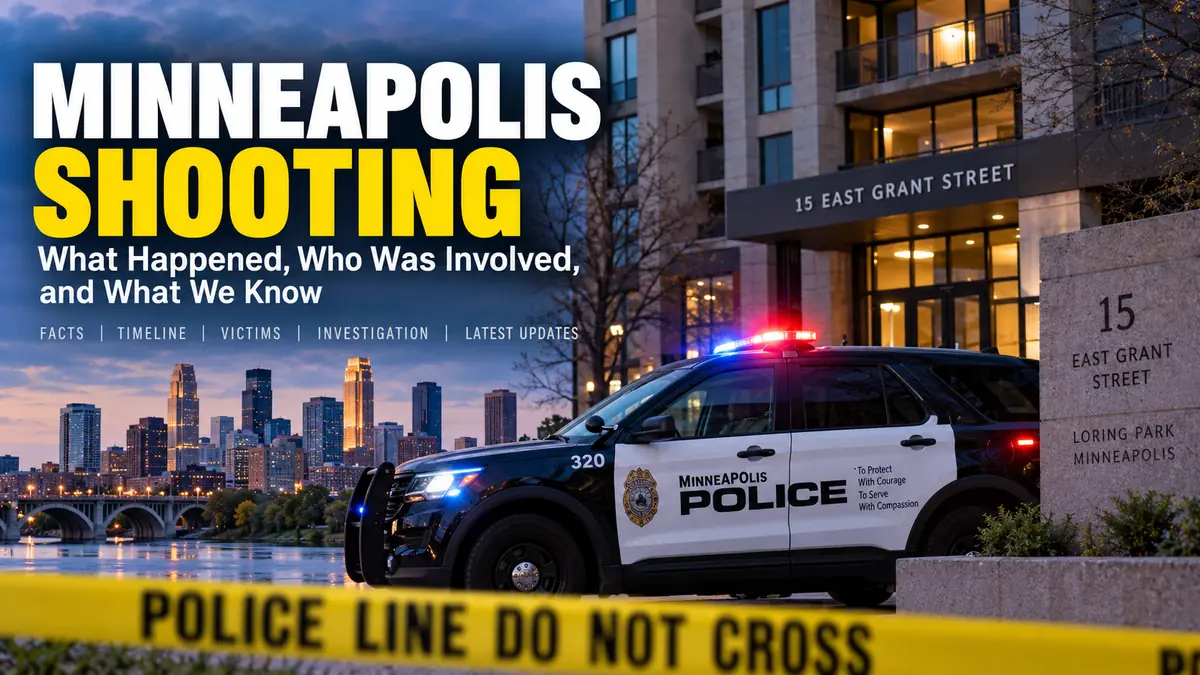
A deadly shooting inside a Minneapolis apartment building on September 2, 2026, killed two residents, wounded several other people, including police officers, and ended with the suspected gunman being fatally shot by police. Newly released body-camera footage and 911 records have since provided a clearer picture of how rapidly the violence unfolded.
The minneapolis shooting occurred at an apartment complex at 15 East Grant Street near Loring Park in downtown Minneapolis. Authorities identified the suspected shooter as 35-year-old Carlton Neal Johnson II. Investigators say the violence began during a custody exchange and continued inside the building, where two residents were killed and responding officers came under fire.
This article explains what happened, who was killed and injured, what investigators have established about the suspect’s history, how police responded, and what newly released evidence has added to the public record.
minneapolis shooting: Key Facts at a Glance
Because early breaking-news reports contained changing casualty figures and incomplete information, the clearest picture comes from subsequent law-enforcement statements and reporting based on investigative records.
| Detail | Verified information |
|---|---|
| Date | September 2, 2026 |
| Location | 15 East Grant Street, Minneapolis |
| Area | Loring Park/downtown Minneapolis |
| Suspected shooter | Carlton Neal Johnson II, 35 |
| Residents killed | Dale Henry Spry, 63, and Muse A. Afrah, 61 |
| Other people wounded | Three civilians and two police officers |
| Officers shot | Joseph Michnowski and Yahye Ahmed |
| Suspect’s outcome | Fatally shot by police |
| Investigating agency for police use of force | Minnesota Bureau of Criminal Apprehension |
The Hennepin County Medical Examiner’s Office identified Johnson and determined that he died from multiple gunshot wounds, with the manner of death classified as homicide. The two residents killed were identified as Dale Henry Spry, 63, and Muse A. Afrah, 61.
Why some initial reports gave different numbers
Breaking events often produce conflicting casualty counts because hospitals, police departments and emergency responders are working with separate information.
The City of Minneapolis initially reported three dead, including the suspected shooter, along with multiple injured civilians and officers. Subsequent investigation clarified that Johnson killed two residents and wounded five other people—two police officers, his former partner and two building employees—before police fatally shot him.
For readers following older reports, the dates attached to updates matter. Later investigative findings generally provide a more complete account than information released during the first hours of an emergency.
Where Did the minneapolis shooting Happen?
The attack occurred at an apartment building at 15 East Grant Street, close to Loring Park in Minneapolis.
The area sits on the edge of downtown, near the Minneapolis Convention Center. Police were initially dispatched to the address at approximately 4:36 p.m. after reports of gunfire.
The violence was not confined to one location inside the property. Investigators reconstructed a sequence beginning outside or near the entrance during a custody exchange and continuing through the apartment building.
That distinction is important because early descriptions of the event sometimes made it sound like a single confrontation. Later evidence showed a rapidly developing series of shootings involving several victims.
How the Shooting Began
According to investigators, the incident began during an arranged custody exchange involving Johnson and a woman believed to be the mother of his child.
Johnson allegedly shot and wounded the woman near the apartment building. He then entered the building.
Inside, investigators say two building employees were also wounded.
The gunman then moved to the ninth floor, where the violence continued.
Two residents were fatally shot: Dale Henry Spry and Muse A. Afrah. Both lived in the apartment complex.
A rapidly escalating emergency
The first reports did not immediately reveal the scale of the attack.
Police responding to what initially appeared to be a shooting encountered a much larger active threat. Officers entered the building while residents were still inside and gunfire was continuing.
AP reported that police reached the building only minutes after the first emergency call.
That rapid transition—from a reported shooting to an armed attacker moving through a residential high-rise—helps explain the chaotic initial information released publicly.
What Happened When Minneapolis Police Entered the Building?
Responding Minneapolis Police Department officers moved into the apartment building and followed the sound of gunfire.
The situation inside was dangerous and confusing. Initial city information described reduced visibility from an unknown airborne substance or haze.
Officers eventually moved toward the ninth floor.
Body-camera footage released on September 16 provides one of the clearest records of what happened next.
Officers encountered the gunman on the ninth floor
Video shows officers moving through the building while searching for victims and the shooter.
Officer Joseph Michnowski was looking down a hallway when Johnson emerged and opened fire, according to AP’s account of the footage. Michnowski was hit but remained able to communicate the shooter’s position to other officers.
Another officer, Yahye Ahmed, was subsequently shot.
CBS Minnesota reported that Michnowski was struck twice in the abdomen and Ahmed was wounded in the leg. Michnowski later left the hospital and returned home.
Police ultimately exchanged gunfire with Johnson.
The Hennepin County Medical Examiner later determined that Johnson died from multiple gunshot wounds.
Who Were the Victims of the minneapolis shooting?
Two residents of the building were killed.
The Minnesota Bureau of Criminal Apprehension identified them as:
- Dale Henry Spry, 63
- Muse A. Afrah, 61
Authorities said both were believed to live in the apartment complex.
Three other civilians survived gunshot wounds: the woman involved in the custody exchange and two building employees, according to subsequent reporting.
Two Minneapolis police officers were also shot.
Officer Joseph Michnowski
Joseph Michnowski had served with the Minneapolis Police Department since 2021, according to the Minnesota Bureau of Criminal Apprehension.
He suffered gunshot wounds while officers searched the building.
Later body-camera footage showed the intensity of the encounter. CBS Minnesota subsequently reported that Michnowski had been released from the hospital.
Officer Yahye Ahmed
Officer Yahye Ahmed, who joined the department in November 2024, was also wounded by gunfire.
The BCA initially identified him as one of the two officers injured during the shooting.
The officers’ injuries became an important part of the investigation because the BCA is responsible for examining the police use of deadly force.
Who Was Carlton Neal Johnson II?
Authorities identified the suspected shooter as Carlton Neal Johnson II, 35.
As investigators examined his background, court documents and accounts from people living at the apartment complex revealed multiple warning signs before the September attack.
Johnson had been involved in disputes at the property and was facing eviction.
Court records cited in reporting described allegations that he had assaulted another resident, openly displayed a firearm and made threatening statements.
Johnson had denied allegations contained in the eviction proceedings.
What happened before the shooting?
According to court records reported by FOX 9, Johnson had allegedly displayed a firearm around the property in June and made statements suggesting he might shoot someone.
Management was pursuing eviction proceedings, with a court hearing scheduled for September 11—nine days after the shooting.
AP subsequently reported that residents described a longer pattern of threats and alarming behavior. One resident said Johnson had discussed harming his former partner and building managers.
Those reports have become a major part of the broader examination of events preceding the attack.
Were There Warning Signs Before the Shooting?
Yes. Court records, residents’ accounts and subsequent reporting indicate that authorities and building management had encountered concerning behavior before September 2.
AP reported that Johnson had threatened neighbors, displayed a pistol and made statements about shooting people. The apartment building’s owners were attempting to evict him, and at least one person had sought a restraining order.
Police had also investigated a June incident involving a weapon.
According to AP, the county attorney’s office ultimately did not bring charges from that investigation because officials said the available evidence was insufficient.
This distinction matters: documented warning signs do not automatically mean authorities had the evidence or legal basis required for a particular intervention at a particular time.
The history nevertheless became an important subject after the shooting because it raised questions about how threats involving firearms are reported, documented and evaluated across police, courts, property management and other systems.
Eviction proceedings
The pending eviction is another significant piece of context.
FOX 9 reported that court documents alleged Johnson displayed a firearm to management personnel and made threatening statements.
The shooting occurred before the scheduled eviction hearing.
Investigators have continued examining the circumstances surrounding Johnson’s behavior and interactions before the attack.
What Does the Newly Released Body-Camera Video Show?
Body-camera recordings released by Minneapolis authorities on September 16 significantly expanded the public record.
The videos document officers entering the building, moving toward the ninth floor and encountering gunfire.
They also illustrate how little time officers had to react.
AP reported that Johnson suddenly emerged while officers were moving toward an injured person in a hallway and opened fire. Officer Michnowski was struck during that encounter.
Footage involving Officer Ahmed captured another exchange of gunfire.
A cloud or haze also appears during the encounter, consistent with earlier reports that officers had difficulty seeing inside parts of the building. CBS reported that the cloud may have resulted from a fire extinguisher or a pipe struck by bullets.
The footage is significant because it allows investigators and the public to compare early descriptions of the incident with contemporaneous video evidence.
What Do the 911 Calls Reveal?
Emergency-call records released alongside the videos provide another perspective.
According to AP, residents and wounded victims called 911 while hiding or waiting for help as the shooting unfolded.
The recordings help establish the sequence and urgency of the emergency rather than merely documenting its aftermath.
They also show one of the challenges officers faced: the incident was occurring across different areas of a multi-story residential building, with civilians still inside.
Police had to locate wounded people, identify the shooter’s position and protect residents at the same time.
How Quickly Did Police Respond?
The police response unfolded within minutes.
AP reported that officers who entered the building reached the active threat extraordinarily quickly, with police confronting Johnson roughly two and a half minutes after the first 911 call.
That speed is notable because the shooting involved a high-rise apartment complex rather than an open outdoor location.
Responding officers had to move through the property while determining where the attacker and victims were located.
The body-camera footage released later gives considerably more context to those initial response times.
Who Is Investigating the Minneapolis Shooting?
Multiple agencies have been involved, but the Minnesota Bureau of Criminal Apprehension (BCA) has a particularly important role.
The BCA identified Johnson, the deceased residents and officers involved in the police shooting investigation.
It identified Officer Liban Mohamed Ibrahim as an officer who discharged his firearm and said investigators were determining whether additional officers also fired.
This part of the investigation is separate from determining Johnson’s actions before and during the attack.
An investigation of an officer-involved shooting generally examines physical evidence, firearms evidence, body-camera recordings, witness accounts and other material to reconstruct the use-of-force encounter.
The medical examiner’s finding that Johnson died from multiple gunshot wounds provides another piece of that reconstruction.
What Is Known About the Motive?
The sequence leading into the attack is clearer than it was during the first hours after the shooting, but motive should be distinguished from chronology.
Investigators say the shooting began around a custody exchange involving Johnson and his former partner. He was also facing eviction following previous disputes and alleged threats involving the apartment building.
Those circumstances establish important context.
They do not, by themselves, establish a single definitive motive for every person Johnson targeted.
That distinction is particularly important because two of the people killed were neighbors, while other victims included his former partner, building employees and responding police officers.
Investigators therefore have to reconstruct not simply what happened, but why particular people were attacked.
Why the September 2026 Shooting Can Be Confused With Other Minneapolis Cases
Searching minneapolis shooting can produce information about several separate incidents.
One especially prominent case was the August 27, 2025, attack at Annunciation Catholic Church and School in Minneapolis.
That was an entirely different shooting.
During the Annunciation attack, a gunman fired through church windows while students attended Mass. Two children were killed. The City of Minneapolis later reported a total of 31 victims, including 30 people affected by gunfire.
The September 2, 2026 Loring Park apartment shooting involved Carlton Johnson and occurred more than a year later.
Readers should check the date, location and names when following updates because headlines using only “Minneapolis shooting” may refer to different events.
What Questions Remain Under Investigation?
Investigators have established much of the basic sequence, but several aspects continue to warrant scrutiny.
One concerns Johnson’s prior interactions with police and whether earlier threats generated sufficient evidence for additional legal action.
Another involves the precise details of the final exchange of gunfire with responding officers.
The BCA investigation is designed to reconstruct that encounter independently.
The newly released video and emergency-call records provide substantial evidence, but investigations can also incorporate witness interviews, forensic findings, firearms analysis, medical evidence and court records.
Questions about how previous threats were handled are separate from determining whether responding officers’ use of force during the September 2 attack complied with applicable law and policy.
What the Evidence Establishes So Far
The most consistent account from official findings and subsequent reporting is straightforward.
On September 2, 2026, Carlton Neal Johnson II allegedly shot a former partner during a custody exchange at a Minneapolis apartment complex, wounded two building employees, moved through the property and fatally shot residents Dale Henry Spry and Muse A. Afrah.
Minneapolis police entered the building while the threat remained active.
Officers Joseph Michnowski and Yahye Ahmed were shot during the response. Johnson was ultimately fatally shot by police.
Later investigation revealed that Johnson had been facing eviction and had previously been accused of threatening behavior involving a firearm. Those earlier incidents are now receiving renewed scrutiny as officials and the community examine whether opportunities for intervention existed before the attack.
The minneapolis shooting remains significant not only because of the lives lost and injuries suffered, but because subsequent body-camera footage, 911 records and court documents have provided an unusually detailed record of the events leading up to and during the attack. As additional official findings are released, those records—not early social-media claims or incomplete breaking-news reports—provide the strongest basis for understanding what happened.