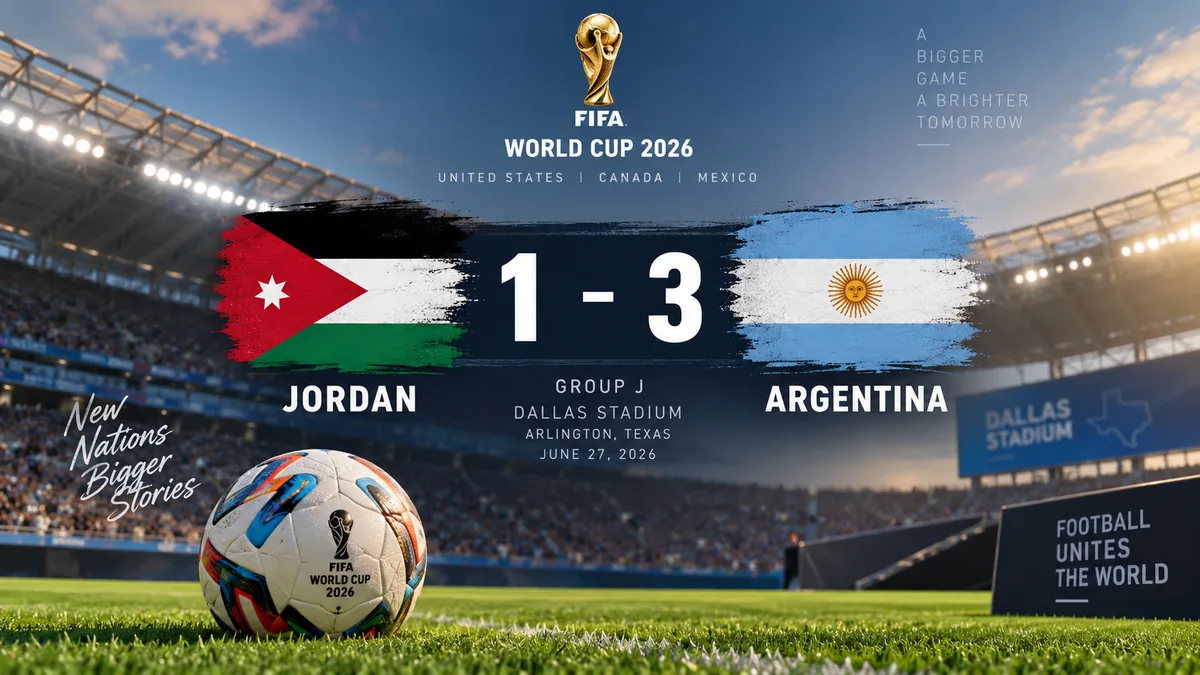
The jordan vs argentina matchup produced one of the most interesting contrasts of the 2026 FIFA World Cup group stage: tournament debutants Jordan against defending champions Argentina. The teams met in Group J at Dallas Stadium, where Argentina secured a 3-1 victory despite making major changes to their starting lineup.
Quick answer: Argentina beat Jordan 3-1 in their 2026 FIFA World Cup Group J match. Giovani Lo Celso opened the scoring, Lautaro Martínez converted a penalty, Mousa Al-Tamari pulled one back for Jordan, and substitute Lionel Messi completed the scoring with an 80th-minute free kick.
jordan vs argentina Match Result at a Glance
The match was played on June 27, 2026 local time in Arlington, Texas, with some international listings showing June 28 because of time-zone differences. FIFA records the fixture as a 3-1 Argentina victory at Dallas Stadium.
| Match detail | Information |
|---|---|
| Competition | FIFA World Cup 2026 |
| Stage | Group J |
| Result | Jordan 1-3 Argentina |
| Venue | Dallas Stadium, Arlington, Texas |
| Jordan scorer | Mousa Al-Tamari, 55′ |
| Argentina scorers | Giovani Lo Celso 19′, Lautaro Martínez 31′ pen., Lionel Messi 80′ |
| Half-time score | Jordan 0-2 Argentina |
| Attendance | 70,649 |
| Referee | István Kovács |
The reported attendance was 70,649, while Romanian referee István Kovács handled the match.
Argentina had already secured first place in Group J before kickoff, which gave coach Lionel Scaloni an opportunity to rotate his squad. FIFA reported that Scaloni made nine changes from the side that had started Argentina’s previous 2-0 victory over Austria.
How jordan vs argentina Unfolded
Argentina did not need long to take control. Jordan defended with numbers and attempted to restrict space, but Argentina’s technical quality and ability to retain possession gradually created openings.
Giovani Lo Celso Opens the Scoring
The first breakthrough arrived in the 19th minute through Giovani Lo Celso.
His goal gave Argentina a 1-0 advantage and rewarded their early control. For Lo Celso, the occasion was particularly significant: FIFA noted that it was his World Cup debut after he had not played at Russia 2018 and missed Qatar 2022 through injury.
Lo Celso’s performance was later recognized by FIFA, which named him Player of the Match.
Lautaro Martínez Makes It 2-0
Argentina doubled the advantage in the 31st minute.
Lautaro Martínez converted from the penalty spot to make the score 2-0. It was an important personal moment for the striker as well: FIFA reported that this was his first World Cup goal after he had failed to score at Qatar 2022.
Jordan therefore entered half-time facing a difficult task against a team comfortable controlling the ball and circulating possession.
Jordan Responds Through Mousa Al-Tamari
Jordan made changes at half-time, including the introduction of Mousa Al-Tamari, one of the country’s most recognizable attacking players.
The substitution quickly made a difference.
In the 55th minute, Jordan constructed an attacking move through the middle before moving the ball to the right. A cross into the penalty area found Al-Tamari, who finished to reduce Argentina’s advantage to 2-1.
That goal gave Jordan a route back into the contest and represented another significant moment in the country’s first World Cup campaign.
Jordan had scored in each of its three group-stage matches, making it the only one of the four 2026 World Cup debutants to score in all three group games.
Why Al-Tamari’s Goal Mattered
Jordan entered the tournament as a World Cup newcomer. Qualification itself represented a historic achievement: the country had never previously reached the men’s FIFA World Cup finals. FIFA records Jordan as qualifying after finishing second in its AFC third-round group.
The national team had also established itself as a stronger force in Asian football by reaching the final of the 2023 AFC Asian Cup, where it finished runner-up to Qatar.
Scoring against the reigning world champions therefore gave Jordan another memorable moment from its debut campaign, even though the result did not change its elimination.
Lionel Messi Comes Off the Bench
One of the biggest pre-match questions was whether Lionel Messi would play.
With Argentina’s position at the top of Group J already secure, Lionel Scaloni initially left Messi on the bench. It marked the first time Argentina had named a World Cup starting XI without Messi since June 30, 2006.
Messi eventually replaced Lautaro Martínez around the hour mark.
His introduction immediately added another creative threat to Argentina’s attack.
Messi Scores Against Jordan
The defining moment came in the 80th minute.
Messi struck a free kick to restore Argentina’s two-goal advantage and establish the final Jordan 1-3 Argentina scoreline.
The goal carried considerable historical significance.
According to FIFA, it was Messi’s sixth goal of the 2026 tournament and his 19th World Cup goal overall. It also meant he had scored in seven consecutive World Cup appearances, establishing a new record.
For a player who began the match among the substitutes, his impact was substantial.
jordan vs argentina Match Stats
The underlying statistics show how much of the game Argentina controlled.
Sky Sports recorded Argentina with 73.3% possession compared with Jordan’s 26.7%. Argentina also produced 12 shots to Jordan’s five and completed 737 accurate passes compared with Jordan’s 228.
| Statistic | Jordan | Argentina |
|---|---|---|
| Goals | 1 | 3 |
| Possession | 26.7% | 73.3% |
| Shots | 5 | 12 |
| Shots on target | 1 | 4 |
| Corners | 2 | 6 |
| Accurate passes | 228 | 737 |
| Passing accuracy | 80% | 92% |
| Fouls | 13 | 7 |
| Yellow cards | 3 | 0 |
| Red cards | 0 | 0 |
Argentina’s 92% passing accuracy illustrates how effectively Scaloni’s side managed possession. Jordan, however, had some success in individual contests: Sky Sports recorded Jordan winning 34 duels compared with Argentina’s 32.
What the Numbers Tell Us
Possession alone does not explain a football match, but the combination of possession, passing accuracy, shots and territory tells a clearer story here.
Argentina repeatedly forced Jordan to defend for extended periods. With more than twice as many shots and more than three times as many accurate passes, Argentina dictated the overall rhythm.
Jordan’s best periods came when it could transition quickly rather than attempt to dominate possession.
That was especially evident after Al-Tamari entered the game.
Jordan vs Argentina Starting Lineups
Argentina’s lineup reflected the team’s secure position in Group J.
Scaloni was able to rotate heavily while still fielding experienced internationals alongside players receiving valuable World Cup minutes.
Jordan Starting XI
Jordan’s lineup included:
- Yazeed Abulaila
- Abdallah Nasib
- Husam Abu Dahab
- Yazan Al-Arab
- Mohannad Abu Taha
- Ehsan Haddad
- Noor Al-Rawabdeh
- Nizar Al-Rashdan
- Ali Olwan
- Ali Azaizeh
- Odeh Fakhoury
Jamal Sellami managed Jordan, while Ehsan Haddad served as captain.
Argentina Starting XI
Argentina started with:
- Emiliano Martínez
- Nicolás Tagliafico
- Marcos Senesi
- Nicolás Otamendi
- Exequiel Palacios
- Leandro Paredes
- Giovani Lo Celso
- Nico Paz
- Giuliano Simeone
- Julián Álvarez
- Lautaro Martínez
Argentina operated with a 4-4-2 structure according to match listings, while Lionel Messi, Alexis Mac Allister, Thiago Almada, Valentín Barco and José López were among those introduced from the bench.
Tactical Analysis: How Argentina Controlled Jordan
Argentina’s advantage was not simply a matter of having more famous players.
Their ability to keep the ball and move Jordan’s defensive structure from side to side created the foundation for the victory.
Argentina’s Possession Game
A 73.3% possession share and 92% passing accuracy allowed Argentina to dictate where much of the match was played.
Leandro Paredes and Exequiel Palacios helped maintain control in midfield, while Lo Celso and Nico Paz offered connections farther forward.
Julián Álvarez and Lautaro Martínez gave Argentina movement across the attacking line, preventing Jordan’s central defenders from simply holding a fixed position.
Even with extensive rotation, Argentina retained the fundamental characteristics of Scaloni’s system: patient circulation, technical security and enough movement between lines to create openings.
Jordan’s Defensive Approach
Jordan spent much of the match without possession, so its priorities were different.
The team needed compact defensive distances, disciplined positioning and quick transitions when Argentina lost the ball.
That approach came with a trade-off. Defending deeper can limit space behind the back line, but it also allows a technically strong opponent to spend more time around the penalty area.
Argentina’s six corners compared with Jordan’s two reflected some of that territorial pressure.
Jordan Became More Dangerous After Half-Time
Al-Tamari’s introduction changed Jordan’s attacking possibilities.
Instead of merely absorbing pressure, Jordan gained a player capable of attacking space and giving Argentina’s defenders something different to consider.
His 55th-minute goal made the match competitive again at 2-1.
The lesson from Jordan’s best period was straightforward: the team looked more threatening when it could move forward quickly and give its attacking players space rather than attempting to match Argentina through prolonged possession.
Jordan vs Argentina Head-to-Head Record
Before the 2026 World Cup, there was effectively no Jordan vs Argentina head-to-head history at senior men’s international level.
FIFA identified their Group J meeting as the first match between the two national teams.
That makes the current senior head-to-head record simple:
| Team | Matches | Wins | Draws | Goals |
|---|---|---|---|---|
| Jordan | 1 | 0 | 0 | 1 |
| Argentina | 1 | 1 | 0 | 3 |
Argentina therefore leads the senior international series 1-0 after their first meeting.
Why the Match Was Historic for Jordan
The importance of the game cannot be understood solely through the 3-1 result.
Jordan was playing in its first FIFA World Cup.
The qualification followed years of progress in Asian football, highlighted by the country’s run to the AFC Asian Cup final and its successful AFC qualification campaign.
Jordan’s Group J opponents were Argentina, Austria and Algeria.
Results were difficult. Jordan lost all three games, finishing fourth with zero points, three goals scored and eight conceded. Argentina finished first with nine points, eight goals scored and only one conceded.
| Group J team | Played | Points | Goal difference |
|---|---|---|---|
| Argentina | 3 | 9 | +7 |
| Austria | 3 | 4 | 0 |
| Algeria | 3 | 4 | -2 |
| Jordan | 3 | 0 | -5 |
Although Jordan did not progress, appearing at the tournament established a new benchmark for the national team.
What the Result Meant for Argentina
For Argentina, the match completed a perfect group stage.
Scaloni’s team won all three Group J fixtures and collected nine points. The victory over Jordan therefore confirmed an ideal statistical finish to the opening phase rather than determining qualification itself, because first place had already been secured before kickoff.
The game also gave Argentina an opportunity to spread playing time across the squad.
FIFA reported that, apart from the reserve goalkeepers, every Argentine outfield player had received World Cup minutes by the end of the Jordan match.
That made the fixture valuable beyond the three points. Players such as Lo Celso, Giuliano Simeone, Marcos Senesi, Valentín Barco and José López gained tournament minutes while several regular starters were given reduced workloads.
Argentina subsequently advanced to face Cape Verde in the Round of 32.
Key Players from Jordan 1-3 Argentina
Giovani Lo Celso
Lo Celso’s influence extended beyond scoring the opening goal.
His World Cup debut came after a complicated personal history with the tournament, and FIFA selected him as the match’s standout player.
Lautaro Martínez
Lautaro’s penalty provided Argentina with breathing room before half-time.
It was also his first goal at a FIFA World Cup, giving the striker a personal milestone before he made way for Messi in the second half.
Mousa Al-Tamari
Al-Tamari demonstrated why he was one of Jordan’s most important attacking threats.
Introduced at half-time, he needed only ten minutes to score. His goal temporarily reduced the deficit to one and gave Jordan its strongest spell of the match.
Lionel Messi
Messi did not need to start to become one of the central stories.
His free-kick made the score 3-1 and extended his remarkable World Cup scoring sequence to seven consecutive appearances. FIFA also recorded it as his 19th career World Cup goal.
The Biggest Takeaways from jordan vs argentina
The scoreline suggests a comfortable Argentina win, and the possession and passing numbers support that interpretation. Yet the match contained more context than a simple favorite-versus-underdog result.
Argentina demonstrated its squad depth. Nine starting-lineup changes did not prevent the defending champions from controlling possession and creating the majority of the chances.
Jordan, meanwhile, showed resilience after going 2-0 down. Al-Tamari’s second-half goal ensured the World Cup newcomers scored in every group-stage game, an achievement no other 2026 debutant managed during the group phase.
For Lo Celso and Lautaro Martínez, the match delivered first World Cup goals and important individual milestones. For Messi, a relatively short appearance was enough to produce another tournament record.
Most importantly, the jordan vs argentina fixture now has a clear place in both nations’ football histories: their first senior meeting ended Jordan 1-3 Argentina, with Lo Celso, Lautaro Martínez and Messi scoring for Argentina and Al-Tamari scoring Jordan’s goal.